Trump family may build ‘giant businesses’ on Ethereum — Lubin

Trump family may build ‘giant businesses’ on Ethereum — Lubin

The Trump family may expand its involvement in the cryptocurrency industry by launching an Ethereum-based business.

This speculation follows the release of several Trump-branded memecoins and Donald Trump’s inauguration as the 47th president of the United States on Jan. 20.

Joseph Lubin, co-founder of Ethereum and founder of Consensys, hinted at the development in a Jan. 21 post on X.

“Based on what I am aware of, the Trump family will build one or more giant businesses on Ethereum,” Lubin wrote. “The Trump administration will do what is good for the USA, and that will involve ETH.”

Lubin suggested that the Trump administration might eventually integrate Ethereum technology into government activities, similar to its current use of internet protocols.

While no official announcement has been made, Lubin pointed to some tell-tale signs, including recent Ether purchases by Trump’s World Liberty Financial (WLFI) decentralized finance platform.

The WLFI-labelled wallet has amassed 55,341 ETH, worth over $183 million, making Ether the wallet’s largest holding after the Circle’s USD Coin stablecoin, Arkham Intelligence data shows.

Trump to bring crypto, TradFi convergence

The Trump administration may also bring more regulatory clarity, enabling greater integration between traditional finance and the cryptocurrency industry, according to Franklin Templeton CEO Jenny Johnson.

More regulatory clarity could act as a catalyst for market growth, especially developments around crypto-based exchange-traded funds (ETFs), according to Ryan Lee, chief analyst at Bitget Research.

Lee told Cointelegraph:

“This convergence may enhance the legitimacy of cryptocurrencies, paving the way for the development of financial products such as ETFs and tokenized assets. However, it also introduces challenges, including higher compliance costs, heightened security concerns, and the persistent issue of managing market volatility.”

However, regulatory clarity is needed first to offer a “stable framework for crypto businesses,” which will ultimately attract more market participants, Lee added.

Trump family memecoins may present new challenges for crypto legislation

Meanwhile, the Trump family’s memecoins may present a new legal gray area for the US securities regulator.

The memecoin launches could bring more regulatory enforcement from the Securities and Exchange Commission, as they set a “precedent that could blur the lines between celebrity, politics and finance,” according to Anndy Lian, an author and intergovernmental blockchain adviser.

Lian told Cointelegraph:

“The question now is whether the SEC will tighten regulations to curb potential market manipulations or if they will adapt to this new reality by establishing clearer guidelines for such tokens.”

“The risk here is that without stringent oversight, the market could be flooded with similar tokens, potentially leading to volatility, scams or even undermining the credibility of cryptocurrencies,” Lian said.

The Official Trump (TRUMP) token has staged a 24-hour recovery of over 10.5% at the time of writing, but remains 44% down from its all-time high of $75.35 recorded on Jan. 19, CoinMarketCap data shows.


Source: https://cointelegraph.com/news/trump-family-ethereum-giant-businesses-lubin


Anndy Lian is an early blockchain adopter and experienced serial entrepreneur who is known for his work in the government sector. He is a best selling book author- “NFT: From Zero to Hero” and “Blockchain Revolution 2030”.

Currently, he is appointed as the Chief Digital Advisor at Mongolia Productivity Organization, championing national digitization. Prior to his current appointments, he was the Chairman of BigONE Exchange, a global top 30 ranked crypto spot exchange and was also the Advisory Board Member for Hyundai DAC, the blockchain arm of South Korea’s largest car manufacturer Hyundai Motor Group. Lian played a pivotal role as the Blockchain Advisor for Asian Productivity Organisation (APO), an intergovernmental organization committed to improving productivity in the Asia-Pacific region.

An avid supporter of incubating start-ups, Anndy has also been a private investor for the past eight years. With a growth investment mindset, Anndy strategically demonstrates this in the companies he chooses to be involved with. He believes that what he is doing through blockchain technology currently will revolutionise and redefine traditional businesses. He also believes that the blockchain industry has to be “redecentralised”.

j j j

Anndy Lian Spoke at Kenya National Innovation Agency Webinar Series: Redecentralise, Revalue & Reform Blockchain businesses in 2023

Anndy Lian Spoke at Kenya National Innovation Agency Webinar Series: Redecentralise, Revalue & Reform Blockchain businesses in 2023

Kenya National Innovation Agency (KENIA) is the leading innovation organisation in Kenya. Dr Tonny Omwansa, CEO of KENIA hosted Anndy Lian to their Webinar Series. The topic is “Redecentralise, Revalue & Reform Blockchain businesses in 2023”.

In 2023, the blockchain business is expected to continue its growth and evolution. The widespread adoption of blockchain technology is likely to drive innovation in various industries such as finance, supply chain management, digital identity, and more. Decentralized finance (DeFi) is predicted to gain more traction, with more people investing in cryptocurrencies and decentralized platforms. The use of blockchain for secure and transparent voting systems is also expected to gain more attention.

Challenges such as scalability, interoperability, and regulatory issues still remain. Nevertheless, as the technology matures, it is likely that solutions to these challenges will emerge, further driving the growth of the blockchain business.

Anndy Lian shared that adopting blockchain technology in a business supply chain can bring numerous benefits such as improved transparency, enhanced security, reduced costs, and increased efficiency.

Here are some steps to follow when adopting blockchain technology in a business supply chain:

Identify the problem: The first step is to identify the pain points in the current supply chain and determine how blockchain technology can be used to address them.

Conduct a feasibility study: A feasibility study should be conducted to determine the potential benefits and costs of adopting blockchain technology in the supply chain.

Choose the right platform: Select a blockchain platform that is suitable for your business needs and that supports the features and functions required for your supply chain.

Develop a pilot project: Develop a small-scale pilot project to test the feasibility and effectiveness of the proposed solution.

Implement the solution: Implement the blockchain solution in the supply chain by integrating it with existing systems and processes.

Monitor and evaluate: Monitor and evaluate the performance of the solution and make adjustments as needed.

Expand the solution: Once the solution has been proven to be effective, expand it to the rest of the supply chain.

Continuously improve: Continuously monitor and evaluate the solution and make improvements as necessary to ensure its ongoing success.

Anndy Lian added: “It’s important to work with experts in blockchain technology to ensure a successful implementation. A well-designed and properly implemented blockchain solution can bring significant benefits to a business supply chain, making it more efficient, secure, and transparent.”

Dr Tonny concluded that blockchain innovation continues to drive new and exciting developments in the technology and its applications, offering new opportunities for businesses and individuals alike.

Dr. Tonny K. Omwansa is also the founding Director of the C4DLab, University of Nairobi’s Innovation Hub. He is also the founder and chairman of the Nairobi Innovation Week which brings numerous stakeholders shaping Kenya’s Innovation Ecosystem. He lecturers at the School of Computing and Informatics, University of Nairobi in Kenya and is the co-author of “Money, Real Quick: Kenya’s disruptive mobile money innovation”.

He holds a PhD in Information Systems in which he researched on the adoption of mobile financial services at the base of the pyramid in Kenya. Besides consultancy services in technology and innovation issues, he is very active in research and capacity building. His research interests are in the design, adoption and impact of innovative low-cost and appropriate technologies in developing countries.

Anndy Lian is a well-rounded business strategist based in Asia. He offers advice across multiple industries for both local and international companies, as well as public listed corporations and governments. With early involvement in the blockchain space, Lian is a seasoned entrepreneur, author, investor, board member, and keynote speaker.

His latest publication, “NFT: From Zero to Hero,” is a guide for anyone eager to explore the potential of NFTs. The book encourages readers to embrace the limitless possibilities of this new technology and to become “heroes” in their own right by taking advantage of its early stages. “NFT: From Zero to Hero” can be purchased on Amazon and Bybit, with over 8,000 copies sold.

In 2022, Lian received an Hon Doctoral Degree from Ulaanbaatar Erdem University, in recognition of his contribution to the advancement of productivity science in Mongolia.

This event is organised by Kenya National Innovation Agency (KENIA). And supported by Block Review, Redecentralise, Blockcast.cc and GoChapaa.


Anndy Lian is an early blockchain adopter and experienced serial entrepreneur who is known for his work in the government sector. He is a best selling book author- “NFT: From Zero to Hero” and “Blockchain Revolution 2030”.

Currently, he is appointed as the Chief Digital Advisor at Mongolia Productivity Organization, championing national digitization. Prior to his current appointments, he was the Chairman of BigONE Exchange, a global top 30 ranked crypto spot exchange and was also the Advisory Board Member for Hyundai DAC, the blockchain arm of South Korea’s largest car manufacturer Hyundai Motor Group. Lian played a pivotal role as the Blockchain Advisor for Asian Productivity Organisation (APO), an intergovernmental organization committed to improving productivity in the Asia-Pacific region.

An avid supporter of incubating start-ups, Anndy has also been a private investor for the past eight years. With a growth investment mindset, Anndy strategically demonstrates this in the companies he chooses to be involved with. He believes that what he is doing through blockchain technology currently will revolutionise and redefine traditional businesses. He also believes that the blockchain industry has to be “redecentralised”.
j j j

KrASIA: Scores of businesses fail to win licenses from city-state’s financial regulator

KrASIA: Scores of businesses fail to win licenses from city-state’s financial regulator

Crypto entrepreneurs find Singapore is not so hospitable after all

Cryptocurrency entrepreneurs lured to Singapore by its apparent openness to the burgeoning industry are discovering just how difficult it is to legally operate in the city-state.

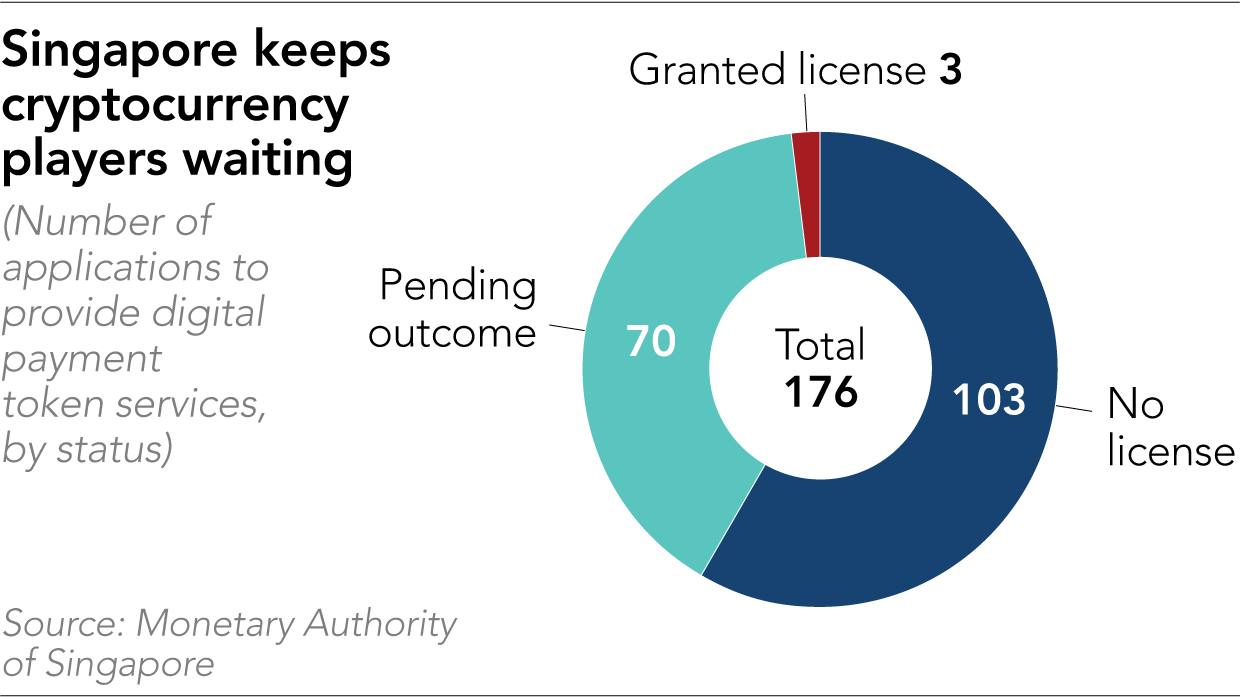
More than 100 of the around 170 businesses that applied for licenses to offer “digital payment token services” have now been turned down or withdrawn their applications, according to the latest figures from regulators.

And scores more face an uncertain future, operating under exemptions but amid a darkening mood over the approval process.

In early September, the Monetary Authority of Singapore (MAS) ordered Binance, one of the world’s largest crypto exchanges, to stop providing services to residents in the city-state, and last week Binance’s Singapore-only affiliate announced it also was shutting down its trading platform for the city-state. Dozens are confronting a similar fate.

Dubai-based crypto exchange Bitxmi is one of 103 companies that appear on the latest MAS list of entities whose exemptions allowing them to operate have been removed. Having set up in Singapore in late 2018, it was unsuccessful in securing a license, chief executive officer Sanjay Jain told Nikkei Asia.

“We can’t operate in Singapore,” he said. “We have an office there, but it’s just more or less—there’s one person for our accounting and legal issues.”

Jain declined to speak about why his outfit did not manage to secure a license from regulators. “That, you need to ask them,” he said.

The introduction of the licensing regime in January was cast as the next step in building a thriving crypto sector and set up a contrast with Singapore’s rival Asian financial hub, Hong Kong, which had taken a more skeptical approach to crypto businesses.

Graph by Nikkei Asia.

A spokesperson for MAS told Nikkei that it is supportive of innovation in the use of blockchain technology, which underpins cryptocurrencies, while also recognizing the risks.

“Cryptocurrencies could be abused for money laundering, terrorism financing, or proliferation financing due to the speed and cross-border nature of the transactions,” the spokesperson said. “Digital payment token service providers in Singapore … have to comply with requirements to mitigate such risks, including the need to carry out proper customer due diligence, conduct regular account reviews, and monitor and report suspicious transactions.”

Rahul Advani, Asia-Pacific policy director at blockchain company Ripple, said Singapore’s stance on digital assets has resulted in the city-state being one of the most advanced and mature nations in the field, helping foster development and innovation in the emerging industry.

“It’s very clear where digital assets and related activities lie on the risk spectrum, so you mitigate the potential of developing and investing in technology that is unregulated,” he told Nikkei.

Crypto players that raced to set up in Singapore run the spectrum from exchange platforms for trading bitcoin, Ethereum, and other tokens, through investment managers and financial advisers looking after digital asset portfolios for the wealthy, to business-to-business outfits helping corporate clients accept cryptocurrency payments.

Outfits that were operating in the country prior to the introduction of the licensing regime were granted exemptions until the outcome of their license application is known. Senior Minister Tharman Shanmugaratnam told parliament in July that there were 90 companies operating under such exemptions.

The MAS website showed that the group had shrunk to about 70 as of December 14.

So far, only three players—DBS Vickers Securities, a unit of Singapore and Southeast Asia’s largest bank, DBS Group Holdings; digital payments startup FOMO Pay; and Australia’s Independent Reserve, which offers crypto exchange services—have been listed on the MAS website as licensed entities.

Two others—Coinhako, which operates a crypto exchange platform, and TripleA, a payments company—have put out announcements themselves saying they have acquired the necessary approvals to operate.

Anndy Lian, chairman of Netherlands-registered crypto trading platform BigONE Exchange, told Nikkei that his outfit does not intend to apply for a license in Singapore presently.

“The whole process of selecting who to give the license to is not very transparent,” he said. “It gives the impression that the government is favoring big players and foreign exchanges.”

MAS has not publicly disclosed why specific crypto players were unable to obtain a permit.

But Nikkei understands that some of them did not have the capacity or infrastructure to meet the high compliance standards set out by the financial regulator to deter money laundering and financing of terrorism.

“Cryptocurrencies are currently being used to channel the earnings of everything from ransomware proceeds, the sale of narcotics to some of the most horrific crimes, including human trafficking,” said Rachel Woolley, head of financial crime at client management solutions provider Fenergo.

“Regulators have now entered this space in an effort to protect the financial services industry from illicit activity in much the same way that activity involving fiat currency must be monitored.”

MAS pointed to comments from its managing director, Ravi Menon, who has said that Singapore does not need 160 players in the crypto sector and it may be better to have “half of them” operating at very high standards.

TripleA told Nikkei that in securing its permit, it had to ensure that its operating procedures for risk assessment, customer due diligence, record-keeping, suspicious transaction reporting, auditing, and training were up to snuff.

But its CEO, Eric Barbier, said TripleA gained little insight into what exactly made the difference between success and failure.

“MAS never talks. MAS asks questions and questions and questions,” he said. “You can ask questions but they will not answer, and most regulators are like this.”

Barbier reckoned that being a business serving other businesses may have helped secure a license. “Especially for consumer-to-consumer, like consumer exchanges and so on, the risk of money laundering is very high, so they need to demonstrate to MAS that they are able to mitigate all those risks accordingly,” he said.

Peiying Chua, financial regulation partner for Singapore at the law firm Linklaters, said it is unlikely MAS is specifically favoring big, incumbent financial players: “Likely reasons for unsuccessful applicants may include a lack of track record or key personnel without adequate experience, a lack of a sustainable business model or serious adverse records relating to directors and key individuals.”

“The regulatory approach by MAS may to some degree stifle innovation in smaller entrepreneurs and sift out smaller virtual asset service providers that may not be able to comply with the regulations,” said Quek Li Fei, partner at law firm CNPLaw.

But he added it “provides a more forward-thinking approach toward encouraging legitimate innovation and entrepreneurship in cryptocurrency and digital asset businesses, with a reasonable level of protection to investors.”

This article first appeared on Nikkei Asia. It’s republished here as part of 36Kr’s ongoing partnership with Nikkei.

Anndy Lian is an early blockchain adopter and experienced serial entrepreneur who is known for his work in the government sector. He is a best selling book author- “NFT: From Zero to Hero” and “Blockchain Revolution 2030”.

Currently, he is appointed as the Chief Digital Advisor at Mongolia Productivity Organization, championing national digitization. Prior to his current appointments, he was the Chairman of BigONE Exchange, a global top 30 ranked crypto spot exchange and was also the Advisory Board Member for Hyundai DAC, the blockchain arm of South Korea’s largest car manufacturer Hyundai Motor Group. Lian played a pivotal role as the Blockchain Advisor for Asian Productivity Organisation (APO), an intergovernmental organization committed to improving productivity in the Asia-Pacific region.

An avid supporter of incubating start-ups, Anndy has also been a private investor for the past eight years. With a growth investment mindset, Anndy strategically demonstrates this in the companies he chooses to be involved with. He believes that what he is doing through blockchain technology currently will revolutionise and redefine traditional businesses. He also believes that the blockchain industry has to be “redecentralised”.
j j j