Diverging signals: Dow rises, gold breaks records, and crypto faces derivatives squeeze

Diverging signals: Dow rises, gold breaks records, and crypto faces derivatives squeeze

As the United States inches closer to a federal government shutdown, with no resolution in sight after talks between congressional leaders and President Donald Trump ended without progress on Monday, investors are navigating a complex web of signals.

Wall Street stays resilient amid shutdown fears

Despite the looming administrative paralysis, Wall Street closed higher on Tuesday, extending its winning streak into a second consecutive quarter. The Dow Jones Industrial Average rose 0.2 per cent, the S&P 500 gained 0.4 per cent, and the Nasdaq added 0.3 per cent.

This resilience suggests that market participants either believe the shutdown will be short-lived or have already priced in its limited economic impact, given that past shutdowns have rarely derailed broader market trends for long.

Treasury yields and gold signal investor anxiety

Beneath the surface, subtle shifts in asset prices reveal deeper unease. US Treasury yields moved in opposite directions, reflecting a classic flight-to-quality dynamic mixed with short-term policy uncertainty. The 10-year yield inched up by one basis point to 4.148 per cent, while the 2-year yield fell by two basis points to 3.612 per cent.

This flattening of the yield curve often signals that investors expect near-term economic disruptions, such as a government shutdown, to weigh on growth, even if longer-term inflation or fiscal concerns remain elevated. Meanwhile, the US Dollar Index declined 0.1 per cent to 97.8, indicating a modest retreat in safe-haven demand for the greenback.

In contrast, gold surged 0.6 per cent to a record high of US$3,858.18 per ounce, underscoring its enduring role as a hedge against political and institutional instability. The precious metal’s ascent to unprecedented levels speaks volumes about the depth of investor anxiety, even as equities hold firm.

Oil and Asian markets reflect fragile demand

Commodities tell a different story. Brent crude oil dropped 1.4 per cent to US$67 per barrel, pressured by expectations that OPEC+ may accelerate its planned output increases in the coming months. This potential supply boost comes at a time when global demand outlooks remain fragile, particularly with China, the world’s largest oil importer, entering its week-long National Day holiday.

Asian equities reflected this caution, trading mixed on Tuesday and lower in early sessions on Wednesday, with mainland China and Hong Kong markets shuttered for the festivities. The absence of Chinese participation in regional trading has amplified volatility and reduced liquidity, leaving other markets more exposed to external shocks, including developments in Washington and shifts in US monetary policy expectations.

Crypto faces a risk-off correction

The crypto market declined 0.51 per cent over the past 24 hours, aligning with the broader theme of risk-off behaviour and profit-taking following recent rallies. Two distinct forces are shaping this correction: regulatory evolution and the dynamics of the derivatives market.

On the regulatory front, the Securities and Exchange Commission (SEC) issued new guidance allowing state-chartered trust companies, such as those operated by Coinbase, to act as custodians for investment advisers managing crypto assets.

At first glance, this appears to be a significant step toward institutional legitimacy. Long-term, it could pave the way for greater participation from traditional finance players who have long cited custody as a primary barrier to entry.

However, the guidance comes with stringent requirements, including mandatory annual audits and strict asset segregation protocols. These conditions have sparked operational concerns among crypto firms, many of which now face the prospect of higher compliance costs and structural overhauls.

As a result, the short-term market reaction has been one of caution rather than celebration. The progress is real, but the path to implementation remains uncertain, and the industry is watching closely for follow-up rule-making and clarity on adoption timelines from major platforms.

Simultaneously, the derivatives market is flashing warning signs. Perpetual futures open interest, a key gauge of leveraged positioning, fell by 5.48 per cent even as trading volume surged by 16.78 per cent. This divergence suggests that traders are actively unwinding leveraged long positions rather than initiating new ones. Compounding the pressure, average funding rates spiked to 0.0068, a staggering 354 per cent increase over 24 hours.

In perpetual futures markets, funding rates represent the cost of maintaining leveraged positions; when they turn sharply positive, it often indicates excessive bullish sentiment that becomes unsustainable. The recent surge suggests that longs were willing to pay a premium to stay in the market, creating a fragile equilibrium that ultimately collapsed under the weight of profit-taking and margin calls.

Notably, US$50 million in liquidations hit the XPL token alone, highlighting how concentrated leverage in smaller altcoins can amplify broader market selloffs. Historically, such spikes in funding rates precede heightened volatility, and if rates turn persistently negative, it could signal a deeper bearish shift as shorts dominate the market.

The current dip in crypto prices thus reflects a tug-of-war between structural progress and cyclical risk reduction. On one side, regulatory clarity around custody could eventually unlock billions in institutional capital, particularly if traditional asset managers gain confidence in secure, compliant infrastructure.

On the other hand, traders are aggressively trimming exposure in anticipation of near-term headwinds not just from potential SEC enforcement actions but also from macro crosscurrents like the US government shutdown and shifting Treasury dynamics.

This tension is further exacerbated by outflows from crypto ETFs, which have seen US$418 million exit Bitcoin funds and US$248 million leave Ethereum products recently. These outflows suggest that even regulated vehicles are not immune to sentiment swings, and that spot market demand may be insufficient to absorb the selling pressure from leveraged traders and cautious institutions alike.

The weeks ahead

Looking ahead, the critical support level for Bitcoin sits at US$113,000. A decisive break below this threshold could trigger further technical selling, especially if derivatives markets remain unstable.

Conversely, holding above this level might attract bargain hunters, particularly if the SEC’s custody framework begins to translate into tangible institutional inflows. Altcoins like Aster and Hyperbot face additional challenges due to supply-side constraints, which could either cushion their downside or exacerbate volatility depending on market liquidity.

Ultimately, the next few weeks will test whether the cryptocurrency market can decouple from macroeconomic noise and regulatory ambiguity, or whether it remains tethered to the same risk calculus that governs traditional assets. For now, prudence prevails, and the record highs in gold alongside muted equity gains suggest that even in a world of rising asset prices, uncertainty remains the dominant currency.


 

Source: https://e27.co/diverging-signals-dow-rises-gold-breaks-records-and-crypto-faces-derivatives-squeeze-20251001/

Anndy Lian is an early blockchain adopter and experienced serial entrepreneur who is known for his work in the government sector. He is a best selling book author- “NFT: From Zero to Hero” and “Blockchain Revolution 2030”.

Currently, he is appointed as the Chief Digital Advisor at Mongolia Productivity Organization, championing national digitization. Prior to his current appointments, he was the Chairman of BigONE Exchange, a global top 30 ranked crypto spot exchange and was also the Advisory Board Member for Hyundai DAC, the blockchain arm of South Korea’s largest car manufacturer Hyundai Motor Group. Lian played a pivotal role as the Blockchain Advisor for Asian Productivity Organisation (APO), an intergovernmental organization committed to improving productivity in the Asia-Pacific region.

An avid supporter of incubating start-ups, Anndy has also been a private investor for the past eight years. With a growth investment mindset, Anndy strategically demonstrates this in the companies he chooses to be involved with. He believes that what he is doing through blockchain technology currently will revolutionise and redefine traditional businesses. He also believes that the blockchain industry has to be “redecentralised”.

j j j

DEX derivatives market forecast to reach $3.48T in 2025: dYdX

DEX derivatives market forecast to reach $3.48T in 2025: dYdX

Derivatives trading on decentralized exchanges (DEXs) is forecast to more than double this year as more investors opt for cheaper and more liquid alternatives to centralized platforms.

According to the dYdX “Annual Ecosystem Report 2024,” DEX derivatives volumes grew 132% last year to reach a record $1.5 trillion. Perpetual DEX volumes were valued at $81 billion in January before skyrocketing to $242 billion by December.

Assuming the same growth rate, dYdX expects total DEX volumes to reach $3.48 trillion in 2025.

DEXs have also become a popular venue for spot trading, more than doubling their spot market share from 9% to 20%, the report said.

While surging DEX volumes are a reflection of the crypto bull market, these platforms also attract users due to their low transaction fees and greater access to more speculative assets.

For example, DEX trading volumes on Solana have skyrocketed due to the memecoin frenzy. In early January, daily trading volumes on Solana-based DEXs exceeded Ethereum and Base combined.

US reporting requirements could push more users toward DEXs in the short term

Despite the inauguration of the pro-crypto Trump administration, certain reporting requirements affecting centralized exchanges in the United States may compel more traders to opt for DEXs.

Beginning this year, the US Internal Revenue Service will require centralized exchanges and other brokers to report digital asset transactions. The reporting rules will expand to DEXs in 2027.

While the IRS said this rule should help investors “file accurate tax returns” on their crypto, some industry participants view it as an overreach.

There’s a “real risk of pushing users toward decentralized platforms like Uniswap or PancakeSwap,” government blockchain expert Anndy Lian told Cointelegraph.

“While decentralized systems currently pose challenges for tax enforcement, advancements in blockchain analytics and potential regulatory developments by 2027 could change this landscape,” said Lian.

The IRS’ reporting rules have faced heavy opposition from the crypto industry, with the Blockchain Association suing the tax agency in December. According to the lawsuit, the IRS has overstepped its statutory authority and has violated the Administrative Procedure Act.


Source: https://cointelegraph.com/news/dex-derivatives-market-forecast-double-2025-dydx

Anndy Lian is an early blockchain adopter and experienced serial entrepreneur who is known for his work in the government sector. He is a best selling book author- “NFT: From Zero to Hero” and “Blockchain Revolution 2030”.

Currently, he is appointed as the Chief Digital Advisor at Mongolia Productivity Organization, championing national digitization. Prior to his current appointments, he was the Chairman of BigONE Exchange, a global top 30 ranked crypto spot exchange and was also the Advisory Board Member for Hyundai DAC, the blockchain arm of South Korea’s largest car manufacturer Hyundai Motor Group. Lian played a pivotal role as the Blockchain Advisor for Asian Productivity Organisation (APO), an intergovernmental organization committed to improving productivity in the Asia-Pacific region.

An avid supporter of incubating start-ups, Anndy has also been a private investor for the past eight years. With a growth investment mindset, Anndy strategically demonstrates this in the companies he chooses to be involved with. He believes that what he is doing through blockchain technology currently will revolutionise and redefine traditional businesses. He also believes that the blockchain industry has to be “redecentralised”.

j j j

Selecting a derivatives DEX: An overview & comparison

Selecting a derivatives DEX: An overview & comparison

For the purposes of this article, we’ll be looking broadly at these three measures: security and privacy, transaction and cost efficiency and lastly, token ecosystems and reward-generating offerings.

Trading volume on decentralized exchanges (DEXs) hit $32 billion within seven days in mid-November, recording another high since early June this year. This came after an explosive, tumultuous week in the crypto industry, which drove many investors — both seasoned and new alike — to take refuge in self-custodial, permissionless and decentralized trading platforms.

A variety of DEX models are available on the market at present; built on the principles of decentralization and financial freedom for all without restrictions, DEXs have been welcomed for the following reasons:

  • Removal of intermediaries supervising trades, where traders execute their trades based on immutable smart contracts
  • Greater security and privacy as only traders are privy to their data and such data cannot be shared/seen by others
  • Traders own their funds and assets, with multiple alternatives for fund recovery in the event of platform service suspensions or disruptions.
  • No access restrictions based on geographical locations or profiles, i.e., no KYC requirements
  • Community-focused, where stakeholders share in the platform’s revenue for providing liquidity, staking, and more.

DEXs such as Uniswap dominated the surge in November 2022, and traders are spoilt for choice when choosing a DEX to rely on, given the multiple options on the market. For seasoned traders searching for a derivatives alternative to capture trading opportunities and use every trading signal to the fullest, one could turn to derivatives DEXs — where margin trading and leverage options exist for customizable orders on various popular contracts.

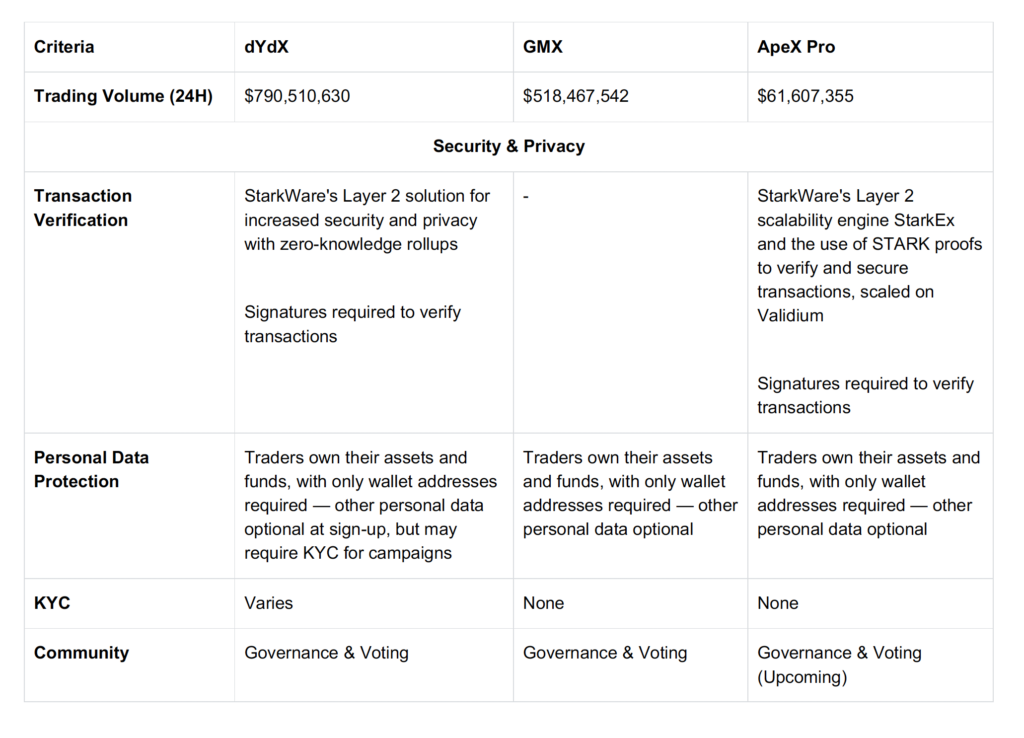
Here’s a comparison of three derivatives DEXs that have shown up on traders’ radars recently, two of which are familiar to most traders — dYdX and GMX. The last DEX we’ll be looking at is the newly-launched ApeX Pro, which has increasingly gained attention after its beta launch back in August with recorded 6,000% growth in trading volume.

Let’s dive into the detail

dYdX is a leading decentralized exchange that supports spot, margin and perpetual trading. GMX is a decentralized spot and perpetual exchange that supports low swap fees and zero price impact trades and works on a multi-asset AMM model. And finally, ApeX Pro is a non-custodial derivative DEX that delivers limitless perpetual contract access with an order book model.

Comparison Criteria

For this article, we’ll be looking broadly at these three measures: (1) security and privacy, (2) transaction and cost efficiency, and lastly, (3) token ecosystems and reward-generating offerings.

The above is a non-exhaustive list of notable highlights from the respective DEXs. dYdX and GMX are trader favorites for good reasons, so let’s see how the new ApeX Pro fares against the other two DEXs.

(1) Security & Privacy

All three DEXs are on relatively equal grounds regarding privacy-preserving measures, of which self-custody of funds is a common denominator across — the importance of a trading platform that is non-custodial is undeniable in light of recent events.

In particular, both dYdX and ApeX Pro have added safeguards with the integration of StarkWare’s Layer 2 scalability engine StarkEx, allowing the users of both DEXs to access forced requests to retrieve their funds even if the DEXs are not in service. Additionally, STARK proofs are used in both dYdX and ApeX Pro to facilitate the accurate verification of transactions, whereas GMX relies on the safety provisions of Arbitrum and Avalanche.

DEXs are known for their privacy-preserving measures, which is why GMX and ApeX Pro, in true decentralized fashion, are fully non-KYC. dYdX, on the other hand, has, on a previous occasion, implemented KYC to claim rewards for a selected campaign.

Another notable factor would be the provisions for governance and community discussions — on dYdX and GMX, pages to host votes and discussions are readily available. At present, however, ApeX Pro is still working towards creating their community-dedicated space for individuals to carry out activities such as voting and putting up suggestions.

(2) Transaction Cost & Efficiency

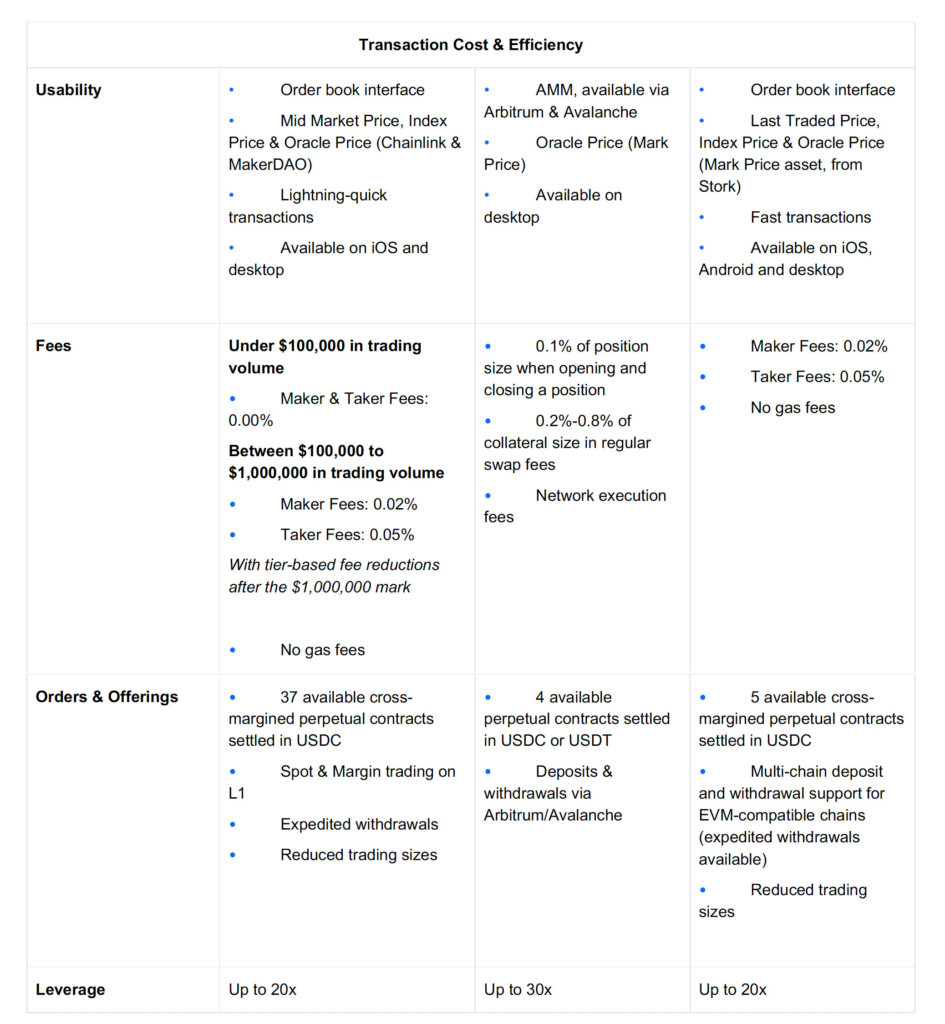
ApeX Pro has decided to go with the orderbook interface that is found most commonly in CEXs, and like dYdX, this trading model works because it removes the barrier to entry for traditional and aspiring crypto traders to step into DeFi. It also utilizes three price types which help to prevent market manipulation. However, it would be up to a trader’s preference to see Mid-Market Price (dYdX) or Last Traded Price (ApeX Pro) for more accurate trades.

With StarkWare’s integration, it is no surprise that ApeX Pro amped up on transaction speeds to process approximately ten trades and 1,000 order placements every second at no gas fees, together with the low maker and taker fees. dYdX’s tiered fees are incredibly comprehensive and cater to different trader’s different trading sizes; without any gas fees, it is unsurprising that derivatives DEX traders have looked primarily at dYdX.

These tiered fees are also familiar to derivatives traders on CEXs. GMX, on the other hand, does charge network execution fees, which means that gas fees paid by the trader for their trade may vary according to market factors.

ApeX Pro doesn’t have tiered fees just yet but considering that it just launched in November, differential fees are likely to drop soon with an upcoming VIP program, where the staked amount of APEX will determine the discount applied to maker-taker fees.

For traders looking for choices in trading pairs, dYdX remains the DEX with the greatest number of perpetual contracts while also providing access to spot and margin trading at the same time on Layer 1 Ethereum. ApeX Pro and GMX do not offer as many perpetual contracts as dYdX. Still, with new trading pairs being introduced frequently, it’s only a matter of time before traders get access to multitudes of assets and pairs on the remaining DEXs.

What might be notable for all is ApeX Pro’s support for multi-chain deposits and withdrawals on EVM-compatible chains; this is certainly a plus point for traders who engage in dynamic trades across multiple platforms, chains and asset categories in crypto.

(3) Tokens & Rewards

Of all factors, this is probably the one that most traders are interested in — how each DEX helps to multiple rewards and earnings while ensuring that these rewards remain valuable to the individual trader over time.

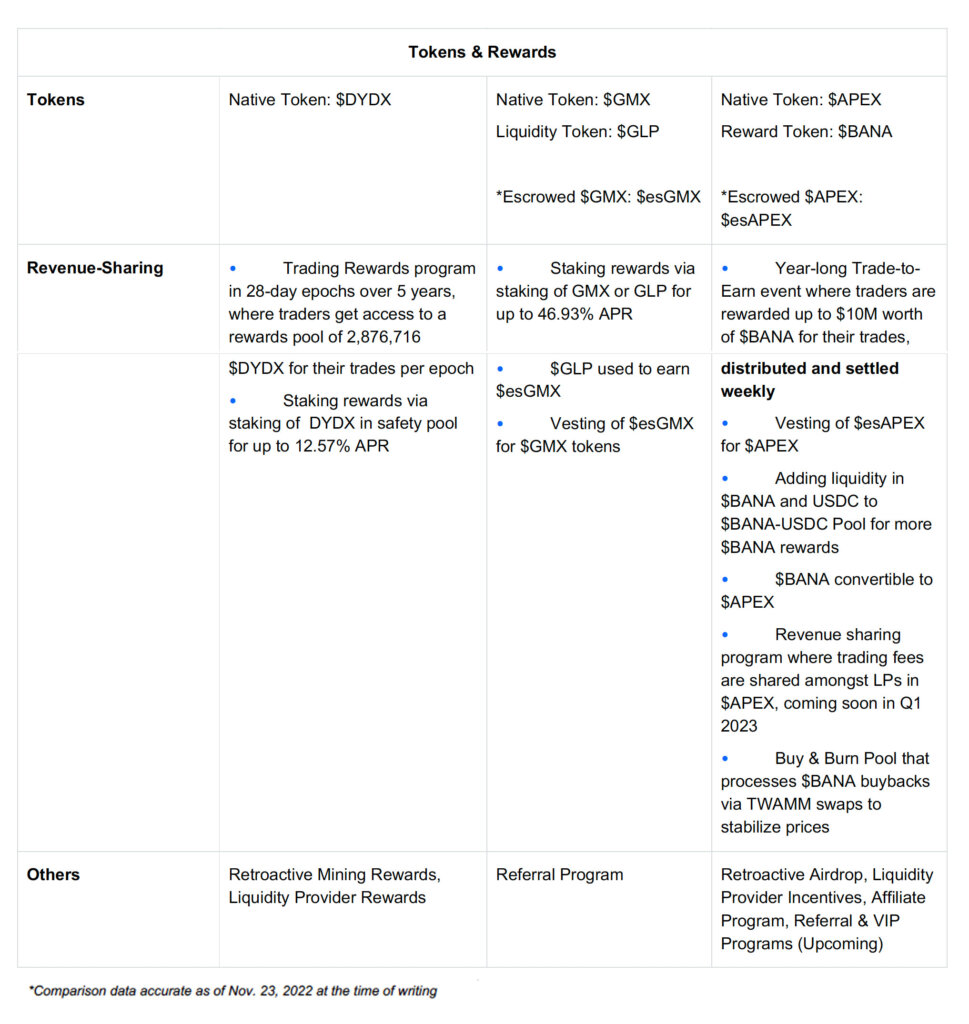
With dYdX and GMX, the success and popularity of trading events to earn rewards and staking incentives are apparent. It is paramount for DEXs to enable access to revenue-sharing programs for their community members and token holders, which commonly involve the distribution of trading fees accrued over a single period. Rewards and incentives are typically distributed in the platform’s native tokens.

dYdX’s offerings are straightforward, with a Trading Rewards program that distributes 2,876,716 $DYDX to traders based on their trading volume in 28-day epochs. On top of that, users can also stake $DYDX in a pool to receive additional staking rewards. This dual-earning track remains a success amongst traders. GMX, on the other hand, has taken community rewards forward by utilizing escrowed tokens in its staking program to stabilize further and sustain the value of the reward tokens that their traders receive.

ApeX Pro follows in GMX’s footsteps by enriching its token ecosystem with escrowed and liquidity tokens, which allows for more dynamism in maximizing token value and sustaining long-term token use cases for the community than using a single token for all DEX initiatives.

With a total supply of 1,000,000,000 $APEX, 25,000,000 $APEX has been minted to create $BANA. With ApeX Pro’s year-long Trade-to-Earn event and weekly reward distributions in $BANA, traders get to swap rewards for tangible incentives in USDC, and also redeem $APEX tokens after the event ends. Traders can also add liquidity to a $BANA-USDC Pool in exchange for LP Tokens, which they can then exchange for more $BANA.

Moreover, ApeX Pro maintains the stability of $BANA’s value with a Buy & Burn Pool, ensuring that its users’ holdings of either token are maximized at any time. $190,000 worth of $BANA will be distributed weekly for a year — a quick and easy settlement that every trader can certainly appreciate.

Conclusion

Innovations in DEX architecture in the nascent DeFi industry abound as DEXs find their footing in a world dominated by CEXs. It’s good news for traders because they can choose DEXs based on the provisions that suit them most or draw their preferred benefits across various platforms. With the growth, it has seen within its first week of mainnet launch and an ecosystem that combines the best of features on existing DEXs, ApeX Pro is one to watch out for in 2023.

Ending with a quote as usual.

“Blockchain-based projects should go back to their roots – decentralization. Decentralization is here to stay and it is the future.”
– Anndy Lian


Source: https://cryptoslate.com/selecting-a-derivatives-dex-an-overview-comparison/

Anndy Lian is an early blockchain adopter and experienced serial entrepreneur who is known for his work in the government sector. He is a best selling book author- “NFT: From Zero to Hero” and “Blockchain Revolution 2030”.

Currently, he is appointed as the Chief Digital Advisor at Mongolia Productivity Organization, championing national digitization. Prior to his current appointments, he was the Chairman of BigONE Exchange, a global top 30 ranked crypto spot exchange and was also the Advisory Board Member for Hyundai DAC, the blockchain arm of South Korea’s largest car manufacturer Hyundai Motor Group. Lian played a pivotal role as the Blockchain Advisor for Asian Productivity Organisation (APO), an intergovernmental organization committed to improving productivity in the Asia-Pacific region.

An avid supporter of incubating start-ups, Anndy has also been a private investor for the past eight years. With a growth investment mindset, Anndy strategically demonstrates this in the companies he chooses to be involved with. He believes that what he is doing through blockchain technology currently will revolutionise and redefine traditional businesses. He also believes that the blockchain industry has to be “redecentralised”.

j j j