Why Dubai’s Regulatory Hack Could Rewrite Crypto’s Rulebook

Why Dubai’s Regulatory Hack Could Rewrite Crypto’s Rulebook

The recent announcement by Dubai’s Virtual Assets Regulatory Authority (VARA), allowing licensed crypto companies to host other firms under their umbrella through “Sponsored Access,” represents a seismic shift in regulatory strategy. This policy, operationalized in 2024, dismantles traditional barriers to entry in the cryptocurrency sector while maintaining institutional-grade oversight. I argue that this model exemplifies “smart regulation”—a framework that balances innovation with accountability, scalability with safety, and local sovereignty with global ambition.

By analyzing its mechanics, implications for startups and institutional players, and alignment with broader trends in regulatory design, it becomes evident that Dubai has redefined what it means to lead in the digital economy.

Barriers, Not Gateways

Prior to this policy shift, launching a regulated cryptocurrency product in Dubai was a complicated process. Prospective virtual asset service providers (VASPs) faced a gauntlet of requirements: months-long licensing procedures, substantial capital investments in infrastructure, and exorbitant legal fees to navigate VARA’s stringent compliance standards. As of early 2024, the average time to secure a full license exceeded six months, with costs often surpassing $500,000—a prohibitive barrier for startups lacking institutional backing. While these measures aimed to safeguard financial integrity, they inadvertently stifled competition, centralized power among well-capitalized incumbents, and delayed the deployment of innovative products to market.

This approach mirrored global trends, where regulators—grappling with the volatility and novelty of crypto—defaulted to heavy-handed frameworks. For instance, the European Union’s Markets in Crypto-Assets (MiCA) regulation, finalized in 2023, imposed rigorous disclosure and transparency mandates, creating compliance burdens that smaller firms struggled to meet. Similarly, the U.S. Securities and Exchange Commission’s (SEC) enforcement-heavy stance against exchanges like Binance and Coinbase has fostered a climate of uncertainty, driving innovators to jurisdictions with clearer rule sets. Dubai, despite its reputation as a tech-forward hub, risked falling into the same trap—until now.

Compliance, Shared

VARA’s Sponsored Access model inverts this paradigm by leveraging existing license holders as “Regulatory Hosts.” Under this system, licensed VASPs—subject to VARA’s approval—can onboard unlicensed entities as “appointed representatives,” effectively extending their compliance infrastructure to these newcomers. The hosts assume full legal responsibility for their sponsored firms, including audits, reporting obligations, and capital adequacy requirements. Crucially, VARA retains overarching oversight, ensuring that decentralization of accountability does not equate to dilution of standards.

This layered approach draws parallels to the UK’s Financial Conduct Authority (FCA) “parent-subsidiary” licensing model, which allows established firms to vouch for affiliates. Dubai’s iteration is distinct in its operational scalability. By mandating that Sponsored VASPs be locally incorporated, VARA anchors accountability within its jurisdiction while enabling rapid onboarding. Early data reveals that over 40 startups have leveraged this to launch products within 30 days of application—a 90% reduction in time-to-market compared to traditional licensing. Costs, too, have plummeted, with sponsored firms reporting compliance expenses under $50,000—a threshold accessible to early-stage ventures.

Speed. Cost. Credibility.

The implications of this shift are profound. First, Sponsored Access democratizes entry into the UAE’s crypto ecosystem, enabling nimble startups to pilot products without diverting resources to redundant compliance structures. For instance, a decentralized finance (DeFi) protocol focused on cross-border remittances can now concentrate on algorithmic risk modeling rather than rebuilding know-your-customer (KYC) systems from scratch. Second, the policy aligns with investor appetites for regulated vehicles: institutional allocations to UAE-based crypto funds have surged, as it reduces counterparty risks.

Notably, this model circumvents the pitfalls of regulatory sandboxes—a tool widely criticized for creating artificial environments that are disconnected from real-world constraints. Sandboxes, such as Singapore’s MAS initiative, often impose arbitrary transaction limits and short-term licenses, forcing firms to reengineer operations post-graduation. Sponsored Access, by contrast, immerses startups in full regulatory compliance from day one, fostering muscle memory around anti-money laundering (AML) protocols and consumer protection. This distinction is vital: while sandboxes simulate safety, VARA’s framework embeds it.

Compliance That Scales

At its core, Sponsored Access embodies the philosophy of “smart regulation”—the idea that regulatory systems must evolve beyond one-size-fits-all mandates. By distributing accountability across hosts and sponsored entities, VARA mitigates its own bureaucratic load while preserving systemic resilience. Consider the analogy of cloud computing: just as AWS provides scalable infrastructure for startups to deploy applications without owning servers, Sponsored VASPs offer a compliance “cloud” where smaller players rent access to regulatory frameworks.

This model also addresses a persistent tension in crypto governance: balancing innovation with investor protection. Critics of decentralized finance (DeFi) often cite its “Wild West” reputation—characterized by rug pulls, exit scams, and opaque tokenomics that erode retail trust. Sponsored Access inoculates against such risks by tethering every participant to a vetted host, creating a chain of liability that deters malfeasance. For example, if a sponsored exchange facilitates illicit transactions, VARA can penalize both the exchange and its host, ensuring that accountability cascades upward.

No Free Passes in Compliance

Skeptics may question whether delegated oversight compromises rigor. But VARA’s design anticipates this concern. Sponsored VASPs must undergo annual third-party audits, publish transparency reports, and maintain minimum capital reserves tied to their risk profiles—a structure reminiscent of Basel III’s tiered capital requirements for banks.

Moreover, the policy incentivizes hosts to act as gatekeepers. Since their reputational and financial stakes are high, Sponsored VASPs conduct due diligence exceeding VARA’s baseline standards. I spoke with two licensed hosts who revealed that all required sponsored firms to implement real-time blockchain analytics tools—a measure beyond current regulatory mandates. This “compliance arms race” elevates industry standards organically.

Regulation That Attracts

The UAE’s strategic bet on Sponsored Access is already paying dividends. Dubai attracted 60% of the Middle East’s crypto venture capital, with firms like Amber Group and Bybit establishing regional headquarters. More critically, the policy has catalyzed niche innovation: startups specializing in sharia-compliant tokenization and halal blockchain gaming—sectors often overlooked in Western markets—are flourishing under this model.

This growth is not merely quantitative. Dubai’s model challenges the dominance of offshore crypto hubs like Seychelles and the British Virgin Islands, which thrived on lax oversight but now face increasing scrutiny from G20 regulators. By offering a middle path—neither a sandbox nor a free-for-all—the UAE positions itself as a Goldilocks jurisdiction: strict enough to earn G20 approval, flexible enough to outpace peers.

Risks, Replication, and What Comes Next

Despite its merits, Sponsored Access is not without risks. Over-reliance on a handful of hosts could create systemic vulnerabilities: if a major VASP collapses, its sponsored entities might face cascading suspensions. VARA must also guard against regulatory arbitrage, where firms exploit ambiguities in cross-border enforcement. To address this, the authority has initiated bilateral agreements with counterpart agencies in other countries, harmonizing audit standards and information-sharing protocols.

Globally, Dubai’s experiment could inspire copycats. The U.S. Commodity Futures Trading Commission (CFTC) has floated similar ideas for derivatives trading, while Brazil’s Securities and Exchange Commission (CVM) is exploring sponsored models for security tokens. If these jurisdictions adopt VARA’s principles, we may witness the emergence of a modular regulatory architecture—a “Lego-block” system where compliance frameworks interlock across borders.

Blueprint for the Digital Age

VARA’s Sponsored Access policy is more than a local reform—it is a blueprint for governing frontier technologies without sacrificing dynamism. By reimagining regulation as shared infrastructure rather than a bottleneck, Dubai has shown that innovation and oversight can coexist without being adversaries. Startups gain agility, hosts earn revenue from compliance-as-a-service, and regulators preserve systemic stability—all while cementing the UAE’s status as a vanguard of the digital age.

As the crypto industry matures, the lessons from Dubai will resonate far beyond the Persian Gulf. In an era where AI, quantum computing, and biohacking challenge existing governance models, the UAE’s gamble offers a template: distribute accountability, empower intermediaries, and build frameworks that scale with technology—not against it. The future belongs to regulators bold enough to take the lead.


Source: https://intpolicydigest.org/why-duba-s-regulatory-hack-could-rewrite-crypto-s-rulebook/

Anndy Lian is an early blockchain adopter and experienced serial entrepreneur who is known for his work in the government sector. He is a best selling book author- “NFT: From Zero to Hero” and “Blockchain Revolution 2030”.

Currently, he is appointed as the Chief Digital Advisor at Mongolia Productivity Organization, championing national digitization. Prior to his current appointments, he was the Chairman of BigONE Exchange, a global top 30 ranked crypto spot exchange and was also the Advisory Board Member for Hyundai DAC, the blockchain arm of South Korea’s largest car manufacturer Hyundai Motor Group. Lian played a pivotal role as the Blockchain Advisor for Asian Productivity Organisation (APO), an intergovernmental organization committed to improving productivity in the Asia-Pacific region.

An avid supporter of incubating start-ups, Anndy has also been a private investor for the past eight years. With a growth investment mindset, Anndy strategically demonstrates this in the companies he chooses to be involved with. He believes that what he is doing through blockchain technology currently will revolutionise and redefine traditional businesses. He also believes that the blockchain industry has to be “redecentralised”.

j j j

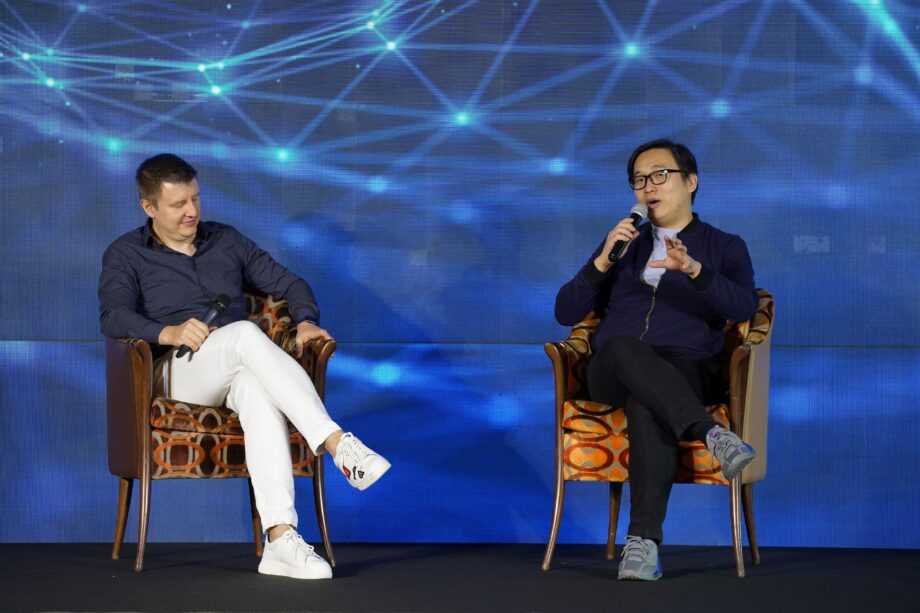
Fireside chat with Anndy Lian at World Tokenization Summit, Dubai

Fireside chat with Anndy Lian at World Tokenization Summit, Dubai

Insights

[sc_fs_multi_faq headline-0=”h2″ question-0=”What is the background of Anndy Lian, the guest speaker in the fireside chat on real-world tokenization?” answer-0=”Anndy Lian, based in Singapore, entered the crypto world in 2013 and became fully immersed in blockchain by 2017. He serves as an intergovernmental blockchain expert, book author, and has advised various governments.” image-0=”” headline-1=”h2″ question-1=”How does Anndy Lian view the state of real-world tokenization, and what changes has he observed since discussing the concept in 2017-2018?” answer-1=”Anndy Lian acknowledges the significant traction real-world tokenization has gained. Initially met with skepticism, governments and companies now embrace the idea, recognizing its straightforwardness. The technology for asset tokenization is deemed ready, with big banks and governments leading the wave.” image-1=”” headline-2=”h2″ question-2=”What are the key challenges highlighted by Anndy Lian regarding the revenue model behind some real-world asset (RWA) projects?” answer-2=”Anndy Lian questions the sustainability and revenue generation of RWA projects, especially those tokenizing assets like mid-level properties. He emphasizes the liquidity problem associated with certain asset tokenization.” image-2=”” headline-3=”h2″ question-3=”According to Anndy Lian, what is the future outlook for stablecoins and carbon credit tokenization, and how do governments perceive stablecoins?” answer-3=”Lian sees stablecoins as here to stay, with more governments likely to embrace them within a certain framework. He views carbon credit tokenization as a valid use case, citing the intriguing traceability of the credit itself.” image-3=”” headline-4=”h2″ question-4=” In Anndy Lian’s perspective, what impact could tokenization have on the financial industry if adopted on a large scale, and what does he envision for the future of transactions?” answer-4=”Lian believes tokenization, if widely adopted, could revolutionize the financial industry, making transactions more efficient, faster, and cheaper. He envisions the potential for 24/7 clearance and money transfers, leading to a more effective financial system.” image-4=”” count=”5″ html=”true” css_class=””]


In the ever-evolving world of blockchain and cryptocurrencies, the concept of real-world tokenization has been gaining significant traction. To delve deeper into this topic, we recently had the pleasure of hosting a fireside chat with Anndy Lian, an intergovernmental blockchain expert and book author.

The discussion was led by Faraj, the Chief Commercial Officer of Venom Foundation, a layer one chain out of Abu Dhabi focusing on stable coins and real-world asset organization globally. Faraj is also the founder of a large community of crypto executives, boasting around 2,000 members.

The guest speaker, Anndy Lian, is based in Singapore but often travels around the globe. He embarked on his journey in the crypto world in 2013 when he bought his first Bitcoin. By 2017, he had fully immersed himself in the blockchain space and has never left since. Lian advises different governments. At one point, he served as a blockchain advisor to an intergovernmental group.

The State of Real-World Tokenization
When asked about his views on real-world tokenization, Lian acknowledged the obvious traction the concept has gained over the years. He recalled how governments were skeptical when he first started discussing the idea around 2017-2018. However, the narrative has since changed. Today, governments and companies are more open to the idea, recognizing the straightforwardness of real-world asset (RWA) tokenization.

Lian believes that the technology for tokenizing assets is 100% ready. He sees big banks and governments pushing the RWA wave, indicating a promising future for the concept. However, he also highlighted a key issue: the revenue model behind some of these RWA projects. He questioned how these companies would sustain themselves and make money, especially given the liquidity problem associated with tokenizing certain assets like mid-level properties.

The Future of Stable Coins and Carbon Credit Tokenization
Discussing the future of stablecoins and carbon credit tokenization, Lian expressed that most government bodies he interacts with recognize that stablecoins are here to stay. He sees a future where more governments will embrace stable coins within a certain framework, which could lead to the acceleration of Central Bank Digital Currencies (CBDCs).

As for carbon credit tokenization, Lian sees it as a valid use case. He has interacted with several carbon credit exchanges and believes that the traceability of the credit itself would be very interesting.

The Impact of Tokenization on the Financial Industry
If tokenization is taken seriously and adopted on a large scale, Lian believes it could have a long-lasting impact on the financial industry. He envisions a future where transactions become more effective, with money moving from point A to B in a much faster and cheaper manner. He also sees the potential for 24/7 clearance and money transfers, leading to a more effective financial system.

The Next Driver of Mass Adoption
When asked about the next driver of mass adoption, Lian expressed his hope for more people to start talking about how they can spend their crypto. He believes that the next “wow” moment would be seeing more adoption, leading to a larger community and driving crypto to the next level.

Conclusion
The fireside chat with Anndy Lian provided valuable insights into the world of real-world tokenization, stablecoins, and carbon credit tokenization. As the blockchain and crypto space continues to evolve, these discussions play a crucial role in shaping the future of the industry. As Lian aptly put it, the key is to read, learn, and explore for oneself, rather than relying solely on influencers or hype.

World Tokenization Summit was held on 21st of November 2023 at Melia Desert Palm, Al Awir Road, Warsan 2, Dubai, United Arab Emirates.

Anndy Lian is an early blockchain adopter and experienced serial entrepreneur who is known for his work in the government sector. He is a best selling book author- “NFT: From Zero to Hero” and “Blockchain Revolution 2030”.

Currently, he is appointed as the Chief Digital Advisor at Mongolia Productivity Organization, championing national digitization. Prior to his current appointments, he was the Chairman of BigONE Exchange, a global top 30 ranked crypto spot exchange and was also the Advisory Board Member for Hyundai DAC, the blockchain arm of South Korea’s largest car manufacturer Hyundai Motor Group. Lian played a pivotal role as the Blockchain Advisor for Asian Productivity Organisation (APO), an intergovernmental organization committed to improving productivity in the Asia-Pacific region.

An avid supporter of incubating start-ups, Anndy has also been a private investor for the past eight years. With a growth investment mindset, Anndy strategically demonstrates this in the companies he chooses to be involved with. He believes that what he is doing through blockchain technology currently will revolutionise and redefine traditional businesses. He also believes that the blockchain industry has to be “redecentralised”.

j j j

Web 3.0 Marketing: How Marketers Can Stay Ahead Of The Curve | World Blockchain Summit Dubai 2023

Web 3.0 Marketing: How Marketers Can Stay Ahead Of The Curve | World Blockchain Summit Dubai 2023

Marketing in Web 3 is not an easy feat. It requires a thorough understanding of the technology’s technical and cultural aspects. The challenge is to market the product in a way that speaks to the people’s cultural orientation while staying true to its technicalities. This is what a panel of experts discussed at the World Blockchain Summit held in Dubai.

The panel consisted of three experts from different industries. Anndy, a Singapore-based venture investor and government advisor; Mirko Maccarrone, the director of Web3 Lightblue; and Shashwat, CMO of NFT3.

Anndy, the moderator of the panel, began the conversation by pointing out the good and bad marketing campaigns in both web2 and web3 spaces. He said that web3 is fast and nimble, but bad habits from web2 often flow into web3 marketing. It is vital to have marketing strategies that work for web3 and cater to the audience’s cultural orientation.

Mirko, who has launched a web-free department and worked with global and regional-level marketing for various brands, highlighted the importance of culturally-oriented marketing. He stated that a marketer who has experience working with fashion brands and writing novels can speak in a language that people understand without being too technical or speculative.

Shashwat, a marketeer in web3 for the past three years, agreed with Miracle and added that marketers need to understand the technology’s technicalities while catering to the audience’s cultural orientation. Shashwat’s company, NFT3, is developing a face ID system for web3 to make signing in to every web3 platform easy and seamless.

The panelists also discussed mass adoption, which is crucial for web3’s success. They agreed that mass adoption can only happen when there is a cultural connection between the product and the audience. This connection is possible when marketers understand the audience’s cultural background and can communicate the product’s technicalities in a way that they understand.

One of the major challenges confronting marketers in the era of Web 3.0 is the need to strike a balance between innovation and cultural relevance. Unlike traditional marketing approaches, which rely on generic messaging and branding, Web 3.0 marketing necessitates a more intricate approach that considers the audience’s unique cultural contexts and sensibilities.

To excel in Web 3.0 marketing, it is imperative to be culturally oriented and possess a varied range of experiences and perspectives. This implies collaborating with individuals who have backgrounds in areas such as fashion, literature, and the arts, as well as those who possess technical expertise in blockchain and decentralized technologies.

Another crucial factor for successful Web 3.0 marketing is the ability to adapt promptly to changing market conditions. The swift and ever-evolving nature of the Web 3.0 landscape necessitates marketers to be nimble and agile, capable of rapidly pivoting in response to new trends and emerging technologies.

Furthermore, Web 3.0 marketing necessitates a profound understanding of the underlying technologies and concepts that drive this new era of innovation. This requires staying current with the latest developments in fields like decentralized finance, non-fungible tokens (NFTs), and smart contracts, and being able to explicate these complex concepts in straightforward language to non-technical audiences.

Web 3.0 marketing presents a thrilling opportunity to create more engaging and interactive experiences for customers. Decentralized applications (dApps) and NFTs provide new prospects for gamification and social interaction, enabling marketers to create immersive, personalized experiences that drive engagement and loyalty.

In conclusion, marketing in web3 is a delicate balance between the technicalities of the technology and the audience’s cultural orientation. Marketers need to be culturally oriented, speak in a language that people understand, and understand the technicalities of the technology they are marketing. Mass adoption will only happen when there is a cultural connection between the product and the audience.

Panelists:

SHASHWAT ETERNAL
CMO
NFT3

MIRKO MACCARRONE
Director
Web3 Lightblue

Moderator:
ANNDY LIAN
Intergovernmental Blockchain Advisor

About World Blockchain Summit (WBS):

World Blockchain Summit (WBS) is a part of Trescon, a rapidly growing company that organizes emerging tech events. It aims to support the growth of Web 3.0 globally. The management team has over 20 years of experience managing successful conferences, expos, and summits. Additionally, WBS works with web 3.0 industry leaders and innovators as advisors to ensure alignment with current market trends and needs.

Socials:

Facebook: http://www.facebook.com/anndylian
Twitter: http://www.twitter.com/anndylian
Instagram: http://www.instagram.com/liananndy
LinkedIn: https://www.linkedin.com/in/anndylian/
Homepage: http://www.anndy.com
YouTube: https://www.youtube.com/@AnndyLian


Anndy Lian is an early blockchain adopter and experienced serial entrepreneur who is known for his work in the government sector. He is a best selling book author- “NFT: From Zero to Hero” and “Blockchain Revolution 2030”.

Currently, he is appointed as the Chief Digital Advisor at Mongolia Productivity Organization, championing national digitization. Prior to his current appointments, he was the Chairman of BigONE Exchange, a global top 30 ranked crypto spot exchange and was also the Advisory Board Member for Hyundai DAC, the blockchain arm of South Korea’s largest car manufacturer Hyundai Motor Group. Lian played a pivotal role as the Blockchain Advisor for Asian Productivity Organisation (APO), an intergovernmental organization committed to improving productivity in the Asia-Pacific region.

An avid supporter of incubating start-ups, Anndy has also been a private investor for the past eight years. With a growth investment mindset, Anndy strategically demonstrates this in the companies he chooses to be involved with. He believes that what he is doing through blockchain technology currently will revolutionise and redefine traditional businesses. He also believes that the blockchain industry has to be “redecentralised”.

j j j