Crypto feels geopolitical heat, Wall Street dips: What else to expect?

Crypto feels geopolitical heat, Wall Street dips: What else to expect?

We are currently navigating a precarious landscape as escalating tensions in the Middle East, particularly between Israel and Iran, stoke fears of a broader regional conflict that could draw in the United States. This geopolitical uncertainty has triggered a notable retreat in global risk sentiment, with investors increasingly wary of the potential for direct US military involvement.

On Tuesday, this apprehension was palpable in the performance of US stock markets, which closed lower across the board. The Dow Jones Industrial Average fell by 0.7 per cent, the S&P 500 declined by 0.8 per cent, and the Nasdaq Composite dropped by 0.9 per cent. These declines underscore the market’s sensitivity to geopolitical risks, especially those that could disrupt global economic stability.

Asia’s markets and central banks on alert

Meanwhile, in Asia, equity indices mainly opened lower on Wednesday, suggesting that the risk-off sentiment is permeating global markets. The US equity index futures indicated a potential rebound, with expectations of a higher open for US stocks. This mixed picture highlights the market’s ongoing struggle to assess the full impact of the unfolding events in the Middle East.

Adding to the complexity, central banks in Asia are grappling with their own set of challenges, as geopolitical tensions intersect with inflationary pressures and concerns about economic growth. On Tuesday, the Bank of Japan (BoJ) maintained its benchmark short-term interest rates at 0.5 per cent, a decision reached unanimously and widely anticipated by market analysts.

The BoJ Governor Kazuo Ueda issued a cautionary note, warning that a sustained rise in energy and oil prices—exacerbated by the Middle East conflict—could drive underlying inflation higher, potentially necessitating further monetary policy action. This statement highlights the delicate balance that central banks must strike in responding to external shocks while maintaining domestic economic stability. Looking ahead, attention in Asia shifts to Bank Indonesia’s (BI) rate decision on Wednesday.

While most analysts surveyed by Bloomberg expect the Bank of Indonesia (BI) to hold rates steady, a significant minority anticipates a 25-basis-point cut. This divergence in expectations reflects the uncertainty surrounding Indonesia’s monetary policy trajectory, particularly as the country navigates the dual pressures of global geopolitical risks and domestic economic needs.

Bonds, dollar, and oil reflect flight to safety and inflation worries

In the bond market, a flight to safety was evident as investors sought refuge in US Treasury securities. The yield on the two-year Treasury note eased by one basis point to 3.95 per cent, while the 10-year yield fell more substantially by five basis points to 4.39 per cent. This movement suggests that investors are favouring longer-term bonds, likely as a hedge against the geopolitical uncertainty and the potential for slower economic growth.

The decline in yields also points to a broader market expectation that central banks, including the Federal Reserve, may need to adopt a more accommodative stance if the situation in the Middle East escalates further. Meanwhile, the US Dollar Index (DXY) staged a robust recovery, climbing 0.8 points from 98.00 to 98.80.

The dollar’s strength in this context is emblematic of its role as a safe-haven currency during periods of heightened global risk. Investors are likely seeking the relative stability and liquidity of the dollar as they brace for potential market disruptions stemming from the Middle East conflict.

Commodities, too, have been caught in the crosscurrents of geopolitical risk. Gold, traditionally viewed as a safe-haven asset, experienced a slight softening, dipping below US$3,400 per ounce to close at US$3,390. This modest decline is somewhat counterintuitive, given the rising geopolitical tensions, and may indicate that investors are not yet fully committed to gold as a hedge, possibly due to the simultaneous strength of the US dollar or other market dynamics.

In stark contrast, Brent crude oil prices surged by four per cent to US$76.40 per barrel, driven by fears that the conflict in the Middle East could disrupt oil supplies from the region, which accounts for a significant portion of global production. The spike in oil prices carries inflationary implications, as higher energy costs can ripple through the global economy, affecting everything from consumer prices to corporate profit margins. This development further complicates the task for central banks, which must now contend with the dual threats of geopolitical instability and rising inflation.

Crypto cools as tensions heat up

The cryptocurrency market has not been immune to these developments. Bitcoin, the leading digital asset, initiated a fresh decline, falling below the US$106,800 zone before stabilising around US$106,200. Technical analysis reveals a short-term triangle formation with support at US$104,200 on the hourly chart of the BTC/USD pair. Bitcoin is currently trading below both the $106,800 level and its 100-hour simple moving average, suggesting that it faces significant resistance.

However, if it manages to hold above the US$103,500 zone, there is potential for a renewed upward movement. Ethereum, the second-largest cryptocurrency, also relinquished its gains from Monday’s rally, briefly dipping below US$2,500 before recovering some ground overnight. These price movements reflect the broader risk-off sentiment permeating global markets, as investors reduce their exposure to more speculative assets, such as cryptocurrencies, in favour of traditional safe havens.

Geopolitical risks have been further amplified by statements from former US President Donald Trump, who, in a series of posts on Truth Social, claimed that the US has “complete and total control” over Iran’s skies and called for Iran’s “unconditional surrender.” While these statements do not reflect official US policy, they contribute to the uncertainty surrounding potential US involvement in the conflict.

The prospect of direct US military engagement in the Middle East is a significant concern for investors, as it could lead to a substantial escalation of hostilities, with far-reaching consequences for global markets. The situation is fluid, and any miscalculation by the involved parties could trigger a rapid deterioration in market sentiment.

Massive liquidations reflect market jitters

In the cryptocurrency space, the market’s reaction to these geopolitical developments has been swift and severe. Over the past 24 hours, more than US$330 million in positions were liquidated, with bullish long bets accounting for nearly US$268 million of that total. This wave of liquidations underscores the heightened volatility in the crypto market, as traders adjust their positions in response to shifting risk dynamics.

It is also worth noting that approximately US$650 million in Bitcoin short positions are at risk of liquidation if the cryptocurrency rebounds to US$107,000. This suggests that while the market has been under pressure, there remains potential for a sharp reversal if sentiment improves.

Additionally, Bitcoin’s Open Interest—a measure of the total number of outstanding derivative contracts—fell by 1.97 per cent in the last 24 hours, indicating that some traders are closing their positions amid the uncertainty. Despite this, more than 55 per cent of Binance’s top traders with open Bitcoin positions are positioned long, according to the long/short ratio. This suggests that a segment of the market remains cautiously optimistic about Bitcoin’s prospects, even in the face of geopolitical headwinds.

Market sentiment, as gauged by the Crypto Fear & Greed Index, has shifted from “Greed” to “Neutral,” reflecting a more cautious stance among cryptocurrency investors. This change aligns with the broader retreat in risk appetite observed across global markets. The index, which aggregates various indicators to assess market psychology, serves as a barometer for investor sentiment. Its move to “Neutral” suggests that the market is in a state of flux, with participants weighing the potential for further downside against the possibility of a recovery.

A personal take on market fragility

From my perspective, the current situation is a stark reminder of how fragile global markets can be. The escalating tensions in the Middle East are not just a regional issue—they have the potential to impact global economic landscapes significantly. The surge in oil prices, for instance, is a double-edged sword: it could fuel inflation, prompting tighter monetary policies, but it could also strain economies already grappling with post-pandemic recovery.

The mixed signals from gold and cryptocurrencies fascinate me—gold’s slight dip despite rising tensions suggests that investors might be prioritising liquidity over traditional hedges, while Bitcoin’s resilience amid liquidations hints at a stubborn bullish undercurrent. I find the central banks’ predicament particularly compelling; the BoJ’s warning about oil-driven inflation and Bank Indonesia’s uncertain path illustrate the tightrope policymakers must walk.

Personally, I think the markets are in a wait-and-see mode—everyone is holding their breath, hoping for de-escalation, but preparing for the worst. It’s a nerve-wracking time, and I can’t help but wonder how long this uncertainty can persist before we see a decisive shift, one way or another.

Conclusion: Balancing risk and caution

In conclusion, the escalating tensions in the Middle East are casting a long shadow over global markets, with the potential for direct US involvement adding a layer of complexity to an already volatile situation. Investors are responding by seeking safety in traditional havens, such as US Treasuries and the dollar, while commodities like oil are surging due to fears of supply disruptions.

The cryptocurrency market, often seen as a barometer of risk sentiment, has also been impacted, with Bitcoin and Ethereum experiencing declines but showing signs of resilience. Central banks, particularly in Asia, are facing a delicate balancing act as they navigate the interplay between geopolitical risks, inflationary pressures, and economic growth.

As the situation in the Middle East continues to evolve, markets are likely to remain on edge, with investors closely monitoring developments for any signs of escalation or de-escalation. In this environment, a diversified portfolio that includes both risk assets and safe havens may be the most prudent approach for navigating the uncertainty ahead. The coming days will be critical.


Source: https://e27.co/crypto-feels-geopolitical-heat-wall-street-dips-what-else-to-expect-20250618/


Anndy Lian is an early blockchain adopter and experienced serial entrepreneur who is known for his work in the government sector. He is a best selling book author- “NFT: From Zero to Hero” and “Blockchain Revolution 2030”.

Currently, he is appointed as the Chief Digital Advisor at Mongolia Productivity Organization, championing national digitization. Prior to his current appointments, he was the Chairman of BigONE Exchange, a global top 30 ranked crypto spot exchange and was also the Advisory Board Member for Hyundai DAC, the blockchain arm of South Korea’s largest car manufacturer Hyundai Motor Group. Lian played a pivotal role as the Blockchain Advisor for Asian Productivity Organisation (APO), an intergovernmental organization committed to improving productivity in the Asia-Pacific region.

An avid supporter of incubating start-ups, Anndy has also been a private investor for the past eight years. With a growth investment mindset, Anndy strategically demonstrates this in the companies he chooses to be involved with. He believes that what he is doing through blockchain technology currently will revolutionise and redefine traditional businesses. He also believes that the blockchain industry has to be “redecentralised”.

j j j

Gold up, oil down, Bitcoin flexes: What should we expect next?

Gold up, oil down, Bitcoin flexes: What should we expect next?

Global risk sentiment, which often serves as a barometer for investor confidence, has been notably muted. On Monday, US stock markets took a hit, breaking a multi-session winning streak that had given some hope of sustained optimism.

The Dow Jones Industrial Average slipped by 0.24 per cent, the S&P 500 dropped 0.64 per cent, and the Nasdaq fell 0.74 per cent, all closing in the red. This downturn came despite encouraging data showing stronger-than-anticipated US services activity and reassuring words from US Treasury Secretary Scott Bessant about forthcoming trade deals.

It’s a puzzling scenario—positive economic signals clashing with a market that seems reluctant to embrace them. To me, this suggests that investors might be wrestling with deeper uncertainties, perhaps questioning whether these bright spots can hold up against broader economic or geopolitical headwinds.

Diving into the bond market, US Treasury yields painted a different picture, trending upward across the curve, though the pace of increase slowed compared to the previous Friday’s surge. The 10-year US Treasury yield rose by 3.5 basis points to settle at 4.343 per cent, while the 2-year yield nudged up by 0.8 basis points to 3.832 per cent.

Rising yields often reflect a shift in investor behaviour—selling off bonds, possibly in anticipation of higher inflation or interest rates down the road. Given the positive services data, one might expect this to signal confidence in economic growth. But the disconnect with the stock market’s decline is striking.

It’s as if the bond market sees a robust future that equity investors aren’t yet buying into. Could this be a sign of skepticism about the longevity of the recovery, or are there other forces—like lingering trade tensions or Federal Reserve policy expectations—clouding the picture? I suspect it’s a bit of both, with markets caught in a tug-of-war between optimism and caution.

Meanwhile, the US Dollar Index (DXY) took a modest dip, falling 0.20 per cent and weakening against most G10 currencies. This softening of the dollar caught my attention, especially when paired with the dramatic strengthening of the Taiwanese Dollar (TWD). The USD/TWD pair tumbled from 31.0 to 30.10, even hitting an intra-day low of around 29.60.

This wasn’t just a random fluctuation—market chatter points to speculation that Taiwan might be allowing its currency to appreciate as part of a trade deal with the US. If true, this could be a strategic move to bolster economic ties, but it also highlights how sensitive currency markets are to geopolitical rumours and policy shifts.

The dollar’s broader weakness might tie back to the Federal Reserve’s stance or the market’s reaction to trade uncertainties, though I’d need to dig deeper into recent Fed statements to pin that down. For now, it’s a reminder that forex markets are rarely quiet when global stakes are high.

Turning to commodities, the story gets even more intriguing. Gold prices jumped 2.9 per cent, a move I see as a classic flight to safety amid a weaker dollar and persistent trade uncertainty. Investors often flock to gold when confidence wavers, and this uptick fits that pattern. On the flip side, Brent crude oil slid 1.7 per cent, continuing its downward trend after OPEC+ agreed over the weekend to ramp up output. The contrast here is stark—gold shining as a safe haven while oil stumbles under supply pressures.

It’s a dynamic that underscores the uneven currents running through the commodity space, with macroeconomic signals and sector-specific decisions pulling in different directions. Asian equity indices mirrored this uncertainty with mixed results in early trading, and US equity index futures hint at a lower opening for US stocks, suggesting that Monday’s cautious mood isn’t dissipating anytime soon.

Now, let’s shift gears to the cryptocurrency market, where things get particularly fascinating. Bitcoin has been a standout performer, even as traditional markets faltered. According to recent insights from VanEck, Bitcoin posted a 13 per cent gain in April, a sharp contrast to the broader market selloff.

This resilience was especially evident during the week ending April 6, when former President Trump’s announcement of new tariff measures sent shockwaves through global markets. While equities and gold took a hit, Bitcoin climbed from US$81,500 to over US$84,500 by week’s end.

For a moment, it looked like Bitcoin might be breaking free from its usual dance with US equities—a phenomenon analysts call decoupling. The 30-day moving average correlation between Bitcoin and the S&P 500 dipped below 0.25 in early April, fueling hopes that it could carve out a path as an independent asset, perhaps even a hedge against global instability.

But that independence didn’t stick. By the end of April, the correlation rebounded to around 0.55, and Bitcoin fell back into step with equity markets. Still, its 13 per cent gain outpaced the Nasdaq Composite’s one per cent decline and the S&P 500’s modest uptick, marking it as a relative winner.

Also Read:

Market wrap: Consumer confidence drops, markets rise, Bitcoin ETF soars

Market wrap: Consumer confidence drops, markets rise, Bitcoin ETF soars

What’s driving this? Part of it might be institutional moves like Strategy’s—formerly MicroStrategy—recent acquisition of 1,895 Bitcoin for US$180 million, wrapping up a US$21 billion equity offering program launched in October. With their holdings now at roughly 555,500 Bitcoin, valued at US$52.4 billion per their latest SEC filing, Strategy’s commitment signals strong corporate faith in Bitcoin’s long-term value.

This kind of institutional backing could be stabilising Bitcoin’s floor, even as its correlation with stocks waxes and wanes. To me, it’s a sign that Bitcoin is maturing—its volatility has reportedly hit a 563-day low, per CoinTelegraph—yet it’s still searching for its identity in the financial ecosystem.

Ethereum, however, tells a different story, one tinged with struggle. Its dominance in smart contract fees has taken a significant hit as users drift to rival networks, likely drawn by lower costs and faster transactions. This migration isn’t just a blip—it’s a challenge to Ethereum’s core promise as the backbone of decentralised applications. Vitalik Buterin, Ethereum’s co-founder, has openly acknowledged the network’s past fixation on complexity, admitting that adjustments are overdue.

His comments hint at a “slimming down” effort, a tacit concession that the grand vision of Ethereum as a “world computer” might be more aspirational than practical. There’s talk of swapping out the Ethereum Virtual Machine (EVM) for RISC-V, which some see as a technical upgrade but others—like me—view as an admission that the layer2 Rollup-Centric strategy has faltered.

While competitors like Solana scoop up users with simpler designs and flashy marketing (think MEME coins), Ethereum is bogged down managing a sprawling web of layer2 solutions. Interoperability among hundreds of L2s sounds ambitious, but in practice, it’s a headache—one that’s driving developers and users away. Buterin’s pivot feels less like a bold reimagining and more like a desperate bid to keep Ethereum relevant.

I can’t help but wonder if this is a case of cutting losses rather than charting a new course. Solana’s gains highlight what Ethereum’s losing: agility and accessibility. Still, Ethereum’s entrenched community and developer base give it a fighting chance—if it can streamline without alienating its core.

Stepping back, the market wrap reveals a world in flux. Global risk sentiment is tepid, with US stocks faltering despite economic green shoots.

Treasury yields are climbing, hinting at growth expectations, yet the dollar’s dip and the TWD’s surge point to trade-driven undercurrents. Commodities split the difference—gold up, oil down—while Bitcoin flexes its muscle but can’t quite break free from equities. Ethereum, meanwhile, grapples with an identity crisis that could reshape its future.

I see this as a moment of reckoning for markets: optimism is there, but it’s fragile, tempered by uncertainties that no trade deal or data point can fully dispel. Investors would do well to watch these threads closely—because in this environment, the next twist is never far off.


Source: https://e27.co/gold-up-oil-down-bitcoin-flexes-what-should-we-expect-next-20250506/

Anndy Lian is an early blockchain adopter and experienced serial entrepreneur who is known for his work in the government sector. He is a best selling book author- “NFT: From Zero to Hero” and “Blockchain Revolution 2030”.

Currently, he is appointed as the Chief Digital Advisor at Mongolia Productivity Organization, championing national digitization. Prior to his current appointments, he was the Chairman of BigONE Exchange, a global top 30 ranked crypto spot exchange and was also the Advisory Board Member for Hyundai DAC, the blockchain arm of South Korea’s largest car manufacturer Hyundai Motor Group. Lian played a pivotal role as the Blockchain Advisor for Asian Productivity Organisation (APO), an intergovernmental organization committed to improving productivity in the Asia-Pacific region.

An avid supporter of incubating start-ups, Anndy has also been a private investor for the past eight years. With a growth investment mindset, Anndy strategically demonstrates this in the companies he chooses to be involved with. He believes that what he is doing through blockchain technology currently will revolutionise and redefine traditional businesses. He also believes that the blockchain industry has to be “redecentralised”.

j j j

Top 5 Decentralized Finance Trends to Expect in 2024: Analyst Insights

Top 5 Decentralized Finance Trends to Expect in 2024: Analyst Insights

The decentralized finance (DeFi) space is leaving the bear winter behind and entering a bull summer as industry interest continues to pick up and the market moves into incentive-driven growth that focuses on real utility and technological innovations.

Or at least, that is what experts in the DeFi space are saying.

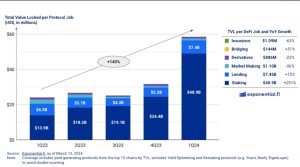
A recent report published by Exponential found that the “latest indicators signal not just growth but a transformative shift” within the DeFi space with significant growth in interest in DeFi yields.

The total value locked (TVL) in yield-generating DeFi protocols has steadily increased from $26.5 billion in the third quarter of 2023 to $59.7 billion in the first quarter of 2024, according to the report.

Total Value Locked per Protocol Job.
Total Value Locked per Protocol Job. Source: Exponential.fi

This growth signifies a return of confidence and liquidity to the DeFi markets.

We spoke to experts to find out the latest DeFi trends for 2024.

Key Takeaways

  • The DeFi industry continues to evolve with $43 billion already locked in low-risk yield contracts, indicating a shift towards more stable and reliable investment avenues.
  • The merging of traditional financial systems with DeFi is a significant trend, with financial institutions expected to use DeFi innovations such as smart contracts and decentralized lending to improve their services.
  • The DeFi space faces potential regulatory hurdles, exemplified by the SEC’s actions against Uniswap.
  • The development of Layer-2 scaling solutions and crypto bridges are pivotal in enhancing transaction speeds and reducing costs, thus supporting the broader adoption of DeFi.
  • Increased international regulatory cooperation is likely to result in a unified global framework for digital assets, balancing innovation with financial stability and opening up new opportunities for the DeFi sector.

DeFi Industry Is Maturing

As central banks signal towards more rate cuts, the DeFi yields space is gaining significant popularity as an attractive investment form with DeFi markets maturing, Anndy Lian, an inter-governmental blockchain advisor, told Techopedia.

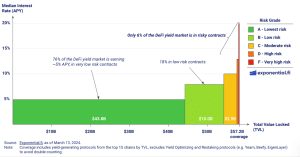
This was also backed by the Exponential report, which noted that over $43 billion were locked into very low-risk DeFi yield contracts.

75% of DeFi total value locked (TVL) is currently in pools offering 0-5% of annual percentage yield (APY).

Total Value Locked in DeFi Yield Markets.
Total Value Locked in DeFi Yield Markets. Source: Exponential.fi

Additionally, new trends in the market are pointing towards more mainstream adoption, with DeFi projects continuing to grow and integrate more and more with traditional finance.

Lian said:

“The focus [of the DeFi space in 2024] seems to be on sustainable growth, improved security, and real-world applications that could lead to wider acceptance and use of DeFi platforms.”

Igor Telyatnikov, CEO and co-founder of AlphaPoint, a digital asset and cryptocurrency trading and investing platform, added that with over $90 billion locked in DeFi protocols, the DeFi market could very much reach and even surpass previous heights of $150 billion locked as previously seen in 2021. He said:

“Despite the challenges faced, DeFi has continued to attract both developers and users, showcasing its ability to innovate and adapt. We are seeing a maturing ecosystem with more robust infrastructure, improved user experiences, and increasing collaboration among projects.”

Decentralized Finance Trends 2024

Over the last year, DeFi applications have undergone significant changes, with a number of new trends starting to show up in the industry, stemming from crypto bridges to a number of Layer-2 (L2) scaling solutions.

Here are some of the biggest DeFi trends experts are paying attention to in the second half of 2024.

1. Traditional Finance Integration

The traditional finance market entering the DeFi space is perhaps the biggest trend in the current DeFi landscape.

Lian noted that the integration of traditional markets into the DeFi space could become a “significant step towards a more inclusive and efficient financial ecosystem,” with traditional financial institutions expected to collaborate more closely with the DeFi space, utilizing features like smart contractstokenization, and decentralized lending to enhance their products and services.

Lian said:

“A growing number of financial institutions are projected to adopt DeFi solutions, with significant investments to streamline operations and offer innovative services. The 24/7 operational model of DeFi breaks down traditional barriers of time and geography, offering constant accessibility and borderless transaction capabilities.”

Telyatnikov added that as regulatory clarity improves, the DeFi space could see a lot of exploration of new use cases in collaboration with more traditional institutions.

“Furthermore, the lines between DeFi and centralized finance will blur, leading to hybrid solutions that combine the best of both worlds.”

2. Layer-2 Scaling Solutions

Layer-2 scaling solutions are a prominent tech DeFi example that is expected to play a crucial role in the second half of 2024, AlphaPoint’s Telyatnikov noted. These solutions will enable faster and cheaper transactions while also maintaining the security of the underlying blockchain.

Lian added that the ability of L2 solutions to enhance the scalability and efficiency of blockchain networks is also vital for the growth of DeFi technology.

3. Crypto Bridges

However, major DeFi platforms have seen other emerging trends in the past year, including the development of crypto bridges and Know Your Customer (KYC’d) DeFi, according to Lian. He said:

“The emergence of crypto bridges has facilitated asset transitions to faster layer 2 networks like Arbitrum and Polygon, enhancing ERC-20 token trading while maintaining exposure to Ethereum.”

4. Regulation

AlphaPoint’s Telyatnikov added that over the past year, one of the most significant changes in the DeFi landscape was the heightened regulatory scrutiny.

One example is recent enforcement actions by the U.S. Securities and Exchange Commission (SEC) aimed at Uniswap Labs, which noted that the commission was planning to recommend legal action against the company.

Telyatnikov said:

“The recent Wells notice issued to Uniswap, the largest decentralized exchange by volume, and the ongoing Tornado Cash case have sent shockwaves and warning signals through the DeFi community, particularly in the US. Uniswap, being a significant utility in the DeFi ecosystem, is now facing a direct attack from regulators, creating uncertainty that may take a long time to resolve, similar to the Coinbase lawsuit.”

5. KYC’d DeFi

Such lawsuit cases bring direct challenges to the legal status of DeFi products, their tokens and use cases, which is why there could also be a potential rise of KYC’d DeFi. Know Your Customer procedures are known to align with regulatory standards and reduce illegal activities, which could serve as a limelight for a number of DeFi platforms.

For example, Singularity, a startup developing a protocol to provide institutions with confidential access to DeFi, attracted $2.2 million to develop a KYC-compliant DeFi platform for institutions.

Miko Matsumura, the managing partner at Gumi Cryptos Capital, said in a press release on February 22, 2024:

“Singularity addresses a crucial need in the market, providing institutional users with both the compliance and the commercial confidentiality necessary to participate in DeFi.”

Additionally, the SEC’s new regulatory definitions have the potential to bring decentralized exchanges (DEXs) within the scope of regulations for US broker-dealers, affecting their operations, which could also play a significant impact on the future of the DeFi space in the coming year.

However, global regulatory cooperation and the balance between innovation and safeguarding against financial stability risks will be crucial for further development of the DeFi space.

“The [current] focus seems to be on creating a regulatory environment that supports innovation while ensuring the security and integrity of the financial system,” Lian said.

The Bottom Line

As DeFi transitions from its speculative phase into a more mature and stable environment, the integration with traditional finance and the adoption of advanced technologies like Layer-2 solutions signify a robust future.

Despite facing regulatory challenges, the sector’s innovative response showcases its resilience and potential for sustained growth.

The growing acceptance and implementation of KYC procedures in DeFi could further enhance its legitimacy and foster broader adoption.

Overall, the future of DeFi looks promising, poised to redefine financial landscapes globally as it bridges the gap between traditional and decentralized finance while navigating regulatory challenges.


Source: https://www.techopedia.com/decentralized-finance-trends

Anndy Lian is an early blockchain adopter and experienced serial entrepreneur who is known for his work in the government sector. He is a best selling book author- “NFT: From Zero to Hero” and “Blockchain Revolution 2030”.

Currently, he is appointed as the Chief Digital Advisor at Mongolia Productivity Organization, championing national digitization. Prior to his current appointments, he was the Chairman of BigONE Exchange, a global top 30 ranked crypto spot exchange and was also the Advisory Board Member for Hyundai DAC, the blockchain arm of South Korea’s largest car manufacturer Hyundai Motor Group. Lian played a pivotal role as the Blockchain Advisor for Asian Productivity Organisation (APO), an intergovernmental organization committed to improving productivity in the Asia-Pacific region.

An avid supporter of incubating start-ups, Anndy has also been a private investor for the past eight years. With a growth investment mindset, Anndy strategically demonstrates this in the companies he chooses to be involved with. He believes that what he is doing through blockchain technology currently will revolutionise and redefine traditional businesses. He also believes that the blockchain industry has to be “redecentralised”.

j j j