Trade talks, Bitcoin surges and market moves: Navigating the July 9 deadline

Trade talks, Bitcoin surges and market moves: Navigating the July 9 deadline

With the 9th July deadline looming, trade policy remains a pivotal concern, influencing investor behaviour and market movements across stocks, treasuries, commodities, and cryptocurrencies. The interplay of these factors paints a picture of cautious optimism tempered by persistent uncertainties, and it’s worth exploring each facet in depth to understand the broader implications.

Global risk sentiment and trade policy dynamics

Global risk sentiment has shown signs of improvement in recent days, driven mainly by developments in evolving trade policies. On Sunday, 29 June, Canada made a significant move by withdrawing its digital services tax on technology companies, a decision aimed at restarting trade negotiations with the United States. This step suggests a willingness to de-escalate tensions and foster a more collaborative economic relationship, which investors have interpreted as a positive signal.

Similarly, reports indicate that the European Union is prepared to accept President Donald Trump’s proposed 10 per cent universal tariff on many of its exports, though it is pushing for lower rates on key sectors. This flexibility hints at a pragmatic approach to avoid a full-blown trade war, further bolstering market confidence.

Not all trade-related news is conciliatory. In a recent Fox News interview, President Trump suggested maintaining 25 per cent tariffs on Japanese cars as negotiations between the US and Japan continue. This stance introduces a layer of uncertainty, signalling that some trade disputes remain unresolved and could potentially escalate.

With the 9th July deadline approaching, likely tied to a critical juncture in these trade talks, the global financial community is watching closely. The mixed signals from these developments suggest that while there’s room for optimism, the path forward is far from clear, and the risk of renewed tensions lingers.

Stock markets reflect cautious optimism

The US stock markets have responded to these trade policy shifts with gains, reflecting a degree of investor confidence. The S&P 500 rose by 0.52 per cent, the Dow Jones Industrial Average climbed 0.63 per cent, and the Nasdaq Composite increased by 0.47 per cent.

These advances indicate that investors are encouraged by the prospect of easing trade frictions, particularly between the US, Canada, and the EU. The anticipation of smoother trade relations could enhance corporate earnings and economic stability, driving equity prices higher.

Yet, this optimism isn’t uniform across all regions. In Asia, equity indices displayed mixed performances during early trading sessions, suggesting that investors there are adopting a more wait-and-see approach. This regional divergence might stem from uncertainties about how US-centric trade policies will ripple through global supply chains, particularly with Japan’s tariff situation unresolved.

Meanwhile, US equity index futures point to a higher opening for American stocks, reinforcing the notion that domestic markets, at least, are leaning toward a bullish outlook in the short term.

Treasury yields and the US dollar signal underlying concerns

While stocks trend upward, the bond market tells a more nuanced story. US Treasury yields eased across the curve, with the 10-year yield dropping 4.9 basis points to 4.228 per cent and the two-year yield falling 2.9 basis points to 3.719 per cent. Typically, declining yields suggest a flight to safety, as investors seek the relative security of government bonds amid uncertainty.

In this context, the yield drop might also reflect anticipation of the upcoming US June jobs report, which could influence the Federal Reserve’s monetary policy decisions. A weaker-than-expected report might fuel expectations of rate cuts, pushing yields down further.

The US Dollar Index adds another layer of complexity, having weakened by 0.54 per cent in a single session and suffering a staggering 10.8 per cent decline since the start of 2025, its worst first-half loss since 1973. This dramatic depreciation could be attributed to several factors, including the shifting trade landscape, economic data signalling a slowdown, or central bank policies diverging from those of other major economies.

A weaker dollar often boosts the appeal of US exports, aligning with the dynamics of trade negotiations, but it also raises questions about the greenback’s long-term strength and its implications for global markets.

Commodities: Gold shines, oil holds steady

In the commodities sphere, gold has emerged as a standout performer, rising 0.88 per cent to US$3,303 per ounce. This uptick underscores its role as a safe-haven asset, appealing to investors wary of economic instability or inflationary pressures.

The trade policy uncertainties, coupled with the dollar’s decline, likely contribute to gold’s allure, as it often thrives when traditional currencies falter. Conversely, Brent crude oil edged down by 0.09 per cent to US$68 per barrel, a marginal shift that suggests stable demand expectations despite the evolving trade environment. Oil’s muted response might indicate that markets don’t yet foresee significant disruptions to global energy flows from these trade talks.

The cryptocurrency surge: Bitcoin takes centre stage

Perhaps the most intriguing development lies in the cryptocurrency market, where Bitcoin is experiencing a notable resurgence. Its price climbed 0.54 per cent to US$107,937, spurred by comments from President Trump urging Republicans not to fret over deficit spending.

Analyst Will Clemente argues that such a stance reinforces the bullish case for Bitcoin and gold, as expansive fiscal policies could stoke inflation, driving investors toward alternative stores of value. This view gained traction as a Trump family-associated cryptocurrency venture raised US$220 million for Bitcoin mining, signalling high-profile endorsement and investment in the digital asset space.

Beyond the headlines, Bitcoin’s dominance is growing. Its share of the total cryptoasset market value has surged to 64 per cent in 2025, the highest since January 2021, according to CoinMarketCap. This rise contrasts sharply with the fate of altcoins, digital assets beyond Bitcoin and stablecoins, which have seen over US$300 billion in market value erased this year.

This divergence suggests a flight to quality within the cryptocurrency ecosystem, with investors favouring Bitcoin’s established reputation over riskier, less proven alternatives.

London’s Bitcoin boom: A corporate shift

The cryptocurrency trend extends beyond individual investors to corporate boardrooms, particularly in London. At least nine London-listed companies, ranging from web design firms to gold miners, have recently announced plans to buy Bitcoin or have already done so, aiming to boost their share prices.

This strategy echoes the success of Japan’s Metaplanet, Germany’s Bitcoin Group, and US-based MicroStrategy, whose valuation skyrocketed nearly 400 per cent since adopting a Bitcoin-centric approach in August 2020.

For London’s equity market, which has historically been light on digital asset exposure and constrained by regulatory limits on crypto-linked products, this marks a significant shift in sentiment. Companies are increasingly viewing Bitcoin as a treasury asset, a hedge against inflation, and a means to attract investor interest.

Synthesising the big picture

Stepping back, the current global risk sentiment is a tapestry of interwoven threads, improving trade relations, persistent uncertainties, and innovative financial strategies. Canada’s tax withdrawal and the EU’s tariff flexibility have injected optimism into markets, evident in US stock gains and futures pointing to further upside.

Yet, Trump’s hardline stance on Japanese tariffs, falling Treasury yields, and the dollar’s historic weakness suggest that not all risks have dissipated. Investors are hedging their bets, flocking to gold and Bitcoin while keeping an eye on economic indicators like the upcoming jobs report.

The cryptocurrency narrative adds a forward-looking dimension. Bitcoin’s ascent, fuelled by corporate adoption, political rhetoric, and market dynamics, positions it as a potential mainstay in the financial landscape. London’s embrace of this trend, alongside the Trump family’s crypto ventures, underscores a broader acceptance of digital assets, even as altcoins falter. This selective enthusiasm highlights a discerning market that prioritises stability amid volatility.

My point of view

In my view, we’re witnessing a pivotal moment where traditional and emerging markets are converging under the weight of shifting trade policies and economic uncertainty. The improvement in global risk sentiment is real but fragile, hinging on the outcomes of negotiations by the 9th July deadline.

Stock market gains reflect hope, but the bond and currency markets reveal a cautious undercurrent that shouldn’t be ignored. Gold’s rise and Bitcoin’s dominance signal a search for resilience in an unpredictable world, whether against inflation, currency devaluation, or geopolitical friction.

For investors, this environment demands a balanced approach: capitalising on equity opportunities while diversifying into safe havens, such as gold and Bitcoin. The cryptocurrency surge, particularly among London-based firms, suggests that digital assets are no longer a fringe consideration but a strategic one for mainstream finance.

The altcoin collapse serves as a reminder that not all innovations endure. As trade talks progress and economic data unfold, flexibility and vigilance will be key. The global market is in flux, but within that flux lies opportunity for those who navigate it wisely.


Source: https://e27.co/trade-talks-bitcoin-surges-and-market-moves-navigating-the-july-9-deadline-20250701/

Anndy Lian is an early blockchain adopter and experienced serial entrepreneur who is known for his work in the government sector. He is a best selling book author- “NFT: From Zero to Hero” and “Blockchain Revolution 2030”.

Currently, he is appointed as the Chief Digital Advisor at Mongolia Productivity Organization, championing national digitization. Prior to his current appointments, he was the Chairman of BigONE Exchange, a global top 30 ranked crypto spot exchange and was also the Advisory Board Member for Hyundai DAC, the blockchain arm of South Korea’s largest car manufacturer Hyundai Motor Group. Lian played a pivotal role as the Blockchain Advisor for Asian Productivity Organisation (APO), an intergovernmental organization committed to improving productivity in the Asia-Pacific region.

An avid supporter of incubating start-ups, Anndy has also been a private investor for the past eight years. With a growth investment mindset, Anndy strategically demonstrates this in the companies he chooses to be involved with. He believes that what he is doing through blockchain technology currently will revolutionise and redefine traditional businesses. He also believes that the blockchain industry has to be “redecentralised”.

j j j

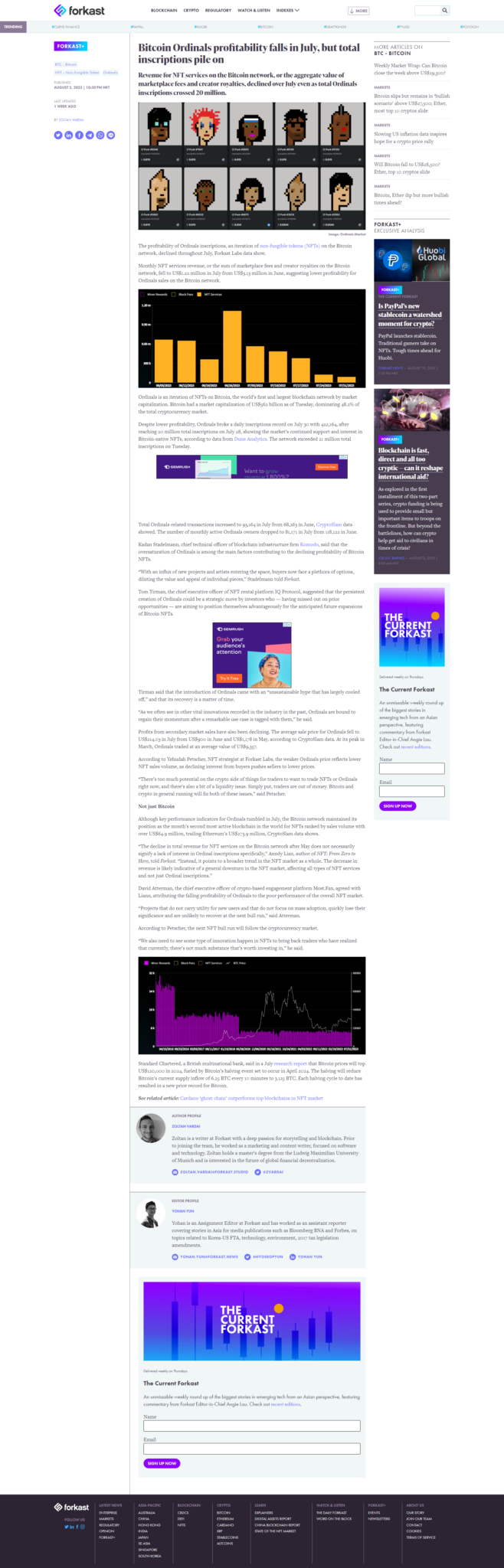
Bitcoin Ordinals profitability falls in July, but total inscriptions pile on

Bitcoin Ordinals profitability falls in July, but total inscriptions pile on

Revenue for NFT services on the Bitcoin network, or the aggregate value of marketplace fees and creator royalties, declined over July even as total Ordinals inscriptions crossed 20 million.

A screenshot of Ordinals Punks, from Bitcoin Ordinals Market
Image: Ordinals.Market

The profitability of Ordinals inscriptions, an iteration of non-fungible tokens (NFTs) on the Bitcoin network, declined throughout July, Forkast Labs data show.

Monthly NFT services revenue, or the sum of marketplace fees and creator royalties on the Bitcoin network, fell to US$1.22 million in July from US$3.13 million in June, suggesting lower profitability for Ordinals sales on the Bitcoin network.

gYubrlMoFjzgEyUf1FqvLHvFSmuO5pEcnoo sCC8Squ6Dn1abPZvffpJthvu5p4kwKKZIduAMuPcejcdQIo5VnljKXkv5vn1n5GPE7IFMlpv IMn1NSQdAxTH78QjSL3sxSTMz5Jw LK9tNc5 iU0

Ordinals is an iteration of NFTs on Bitcoin, the world’s first and largest blockchain network by market capitalization. Bitcoin had a market capitalization of US$562 billion as of Tuesday, dominating 48.2% of the total cryptocurrency market.

Despite lower profitability, Ordinals broke a daily inscriptions record on July 30 with 422,164, after reaching 20 million total inscriptions on July 28, showing the market’s continued support and interest in Bitcoin-native NFTs, according to data from Dune Analytics. The network exceeded 21 million total inscriptions on Tuesday.

Kadan Stadelmann, chief technical officer of blockchain infrastructure firm Komodo, said that the oversaturation of Ordinals is among the main factors contributing to the declining profitability of Bitcoin NFTs.

“With an influx of new projects and artists entering the space, buyers now face a plethora of options, diluting the value and appeal of individual pieces,” Stadelmann told Forkast.

Tom Tirman, the chief executive officer of NFT rental platform IQ Protocol, suggested that the persistent creation of Ordinals could be a strategic move by investors who — having missed out on prior opportunities — are aiming to position themselves advantageously for the anticipated future expansions of Bitcoin NFTs.

“As we often see in other vital innovations recorded in the industry in the past, Ordinals are bound to regain their momentum after a remarkable use case is tagged with them,” he said.

Profits from secondary market sales have also been declining. The average sale price for Ordinals fell to US$214.03 in July from US$900 in June and US$1,178 in May, according to CryptoSlam data. At its peak in March, Ordinals traded at an average value of US$9,357.

According to Yehudah Petscher, NFT strategist at Forkast Labs, the weaker Ordinals price reflects lower NFT sales volume, as declining interest from buyers pushes sellers to lower prices.

“There’s too much potential on the crypto side of things for traders to want to trade NFTs or Ordinals right now, and there’s also a bit of a liquidity issue. Simply put, traders are out of money. Bitcoin and crypto in general running will fix both of these issues,” said Petscher.

Not just Bitcoin

Although key performance indicators for Ordinals tumbled in July, the Bitcoin network maintained its position as the month’s second most active blockchain in the world for NFTs ranked by sales volume with over US$64.9 million, trailing Ethereum’s US$273.9 million, CryptoSlam data shows.

“The decline in total revenue for NFT services on the Bitcoin network after May does not necessarily signify a lack of interest in Ordinal inscriptions specifically,” Anndy Lian, author of NFT: From Zero to Hero, told Forkast. “Instead, it points to a broader trend in the NFT market as a whole. The decrease in revenue is likely indicative of a general downturn in the NFT market, affecting all types of NFT services and not just Ordinal inscriptions.”

David Atterman, the chief executive officer of crypto-based engagement platform Most.Fan, agreed with Liann, attributing the falling profitability of Ordinals to the poor performance of the overall NFT market.

“Projects that do not carry utility for new users and that do not focus on mass adoption, quickly lose their significance and are unlikely to recover at the next bull run,” said Atterman.

According to Petscher, the next NFT bull run will follow the cryptocurrency market.

“We also need to see some type of innovation happen in NFTs to bring back traders who have realized that currently, there’s not much substance that’s worth investing in,” he said.

L7AocKJIdj YNaMP00EUmjf3fVIxahfWlF2hfFEJr800yQK190aARG17GgFz wM 7igphkZ9xzo73EvDuH5 QkAzhSCx B sxtoWOYr4dTQY2QgdccPCUDnhhxqNW 6d1gmPeKz5mJ4stU987KjC Pk

Standard Chartered, a British multinational bank, said in a July research report that Bitcoin prices will top US$120,000 in 2024, fueled by Bitcoin’s halving event set to occur in April 2024. The halving will reduce Bitcoin’s current supply inflow of 6.25 BTC every 10 minutes to 3.125 BTC. Each halving cycle to date has resulted in a new price record for Bitcoin.

Source: https://forkast.news/bitcoin-ordinals-profitability-inscriptions/

Anndy Lian is an early blockchain adopter and experienced serial entrepreneur who is known for his work in the government sector. He is a best selling book author- “NFT: From Zero to Hero” and “Blockchain Revolution 2030”.

Currently, he is appointed as the Chief Digital Advisor at Mongolia Productivity Organization, championing national digitization. Prior to his current appointments, he was the Chairman of BigONE Exchange, a global top 30 ranked crypto spot exchange and was also the Advisory Board Member for Hyundai DAC, the blockchain arm of South Korea’s largest car manufacturer Hyundai Motor Group. Lian played a pivotal role as the Blockchain Advisor for Asian Productivity Organisation (APO), an intergovernmental organization committed to improving productivity in the Asia-Pacific region.

An avid supporter of incubating start-ups, Anndy has also been a private investor for the past eight years. With a growth investment mindset, Anndy strategically demonstrates this in the companies he chooses to be involved with. He believes that what he is doing through blockchain technology currently will revolutionise and redefine traditional businesses. He also believes that the blockchain industry has to be “redecentralised”.

j j j

NFT market slumped by 25% between June and July

NFT market slumped by 25% between June and July

Along with the general crypto market, NFT sales have taken a massive hit in the face of the ongoing crypto winter.

According to data from NFT aggregation site CryptoSlam, July’s secondary NFT market sales fell to $650 million, a 25% drop from June figures. This is the second month in a row that NFT sales have been below $1 billion.

Anndy Lian, blockchain author and entrepreneur and founding member of NFT creator studio Influxo explained that “the current [crypto] market right now is in a bear market […] so [NFT] sales actually reflect very much on how the market is reacting.”

Meanwhile, NFT relations strategist for CryptoSlam, Yehudah Petscher said he thinks the market was yet to find the bottom.


I don’t know if we’ll find the bottom this year […] I believe this bear market we’re in could extend for multiple years.

However, Petscher is optimistic about the number of unique buyers currently in the market. The number of buyers fell just 7% month-on-month in July to 532,000, a higher figure than that of July last year. He said that while total sales in U.S. dollars are down, the number of transactions makes for a slightly more optimistic outlook.


NFTs are in a rough place right now, but I still think in a very healthy place as far as growth [or] as far as transactions [are concerned].

The upcoming “Merge” for Ethereum could give the NFT market a boost, as the leading blockchain for NFTs is due to move to a proof-of-stake (PoS) consensus in the coming months. The transition aims to reduce the energy used in the Ethereum network by up to 99%.

“I think [the Merge] will create another spur of hype among the Ethereum fan base,” Lian said, warning that transaction fees will likely remain high.

Meanwhile, Yuga Labs projects continue their dominance of the bestseller list in July, with the company’s Bored Ape Yacht Club (BAYC), Mutant Ape Yacht Club (MAYC), and CryptoPunks all in the top five.


Original Source: https://www.investing.com/news/cryptocurrency-news/nft-market-slumped-by-25-between-june-and-july-2860876

Anndy Lian is an early blockchain adopter and experienced serial entrepreneur who is known for his work in the government sector. He is a best selling book author- “NFT: From Zero to Hero” and “Blockchain Revolution 2030”.

Currently, he is appointed as the Chief Digital Advisor at Mongolia Productivity Organization, championing national digitization. Prior to his current appointments, he was the Chairman of BigONE Exchange, a global top 30 ranked crypto spot exchange and was also the Advisory Board Member for Hyundai DAC, the blockchain arm of South Korea’s largest car manufacturer Hyundai Motor Group. Lian played a pivotal role as the Blockchain Advisor for Asian Productivity Organisation (APO), an intergovernmental organization committed to improving productivity in the Asia-Pacific region.

An avid supporter of incubating start-ups, Anndy has also been a private investor for the past eight years. With a growth investment mindset, Anndy strategically demonstrates this in the companies he chooses to be involved with. He believes that what he is doing through blockchain technology currently will revolutionise and redefine traditional businesses. He also believes that the blockchain industry has to be “redecentralised”.

j j j