Keep Calm: Hong Kong’s Stablecoin Rules Explained

Keep Calm: Hong Kong’s Stablecoin Rules Explained

Let’s be clear about Hong Kong’s new stablecoin regime. After months of poring over statutes, speaking with regulators, and sifting the louder myths from the quieter facts, the signal is finally audible through the noise. Much of the commentary mistakes a drizzle for a monsoon. If you’ve been fretting about whether Tether suddenly needs a Hong Kong license, or whether buying USDT at a neighborhood shop has become illicit, exhale. What follows is a plain-English guide to what the rules actually do—no hedging, no techno-mystique, just the architecture as written. Think of it as a field note from someone who’s read the fine print so you don’t have to.

Here’s the frame: the Stablecoins Ordinance took effect on August 1. Serious teams moved ahead of that date because the Hong Kong Monetary Authority (HKMA) spent years laying the groundwork and finalized its guidance only recently. The core principle is straightforward. If you’re issuing new fiat-referenced stablecoins—think USDT or USDC-style instruments pegged to a sovereign currency—you need the HKMA’s blessing. No license, no minting in Hong Kong. Full stop.

The biggest misconception is scope. These rules are not a blanket on every imaginable interaction with a stablecoin. They are tightly aimed at issuance—the moment a token is created and enters circulation. When the law describes “regulated activity,” it means minting, not downstream trading. If baking bread is issuance, groceries and restaurants are secondary markets. The ordinance regulates the bakery, not the bodega. Swapping USDT at a Hong Kong OTC desk or trading it on a local exchange does not, by itself, breach the rulebook. A great many people have been panicking over the wrong thing.

Which brings us to Tether and Circle, the familiar elephants in the room. Do USDT and USDC need Hong Kong licenses? No. And it’s not a matter of corporate intransigence; it’s baked into the statute. The ordinance targets stablecoins issued in Hong Kong and pegged to the Hong Kong dollar. USDT and USDC are minted offshore and reference the U.S. dollar. Unless those firms decide to launch a brand-new HKD-pegged product from within Hong Kong—a prospect for which they’ve shown no appetite—they fall outside the framework as written. That’s not defiance; it’s design.

So what counts as “in Hong Kong”? Not where someone clicks “mint” on a laptop. The analysis looks at the whole enterprise: legal domicile, where operations are run, where reserves are held, and how and to whom the product is marketed. A Cayman-registered firm that runs its day-to-day from a central office, holds reserves with local institutions, and pushes its product to Hong Kong users is very likely within the HKMA’s remit. Blockchains may be borderless; businesses are not.

That naturally leads to the term “active promotion.” The Securities and Futures Commission (SFC) has long drawn a line here: marketing to Hong Kong residents without the right approvals is risky. But “active promotion” is more than merely having a website that loads in Kowloon. It looks like targeted campaigns at Hong Kong users, accepting local payment rails, publishing Chinese-language materials aimed at this market, running roadshows or community events here, and regularly pitching local platforms or investors. If your sales team courts Hong Kong exchanges and you host meetups in central, that’s active promotion. If your site is globally visible but you do nothing to cultivate Hong Kong users, you’re far less exposed. Intent matters; you can’t “accidentally” market to Hong Kong.

Another point lost in the rumor mill: the HKMA can’t conjure new obligations by fiat. Any expansion of regulated activities must be announced through the Hong Kong Gazette. This is not creeping, back-channel rulemaking. It’s a transparent process with public notice. So if someone warns you that “OTC desks might be randomly banned next month,” they’re trading in speculation, not law. The ordinance sets the perimeter; widening it requires due procedure.

On licensing, this is where theory meets practice. Unlike many financial licenses, you don’t just download an application packet and hit “submit.” You first sit down—formally—with the HKMA. That pre-application conversation is a filter. Supervisors will test your model: how you mint and redeem, how reserves are safeguarded, how audits work, and how you’d handle stress. Why the gatekeeping? Because Hong Kong doesn’t intend to franchise dozens of interchangeable issuers. The HKMA has said as much: the market cannot sustain a crowd of “USDC-but-with-a-new-name” projects. They want serious operators with real systems, not façades.

Teams that have gone through these preliminaries report a consistent hierarchy of concern: protect users first, everything else second. Reserve quality sits at the top—cash and cash equivalents that are liquid, high-grade, and cleanly custodied. Segregation is scrutinized: are customer assets bankruptcy-remote? Redemption mechanics are stress-tested: can users get out, at par, under pressure? One applicant spent multiple meetings walking through their audit pipeline—frequency, independence, scope. The message is blunt: if you cannot prove, not merely promise, that your token is fully and transparently backed, don’t queue up.

What about non-HKD stablecoins? The current rules are deliberately narrow: they explicitly target HKD-pegged products. A U.S. dollar-referenced coin issued from Hong Kong is not automatically captured unless it’s being actively marketed here as a payment instrument. That leaves a gray band that the HKMA will almost certainly address over time. For now, a euro-pegged token issued in Hong Kong but aimed solely at European users likely sits outside the scope. Start touting it to Hong Kong consumers as a way to pay for dim sum, and you’ve crossed into regulated territory.

This targeted approach distinguishes Hong Kong from the EU’s MiCA, which sweeps far more broadly. Hong Kong’s priority is the stability and credibility of the Hong Kong dollar. That’s strategically sensible. You do not want a proliferation of unofficial “digital HKD”s fragmenting the monetary system. It also means day-to-day usage of the big, dollar-referenced incumbents—USDT among them—remains largely unaffected. Markets haven’t convulsed because, for most users, little changes in the near term. The sharper impact will be on would-be issuers of local-currency tokens.

Timing matters. The ordinance cleared LegCo in May and took legal effect on August 1. With the law now in force, the pre-application and formal filing process is underway. Expect the first approvals, if any, to arrive no earlier than early 2026. The HKMA has signaled—as clearly as regulators ever do—that speed will not be the metric. That’s a feature, not a bug. Fast-tracked licensing has gone poorly elsewhere; Hong Kong is opting for methodical vetting.

For ordinary residents, the near-term impact is modest. Your ability to buy USDT or USDC is not suddenly curtailed. The meaningful change will come if local firms begin offering HKD-pegged tokens for everyday payments. Those products will require HKMA approval, and rightly so. Imagine taxi apps, supermarkets, or utility providers each pushing their own “digital HKD.” Without guardrails, you’d get fragmentation and confusion. The ordinance is an anti-chaos measure as much as a pro-innovation one.

A final plea against absolutism: this framework is neither an existential threat to crypto nor a magic wand for financial modernization. It is a pragmatic, bounded attempt to protect monetary stability while creating a lane for credible innovation. When the HKMA says the market can support only a handful of issuers, it isn’t stinginess; it’s prudence. You don’t need twenty digital Hong Kong dollars. You need one or two that the public can trust.

The deeper story is cultural. Hong Kong is pivoting from crypto spectacle to institutional plumbing. After the carnage of 2022, the city is choosing guardrails first and productization later. That may feel slow to the “move fast and break things” set, but ask anyone burned by opaque reserves and imploding pegs whether deliberation is a vice or a virtue. This is what learning looks like.

So, practical advice. First, map your activity honestly against the ordinance: are you issuing or merely facilitating use? Second, if issuance is anywhere in scope, start or continue the pre-application dialogue with the HKMA now; it’s already in effect. Third, treat Telegram lore and X threads as background noise and rely on the published guidance. The statute itself reads like legal spaghetti, but the HKMA’s plain-language materials are, refreshingly, actually plain.

The regime is not perfect—no regime is—but it is necessary. Stablecoins now function as critical rails for the broader digital-asset economy; leaving them ungoverned invites familiar disasters. By focusing on the HKD, Hong Kong is protecting its monetary core without strangling optionality elsewhere. The real test will come when the first applications are approved or rejected. That’s when we’ll see just how tight the screws really are. Until then, trade the anxiety for accuracy. When the subject is money, clarity isn’t a luxury—it’s the whole point. We’ve done enough guessing. It’s time to deal in facts.


Source: https://intpolicydigest.org/keep-calm-hong-kong-s-stablecoin-rules-explained/

Anndy Lian is an early blockchain adopter and experienced serial entrepreneur who is known for his work in the government sector. He is a best selling book author- “NFT: From Zero to Hero” and “Blockchain Revolution 2030”.

Currently, he is appointed as the Chief Digital Advisor at Mongolia Productivity Organization, championing national digitization. Prior to his current appointments, he was the Chairman of BigONE Exchange, a global top 30 ranked crypto spot exchange and was also the Advisory Board Member for Hyundai DAC, the blockchain arm of South Korea’s largest car manufacturer Hyundai Motor Group. Lian played a pivotal role as the Blockchain Advisor for Asian Productivity Organisation (APO), an intergovernmental organization committed to improving productivity in the Asia-Pacific region.

An avid supporter of incubating start-ups, Anndy has also been a private investor for the past eight years. With a growth investment mindset, Anndy strategically demonstrates this in the companies he chooses to be involved with. He believes that what he is doing through blockchain technology currently will revolutionise and redefine traditional businesses. He also believes that the blockchain industry has to be “redecentralised”.

j j j

What Are the Major September Events to Keep an Eye On? The CPI, the Merge, the FOMC, & Vasil

What Are the Major September Events to Keep an Eye On? The CPI, the Merge, the FOMC, & Vasil

September 2022 will be an eventful month. The stock market has had a terrible month in the past. However, this is may not the case for the cryptocurrency markets. In my humble view, there are a few of major events that investors should pay special attention to since they are all interconnected.

Consumer Price Index (CPI)

We’ll begin on September 13th. The Consumer Price Index (CPI) data will be released by the United States Bureau of Labor Statistics.

One of these data points is the August jobs report, which is already out. A careful examination of US labor market statistics revealed that nonfarm payrolls increased by 315,000 in August, above the projected 298,000 but falling short of the prior month’s 526,000. A healthy labor market means a more resilient economy, prompting the Fed to take on inflation more forcefully. Analysts are also looking for clues in the employment data about what is going on with wage growth.

The CPI numbers for the United States, together with the August jobs data released earlier this month, will eventually help the Fed decide whether to boost rates by 50 basis points or 75 basis points. In the United States, the inflation rate rose from 8.6% in May 2022 to 8.5% in July and 9.1% in June. The August inflation rate in the United States might serve as a guideline for future Fed rate rises.

Ethereum Merge

This is a highly anticipated event in the cryptocurrency world this year. This event has already started. They have released the Bellatrix upgrade, the final update before the Merge, which is set for September 13-15.

This upgrade shift the network’s consensus method from Proof of Work (PoW) to Proof of Stake (PoS). This will lower Ethereum’s carbon footprint by removing crypto mining . This decision has also had an impact on Nvidia’s stock price, given they are a major provider of mining equipment. The miners are nevertheless optimistic, believing that the fork will keep them in business. On top of that, there was a lot of publicity and marketing hype around the new Eth PoW airdrop. Key thought leaders are reminding everyone that borrowing as much ETH as possible from AAVE or Compound before the snapshot is a good idea since they can expect maximum utilization.

The charts are exhibiting strong indicators, with the price of Ethereum increasing by 4.98% while Bitcoin remains unchanged.

Federal Open Market Committee (FOMC)

Throughout the year, the FOMC has eight regularly scheduled meetings and extra talks as appropriate. The next meeting is scheduled on September 21.

The Fed Chairman Powell’s “powerful” speech at Jackson Hole on August 26 is primarily to blame for the recent sharp decline in market prices. Powell’s comments were substantially more hawkish than anticipated and alarmed the market.

The market anticipated the Fed to remain neutral after recent inflation statistics revealed that inflation had peaked and prices were dropping. They expected the Fed to keep to its plans to increase interest rates by another 100-120 basis points (1% -1.2%) by the end of 2022, bringing the Fed funds rate to 3.25%-3.5%. At the last FOMC meeting, Powell had also given the market the assurance that the economy would have a soft landing and that no recession was imminent.

Powell used words like “bring some pain to households and businesses” and “very likely be some softening of labor conditions”. Analysts who looked at the speech were reading that the Fed Chair was suggesting the recent fall in inflation was not good enough. To stop inflation once and for all, the Fed was prepared to increase the unemployment rate, reduce wage growth, and sacrifice short-term growth.

For many Americans, the critical question is whether they can continue to keep their jobs, not the increase in rates of September as the Fed bears down on inflation.

The FOMC has raised interest rates four times in 2022 so far. If you are wondering what has the rate got to do with cryptocurrencies. For your information, Bitcoin’s price dipped as low as $17,500 following the Fed’s two-day meeting on June 14 and 15. The Fed raised interest rates by 0.75%. Generally, traders leave the market when interest rates increase, or other markets are impacted, which leads to a sell-off in cryptocurrencies.

Cardano Vasil Hard Fork

The Cardano Vasil hard fork is the second most anticipated update in the cryptocurrency market, after only the Ethereum Merge.

Many of us may not know the term “Vasil”. Cardano, ranked 8th on CoinMarketcap is a proof-of-stake blockchain platform: the first to be founded on peer-reviewed research and developed through evidence-based methods.

Vasil is a significant improvement to Cardano, delivering enhanced network capacity and decreased transaction costs. Plutus, Cardano’s smart contract platform, will also be improved as part of the upgrade, allowing developers to design more efficient blockchain-based apps.

Cardano’s ADA token price rose 2.2% in the past 24 hours and 14% in the last week. This upgrade is confirmed to be on September 22.

Impact on the Financial Market

Because Bitcoin is viewed as an investment vehicle akin to stocks and bonds, the FOMC and macroeconomic pronouncements can have a significant influence on its price. Numerous studies suggest that these announcements have an influence on the whole financial market.

It remains to be seen whether history repeats itself and stocks end the month of September lower. As additional evidence comes in over the coming months, the idea of a Fed Pivot that was dismissed after Jackson Hole could start to materialize. Investors in the stock market anticipate that the Fed’s decision will provide them with guidance before the results of the upcoming quarter are released and when macroeconomic conditions change in 2023. Perhaps Ethereum and Cardano are the only shining knights in this financial uncertainty.

We will see.

I will end with a quote. “You will most likely come out on top in this bear market if you stick to your financial strategies and maintain your sense. Keep in mind that the people who sow their seeds today can become the millionaires who will profit from the upcoming bull market.”- Anndy Lian.


Source: https://www.securities.io/what-are-the-major-september-events-to-keep-an-eye-on-the-cpi-the-merge-the-fomc-vasil/


Anndy Lian is an early blockchain adopter and experienced serial entrepreneur who is known for his work in the government sector. He is a best selling book author- “NFT: From Zero to Hero” and “Blockchain Revolution 2030”.

Currently, he is appointed as the Chief Digital Advisor at Mongolia Productivity Organization, championing national digitization. Prior to his current appointments, he was the Chairman of BigONE Exchange, a global top 30 ranked crypto spot exchange and was also the Advisory Board Member for Hyundai DAC, the blockchain arm of South Korea’s largest car manufacturer Hyundai Motor Group. Lian played a pivotal role as the Blockchain Advisor for Asian Productivity Organisation (APO), an intergovernmental organization committed to improving productivity in the Asia-Pacific region.

An avid supporter of incubating start-ups, Anndy has also been a private investor for the past eight years. With a growth investment mindset, Anndy strategically demonstrates this in the companies he chooses to be involved with. He believes that what he is doing through blockchain technology currently will revolutionise and redefine traditional businesses. He also believes that the blockchain industry has to be “redecentralised”.

j j j

Apecoin (APE) price prediction: Will the debut surge keep up?

Apecoin (APE) price prediction: Will the debut surge keep up?

Ape coin (APE), the native cryptocurrency of the popular non-fungible token (NFT) collection Bored Ape Yacht Club (BAYC), became the biggest metaverse token by market capitalisation a little over a month after its release. The coin has dethroned Decentraland’s coin (MANA), which has been around since early 2020.

Recent news that ApeCoin will implement a staking mechanism in the coming weeks as well as Elon Musk briefly changing his profile picture on Twitter to a collage of a number of avatars from the BAYC NFT collection, drove the APE NFT coin price up on 5 May as it managed to gain nearly 19% of its value in less than 24 hours.

Will the future APE coin price prediction be as bullish as its early start, and what are the key projections for the popular NFT cryptocurrency?

What is ApeCoin?

ApeCoin (APE), was launched on 17 March 2022 by the founders of the BAYC NFT collection Yuga Labs, which also formed the APE Foundation, a means of aiding the decentralised development of the APE ecosystem.

Created with the goal of becoming the “heart of art, gaming, entertainment and events on the blockchain”, the APE Foundation will be in charge of overlooking the decisions of the ApeCoin Decentralised Autonomous Organisation (DAO).

The crypto will be responsible for administration, bookkeeping, project management and other tasks necessary to ensure the DAO community can build new Web3 applications and services, such as the APE NFT coin itself.

ApeCoin’s main focus is decentralisation and through the APE Improvement Proposal Process it will allow ApeCoin DAO members to make decisions regarding Ecosystem Fund allocations, governance rules, upcoming projects, partnerships and more.

The ApeCoin Foundation is managed by a board which oversees  the community and carries out DAO proposals. The initial board serves a term of six months and is voted in by DAO members.

The current members of the board are:

  • Reddit co-founder Alexis Ohanian
  • FTX head of ventures and gaming Amy Wu
  • Sound Ventures principal Maaria Bajwa
  • Animoca Brands co-founder and chair Yat Siu
  • Horizen Labs president and general counsel Dean Steinbeck

The APE NFT coin is an ERC-20 cryptocurrency designed on the Ethereum protocol. Apart from governance, the token:

  • Provides holders with access to certain parts of the ecosystem unavailable to others, such as exclusive games, merchandise, events and services.
  • Can be incorporated into other services, games and projects.

ApeCoin was launched through an airdrop, which allowed certain groups of holders to receive the tokens as rewards. The cryptocurrency’s total supply stands at one billion. No new tokens can be minted.

Upon release, the tokens’ total supply was distributed as follows:

  • 62% was allocated to the ecosystem’s fund and given to BAYC and Mutant Ape Yacht Club (MAYC) NFT holders.
  • 16% was allocated to Yuga Labs and charity.
  • 14% was allocated to the companies and people that helped to create the project.
  • 8% was allocated to the BAYC founders.

At the time of writing (9 May), over 284 million APE coins were in circulation according to CoinMarketCap. APE’s market capitalisation surpassed $3.18bn, making it the 33rd biggest cryptocurrency.

Apecoin price analysis following successful debut

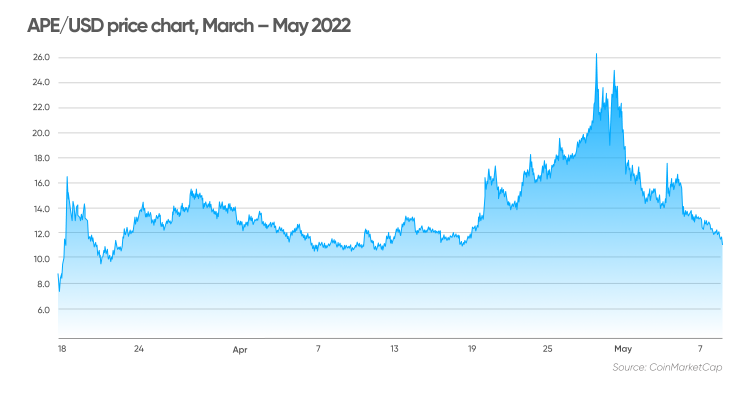
The APE NFT coin saw its value surge 126.8% on the first day of launch, reaching $16.47, up from $7.2604 in less than 24 hours, as seen on the price chart below. The coin retreated to $14. 03 by the end of the day and continued to move sideways throughout 19 March 2022 before falling to values just above $9 on 21 March 2022.

By 24 March, the APE token price climbed back to over $14 as anticipation grew ahead of the first ever ApeCoin DAO voting event, which was due to take place on the day. The cryptocurrency peaked at $15.43 on 28 March 2022 before embarking on a bearish journey into April 2022.

APE/USD price chart, March – May 2022

In April 2022, the APE token price peaked on three occasions:

  • On 10 April at $12.27 – the Bored & Hungry restaurant in California became the first ever catering establishment to accept payments in ether (ETH) and APE.
  •  On 21 April at $17.31–  following announcements that ApeCoin was cooperating with the OliveXFitness Metaverse to grant APE token holders special access to the metaverse’s move-to-earn Dustland games.
  • On 29 April at $26.19 – its all-time high value, as three new proposals were opened for ApeCoin DAO members to vote on.

On 30 April 2022, one of the largest NFT marketplaces, OpenSea, announced that it would start accepting the APE cryptocurrency for NFT purchases on its platform. This led to an over 30% one-day gain as the APE price rose to just below $25.

Following 102% April 2022 gains, the APE NFT coin chart started on a downwards trend, losing over 45% of its value by the time of writing (9 May). Today the coin is trading at $11.24.

In terms of APE token technical analysis, short-term sentiment for the token at the time of writing (9 May) was largely bearish.

Relative Strength Index (RSI) reading of 41.89 was pointing towards neutral territory. A reading of 30 or below would indicate that the asset is becoming undervalued. Meanwhile, the token was trading below its three, five and 10-day moving averages, indicating a bearish trend.

Will apecoin go back up? Future outlook

The debut success of the coin and its speedy price reversal leaves a question on investors’ lips: is apecoin a good investment? There are multiple factors at play.

Recent ApeCoin news saw ApeCoin DAO members approve two measures that would let them lock their tokens for a period of time in exchange for more apecoins in future. The finalisation of this decision on 5 May 2022 led to a mini surge in the APE price, which jumped by 23.9%, up from $14.13 on the previous day to $17.52.

In an announcement in a Twitter thread, ApeCoin noted that the new updates would be implemented “within the next week or two” following the end of the voting.

In addition to that, on 5 May, another proposal was going live for a community-wide vote to deal with security tools and education. The vote is set to end by 12 May 2022. If successful, the plan will be implemented in three phases.

Other ApeCoin news that could move the APE price in the future includes the launch of Otherside on 1 May 2022 – the largest expansion of the Bored Ape NFT universe, powered by apecoin.

Otherside is an online metaverse and role-playing game connected to the BAYC ecosystem where players can purchase lands and real estate. It was reported that 45 minutes after the metaverse’s launch BAYC sold over $100m worth of digital real estate.

Following the 1 May successes, crypto analyst and the founder of Eight Global, Michaël van de Poppe, said on Twitter that the APE price prediction had potential to embark on a bullish trend towards $19 and even $20.

One of the main reasons to why the APE cryptocurrency has managed to generate a lot of buzz was because it was built on the Ethereum blockchain, BigOne Exchange chair in Asia, Anndy Lian, told Capital.com.

“Looking at some of the volumes transacted on Whalealert and Whalestats, I can safely say that APE is one of the most purchased altcoins amongst the Ethereum whales. This is a very positive sign for the token and I must say APE is not just another ordinary meme coin,” he added.

However, the token could benefit from some more utility, Lian noted.

“The faith and comradeship within their community help keep the price and volume going, while doing so the other immediate thing they should really look at is to increase utility online and offline. APE is currently being used in Benji Bananas as an in-game currency and E11EVEN Residencies in Miami has also accepted APE as payment.”

Lian concluded that the proposal from APE owners to lock up and stake their coins are “very sound measures to keep the token sustainable, especially in bear markets”.

ApeCoin price prediction 2022-2025, 2030

Algorithm-based forecasting service Wallet Investor gave a bullish outlook on the future of the APE/USD forecast at the time of writing (9 May), calling apecoin “an awesome long-term investment”.

Based on its analysis of past price performance, Wallet Investor expected the APE target price to grow to $30.501 by 2023, $43.940 by 2024 and reach $87.357 by 2027.

DigitalCoinPrice echoed an upbeat apecoin crypto price prediction, projecting that the token’s value could steadily grow in the coming years. The site noted that APE could end this year at $16.23 and reach $25.30 by the end of 2025.

By the end of 2027, the site’s APE crypto price prediction suggested that the coin could trade at $35.25. Its long-term APE prediction showed that the cryptocurrency has the potential to reach $54.26 by 2030.

Note that predictions can be wrong. Forecasts and analysts’ expectations shouldn’t be used as a substitute for your own research. Always conduct your own due diligence. And never invest or trade money you cannot afford to lose.


Original Source: https://capital.com/apecoin-ape-price-prediction

Anndy Lian is an early blockchain adopter and experienced serial entrepreneur who is known for his work in the government sector. He is a best selling book author- “NFT: From Zero to Hero” and “Blockchain Revolution 2030”.

Currently, he is appointed as the Chief Digital Advisor at Mongolia Productivity Organization, championing national digitization. Prior to his current appointments, he was the Chairman of BigONE Exchange, a global top 30 ranked crypto spot exchange and was also the Advisory Board Member for Hyundai DAC, the blockchain arm of South Korea’s largest car manufacturer Hyundai Motor Group. Lian played a pivotal role as the Blockchain Advisor for Asian Productivity Organisation (APO), an intergovernmental organization committed to improving productivity in the Asia-Pacific region.

An avid supporter of incubating start-ups, Anndy has also been a private investor for the past eight years. With a growth investment mindset, Anndy strategically demonstrates this in the companies he chooses to be involved with. He believes that what he is doing through blockchain technology currently will revolutionise and redefine traditional businesses. He also believes that the blockchain industry has to be “redecentralised”.

j j j