5 crypto events that will make or break 2026: What investors must know before April

5 crypto events that will make or break 2026: What investors must know before April

The second quarter of 2026 marks a defining moment for digital assets, as regulatory milestones and macroeconomic shifts converge to reshape the crypto landscape. As someone who has navigated this industry for over fifteen years and advised governments on blockchain policy, I see these upcoming events not as isolated developments but as interconnected forces that will determine whether crypto matures into a legitimate pillar of global finance or remains trapped in regulatory limbo.

The period between late March and early July presents five catalysts that demand close attention, each carrying the potential to unlock capital, clarify rules, or alter the monetary conditions that underpin risk asset performance. Understanding how these events interact requires looking beyond headlines to the structural changes they introduce for investors, builders, and policymakers alike.

The CLARITY Act (April 3, 2026)

Industry leaders anticipate President Trump could sign the CLARITY Act by April 3, 2026, a move that would finally delineate regulatory responsibilities between the SEC and CFTC. This legislation matters because legal ambiguity has long stifled innovation in the world’s largest capital market.

When projects face uncertain enforcement actions rather than clear compliance pathways, talent and capital migrate elsewhere. The passage would reduce legal risks for US-based crypto initiatives and signal to traditional finance that digital assets operate under a predictable framework.

I have long argued that regulation should enable rather than constrain technological progress, and this bill represents a step toward that balance. Reduced uncertainty often precedes capital deployment, so we could see accelerated institutional participation once the rules of engagement become transparent. Projects that previously hesitated to launch in the United States may now proceed, knowing which agency oversees their token structure and what disclosures they must provide.

SEC Crypto ETF Decisions (March 27, 2026)

Just one week earlier, on March 27, 2026, the SEC must issue final decisions on 91 pending crypto ETF applications spanning 24 tokens. Analysts expect verdicts to arrive sooner, given the perceived friendlier regulatory stance, but the deadline itself creates a hard boundary for market expectations.

Approval of altcoin ETFs, such as those tracking Solana or XRP, would replicate the institutional access wave that Bitcoin and Ethereum ETFs initiated. These products serve as regulated conduits for pension funds, endowments, and registered investment advisors who cannot directly hold digital assets.

The scale of potential inflows remains substantial, and I view this as a critical test of whether US regulators will allow market demand to shape product availability. Institutional capital moves deliberately, but once allocated, it tends to remain invested, providing a stabilising influence on volatile markets. The applications represent diverse strategies and underlying assets, meaning approvals could broaden exposure beyond the largest cryptocurrencies and introduce investors to protocols with different risk and return profiles.

Tax-Advantaged Crypto ETNs (April 6, 2026)

The United Kingdom takes a different approach, allowing crypto exchange-traded notes to be held in tax-advantaged accounts starting April 6, 2026. This policy change qualifies these instruments for Individual Savings Accounts and self-invested personal pensions, granting millions of retail investors and pension funds a familiar wrapper for crypto exposure.

The significance lies in the stickiness of this capital. Retirement savings and tax-efficient accounts typically exhibit lower turnover than speculative trading capital, potentially reducing volatility over time. From my perspective, this move demonstrates how progressive regulation can expand access without compromising investor protections.

The UK framework may attract global crypto firms seeking a clear European base, especially as other jurisdictions grapple with more fragmented rules. Millions of UK residents now have a straightforward way to allocate a portion of their long-term savings to digital assets, and pension fund managers have a compliant vehicle to explore this emerging asset class within their fiduciary mandates.

Federal Reserve Leadership Transition (May 15, 2026)

Monetary policy leadership also shifts in May 2026 when Federal Reserve Chair Jerome Powell’s term ends on May 15. The nomination process that follows could usher in a more dovish approach to interest rates and balance sheet management.

History shows that easier monetary conditions boost liquidity for risk assets, and crypto has consistently correlated with periods of expanding money supply. A new chair selected by President Trump might prioritise growth-oriented policies, which would indirectly support digital asset valuations. I monitor these macro signals closely because crypto does not exist in a vacuum.

Global liquidity conditions often outweigh project-specific developments in driving price action, making the Fed chair transition a pivotal variable for the second half of 2026. A shift toward lower rates or faster balance sheet expansion would increase the pool of capital seeking yield, and digital assets often benefit when investors search for returns beyond traditional fixed income.

MiCA Implementation Deadline (July 1, 2026)

Finally, the European Union’s Markets in Crypto Assets regulation comes into full effect on July 1, 2026, requiring all crypto firms operating in the bloc to meet comprehensive compliance standards. MiCA creates a regulatory passport that allows approved entities to serve customers across all member states, but it also raises operational costs and may force smaller projects to exit the market. This consolidation could strengthen the remaining players while enhancing consumer trust through standardised disclosures and reserve requirements.

Having studied regulatory frameworks globally, I recognise that MiCA’s rigour may initially slow innovation but ultimately lend credibility to the sector. Firms that adapt early will gain competitive advantages in the world’s largest single market, while those that resist may find their access limited. The July 1 deadline creates a clear timeline for compliance investments, and companies that treat this as a strategic priority rather than a bureaucratic hurdle will position themselves for long-term growth.

Among these catalysts, the Federal Reserve leadership transition stands out as the most immediate market-moving factor, as it directly influences global liquidity that underpins all risk assets. The interplay between these events will define crypto’s trajectory through 2026 and beyond, rewarding those who understand both its technical and macroeconomic dimensions. Investors who track regulatory deadlines alongside central bank communications will gain an edge in anticipating capital flows and positioning portfolios for the next phase of digital asset adoption.


Source: https://e27.co/5-crypto-events-that-will-make-or-break-2026-what-investors-must-know-before-april-20260223/

Anndy Lian is an early blockchain adopter and experienced serial entrepreneur who is known for his work in the government sector. He is a best selling book author- “NFT: From Zero to Hero” and “Blockchain Revolution 2030”.

Currently, he is appointed as the Chief Digital Advisor at Mongolia Productivity Organization, championing national digitization. Prior to his current appointments, he was the Chairman of BigONE Exchange, a global top 30 ranked crypto spot exchange and was also the Advisory Board Member for Hyundai DAC, the blockchain arm of South Korea’s largest car manufacturer Hyundai Motor Group. Lian played a pivotal role as the Blockchain Advisor for Asian Productivity Organisation (APO), an intergovernmental organization committed to improving productivity in the Asia-Pacific region.

An avid supporter of incubating start-ups, Anndy has also been a private investor for the past eight years. With a growth investment mindset, Anndy strategically demonstrates this in the companies he chooses to be involved with. He believes that what he is doing through blockchain technology currently will revolutionise and redefine traditional businesses. He also believes that the blockchain industry has to be “redecentralised”.

j j j

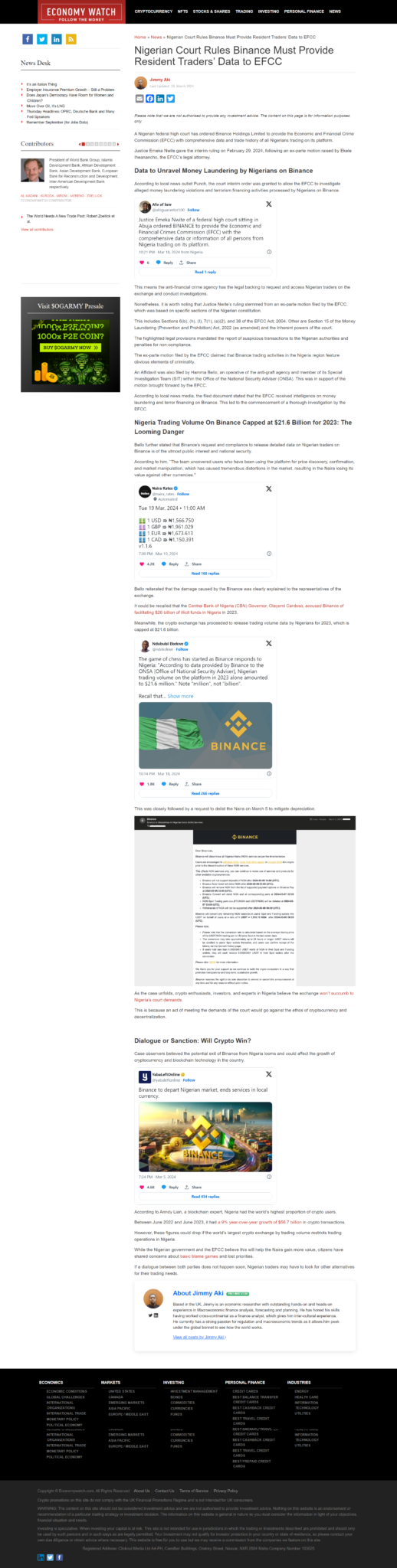
Nigerian Court Rules Binance Must Provide Resident Traders’ Data to EFCC

Nigerian Court Rules Binance Must Provide Resident Traders’ Data to EFCC

A Nigerian federal high court has ordered Binance Holdings Limited to provide the Economic and Financial Crime Commission (EFCC) with comprehensive data and trade history of all Nigerians trading on its platform.

Justice Emeka Nwite gave the interim ruling on February 29, 2024, following an ex-parte motion raised by Ekele Iheanancho, the EFCC’s legal attorney.

Data to Unravel Money Laundering by Nigerians on Binance

According to local news outlet Punch, the court interim order was granted to allow the EFCC to investigate alleged money laundering violations and terrorism financing activities processed by Nigerians on Binance.


This means the anti-financial crime agency has the legal backing to request and access Nigerian traders on the exchange and conduct investigations.

Nonetheless, it is worth noting that Justice Nwite’s ruling stemmed from an ex-parte motion filed by the EFCC, which was based on specific sections of the Nigerian constitution.

This includes Sections 6(b), (h), (I), 7(1), (a)(2), and 38 of the EFCC Act, 2004. Other are Section 15 of the Money Laundering (Prevention and Prohibition) Act, 2022 (as amended) and the inherent powers of the court.

The highlighted legal provisions mandated the report of suspicious transactions to the Nigerian authorities and penalties for non-compliance.

The ex-parte motion filed by the EFCC claimed that Binance trading activities in the Nigeria region feature obvious elements of criminality.

An Affidavit was also filed by Hamma Bello, an operative of the anti-graft agency and member of its Special Investigation Team (SIT) within the Office of the National Security Adviser (ONSA). This was in support of the motion brought forward by the EFCC.

According to local news media, the filed document stated that the EFCC received intelligence on money laundering and terror financing on Binance. This led to the commencement of a thorough investigation by the EFCC.

Nigeria Trading Volume On Binance Capped at $21.6 Billion for 2023: The Looming Danger

Bello further stated that Binance’s request and compliance to release detailed data on Nigerian traders on Binance is of the utmost public interest and national security.

According to him, “The team uncovered users who have been using the platform for price discovery, confirmation, and market manipulation, which has caused tremendous distortions in the market, resulting in the Naira losing its value against other currencies.”


Bello reiterated that the damage caused by the Binance was clearly explained to the representatives of the exchange.

It could be recalled that the Central Bank of Nigeria (CBN) Governor, Olayemi Cardoso, accused Binance of facilitating $26 billion of illicit funds in Nigeria in 2023.

Meanwhile, the crypto exchange has proceeded to release trading volume data by Nigerians for 2023, which is capped at $21.6 billion.


This was closely followed by a request to delist the Naira on March 5 to mitigate depreciation.

As the case unfolds, crypto enthusiasts, investors, and experts in Nigeria believe the exchange won’t succumb to Nigeria’s court demands.

This is because an act of meeting the demands of the court would go against the ethos of cryptocurrency and decentralization.


Dialogue or Sanction: Will Crypto Win?

Case observers believed the potential exit of Binance from Nigeria looms and could affect the growth of cryptocurrency and blockchain technology in the country.


According to Anndy Lian, a blockchain expert, Nigeria had the world’s highest proportion of crypto users.

Between June 2022 and June 2023, it had a 9% year-over-year growth of $56.7 billion in crypto transactions.

However, these figures could drop if the world’s largest crypto exchange by trading volume restricts trading operations in Nigeria.

While the Nigerian government and the EFCC believe this will help the Naira gain more value, citizens have shared concerns about basic blame games and lost priorities.

If a dialogue between both parties does not happen soon, Nigerian traders may have to look for other alternatives for their trading needs.

Source:https://www.economywatch.com/news/nigerian-court-rules-binance-must-provide-resident-traders-data-to-efcc

Anndy Lian is an early blockchain adopter and experienced serial entrepreneur who is known for his work in the government sector. He is a best selling book author- “NFT: From Zero to Hero” and “Blockchain Revolution 2030”.

Currently, he is appointed as the Chief Digital Advisor at Mongolia Productivity Organization, championing national digitization. Prior to his current appointments, he was the Chairman of BigONE Exchange, a global top 30 ranked crypto spot exchange and was also the Advisory Board Member for Hyundai DAC, the blockchain arm of South Korea’s largest car manufacturer Hyundai Motor Group. Lian played a pivotal role as the Blockchain Advisor for Asian Productivity Organisation (APO), an intergovernmental organization committed to improving productivity in the Asia-Pacific region.

An avid supporter of incubating start-ups, Anndy has also been a private investor for the past eight years. With a growth investment mindset, Anndy strategically demonstrates this in the companies he chooses to be involved with. He believes that what he is doing through blockchain technology currently will revolutionise and redefine traditional businesses. He also believes that the blockchain industry has to be “redecentralised”.

j j j

Experts Roundtable: What DEXs Must Do Better for Adoption

Experts Roundtable: What DEXs Must Do Better for Adoption

Binance, one of the most prominent cryptocurrency exchanges in the decentralized finance (DeFi) industry, was recently hit with one of the biggest fines in crypto history. As part of its plea deal, the company is set to pay a $4.3 billion fine, and its co-founder and former CEO, Changpeng Zhao (CZ), had to step down from his position.

Following the Binance debacle, Bittrex Global, another crypto exchange, has decided to stop its operation in the United States.

The murky Proof of Reserves and ensuing lawsuits and regulatory uncertainty of CEXs have led many people to leap to decentralized exchanges (DEXs).

So we ask the experts: What can DEXs learn from their centralized cousins in 2024?

Binance Plea Deal Highlights Importance of DEXs in Crypto Space

DEXs manage to solve several problems either caused or suffered by CEX centralized exchanges (CEXs) like Binance and FTX.

A large part of that is removing the centralized “moneypot” and authority, David Bleznak, the managing partner at Draper Goren Blockchain (DGB), told Technopedia.

“In an ideal world, there would be no central entity to incur penalties or fines if the DEX is actually decentralized. However, in practice there are usually parties involved in getting the DEX off the ground or even further operating some critical infrastructure (see Uniswap Labs).


These entities can follow the law and continue to forgo hosting front-ends that facilitate trading of fraudulent tokens or other prohibited activity.”

Anndy Lian, the author of NFT: From Zero to Hero, added that the recent Binance news highlighted how important decentralized exchanges are for cryptocurrency.

“Binance is facing legal challenges from various regulators around the world, who accuse the platform of violating financial laws and facilitating illicit activities.


“This has raised concerns among users about the security, privacy, and accessibility of their funds and data on centralized platforms. DEXs, on the other hand, offer a more decentralized and trustless alternative, where users can trade directly with each other without intermediaries or censorship.”

Moreover, DEXs allow users to have access to a much more comprehensive range of crypto assets and services like derivatives, lending, and non-fungible tokens (NFTs) that may not be available or compliant on centralized platforms.

DEX Regulatory Compliance – A Must

Regulatory compliance is one of the most crucial aspects DEXs must remember to prevent a recurrence of events similar to those surrounding Binance, Lian told Technopedia.

Adhering to regulatory standards ensures legal scrutiny and oversight, fostering trust among users, exchanges, and authorities.

Lian stressed:

“While DEXs may not have a central authority or entity that can be held accountable, they still need to respect the laws and rules of the land, especially when it comes to anti-money laundering, counter-terrorism financing, consumer protection, and taxation.”

Unfortunately, the recent events surrounding Binance have forced an array of negative headlines to circulate in the cryptocurrency industry; however, the fact that the Binance case has been settled provides some stability and certainty within the space, Ben Weiss, the CEO and co-founder at CoinFlip, noted.

“The issues facing Binance have shown that where a company is based won’t impact the basics of sanctions screening and AML/KYC.


“I believe decentralized exchanges are going to also be expected to perform the basics of AML/KYC and sanctions screening, and just because an exchange is decentralized doesn’t mean governments won’t expect their laws and regulations to be followed.”

Lian added that DEXs could use the Binance case as a case study to strengthen their operations by implementing appropriate measures and mechanisms to ensure AML/KYC compliance, geo-blocking, governance, and auditing. Moreover, DEXs can also collaborate and communicate with regulators and policymakers to ensure nothing goes unnoticed.

DGB’s Bleznak said:

“It has taken a long time for the true (crypto) believers to accept that code is not law… law is law, and we have not just a responsibility but an obligation and civic duty to uphold the rule of law.


It is important, no matter how decentralized we make these systems, to keep this perspective. Further, we should all act morally outside of the rule of law and choose not to cut corners or let our greed get the best of our decision-making.”

Education and Staying Up-to-Date Are Key

According to Lian, one of the key challenges faced by DEXs is the lack of awareness and understanding among users about the risks and benefits associated with decentralized trading, which is why educating users is another key aspect DEXs must consider.

“Decentralized trading can offer users more freedom, choice, and control over their assets and transactions, but it also requires more responsibility, knowledge, and skill.


“Users need to be aware of the potential pitfalls and dangers of decentralized trading, such as volatility, liquidity, slippage, scams, and bugs. Users also need to be familiar with the technical aspects and mechanisms of decentralized trading, such as wallets, keys, gas fees, swaps, and pool.”

However, this can be easily achieved through  “comprehensive guides, interactive tutorials, and community engagement initiatives,” DGB’s Bleznak explained.

Another initiative DEXs could consider is partnering with educational platforms and influencers in the digital assets industry, which could broaden their reach.

However, because DEXs leverage the power of smart contracts, staying up to date with the latest technological developments is another key aspect DEXs should keep in mind in the new year, CoinFlip’s Weiss added.

“The biggest challenges for DEXs are related to the user experience, such as complicated interfaces and thin liquidity.  That said, DEXs are innovating rapidly such as by using layer 2 solutions to increase scalability and capacity.”

In addition, DEXs can also leverage emerging technologies like Layer 2 scaling solutions, sharding, and cross-chain interoperability to address some of the current challenges they may face, like high transaction fees, network congestion, and limited asset diversity, Bleznak said.

“Implementing these technologies can enhance the user experience by reducing transaction costs and improving transaction speeds.”

DEXs Have Big Potential to Democratize Finance

CoinFlip’s Weiss noted that DEXs “have a lot of potential to democratize finance” because they eliminate the intermediaries present in traditional finance and are especially important in countries that have historically had little banking and financial infrastructure.

“DEXs are harder to navigate than CEXs from both a user learning curve and user interface perspective.


“That said, because the wallets are non-custodial, DEXs can be a more secure option than a CEX but only if the user has the sophistication level necessary to navigate a platform that will more likely have a complicated interface and require knowledge of crypto.”

DEXs Can Strike a Balance Between User Privacy and Security

Moreover, DEXs can balance user privacy and security by leveraging advanced cryptographic techniques like zero-knowledge proofs, which enhance privacy while maintaining security.

User privacy is one of the main advantages of DEXs as users can trade anonymously without disclosing their personal information or financial data, Lian added.

“However, user privacy can also pose risks and challenges, such as fraud, theft, hacking, and abuse. Therefore, DEXs need to implement robust security measures to protect users and their funds, such as encryption, multi-signature, smart contracts, and insurance.


“DEXs can strike a balance between maintaining user privacy and implementing robust security measures by adopting a risk-based approach, where they apply different levels of verification and protection depending on the type, size, and frequency of transactions.”

The Bottom Line

In navigating the challenges posed by the recent Binance lawsuit, decentralized exchanges must prioritize regulatory compliance, emphasizing adherence to legal standards that will build trust among users, the exchanges themselves, and regulating bodies.

Educational initiatives are crucial to raising awareness about the risks and benefits of decentralized trading, requiring DEXs to provide comprehensive guides and engage with the community.

Meanwhile, staying abreast of technological advancements, leveraging emerging solutions, and finding a balance between user privacy and security will be key in unlocking the vast potential of DEXs in 2024.


Source: https://www.techopedia.com/decentralized-exchanges-adoption-challenges-expert-panel


Anndy Lian is an early blockchain adopter and experienced serial entrepreneur who is known for his work in the government sector. He is a best selling book author- “NFT: From Zero to Hero” and “Blockchain Revolution 2030”.

Currently, he is appointed as the Chief Digital Advisor at Mongolia Productivity Organization, championing national digitization. Prior to his current appointments, he was the Chairman of BigONE Exchange, a global top 30 ranked crypto spot exchange and was also the Advisory Board Member for Hyundai DAC, the blockchain arm of South Korea’s largest car manufacturer Hyundai Motor Group. Lian played a pivotal role as the Blockchain Advisor for Asian Productivity Organisation (APO), an intergovernmental organization committed to improving productivity in the Asia-Pacific region.

An avid supporter of incubating start-ups, Anndy has also been a private investor for the past eight years. With a growth investment mindset, Anndy strategically demonstrates this in the companies he chooses to be involved with. He believes that what he is doing through blockchain technology currently will revolutionise and redefine traditional businesses. He also believes that the blockchain industry has to be “redecentralised”.

j j j