No CPI, no confidence: How data paralysis is fueling crypto’s November slide

No CPI, no confidence: How data paralysis is fueling crypto’s November slide

The macro landscape this week sits in a state of suspended animation, defined less by new developments than by their absence. At the heart of this inertia is the ongoing US government shutdown, which began on October 1 and has now stretched into its sixth week, becoming the longest in the nation’s history. This institutional paralysis has created a critical data void, most notably delaying the release of the October Consumer Price Index report that was originally scheduled for Thursday, November 13.

The White House has even conceded that this key inflation gauge for October may never be officially released, leaving a permanent blind spot in the economic record. This vacuum of information forces markets to anchor their expectations on whatever data trickles out, elevating the importance of tonight’s release of weekly initial jobless claims, which are expected to show a figure of 218,000 for the week ending November 8.

In this context of uncertainty, risk sentiment has turned cautious. US equities closed mixed on Wednesday, with the Dow showing modest strength while the tech-heavy Nasdaq declined, a divergence that speaks to a subtle but important rotation within the market. This caution was also evident in the Treasury market, where yields edged lower as investors welcomed tentative signs of progress in Congress toward a resolution that would reopen the government. The 10-year yield’s retreat to 4.06 per cent reflects this flight to safety and a renewed hope for a political compromise. The US Dollar Index, for its part, remained largely flat, closing at 99.47, signaling that traders are in a holding pattern, unwilling to make significant directional bets until the political fog lifts and the next concrete piece of economic data arrives.

The crypto market, however, has been unable to insulate itself from this broader macro malaise. It has fallen a further 0.56 per cent over the last 24 hours, a move that extends a more painful 11.7 per cent monthly decline. This persistent weakness is not a single-factor event but rather a perfect storm of three distinct, reinforcing pressures: a clear pattern of institutional profit-taking, a sharp contagion event in the derivatives market, and an uncomfortably tight correlation with the performance of US tech stocks.

The first of these bearish forces is institutional retrenchment. While spot Bitcoin ETFs have been a major structural support for the market since their launch, their influence has waned in recent weeks. Data from trackers shows a clear trend of capital flight, with the total assets under management for these funds dropping from a recent high of around US$140.7 billion to US$138.9 billion over a single week, a decline of 8.7 per cent. This outflow is more than a simple portfolio rebalance; it signals a deeper shift in sentiment among large, sophisticated players. As the 10x Research CEO warned, a sense of fatigue has set in, driven by Bitcoin’s notable underperformance in 2025 relative to both the soaring price of gold and the resilient gains in the tech-heavy Nasdaq. For institutions that bought the post-ETF approval rally, the current environment offers a compelling reason to trim their exposure and lock in what gains remain.

The second pressure point is a stark reminder of the fragility embedded in the crypto ecosystem’s leverage. The US$63 million liquidation cascade on the Popcat memecoin, centered on the Hyperliquid exchange, was not an isolated incident but a canary in the coal mine. This single event triggered a broader wave of deleveraging across the entire crypto market, evidenced by a 14.7 per cent drop in total open interest. This is the process of overextended, speculative positions, particularly in the volatile altcoin sector, being forcibly closed out, creating a self-reinforcing cycle of selling that spills over into the entire asset class. The subsequent cooling of perpetual funding rates, which fell by 41 per cent in just 24 hours, confirms a sharp and sudden reduction in speculative appetite. The market is in a defensive crouch.

The third and perhaps most inescapable headwind is crypto’s persistent and powerful link to traditional equities, specifically the Nasdaq-100. The market’s 24-hour price action has shown a correlation of 0.88 with the Nasdaq-100, its strongest link to the index since March 2025. This statistic is a powerful testament to the fact that, for all its claims of being a separate, uncorrelated asset, crypto remains a risk asset first and foremost. Its fate is now inextricably tied to the same macro forces that move the markets for Apple, Microsoft, and Nvidia. Therefore, any pre-market weakness in the Nasdaq, such as the 1.2 per cent drop seen on Thursday, driven by fears over sticky inflation and a more hawkish Federal Reserve, will inevitably be mirrored in a retreat across the crypto board.

In conclusion, the market’s current malaise is a confluence of its own internal dynamics and the external macroeconomic environment. The derivatives market is in a state of recovery from its recent squeeze, with perpetual funding rates having turned slightly positive again at plus 0.0014 per cent. However, this technical stabilisation is overshadowed by a collapse in market confidence, as evidenced by the Fear and Greed Index plunging into the Extreme Fear territory at a reading of 25.

The path forward is clouded by the absence of the CPI data, but its eventual release or its continued absence will be a critical test. The key question on every trader’s mind is whether Bitcoin can hold the critical psychological and technical support level of US$100,000 if the October inflation data, when it finally emerges, shows a year-over-year increase that exceeds the 3.4 per cent threshold, which would likely cement a risk-off posture across all markets.

Until then, all assets remain chained to this unprecedented political and data-driven uncertainty.

Source: https://e27.co/no-cpi-no-confidence-how-data-paralysis-is-fueling-cryptos-november-slide-20251113/


Anndy Lian is an early blockchain adopter and experienced serial entrepreneur who is known for his work in the government sector. He is a best selling book author- “NFT: From Zero to Hero” and “Blockchain Revolution 2030”.

Currently, he is appointed as the Chief Digital Advisor at Mongolia Productivity Organization, championing national digitization. Prior to his current appointments, he was the Chairman of BigONE Exchange, a global top 30 ranked crypto spot exchange and was also the Advisory Board Member for Hyundai DAC, the blockchain arm of South Korea’s largest car manufacturer Hyundai Motor Group. Lian played a pivotal role as the Blockchain Advisor for Asian Productivity Organisation (APO), an intergovernmental organization committed to improving productivity in the Asia-Pacific region.

An avid supporter of incubating start-ups, Anndy has also been a private investor for the past eight years. With a growth investment mindset, Anndy strategically demonstrates this in the companies he chooses to be involved with. He believes that what he is doing through blockchain technology currently will revolutionise and redefine traditional businesses. He also believes that the blockchain industry has to be “redecentralised”.

j j j

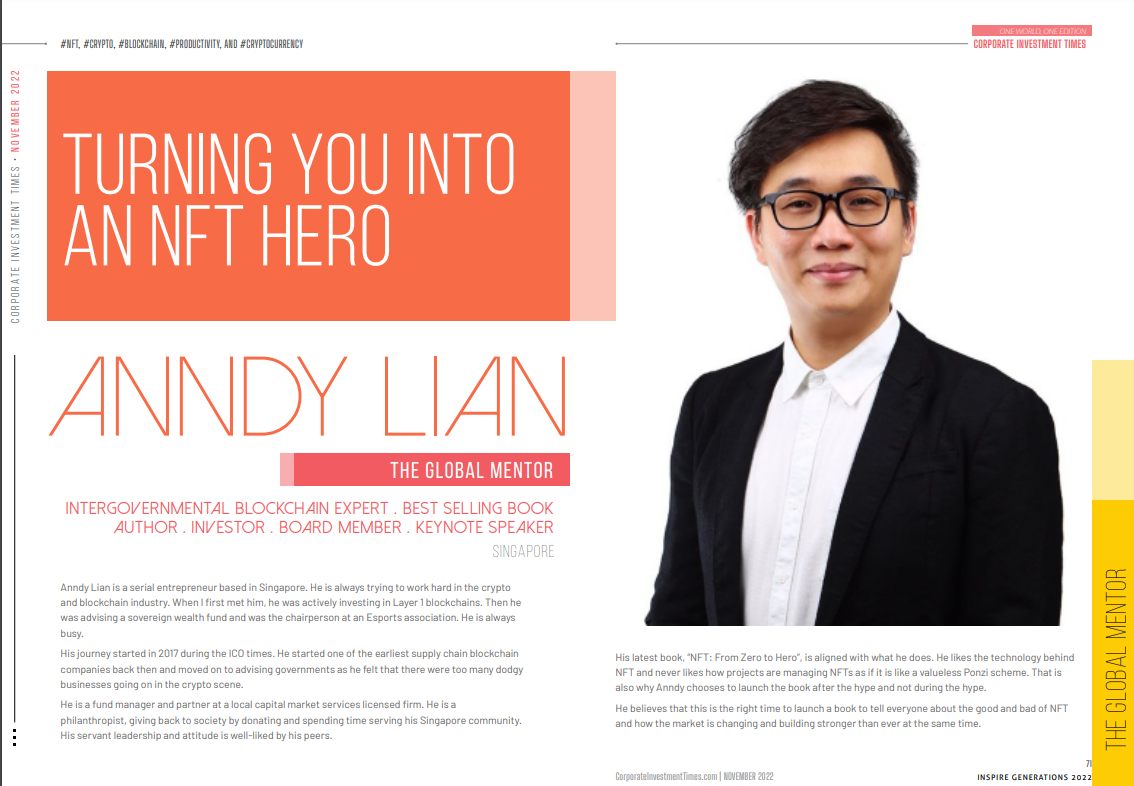
Corporate Investment Times (November 2022): Turning You Into An NFT Hero

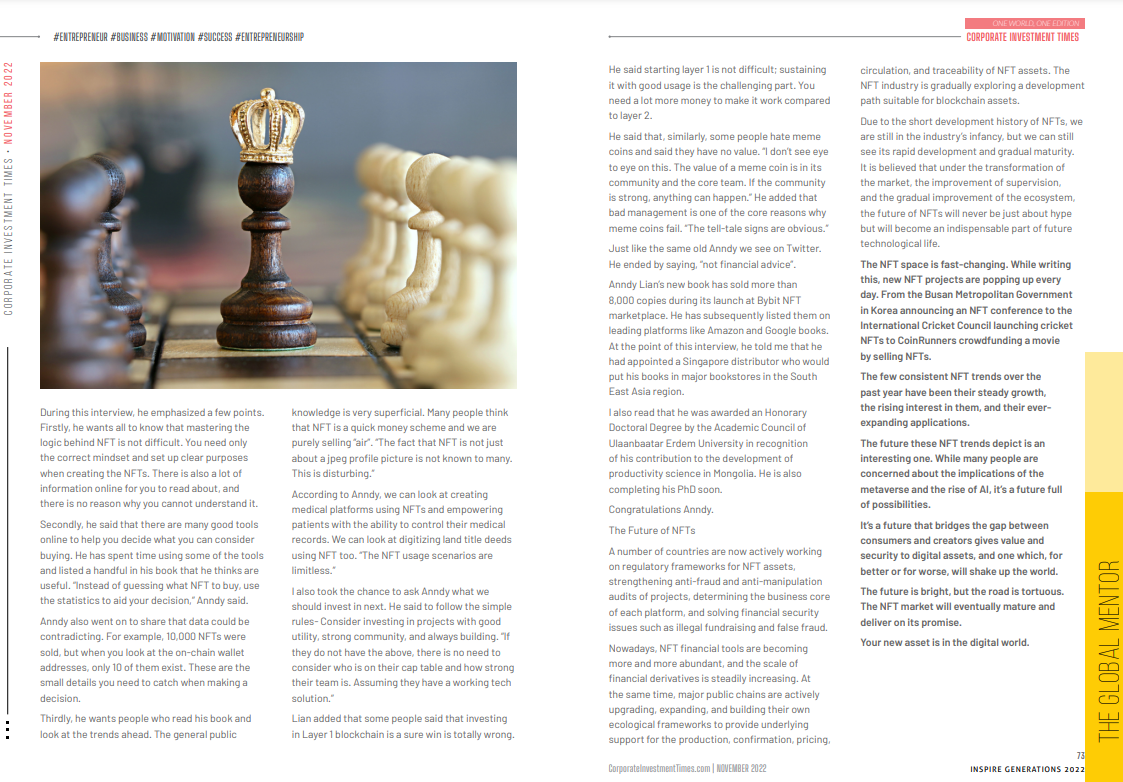
Corporate Investment Times (November 2022): Turning You Into An NFT Hero

Anndy Lian is a serial entrepreneur based in Singapore. He is always trying to work hard in the crypto and blockchain industry. When I first met him, he was actively investing in Layer 1 blockchains. Then he was advising a sovereign wealth fund and was the chairperson at an Esports association. He is always busy.


His journey started in 2017 during the ICO times. He started one of the earliest supply chain blockchain companies back then and moved on to advising governments as he felt that there were too many dodgy businesses going on in the crypto scene.


He is a fund manager and partner at a local capital market services licensed firm. He is a philanthropist, giving back to society by donating and spending time serving his Singapore community. His servant leadership and attitude is well-liked by his peers.


His latest book, “NFT: From Zero to Hero”, is aligned with what he does. He likes the technology behind NFT and never likes how projects are managing NFTs as if it is like a valueless Ponzi scheme. That is also why Anndy chooses to launch the book after the hype and not during the hype. He believes that this is the right time to launch a book to tell everyone about the good and bad of NFT and how the market is changing and building stronger than ever at the same time.


During this interview, he emphasized a few points. Firstly, he wants all to know that mastering the logic behind NFT is not difficult. You need only the correct mindset and set up clear purposes when creating the NFTs. There is also a lot of information online for you to read about, and there is no reason why you cannot understand it.


Secondly, he said that there are many good tools online to help you decide what you can consider buying. He has spent time using some of the tools and listed a handful in his book that he thinks are useful. “Instead of guessing what NFT to buy, use the statistics to aid your decision,” Anndy said.


Anndy also went on to share that data could be contradicting. For example, 10,000 NFTs were sold, but when you look at the on-chain wallet addresses, only 10 of them exist. These are the small details you need to catch when making a decision.


Thirdly, he wants people who read his book and look at the trends ahead. The general public knowledge is very superficial. Many people think that NFT is a quick money scheme and we are purely selling “air”. “The fact that NFT is not just about a jpeg profile picture is not known to many. This is disturbing.”


According to Anndy, we can look at creating medical platforms using NFTs and empowering patients with the ability to control their medical records. We can look at digitizing land title deeds using NFT too. “The NFT usage scenarios are limitless.”


I also took the chance to ask Anndy what we should invest in next. He said to follow the simple rules- Consider investing in projects with good utility, strong community, and always building. “If they do not have the above, there is no need to consider who is on their cap table and how strong their team is. Assuming they have a working tech solution.”


Lian added that some people said that investing in Layer 1 blockchain is a sure win is totally wrong. He said starting layer 1 is not difficult; sustaining it with good usage is the challenging part. You need a lot more money to make it work compared to layer 2.


He said that, similarly, some people hate meme coins and said they have no value. “I don’t see eye to eye on this. The value of a meme coin is in its community and the core team. If the community is strong, anything can happen.” He added that bad management is one of the core reasons why meme coins fail. “The tell-tale signs are obvious.”


Just like the same old Anndy we see on Twitter. He ended by saying, “not financial advice”.


Anndy Lian’s new book has sold more than 8,000 copies during its launch at Bybit NFT marketplace. He has subsequently listed them on leading platforms like Amazon and Google books. At the point of this interview, he told me that he had appointed a Singapore distributor who would put his books in major bookstores in the South East Asia region.


I also read that he was awarded an Honorary Doctoral Degree by the Academic Council of Ulaanbaatar Erdem University in recognition of his contribution to the development of productivity science in Mongolia. He is also completing his PhD soon.


Congratulations Anndy.


Source:

Anndy Lian is an early blockchain adopter and experienced serial entrepreneur who is known for his work in the government sector. He is a best selling book author- “NFT: From Zero to Hero” and “Blockchain Revolution 2030”.

Currently, he is appointed as the Chief Digital Advisor at Mongolia Productivity Organization, championing national digitization. Prior to his current appointments, he was the Chairman of BigONE Exchange, a global top 30 ranked crypto spot exchange and was also the Advisory Board Member for Hyundai DAC, the blockchain arm of South Korea’s largest car manufacturer Hyundai Motor Group. Lian played a pivotal role as the Blockchain Advisor for Asian Productivity Organisation (APO), an intergovernmental organization committed to improving productivity in the Asia-Pacific region.

An avid supporter of incubating start-ups, Anndy has also been a private investor for the past eight years. With a growth investment mindset, Anndy strategically demonstrates this in the companies he chooses to be involved with. He believes that what he is doing through blockchain technology currently will revolutionise and redefine traditional businesses. He also believes that the blockchain industry has to be “redecentralised”.

j j j

#LetsTalkCrypto- The NFT Boom on NewsX [5 November 2021]- Garrett Minks, Anndy Lian, Vishal Malhotra

#LetsTalkCrypto- The NFT Boom on NewsX [5 November 2021]- Garrett Minks, Anndy Lian, Vishal Malhotra

NewsX’s #LetsTalkCrypto Series talked about The NFT Boom. A non-fungible token is a unique and non-interchangeable unit of data stored on a digital ledger. NFTs can be used to represent easily-reproducible items such as photos, videos, audio, and other types of digital files as unique items, and use blockchain technology to establish a verified and public proof of ownership.

The following were the guest for the segment:

Garrett Minks, Founder & CTO, Rair
Anndy Lian, Co-founder, INFLUXO
Vishal Malhotra, Actor

Vishal Malhotra, Actor said: “The utility is a big part of his NFT. It can be basically tokenized into a ticket which allows you to seat with me during the premiere of my next film. But my main intention is to create value for somebody who collects my NFT. I feel NFT is here to stay in a very big way especially in India.”

He is the first Indian actor to collaborate with an artist to do so. The art is a depiction of Vishal’s 25 years in Bollywood and the most popular characters he has portrayed over these years. The NFT was sold for 2.5 ETH.

Anndy Lian, Chairman of BigONE Exchange and Founding member of INFLUXO added: “NFT can be part of a purchase experience. In the past, if you purchase an artwork you can only show your friend at your house. But now with NFT digital artwork, you can show them the exact piece on your own metaverse.”

NewsX is India’s fastest growing English News Channel and enjoys the highest viewership and highest time spent amongst educated urban Indians.

Ever since its acquisition by the ITV Network, the channel has witnessed unprecedented growth.

NewsX is the News Leader and sets the news agenda for the nation, with its crisp formats, straight forward reporting, pointed debates, trending hashtags, and engaging mix of stories.

The live segment can be found on www.newsx.com.

Anndy Lian is an early blockchain adopter and experienced serial entrepreneur who is known for his work in the government sector. He is a best selling book author- “NFT: From Zero to Hero” and “Blockchain Revolution 2030”.

Currently, he is appointed as the Chief Digital Advisor at Mongolia Productivity Organization, championing national digitization. Prior to his current appointments, he was the Chairman of BigONE Exchange, a global top 30 ranked crypto spot exchange and was also the Advisory Board Member for Hyundai DAC, the blockchain arm of South Korea’s largest car manufacturer Hyundai Motor Group. Lian played a pivotal role as the Blockchain Advisor for Asian Productivity Organisation (APO), an intergovernmental organization committed to improving productivity in the Asia-Pacific region.

An avid supporter of incubating start-ups, Anndy has also been a private investor for the past eight years. With a growth investment mindset, Anndy strategically demonstrates this in the companies he chooses to be involved with. He believes that what he is doing through blockchain technology currently will revolutionise and redefine traditional businesses. He also believes that the blockchain industry has to be “redecentralised”.

j j j