Iran war pushes Asia’s Gulf migrants to use stablecoins for remittances

Iran war pushes Asia’s Gulf migrants to use stablecoins for remittances
Asian migrant workers in the Gulf are testing stablecoins as a backup channel for sending money home, as the Iran war heightens fears that the risk of US sanctions could disrupt remittances that millions of families and several Asian economies rely on.

Remittances from these workers account for 3 per cent to 5 per cent of gross domestic product in several emerging markets – in Nepal, it is as high as 10 per cent, according to data from the Global Settlement Network.

Concerns over remittance flows have escalated after the US warned against toll payments to Iran for ship passage through the Strait of Hormuz, which has largely been blocked amid the ongoing conflict between the two countries.

“There has been a quiet but noticeable informal pivot among South Asian migrant workers, including a significant number from India, towards digital tokens such as stablecoins in the period following the Iran conflict,” said Anndy Lian, a Singapore-based adviser to governments on blockchain and information technology.

“Rather than routing everything through traditional dollar-linked banking channels, a slice of remittances is now moving via instruments like USDT,” he said, referring to the Tether stablecoin backed by the US dollar.

A stablecoin is a type of cryptocurrency designed to maintain a stable value by pegging it to a reserve asset, which could be a fiat currency or other assets, such as gold.

Stablecoins currently account for about 3 to 4 per cent of overall remittances of Gulf-based workers, according to Lian, suggesting that these workers still mostly prefer to transfer money through banks and licensed operators.

Millions of people from India, Sri Lanka, Pakistan, Bangladesh and other countries have worked in the oil-rich Middle East for years. However, their job uncertainties have increased in recent months as the Iran war entangled other Gulf states.

Lian said a key attraction of the widely used USDT was that it commanded a higher value by about 4 to 5 per cent in markets such as India, compared with the official exchange rate for the US dollar, allowing recipients to get more value.

The prospect of sanctions related to the Iran war has raised fears about disruptions to the dollar-based monetary transfers through traditional modes, although there is no sign that Washington is planning to block legitimate remittances, according to Lian.

Several Gulf countries, such as the UAE, Bahrain and Saudi Arabia, have introduced regulations in recent years to allow stablecoins in their financial systems.

Workers in the Middle East are increasingly turning to stablecoins for remittances, given that such transfers are faster than traditional banking systems, according to Lian.

“The shift is real, but incremental, and is concentrated among the more tech-comfortable, urban-linked segment of the diaspora rather than the broader labour corridors,” he said.

Raj Kapoor, president of the India Blockchain Alliance, said global banks had tightened their Gulf operations due to the Iran war, which had affected their treasury and other functions that underpinned remittance flows.

Stablecoins, particularly the USDT and USDC, have filled the gap for financial settlements in the region, according to Kapoor.

“The Iran war has functioned less as a cause and more as a powerful accelerant of a shift that was already structurally under way,” he added.

Ryan Kirkley, co-founder and co-CEO of Global Settlement Network, said the Iran war had caused disruption not only to energy supplies and dollar liquidity but also remittances.

Countries across South Asia and Southeast Asia are reliant on these monetary transfers, with India alone having received US$125 billion in remittances last year and Gulf nations contributing to a third of the figure, according to Kirkley.

Given their significance, compliance standards for stablecoins and tokenised payments should be enhanced and for migrant workers to have this option to send their money home amid the Iran war, Kirkley said.

“If a Gulf bank pulls back on dollar clearing or a UAE exchange house tightens onboarding because of secondary-sanctions exposure, the first thing to feel it is not the oil tanker, it is the construction worker in [the city of] Sharjah trying to send 2,000 UAE dirhams [US$545] home,” he said.


 

Source: https://www.scmp.com/week-asia/economics/article/3353456/iran-war-pushes-asias-gulf-migrants-use-stablecoins-remittances

Anndy Lian is an early blockchain adopter and experienced serial entrepreneur who is known for his work in the government sector. He is a best selling book author- “NFT: From Zero to Hero” and “Blockchain Revolution 2030”.

Currently, he is appointed as the Chief Digital Advisor at Mongolia Productivity Organization, championing national digitization. Prior to his current appointments, he was the Chairman of BigONE Exchange, a global top 30 ranked crypto spot exchange and was also the Advisory Board Member for Hyundai DAC, the blockchain arm of South Korea’s largest car manufacturer Hyundai Motor Group. Lian played a pivotal role as the Blockchain Advisor for Asian Productivity Organisation (APO), an intergovernmental organization committed to improving productivity in the Asia-Pacific region.

An avid supporter of incubating start-ups, Anndy has also been a private investor for the past eight years. With a growth investment mindset, Anndy strategically demonstrates this in the companies he chooses to be involved with. He believes that what he is doing through blockchain technology currently will revolutionise and redefine traditional businesses. He also believes that the blockchain industry has to be “redecentralised”.

j j j

DeCC Day Token 2049 Singapore – Use Cases With Commercial Application

DeCC Day Token 2049 Singapore – Use Cases With Commercial Application

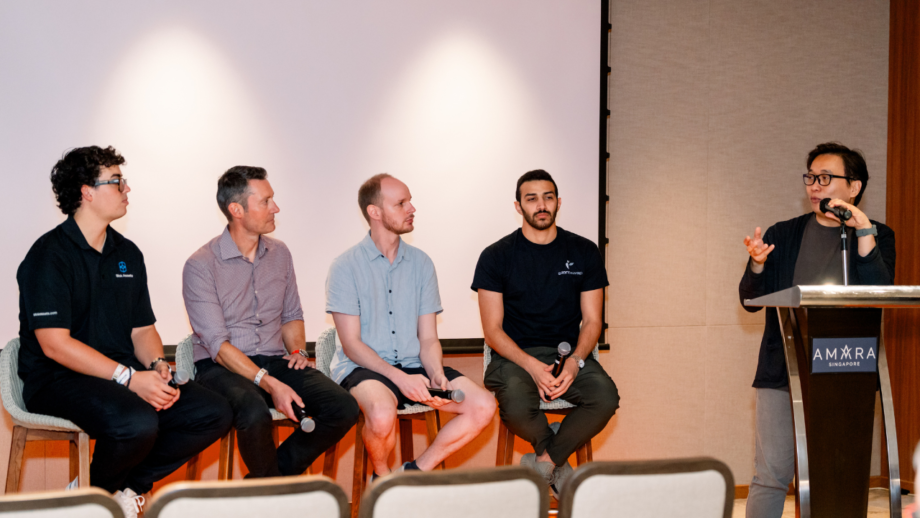
During the Token 2049 week in Singapore, the DeCC event hosted a panel discussion titled “Use Cases with Commercial Applications.” Moderated by Anndy Lian, a book author and governmental blockchain advisor, the panel featured prominent figures in the blockchain industry: Gavin Thomas, Co-Founder of TEN Protocol; Josh Wyant, Founder of Novapolis; Cal, Lead Developer at SquidGrow and SilentSwap; and Juan Mari, CEO of Blok Assets. The discussion delved into the practical applications of blockchain technology, focusing on privacy, regulatory challenges, and the potential for blockchain to revolutionize various industries.

The panel began with introductions, setting the stage for a deep dive into the commercial applications of blockchain. Juan Mari introduced Blok Assets, a firm based in Puerto Rico that builds legal structures within the SEC and FCA frameworks to tokenize assets. Gavin Thomas highlighted TEN Protocol’s work on an encrypted layer 2 for Ethereum, while Josh Wyant described Novapolis as a decentralized cloud platform with a community-centric approach. Cal, representing SilentSwap, explained their focus on privacy swaps powered by the Secret Network, enabling asset exchanges across multiple EVM chains.

The discussion quickly turned to privacy, a critical aspect of blockchain technology. The panelists shared various case studies illustrating the importance of privacy in commercial applications. Gavin Thomas cited the Italian banking system’s use of an enterprise-grade blockchain, which incorporates privacy into its design. He emphasized the potential benefits of moving to public blockchains with confidential computing, which could reduce vendor lock-in and foster competition, ultimately benefiting consumers.

Cal shared insights from SilentSwap’s journey, initially targeting consumer users but later attracting business clients who also required privacy. He highlighted the need for privacy in business transactions, where competitors should not have access to each other’s financial details. This need for privacy extends to various scenarios, such as venture capitalists being copy-traded or competitive traders being front-run by rivals. SilentSwap is now developing a business-to-business SDK to address these privacy concerns.

Juan Mari pointed out the lack of protocols for transfer agents in the tokenization of real-world assets. He stressed the need for a transfer agent with robust data privacy layers, especially when dealing with regulatory bodies like the SEC and FCA. The absence of such a solution presents a significant opportunity for innovation in the blockchain space.

The conversation then shifted to the role of confidential computing in governance and regulatory compliance. The panelists discussed how confidential computing could enable secure voting and other governance applications while maintaining privacy. They acknowledged the challenges governments face in balancing privacy with regulatory requirements, such as anti-money laundering (AML) and know-your-customer (KYC) processes. The panelists emphasized the importance of educating regulators about the benefits of blockchain technology and the potential for confidential computing to enhance security and privacy.

Anndy Lian raised the issue of privacy in the context of meme projects, questioning its importance in such communities. The panelists agreed that privacy remains crucial, even in meme projects, as it allows developers and traders to maintain anonymity and protect their identities. They shared anecdotes of individuals who have faced challenges due to a lack of privacy, underscoring the need for solutions that enable users to control their data and identities.

The panel also addressed the challenges of promoting and educating users about blockchain technology. They noted that many blockchain projects struggle to communicate their value propositions effectively, often using complex terminology that alienates potential users. The panelists suggested simplifying the user experience and abstracting away the complexity of blockchain to drive adoption. They emphasized the need for a “killer app” that showcases the benefits of blockchain without requiring users to understand the underlying technology.

In discussing the future of blockchain, the panelists expressed optimism about its potential to transform industries such as trade finance. They highlighted the inefficiencies in traditional trade finance processes, which involve extensive paperwork and reliance on third parties. Blockchain technology, with its ability to facilitate secure and transparent transactions, could streamline these processes and reduce friction. The panelists envisioned a future where blockchain underpins global trade finance, enabling more efficient and secure transactions.

The panel concluded with a discussion on emerging use cases for decentralized applications (dApps) that offer significant value for commercial adoption. They identified trade finance, real-world asset tokenization, and privacy-preserving advertising as areas ripe for innovation. The panelists also highlighted the potential for confidential computing to extend beyond web 3.0, enabling web 2.0 applications to incorporate privacy-preserving features.

Overall, the panel discussion at DeCC provided valuable insights into the commercial applications of blockchain technology. The panelists highlighted the importance of privacy, the challenges of regulatory compliance, and the potential for blockchain to revolutionize industries. As blockchain technology continues to evolve, it holds the promise of transforming how businesses operate, offering new opportunities for innovation and growth.

Anndy Lian is an early blockchain adopter and experienced serial entrepreneur who is known for his work in the government sector. He is a best selling book author- “NFT: From Zero to Hero” and “Blockchain Revolution 2030”.

Currently, he is appointed as the Chief Digital Advisor at Mongolia Productivity Organization, championing national digitization. Prior to his current appointments, he was the Chairman of BigONE Exchange, a global top 30 ranked crypto spot exchange and was also the Advisory Board Member for Hyundai DAC, the blockchain arm of South Korea’s largest car manufacturer Hyundai Motor Group. Lian played a pivotal role as the Blockchain Advisor for Asian Productivity Organisation (APO), an intergovernmental organization committed to improving productivity in the Asia-Pacific region.

An avid supporter of incubating start-ups, Anndy has also been a private investor for the past eight years. With a growth investment mindset, Anndy strategically demonstrates this in the companies he chooses to be involved with. He believes that what he is doing through blockchain technology currently will revolutionise and redefine traditional businesses. He also believes that the blockchain industry has to be “redecentralised”.

j j j

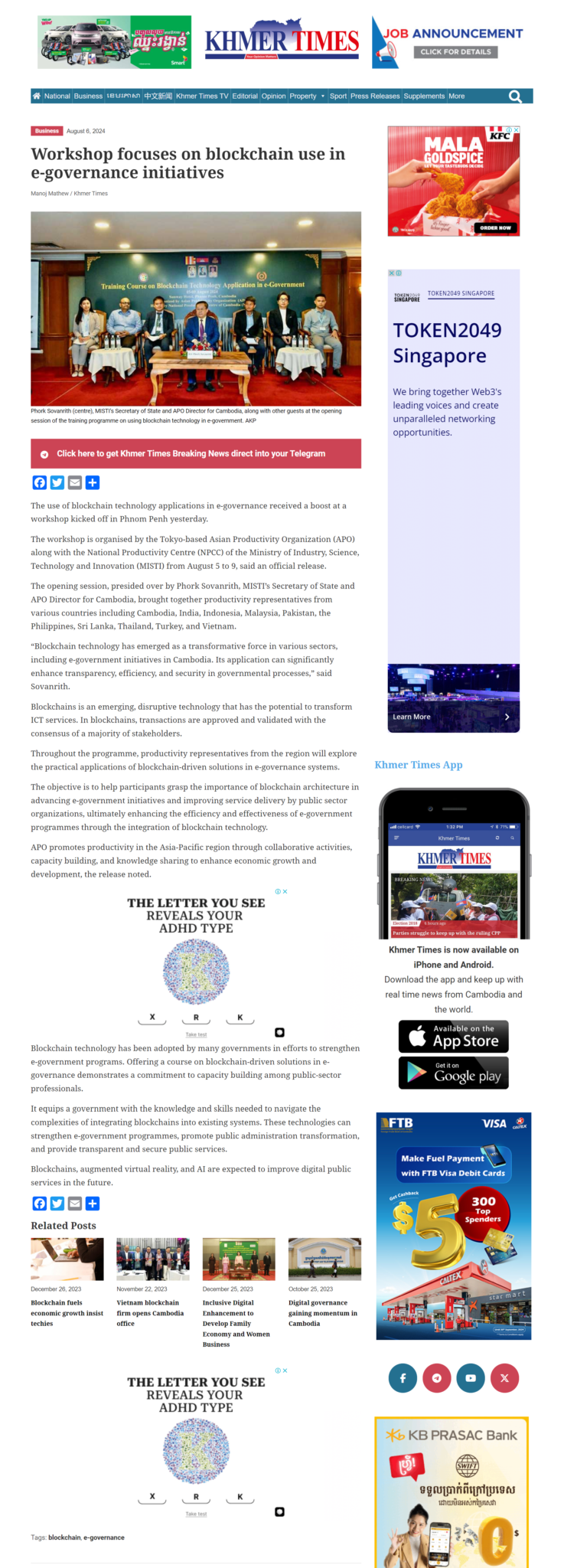
Workshop focuses on blockchain use in e-governance initiatives

Workshop focuses on blockchain use in e-governance initiatives

The use of blockchain technology applications in e-governance received a boost at a workshop kicked off in Phnom Penh yesterday.

The workshop is organised by the Tokyo-based Asian Productivity Organization (APO) along with the National Productivity Centre (NPCC) of the Ministry of Industry, Science, Technology and Innovation (MISTI) from August 5 to 9, said an official release.

The opening session, presided over by Phork Sovanrith, MISTI’s Secretary of State and APO Director for Cambodia, brought together productivity representatives from various countries including Cambodia, India, Indonesia, Malaysia, Pakistan, the Philippines, Sri Lanka, Thailand, Turkey, and Vietnam.

“Blockchain technology has emerged as a transformative force in various sectors, including e-government initiatives in Cambodia. Its application can significantly enhance transparency, efficiency, and security in governmental processes,” said Sovanrith.

Blockchains is an emerging, disruptive technology that has the potential to transform ICT services. In blockchains, transactions are approved and validated with the consensus of a majority of stakeholders.

Throughout the programme, productivity representatives from the region will explore the practical applications of blockchain-driven solutions in e-governance systems.

The objective is to help participants grasp the importance of blockchain architecture in advancing e-government initiatives and improving service delivery by public sector organizations, ultimately enhancing the efficiency and effectiveness of e-government programmes through the integration of blockchain technology.

APO promotes productivity in the Asia-Pacific region through collaborative activities, capacity building, and knowledge sharing to enhance economic growth and development, the release noted.

Blockchain technology has been adopted by many governments in efforts to strengthen e-government programs. Offering a course on blockchain-driven solutions in e-governance demonstrates a commitment to capacity building among public-sector professionals.

It equips a government with the knowledge and skills needed to navigate the complexities of integrating blockchains into existing systems. These technologies can strengthen e-government programmes, promote public administration transformation, and provide transparent and secure public services.

Blockchains, augmented virtual reality, and AI are expected to improve digital public services in the future.


Source: https://www.khmertimeskh.com/501535762/workshop-focuses-on-blockchain-use-in-e-governance-initiatives/

Anndy Lian is an early blockchain adopter and experienced serial entrepreneur who is known for his work in the government sector. He is a best selling book author- “NFT: From Zero to Hero” and “Blockchain Revolution 2030”.

Currently, he is appointed as the Chief Digital Advisor at Mongolia Productivity Organization, championing national digitization. Prior to his current appointments, he was the Chairman of BigONE Exchange, a global top 30 ranked crypto spot exchange and was also the Advisory Board Member for Hyundai DAC, the blockchain arm of South Korea’s largest car manufacturer Hyundai Motor Group. Lian played a pivotal role as the Blockchain Advisor for Asian Productivity Organisation (APO), an intergovernmental organization committed to improving productivity in the Asia-Pacific region.

An avid supporter of incubating start-ups, Anndy has also been a private investor for the past eight years. With a growth investment mindset, Anndy strategically demonstrates this in the companies he chooses to be involved with. He believes that what he is doing through blockchain technology currently will revolutionise and redefine traditional businesses. He also believes that the blockchain industry has to be “redecentralised”.

j j j