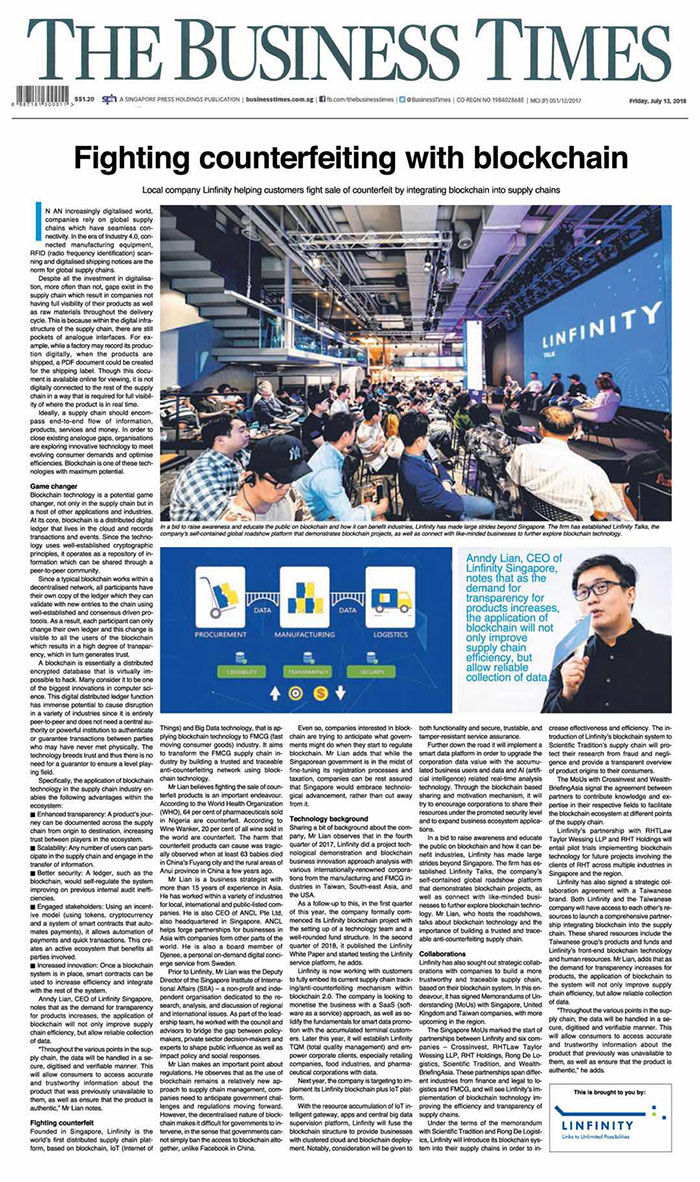
The block chain is about to bring about an unprecedented industrial revolution. All this is attributed to the distributed and decentralized storage mode and strong storage capacity of the block chain for the network. With this advantage, it can provide enterprises or organizations with better quality services, such as improving efficiency, making information transparent, and strengthening network security. According to a study by Juniper Research, more than two-thirds of enterprises expressed their willingness to introduce block chain technology, which is also an unprecedented new user connection method.
Linfinity, born in Singapore, is a pioneer in integrating block chain technology with the cross-border supply chain industry, aiming at establishing a reliable and traceable anti-counterfeiting supply chain solution through block chain technology. It not only reduces the cost of supply chain management, but also increases the safety of commodity circulation. Through different applications in different industries, Linfinity saw the huge potential implied by the block chain in various industries, such as food industry, fast moving consumer goods industry, and even financial market.
Recently, in an exclusive interview with Singapore’s 938Now radio – block chain series, Anndy Lian, CEO of Linfinity, expressed a series of insightful views on Linfinity’s focus on applying block chain technology to the supply chain industry.

What role does Linfinity play in the logistics industry?
In the logistics industry, Linfinity focuses on the entire supply chain system. At present, Linfinity is working hard to build an ecosystem that organically combines block chains with traditional logistics. In this system, we can easily check the specific conditions such as raw material supply, logistics, distribution, etc. Not only that, Linfinity also touched on other aspects. Recently, Linfinity Talk in South Korea also talked about the important role Linfinity plays in supply chain material recovery. In addition, we are also interested in integrating block chains with different industries or organizations, such as banks and financial institutions.
What role does Linfinity play? Is the supply chain managed by the participating companies themselves, or is it managed by Linfinity?
At present, Linfinity mainly has the following two modes in the commercial application cooperation of the block chain:
1. Linfinity assists them in onchain management until they can run independently or builds ecology together with them;
2. If the other party has its own block chain, the information on these chains will become very private, and Linfinity will graft the information on these chains to Linfinity’s own block chain for use by the other party.
Is Linfinity a provider of block chain technology solutions? Are there any other partners?
Yes, Linfinity is a pioneer in providing block chain technology solutions. as far as I know, we may be the first in the industry now, but I believe there will be more partners in this industry to promote the vigorous development of this industry. This is the “way” of the block chain industry.
How to improve the transparency of end customer information through block chain technology and Linfinity ecology?
If you look at a specific industry, such as cosmetics industry, from product production to store terminals, all links in the entire supply chain are quite complicated and complicated, so it is very difficult to change the entire industry chain. We have found a common pain point in the cosmetics industry – “fake goods are rampant”, especially for some famous brands, the resulting social impact is fatal.
This is a very serious problem. If all the product data are centrally stored according to the traditional supply chain system, this structure is very vulnerable to hacker attacks, such as adjusting the production date, etc. The use of decentralized block chain technology makes it necessary for each data node to authenticate each other so as to ensure the genuine attributes of the product identity.
Linfinity focuses on these pain points and proposes a series of solutions to the cosmetic industry. First, reduce the anti-counterfeiting cost; second, use the block chain to enhance the brand image.
Based on block chain technology, product information becomes more transparent, thus achieving the purpose of tracking and anti-counterfeiting. This will be a “trust ecology” built by merchants and consumers. It has better brand consensus and better user experience.
Does the appearance of Linfinity mean the disappearance of fake goods?
Yes, as the number of blocks in the chain continues to increase, the mutual authentication of various links will also increase accordingly, which makes counterfeiting more difficult. The traditional physical anti-counterfeiting method is to confirm authenticity by scanning two-dimensional codes, RFID tags or bar codes. Unfortunately, these codes are easily copied and forged by counterfeiters. As for Linfinity, relying on the distributed characteristics of the block chain, we can create our own unique certification mark — Linfinity Mark. It can let people know that once you scan this special two-dimensional code, you can track and verify all the information about the product.
What is the progress of Linfinity’s current business practice?
A month ago, Linfinity signed six memorandums of understanding with some large companies in Singapore, one of which is a very traditional logistics company. If they take advantage of the advantages of block chain technology, they will develop better. For example, improve management efficiency and discover potential food safety problems.
In addition, in Taiwan, Linfinity has signed a strategic cooperation agreement with Alishan Group, which will provide block chain anti-counterfeiting technology for its cigarette brands. At the same time, Linfinity has also talked with some Chinese food suppliers. They all face serious problems of lost goods and stale fruits. If they use block chain technology to make information going onchain, then these problems will be solved — goods can be tracked and fruit information will be clear at a glance.
Why are there some people who are skeptical about the block chain? How do you think people should view the new technology of block chain?
The misunderstanding of the block chain mainly comes from people’s ignorance of it. The block chain is like a “catalyst” that can ” empower” traditional enterprises which thus embark on the digital track. I do not think that the emergence of block chain technology will cause more people to lose their original jobs.
In fact, many block chain projects are aimed at commercialization or proving the concept itself. When we are gradually realizing commercialization, we still need to do a lot of preparatory work. For example, the traditional large-scale enterprises may have resistance to this because they already have a mature data management system, which makes the cost of their transformation huge. For ordinary enterprises, it is relatively easier to accept new technologies. they believe that the block chain is helpful to the long-term development of their own enterprises.
Block chain is a technological revolution. Its appearance will not only change the traditional technology and application scene, but also may change the management mode of enterprises. Lower cost, better brand, broader market — this is the biggest bonus that block chain technology brings to enterprises.
What are the advantages of combining block chain technology with traditional supply chain and logistics business?
Decentralized or distributed organization is the biggest feature of block chain, which is not available in traditional organization. For example, for a famous brand shampoo, because some batches of products failed to meet the quality inspection standards, they was recycled by unscrupulous middlemen, and was transported and exported to overseas for sale. Without the introduction of block chain technology, consumers would not be able to check whether the quality of the shampoo they bought was qualified. Whether the information of products is transparent or not in all circulation links is the biggest difference between the block chain and the traditional technology.
Does the enterprise need to continuously update its own system in order to integrate with the block chain technology?
No, the block chain technology is just like a layer of network. It only needs to be attached to the original system. Its function is only to collect and feedback data and information for enterprises, so as to achieve mutual authentication and tracking of information on various blocks.
Does the supply chain ecology based on block chain include a payment system?
It is possible. Linfinity is already in contact with banks and other like-minded partners, such as the issue of financing loans. The financial lending market must consider the safety and traceability. The essential attribute of the block chain can help the financial industry to solve this problem so that the lending and financing business can be carried out safely and efficiently.

Anndy Lian is an early blockchain adopter and experienced serial entrepreneur who is known for his work in the government sector. He is a best selling book author- “NFT: From Zero to Hero” and “Blockchain Revolution 2030”.
Currently, he is appointed as the Chief Digital Advisor at Mongolia Productivity Organization, championing national digitization. Prior to his current appointments, he was the Chairman of BigONE Exchange, a global top 30 ranked crypto spot exchange and was also the Advisory Board Member for Hyundai DAC, the blockchain arm of South Korea’s largest car manufacturer Hyundai Motor Group. Lian played a pivotal role as the Blockchain Advisor for Asian Productivity Organisation (APO), an intergovernmental organization committed to improving productivity in the Asia-Pacific region.
An avid supporter of incubating start-ups, Anndy has also been a private investor for the past eight years. With a growth investment mindset, Anndy strategically demonstrates this in the companies he chooses to be involved with. He believes that what he is doing through blockchain technology currently will revolutionise and redefine traditional businesses. He also believes that the blockchain industry has to be “redecentralised”.