Bitcoin drops to US$80K while these 4 tokens surge over 100% in 7 days

Bitcoin drops to US$80K while these 4 tokens surge over 100% in 7 days

Today marked an end to what had been a record-breaking week for US equities. Major indices pulled back as escalating tensions in the Middle East rattled investor confidence, abruptly reversing the bullish sentiment that had recently pushed stocks to all-time highs. The S&P 500 closed at 7,337.11, down 0.38 per cent, while the Nasdaq Composite slipped 0.13 per cent to 25,806.20. The Dow Jones Industrial Average faced the steepest decline among the major benchmarks, falling 0.63 per cent to close at 49,596.97. This coordinated pullback reflects more than routine profit-taking after Thursday’s volatile session, where indices hit fresh peaks before reversing lower.

The catalyst for this shift came from disturbing reports of explosions near a southern Iranian port city and subsequent American naval responses to attacks in the Strait of Hormuz. This geopolitical shock sent immediate ripples through commodity markets, with Brent crude settling above US$100 per barrel and West Texas Intermediate rising to approximately US$95.90 as concerns over energy supply routes intensified. Investors fled to traditional safe havens, pushing gold above US$4,700 per ounce. The yen experienced persistent volatility as well, rallying roughly 1.8 per cent against the dollar following suspected intervention by Japanese authorities, while US 10-year Treasury yields rose by four basis points on Thursday as the dollar strengthened.

The cryptocurrency market mirrored this broader risk-off sentiment, though with its own distinct characteristics. Bitcoin fell 1.74 per cent to US$80,015.27 over 24 hours, tracking a broader market pullback, as the total crypto market cap declined 1.36 per cent. This high correlation suggests the move stemmed from broad market factors rather than any Bitcoin-specific event. Trading volume fell 11.55 per cent, confirming subdued participation across digital assets. Bitcoin saw US$96.64M in liquidations over 24 hours, though this marked a 39.8 per cent decrease from the prior period, indicating that while leveraged positions unwound, the move did not reflect extreme speculative excess.

A fascinating divergence emerged within the crypto ecosystem beneath this surface weakness. Several tokens in the top 30 posted impressive gains over the past week while Bitcoin and the broader market cooled. Ton surged 105 per cent in seven days, demonstrating extraordinary momentum. Zcash climbed 63 per cent over the same period, while Bittensor advanced 21 per cent. Hyperliquid added seven per cent in the last seven days. This selective strength suggests capital rotation rather than wholesale abandonment of digital assets. Bitcoin’s dominance dipped slightly to 60.33 per cent as the Altcoin Season Index rose 2.38 per cent, signalling ongoing movement toward riskier assets even as the overall market consolidated.

The near-term outlook for Bitcoin hinges on whether it can defend the US$78,000 support level. A successful defence could lead to consolidation between US$78,000 and US$82,000, with potential to retest higher levels. A decisive break below US$78,000 risks triggering further selling toward US$75,000. The critical trigger to watch involves US spot Bitcoin ETF flows, which have shown steady growth recently. A sustained reversal in these institutional inflows could provide the sentiment shift needed to stabilise prices or, conversely, accelerate downward momentum.

Corporate earnings provided isolated bright spots amid the geopolitical gloom. Fortinet surged 20 per cent on raised guidance, and Peloton rose nine per cent after beating revenue expectations. Chipmakers like Arm Holdings suffered as the smartphone industry slowed, highlighting sector-specific vulnerabilities that compound broader macro concerns. Regional markets felt the contagion quickly, with the ASX 200 set for a sharp decline of over 1.7 per cent at the open, following the late-session reversal in US equities. European indices faced similar pressure early Friday, though corporate earnings from firms like Tenaris and Endesa provided isolated support earlier in the week.

Regulatory clarity remains a critical variable for cryptocurrency markets. The CLARITY Act represents a pivotal moment for the industry, with the White House aiming to sign it on July 4. Key negotiators, such as Senator Kirsten Gillibrand, suggest a presidential signature may not come until August 2026 due to ongoing debates over ethics and consumer-protection provisions. This timeline matters enormously for institutional participation and market structure. I hope the closer we get to passage, the more confidence returns to digital asset markets, potentially providing a counterweight to macro headwinds.

For now, remain hopeful.


Source: https://e27.co/bitcoin-drops-to-us80k-while-these-4-tokens-surge-over-100-in-7-days-20260508/

Anndy Lian is an early blockchain adopter and experienced serial entrepreneur who is known for his work in the government sector. He is a best selling book author- “NFT: From Zero to Hero” and “Blockchain Revolution 2030”.

Currently, he is appointed as the Chief Digital Advisor at Mongolia Productivity Organization, championing national digitization. Prior to his current appointments, he was the Chairman of BigONE Exchange, a global top 30 ranked crypto spot exchange and was also the Advisory Board Member for Hyundai DAC, the blockchain arm of South Korea’s largest car manufacturer Hyundai Motor Group. Lian played a pivotal role as the Blockchain Advisor for Asian Productivity Organisation (APO), an intergovernmental organization committed to improving productivity in the Asia-Pacific region.

An avid supporter of incubating start-ups, Anndy has also been a private investor for the past eight years. With a growth investment mindset, Anndy strategically demonstrates this in the companies he chooses to be involved with. He believes that what he is doing through blockchain technology currently will revolutionise and redefine traditional businesses. He also believes that the blockchain industry has to be “redecentralised”.


j j j

LayerZero Team Accused North Korea of Hacking KelpDAO

LayerZero Team Accused North Korea of Hacking KelpDAO

Behind the attack on the liquid restaking protocol KelpDAO, which saw attackers siphon off roughly $290 million-$292 million, is likely the North Korean hacking group Lazarus Group — specifically its TraderTraitor subunit, which is often linked to state-backed cyberattacks — according to a statement from LayerZero.

The incident, which occurred on April 18, 2026, has already triggered a chain reaction across the DeFi sector: mass withdrawals from Aave, a drop in the market’s total value locked, and renewed concerns about the security of crosschain infrastructure.

How the Hack Happened and Why Responsibility Is Partly Placed on KelpDAO

According to LayerZero, the attackers carried out a sophisticated attack on the RPC infrastructure used by the DVN node to validate transactions.

The hackers:

  • Compromised two RPC nodes
  • Replaced the binary files that ran the op-geth nodes
  • Carried out RPC request spoofing attacks
  • Simultaneously launched a DDoS attack on unaffected nodes
  • Forced the system to switch to “poisoned” backup RPCs

As a result, the DVN confirmed transactions that never actually happened.

LayerZero emphasized that the compromise did not spread to other assets.

At the same time, the crypto community sharply criticized KelpDAO for choosing a weak architecture without redundant verification. One user, under the handle hendricks, noted that the risk of the 1/1 DVN model had been raised as far back as 15 months ago on the Aave governance forum:

“This wasn’t bad luck — this was a conscious choice. Extremely suspicious.”

Criticism was also directed at LayerZero itself. User Bradly (CryptPlayer) noted:

“It looks like you shift all responsibility to KelpDAO, but actually you share it.”

A similar view was voiced by StarkWare CISO Haim Krasniker, who pointed out a contradiction in the failover mechanism:

“Once that DDoS happened, it should not default to Internal RPCs that are solely controlled by LZ.”

Domino Effect: Aave, Decline in TVL, and Pressure on ETH Liquidity

The most serious secondary hit landed on Aave. After the hack, the rsETH asset was urgently frozen on Aave V3 and V4. This was announced by protocol founder Stani Kulechov.

According to market estimates, the incident has already caused Aave’s TVL to drop to approximately $18 billion due to fears of bad debt.

Analyst Anndy Lian noted that the direct debt of $177 million accounts for just 0.65% of Aave’s total value locked (TVL), estimated at around $27.3 billion, but the biggest pressure is being felt by liquidity providers on Ethereum.

In his words:

“It is currently facing its most severe existential test since inception.”

Recall that the KelpDAO hack was only part of a broader cybersecurity crisis in the crypto industry. According to CertiK, in March 2026 alone, 46 attacks were recorded, the highest figure since November 2024.

In addition, the market has already endured:

  • The hack of Drift for about $280 million
  • An incident involving Stabble due to the possible involvement of a developer linked to North Korea
  • The hack of Hyperbridge, which triggered Polkadot (DOT) to drop to $1.15 after the illicit minting of 1 billion DOT


Source: https://incrypted.com/en/layerzero-team-accused-north-korea-of-hacking-kelpdao/


Anndy Lian is an early blockchain adopter and experienced serial entrepreneur who is known for his work in the government sector. He is a best selling book author- “NFT: From Zero to Hero” and “Blockchain Revolution 2030”.

Currently, he is appointed as the Chief Digital Advisor at Mongolia Productivity Organization, championing national digitization. Prior to his current appointments, he was the Chairman of BigONE Exchange, a global top 30 ranked crypto spot exchange and was also the Advisory Board Member for Hyundai DAC, the blockchain arm of South Korea’s largest car manufacturer Hyundai Motor Group. Lian played a pivotal role as the Blockchain Advisor for Asian Productivity Organisation (APO), an intergovernmental organization committed to improving productivity in the Asia-Pacific region.

An avid supporter of incubating start-ups, Anndy has also been a private investor for the past eight years. With a growth investment mindset, Anndy strategically demonstrates this in the companies he chooses to be involved with. He believes that what he is doing through blockchain technology currently will revolutionise and redefine traditional businesses. He also believes that the blockchain industry has to be “redecentralised”.

j j j

Binance and Bitget Announce to Investigate RaveDAO Token Trading

Binance and Bitget Announce to Investigate RaveDAO Token Trading

Binance and Bitget have both announced that they are going to investigate trading activity involving the RaveDAO token after concerns were raised about possible market manipulations.

In response to ZachXBT’s post, Bitget CEO Gracy Chen also confirmed the same direction, stating, “thanks for highlighting! We’ve started investigating into $RAVE.”

Shortly after, Binance co-CEO Richard Teng also responded directly to the issue, saying, “Thanks for flagging this with us @zachxbt. We’re looking into it. We will always do our part to investigate all market misconduct.”

How it all started

The issue became public when ZachXBT shared on X that “pump and dump activity for RAVE token originated on Bitget, Binance and Gate,” adding that insiders were controlling more than 90% of the supply.

He called on Binance co-founder He Yi and Bitget CEO Gracy Chen to carry out internal checks and remove those responsible from their platforms. He also placed a $10,000 bounty for whistleblowers who could provide proof of manipulation. Bitget later confirmed that an investigation into $RAVE had started.

ZachXBT shared early warning signals from on-chain data

ZachXBT explained that wallets linked to the RaveDAO project sent about 18.58 million RAVE tokens to Bitget before any price movement began. At that time, the token was trading under $0.50 and there was no public announcement about the transfer.

Roughly ten hours later, trading activity picked up sharply. At the same time, reports showed that about 74% of traders on Binance were holding short positions, meaning they were betting the price would fall.

Later, around 29.78 million tokens were pulled out from Bitget, which reduced the amount of tokens available for selling on the market. This shift in liquidity is said to have helped fuel a fast price surge, as short positions were squeezed out of the market.

The price moved from about $0.27 to over $14 within seven days, marking a rise of more than 5,500%. In a separate chart shared by ZachXBT, RAVE also showed a 10,383% increase over a 30-day period, highlighting the extreme volatility in trading activity.

ZachXBT said he had already contacted a RaveDAO co-founder before going public but received no response. In his words, “We cannot allow this blatant market manipulation by insiders controlling more than 90% RAVE support to further extract from retail investors.” He later pushed exchanges again to act quickly and investigate all linked accounts involved in the activity.

Insider control Allegations grow stronger

Blockchain analyst Anndy Lian also pointed to heavy token concentration. He stated that the top 10 wallets hold around 98.16% of total supply.

At the same time, the token structure also raised concerns. The fully diluted valuation was said to be around four times higher than the current market cap, a pattern often followed by large corrections in crypto markets. No public codebase or completed security audit has been released for the project, which added more questions around transparency.

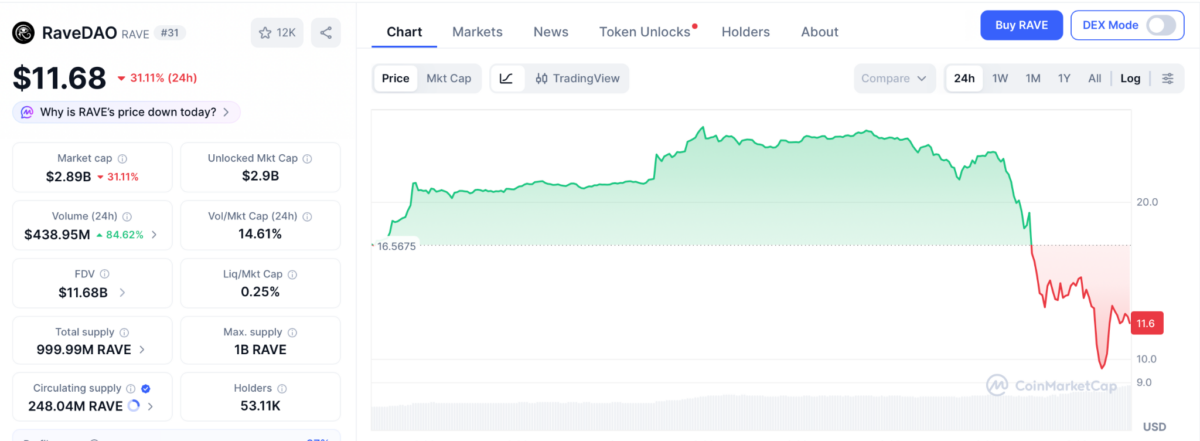
RAVE is down 30% in 24 hours

Despite the concerns, RAVE continued to trade actively. At one point, its market capitalization reportedly surged to over $6.52 billion. The price also rose by about 44% on Saturday, reaching around $27.23 during early trading hours. However, it is now down by 30% to about $11.

RaveDAO price chart | Source: CoinMarketCap

ZachXBT maintained that coordinated actions from insiders may have driven the price movement through controlled supply and liquidity shifts.


Source: https://www.cryptotimes.io/2026/04/18/binance-and-bitget-announce-to-investigate-ravedao-token-trading/

Anndy Lian is an early blockchain adopter and experienced serial entrepreneur who is known for his work in the government sector. He is a best selling book author- “NFT: From Zero to Hero” and “Blockchain Revolution 2030”.

Currently, he is appointed as the Chief Digital Advisor at Mongolia Productivity Organization, championing national digitization. Prior to his current appointments, he was the Chairman of BigONE Exchange, a global top 30 ranked crypto spot exchange and was also the Advisory Board Member for Hyundai DAC, the blockchain arm of South Korea’s largest car manufacturer Hyundai Motor Group. Lian played a pivotal role as the Blockchain Advisor for Asian Productivity Organisation (APO), an intergovernmental organization committed to improving productivity in the Asia-Pacific region.

An avid supporter of incubating start-ups, Anndy has also been a private investor for the past eight years. With a growth investment mindset, Anndy strategically demonstrates this in the companies he chooses to be involved with. He believes that what he is doing through blockchain technology currently will revolutionise and redefine traditional businesses. He also believes that the blockchain industry has to be “redecentralised”.
j j j