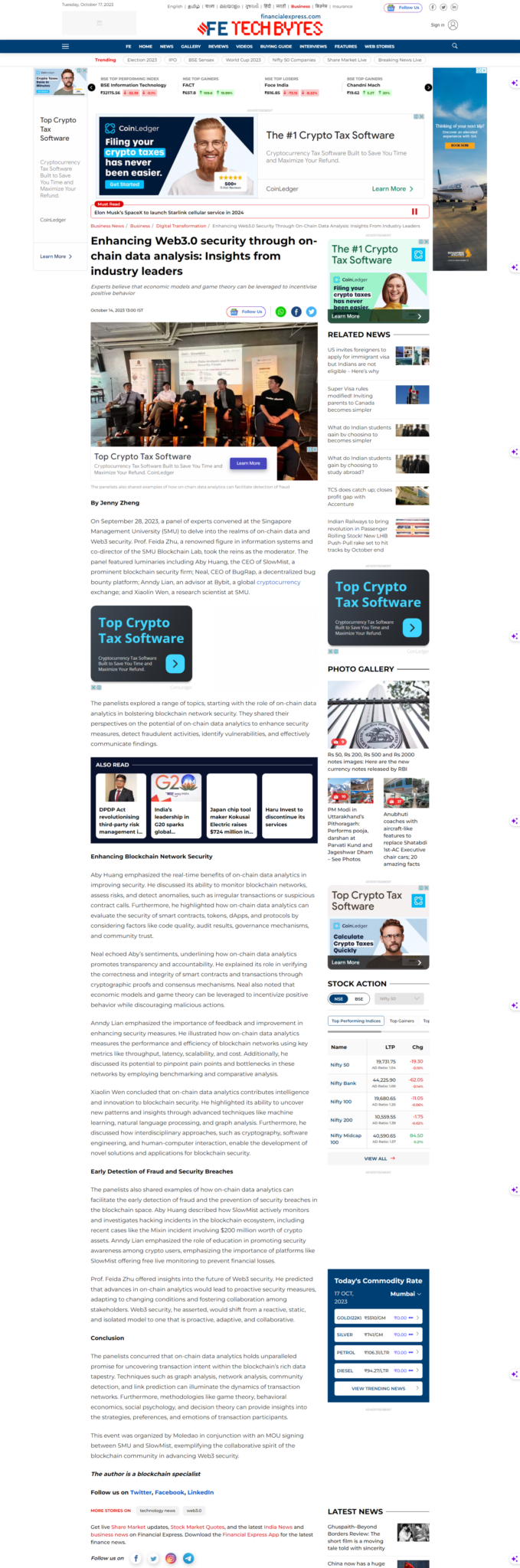
Enhancing Web3.0 security through on-chain data analysis: Insights from industry leaders

Enhancing Web3.0 security through on-chain data analysis: Insights from industry leaders

On September 28, 2023, a panel of experts convened at the Singapore Management University (SMU) to delve into the realms of on-chain data and Web3 security. Prof. Feida Zhu, a renowned figure in information systems and co-director of the SMU Blockchain Lab, took the reins as the moderator. The panel featured luminaries including Aby Huang, the CEO of SlowMist, a prominent blockchain security firm; Neal, CEO of BugRap, a decentralized bug bounty platform; Anndy Lian, an advisor at Bybit, a global cryptocurrency exchange; and Xiaolin Wen, a research scientist at SMU.

The panelists explored a range of topics, starting with the role of on-chain data analytics in bolstering blockchain network security. They shared their perspectives on the potential of on-chain data analytics to enhance security measures, detect fraudulent activities, identify vulnerabilities, and effectively communicate findings.

Enhancing Blockchain Network Security

Aby Huang emphasized the real-time benefits of on-chain data analytics in improving security. He discussed its ability to monitor blockchain networks, assess risks, and detect anomalies, such as irregular transactions or suspicious contract calls. Furthermore, he highlighted how on-chain data analytics can evaluate the security of smart contracts, tokens, dApps, and protocols by considering factors like code quality, audit results, governance mechanisms, and community trust.

Neal echoed Aby’s sentiments, underlining how on-chain data analytics promotes transparency and accountability. He explained its role in verifying the correctness and integrity of smart contracts and transactions through cryptographic proofs and consensus mechanisms. Neal also noted that economic models and game theory can be leveraged to incentivize positive behavior while discouraging malicious actions.

Anndy Lian emphasized the importance of feedback and improvement in enhancing security measures. He illustrated how on-chain data analytics measures the performance and efficiency of blockchain networks using key metrics like throughput, latency, scalability, and cost. Additionally, he discussed its potential to pinpoint pain points and bottlenecks in these networks by employing benchmarking and comparative analysis.

Xiaolin Wen concluded that on-chain data analytics contributes intelligence and innovation to blockchain security. He highlighted its ability to uncover new patterns and insights through advanced techniques like machine learning, natural language processing, and graph analysis. Furthermore, he discussed how interdisciplinary approaches, such as cryptography, software engineering, and human-computer interaction, enable the development of novel solutions and applications for blockchain security.

Early Detection of Fraud and Security Breaches

The panelists also shared examples of how on-chain data analytics can facilitate the early detection of fraud and the prevention of security breaches in the blockchain space. Aby Huang described how SlowMist actively monitors and investigates hacking incidents in the blockchain ecosystem, including recent cases like the Mixin incident involving $200 million worth of crypto assets. Anndy Lian emphasized the role of education in promoting security awareness among crypto users, emphasizing the importance of platforms like SlowMist offering free live monitoring to prevent financial losses.

Prof. Feida Zhu offered insights into the future of Web3 security. He predicted that advances in on-chain analytics would lead to proactive security measures, adapting to changing conditions and fostering collaboration among stakeholders. Web3 security, he asserted, would shift from a reactive, static, and isolated model to one that is proactive, adaptive, and collaborative.

Conclusion

The panelists concurred that on-chain data analytics holds unparalleled promise for uncovering transaction intent within the blockchain’s rich data tapestry. Techniques such as graph analysis, network analysis, community detection, and link prediction can illuminate the dynamics of transaction networks. Furthermore, methodologies like game theory, behavioral economics, social psychology, and decision theory can provide insights into the strategies, preferences, and emotions of transaction participants.

This event was organized by Moledao in conjunction with an MOU signing between SMU and SlowMist, exemplifying the collaborative spirit of the blockchain community in advancing Web3 security.


Source: https://www.financialexpress.com/business/digital-transformation-enhancing-web3-0-security-through-on-chain-data-analysis-insights-from-industry-leaders-3272181/

Anndy Lian is an early blockchain adopter and experienced serial entrepreneur who is known for his work in the government sector. He is a best selling book author- “NFT: From Zero to Hero” and “Blockchain Revolution 2030”.

Currently, he is appointed as the Chief Digital Advisor at Mongolia Productivity Organization, championing national digitization. Prior to his current appointments, he was the Chairman of BigONE Exchange, a global top 30 ranked crypto spot exchange and was also the Advisory Board Member for Hyundai DAC, the blockchain arm of South Korea’s largest car manufacturer Hyundai Motor Group. Lian played a pivotal role as the Blockchain Advisor for Asian Productivity Organisation (APO), an intergovernmental organization committed to improving productivity in the Asia-Pacific region.

An avid supporter of incubating start-ups, Anndy has also been a private investor for the past eight years. With a growth investment mindset, Anndy strategically demonstrates this in the companies he chooses to be involved with. He believes that what he is doing through blockchain technology currently will revolutionise and redefine traditional businesses. He also believes that the blockchain industry has to be “redecentralised”.

j j j

On-chain data and Web3 security: Insights from industry experts

On-chain data and Web3 security: Insights from industry experts

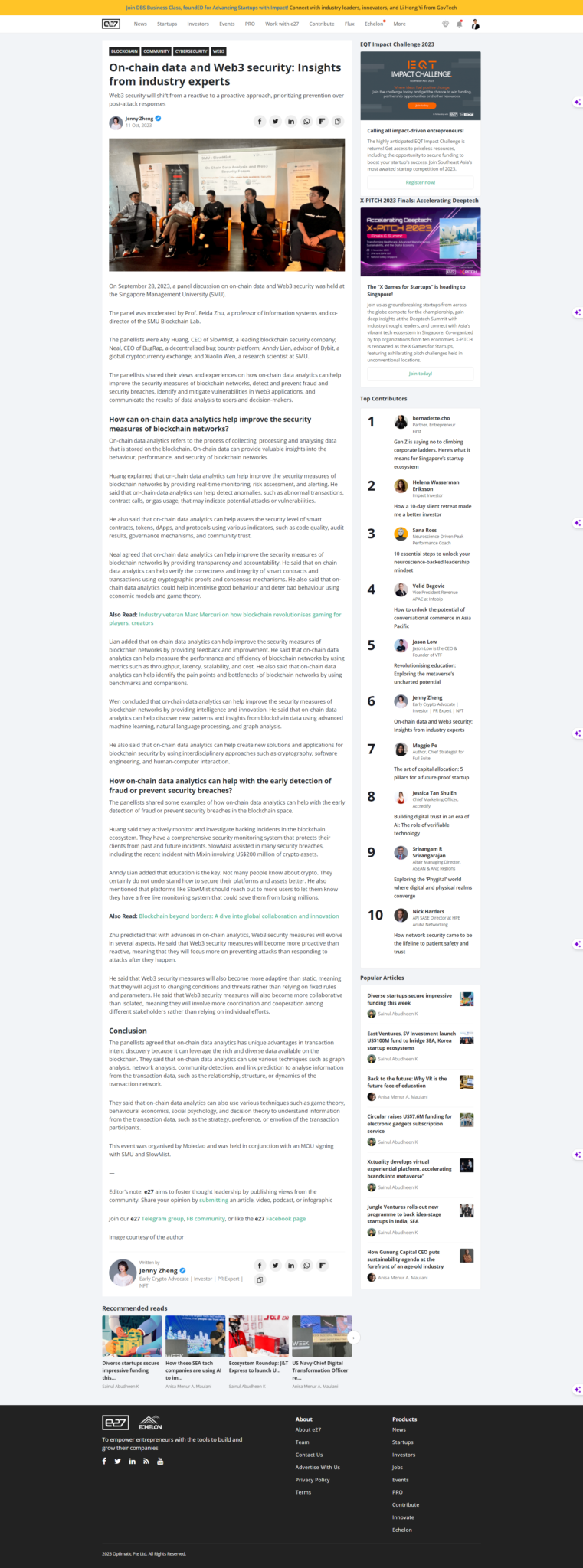
On September 28, 2023, a panel discussion on on-chain data and Web3 security was held at the Singapore Management University (SMU).

The panel was moderated by Prof. Feida Zhu, a professor of information systems and co-director of the SMU Blockchain Lab.

The panellists were Aby Huang, CEO of SlowMist, a leading blockchain security company; Neal, CEO of BugRap, a decentralised bug bounty platform; Anndy Lian, advisor of Bybit, a global cryptocurrency exchange; and Xiaolin Wen, a research scientist at SMU.

The panellists shared their views and experiences on how on-chain data analytics can help improve the security measures of blockchain networks, detect and prevent fraud and security breaches, identify and mitigate vulnerabilities in Web3 applications, and communicate the results of data analysis to users and decision-makers.

How can on-chain data analytics help improve the security measures of blockchain networks?

On-chain data analytics refers to the process of collecting, processing and analysing data that is stored on the blockchain. On-chain data can provide valuable insights into the behaviour, performance, and security of blockchain networks.

Huang explained that on-chain data analytics can help improve the security measures of blockchain networks by providing real-time monitoring, risk assessment, and alerting. He said that on-chain data analytics can help detect anomalies, such as abnormal transactions, contract calls, or gas usage, that may indicate potential attacks or vulnerabilities.

He also said that on-chain data analytics can help assess the security level of smart contracts, tokens, dApps, and protocols using various indicators, such as code quality, audit results, governance mechanisms, and community trust.

Neal agreed that on-chain data analytics can help improve the security measures of blockchain networks by providing transparency and accountability. He said that on-chain data analytics can help verify the correctness and integrity of smart contracts and transactions using cryptographic proofs and consensus mechanisms. He also said that on-chain data analytics could help incentivise good behaviour and deter bad behaviour using economic models and game theory.

Lian added that on-chain data analytics can help improve the security measures of blockchain networks by providing feedback and improvement. He said that on-chain data analytics can help measure the performance and efficiency of blockchain networks by using metrics such as throughput, latency, scalability, and cost. He also said that on-chain data analytics can help identify the pain points and bottlenecks of blockchain networks by using benchmarks and comparisons.

Wen concluded that on-chain data analytics can help improve the security measures of blockchain networks by providing intelligence and innovation. He said that on-chain data analytics can help discover new patterns and insights from blockchain data using advanced machine learning, natural language processing, and graph analysis.

He also said that on-chain data analytics can help create new solutions and applications for blockchain security by using interdisciplinary approaches such as cryptography, software engineering, and human-computer interaction.

How on-chain data analytics can help with the early detection of fraud or prevent security breaches?

The panellists shared some examples of how on-chain data analytics can help with the early detection of fraud or prevent security breaches in the blockchain space.

Huang said they actively monitor and investigate hacking incidents in the blockchain ecosystem. They have a comprehensive security monitoring system that protects their clients from past and future incidents. SlowMist assisted in many security breaches, including the recent incident with Mixin involving US$200 million of crypto assets.

Anndy Lian added that education is the key. Not many people know about crypto. They certainly do not understand how to secure their platforms and assets better. He also mentioned that platforms like SlowMist should reach out to more users to let them know they have a free live monitoring system that could save them from losing millions.

Zhu predicted that with advances in on-chain analytics, Web3 security measures will evolve in several aspects. He said that Web3 security measures will become more proactive than reactive, meaning that they will focus more on preventing attacks than responding to attacks after they happen.

He said that Web3 security measures will also become more adaptive than static, meaning that they will adjust to changing conditions and threats rather than relying on fixed rules and parameters. He said that Web3 security measures will also become more collaborative than isolated, meaning they will involve more coordination and cooperation among different stakeholders rather than relying on individual efforts.

Conclusion

The panellists agreed that on-chain data analytics has unique advantages in transaction intent discovery because it can leverage the rich and diverse data available on the blockchain. They said that on-chain data analytics can use various techniques such as graph analysis, network analysis, community detection, and link prediction to analyse information from the transaction data, such as the relationship, structure, or dynamics of the transaction network.

They said that on-chain data analytics can also use various techniques such as game theory, behavioural economics, social psychology, and decision theory to understand information from the transaction data, such as the strategy, preference, or emotion of the transaction participants.

This event was organised by Moledao and was held in conjunction with an MOU signing with SMU and SlowMist.


Source: https://e27.co/on-chain-data-and-web3-security-insights-from-industry-experts-20231006/

Anndy Lian is an early blockchain adopter and experienced serial entrepreneur who is known for his work in the government sector. He is a best selling book author- “NFT: From Zero to Hero” and “Blockchain Revolution 2030”.

Currently, he is appointed as the Chief Digital Advisor at Mongolia Productivity Organization, championing national digitization. Prior to his current appointments, he was the Chairman of BigONE Exchange, a global top 30 ranked crypto spot exchange and was also the Advisory Board Member for Hyundai DAC, the blockchain arm of South Korea’s largest car manufacturer Hyundai Motor Group. Lian played a pivotal role as the Blockchain Advisor for Asian Productivity Organisation (APO), an intergovernmental organization committed to improving productivity in the Asia-Pacific region.

An avid supporter of incubating start-ups, Anndy has also been a private investor for the past eight years. With a growth investment mindset, Anndy strategically demonstrates this in the companies he chooses to be involved with. He believes that what he is doing through blockchain technology currently will revolutionise and redefine traditional businesses. He also believes that the blockchain industry has to be “redecentralised”.
j j j

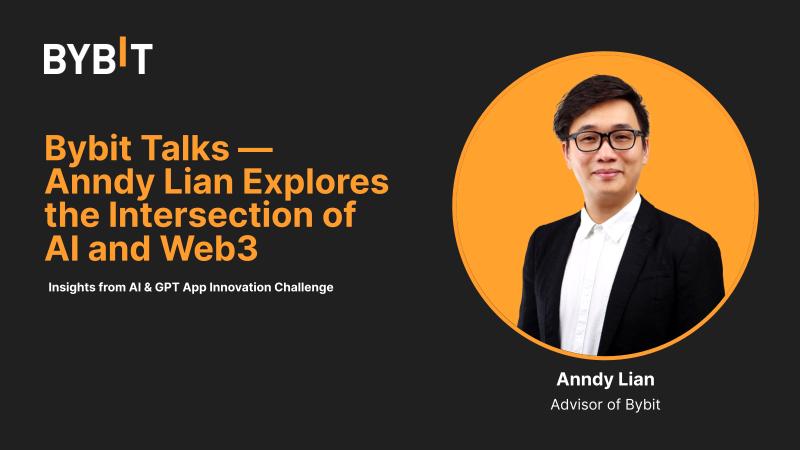
Bybit Talks- Anndy Lian Explores the Intersection of AI and Web3

Bybit Talks- Anndy Lian Explores the Intersection of AI and Web3

Understanding Web3: A Decentralized Vision Web3, often referred to as the “next generation of the internet,” embodies a vision of decentralization and user control. At its core lies blockchain technology, the backbone of secure and transparent data storage and transfer. Web3 aims to liberate users from the clutches of centralized control, offering newfound autonomy over personal data, privacy, and financial transactions. Anndy Lian’s extensive experience across diverse sectors uniquely positions him to advocate for and guide the integration of Web3’s disruptive potential.

AI Unleashed: Beyond Human Capabilities

The concept of AI, an ability for machines to replicate human-like functions such as reasoning, learning, planning, and creativity, is rapidly advancing. Anndy Lian’s multifaceted expertise places him at the intersection of AI’s immense potential and its transformative power across industries. As AI continues to evolve, it carries the promise of revolutionizing sectors, pushing boundaries, and enabling solutions previously thought impossible.

AI Empowering Web3: A Synergistic Future

An intriguing symbiosis emerges as AI complements and enhances Web3’s functionality. By automating tasks traditionally performed by humans, such as wallet management, cryptocurrency trading, and NFT creation, AI streamlines processes and unlocks time for more innovative endeavors. Additionally, AI’s prowess in fraud detection and prevention strengthens Web3’s security infrastructure, ensuring a safer digital landscape. As AI personalizes user experiences, each interaction becomes uniquely tailored, offering content, products, and services aligned with individual interests.

Blockchain’s Safeguard for AI: Ethical Governance

Blockchain-based AI governance introduces a novel approach to ensuring the ethical, transparent, and accountable use of AI systems. Anndy Lian’s intricate grasp of this intersection underscores its significance. Blockchain’s distributed ledger technology records, verifies, and audits AI actions, fostering trust among stakeholders. The integration of blockchain and AI addresses the challenge of explainable AI, enhancing data integrity and bolstering recommendations. The resultant audit trail and heightened data security are poised to redefine our perception of AI’s potential.

Individual Benefits of AI and Blockchain Fusion

The fusion of AI and blockchain extends benefits to individuals on multiple fronts. AI’s adeptness in identifying patterns enables fraud detection, with blockchain’s integration adding a layer of verification, reducing fraud’s potential impact. Additionally, AI’s vigilant monitoring aligns with blockchain’s role in copyright protection, guaranteeing the immutable record of intellectual property ownership and usage rights. The synergy culminates in smart contracts, where blockchain’s decentralized nature augments by AI’s efficiency, streamlining processes across finance, legal agreements, and supply chain management.

Looking forward, Anndy Lian’s insight extends to the emergence of Web4, a decentralized internet controlled by users, eradicating centralized control. AI, in this context, strengthens relationships through its analytical prowess, unraveling user behavior, preferences, and interactions. By optimizing communication, connections, and overall relationship experiences, AI evolves from a tool to an essential component of human interaction.

Final Thoughts: Where Blockchain and AI Converge

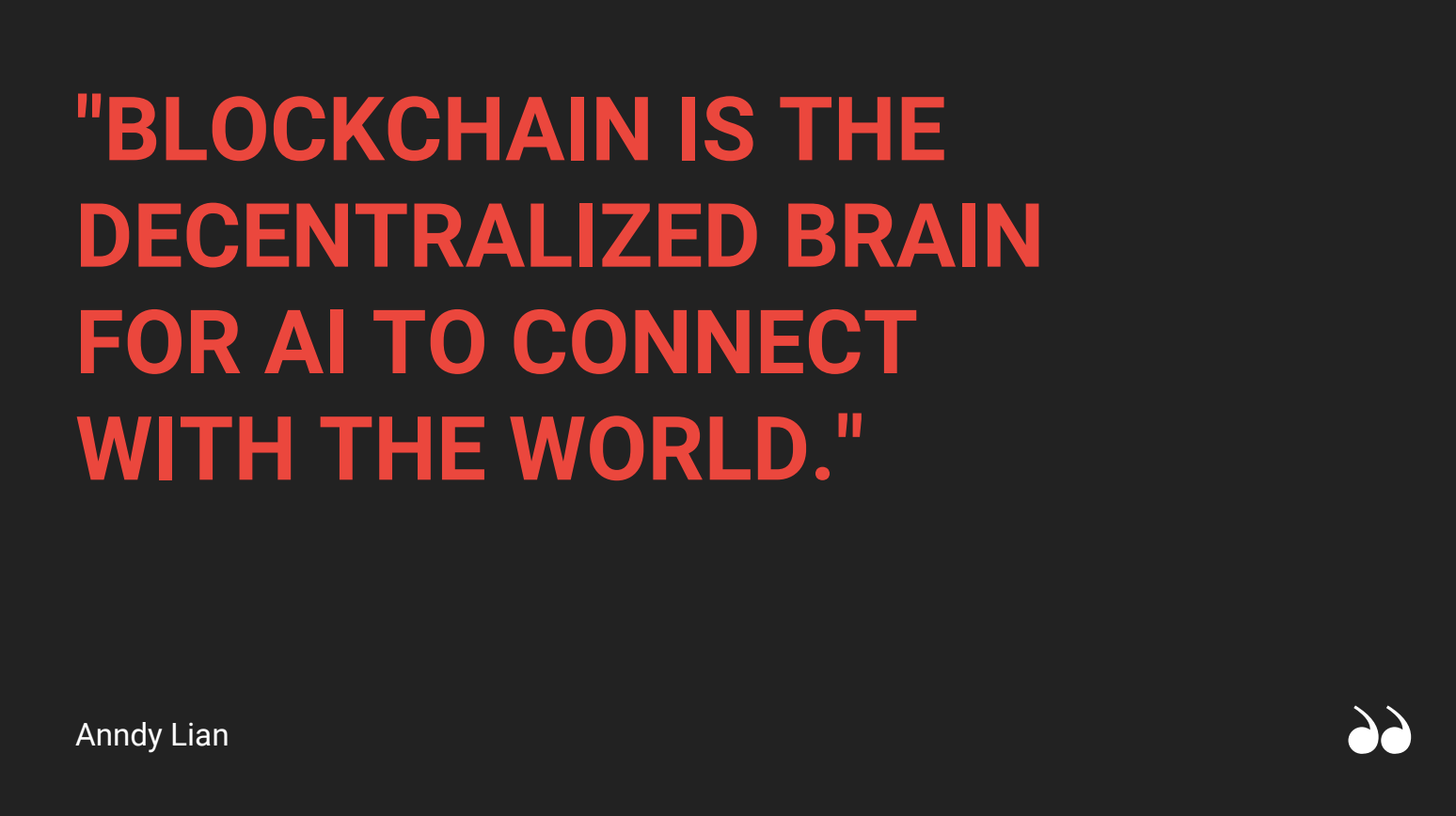
In the midst of this transformative epoch, Anndy Lian’s guiding philosophy resonates powerfully: “Don’t trust human, trust the math.” As AI empowers Web3 and blockchain safeguards its ethical use, a future emerges where technology’s potential is realized, controlled by decentralized networks and informed by data-driven decisions. In this evolving narrative, AI and Web3 unite, forming a decentralized brain for AI to connect with the world, ensuring a future marked by innovation, synergy, and boundless possibilities. End with the quote, “Blockchain is the decentralized brain for AI to connect with the world.”

Check out the full speech from Anndy on AI & GPT App Innovation Challenge!

Also, check out Bybit’s first community-driven research on the intersection of AI and crypto.


Source: https://blog.bybit.com/en-US/post/bybit-talks—ai-web3-crafting-a-future-of-synergy-and-innovation-blta2cd448426e57977/


Anndy Lian is an early blockchain adopter and experienced serial entrepreneur who is known for his work in the government sector. He is a best selling book author- “NFT: From Zero to Hero” and “Blockchain Revolution 2030”.

Currently, he is appointed as the Chief Digital Advisor at Mongolia Productivity Organization, championing national digitization. Prior to his current appointments, he was the Chairman of BigONE Exchange, a global top 30 ranked crypto spot exchange and was also the Advisory Board Member for Hyundai DAC, the blockchain arm of South Korea’s largest car manufacturer Hyundai Motor Group. Lian played a pivotal role as the Blockchain Advisor for Asian Productivity Organisation (APO), an intergovernmental organization committed to improving productivity in the Asia-Pacific region.

An avid supporter of incubating start-ups, Anndy has also been a private investor for the past eight years. With a growth investment mindset, Anndy strategically demonstrates this in the companies he chooses to be involved with. He believes that what he is doing through blockchain technology currently will revolutionise and redefine traditional businesses. He also believes that the blockchain industry has to be “redecentralised”.

j j j