Anndy Lian Commented on “Banking Giants Laundering Billions Might Turn Against Bitcoin Too” at CryptoNews

Anndy Lian Commented on “Banking Giants Laundering Billions Might Turn Against Bitcoin Too” at CryptoNews

Banking Giants Laundering Billions Might Turn Against Bitcoin Too

Documents uncovered by an investigation conducted by 110 news organizations appear to show global banking giants moving trillions of dollars for clients allegedly involved in fraud, embezzlement, money laundering, and more, as the banks defend themselves against the allegations. Meanwhile, the crypto community appears to be divided as to whether it spells good news for crypto in general, and bitcoin (BTC) in particular. (Updated at 17:45 UTC: updates in bold.)

The evidence was uncovered by the International Consortium of Investigative Journalists (ICIJ) in a new report. The consortium said that it, together with BuzzFeed News and 108 other media organization, conducted a 16-month, cross-border investigation, and revealed the leaked documents, now known as the FinCenFiles.

The consortium wrote that “secret United States government documents reveal” that global banks “have defied money laundering crackdowns by moving staggering sums of illicit cash for shadowy characters and criminal networks.” The five named banks are JPMorganHSBCStandard Chartered BankDeutsche Bank and Bank of New York Mellon.

Furthermore, the leaked documents allegedly “show banks blindly moving cash through their accounts for people they can’t identify, failing to report transactions with all the hallmarks of money laundering until years after the fact, even doing business with clients enmeshed in financial frauds and public corruption scandals.”

These files, the authors said, include more than 2,100 suspicious activity reports (SARs) filed by banks and other financial firms with the United States Department of Treasury’s Financial Crimes Enforcement Network, also known as FinCEN.

ICIJ said:

“[The] documents identify more than [USD] 2 trillion in transactions between 1999 and 2017 that were flagged by financial institutions’ internal compliance officers as possible money laundering or other criminal activity — including [USD] 514 billion at JPMorgan and [USD] 1.3 trillion at Deutsche Bank. […] The FinCEN Files represent less than 0.02% of the more than 12 million suspicious activity reports that financial institutions filed with FinCEN between 2011 and 2017.”

ICIJ added that United States agencies responsible for enforcing money-laundering laws rarely prosecute megabanks that break the law, “and the actions authorities do take barely ripple the flood of plundered money that washes through the international financial system.”

Per the authors, the data shows that Deutsche Bank is leading by some distance, with JPMorgan in second place.

“Mobsters pushed billions through Deutsche Bank in one of the biggest dirty money scams ever,” tweeted BuzzFeed News, adding that “small businesses were crushed” in the process.

The news outlet further claimed that the bank’s executives “had direct knowledge for years of serious failings that left the bank vulnerable to money launderers.” After a USD 10 billion mirror trading scandal was exposed, “Deutsche Bank blamed it on a few middle-level staffers in its Moscow office, paid a fine, and got back to business,” reported BuzzFeed News.

Crypto as a systemic threat

News of the traditional banking system’s alleged wrongdoings came as little surprise to the crypto community.

And the irony of the situation was not lost on many commentators: While regulators ramp up the pressure on the crypto industry, particularly in the field of anti-money laundering (AML) measures, the banking sector appears to be running roughshod over the very same AML rules.

Commenting on a report on HSBC’s drop to a 25-year low today in the stock market, the CEO of crypto exchange Binance, Changpeng Zhao, tweeted that it “might be a good time for their treasury to buy bitcoin?”

However, Anndy Lian, investor and blockchain adviser, didn’t agree that this was a good idea, writing: “On the contrary, I hope HSBC to stay away from bitcoin. Early stages mess the soup.”

Others, like the Chief Legal Officer of crypto exchange Kraken, Marco Santori, also claimed that this will not help Bitcoin’s cause at all.

“If you think this is good for bitcoin, man you are going to be so disappointed,” he said. “I wonder if this will compel FinCEN to publish more information about the efficacy of its enforcement activity. It would serve to quell many complaints to the tune of “Why do we send all this info to FinCEN – what good has it done?”

Others, like GetLevvel CEO Chris Hart, also chimed in saying that there is a risk that “the answer to a perception of poor enforcement is more enforcement, and ‘more’ isn’t limited to fiat-based transactions.”

Bitcoin educator, author, and entrepreneur Andreas Antonopoulos also stressed that this leak will be used against cryptocurrencies. According to him, the correct analysis of this news is that AML/CTF (counter terrorism financing) and KYC (know your customer) don’t work and the report will be used to increase the use of controls and surveillance.


“That makes crypto-currency a systemic threat, not to the economic nature of national money, but to the control and surveillance system of geopolitical money. Math money doesn’t play politics, which makes it automatically “rogue” money,” he said, estimating that “the war on cash and the war on “illicit” money becomes an all out war on the only money that still works.”

According to him, “the solution is to stop trying to use money (a tool) to fight crime (human nature).”

“But if you think the hypocrites will back down and adopt sensible systems and laws that enable human trade and economic inclusion, you are wrong,” Antonopoulos said.


Banks respond

“BNY Mellon takes its role in protecting the integrity of the global financial system seriously, including filing Suspicious Activity Reports (SARs),” told Cryptonews.com Associate Director for Corporate Communications Sorrel Beynon, adding that they “fully comply with all applicable laws and regulations, and assist authorities in the important work they do.” The bank cannot by law, they claim, “comment on any alleged SAR we may have filed or that may have been illegally disclosed by third parties to the media.”

Deutsche Bank’s Head of UK Media Relations, Charlie Olivier, told Cryptonews.com that the fight against financial crime, money laundering and capital flight has been a priority for both investigating authorities and financial institutions, the latter of which, Deutsche Bank included, have invested “billions of dollars” to more support authorities in this effort. “Naturally, this leads to increased detection levels.”

Olivier stated that “the ICIJ has reported on a number of historic issues,” claiming that “those relating to Deutsche Bank are well known to our regulators.”

“The issues have already been investigated and led to regulatory resolutions in which the bank’s cooperation and remediation was publicly recognized. Where necessary and appropriate, consequence management was applied. To the extent that information referenced by the ICIJ is derived from SARs, it should be noted that this is information that is pro-actively identified and submitted by banks to governments pursuant to the law. SARs are alerts of potential issues, not proven facts,” he said.

Per the statement provided by Standard Chartered Group Media Relations Director, Josephine Wong, to Cryptonews.com, SARs are filed by the banks “when circumstances warrant and that means our screening and monitoring systems are working as intended.” A SAR filing does not mean there has been criminal activity, but that the bank has identified “something suspicious or irregular in a transaction that meets the filing requirements in the local market,” which is then reported to law enforcement “so they can investigate and, if they see fit, take further action.”

“The reality is that there will always be attempts to launder money and evade sanctions; the responsibility of banks is to build effective screening and monitoring programs to protect the global financial system,” said Wong, adding that in 2019 Standard Chartered “monitored more than 1.2 billion transactions for potential suspicious activity and screened more than 157 million for sanctions compliance.”

JPMorgan declined to comment. We contacted HSBC as well, and will update should they reply.


Source: https://cryptonews.com/news/leak-alleges-banking-giants-moving-staggering-sums-of-illici-7768.htm

 

Anndy Lian is an early blockchain adopter and experienced serial entrepreneur who is known for his work in the government sector. He is a best selling book author- “NFT: From Zero to Hero” and “Blockchain Revolution 2030”.

Currently, he is appointed as the Chief Digital Advisor at Mongolia Productivity Organization, championing national digitization. Prior to his current appointments, he was the Chairman of BigONE Exchange, a global top 30 ranked crypto spot exchange and was also the Advisory Board Member for Hyundai DAC, the blockchain arm of South Korea’s largest car manufacturer Hyundai Motor Group. Lian played a pivotal role as the Blockchain Advisor for Asian Productivity Organisation (APO), an intergovernmental organization committed to improving productivity in the Asia-Pacific region.

An avid supporter of incubating start-ups, Anndy has also been a private investor for the past eight years. With a growth investment mindset, Anndy strategically demonstrates this in the companies he chooses to be involved with. He believes that what he is doing through blockchain technology currently will revolutionise and redefine traditional businesses. He also believes that the blockchain industry has to be “redecentralised”.

j j j

Anndy Lian To Moderate at the CABA ASEAN Summit 2020 on Technology Adoption & Investment Trends

Anndy Lian To Moderate at the CABA ASEAN Summit 2020 on Technology Adoption & Investment Trends

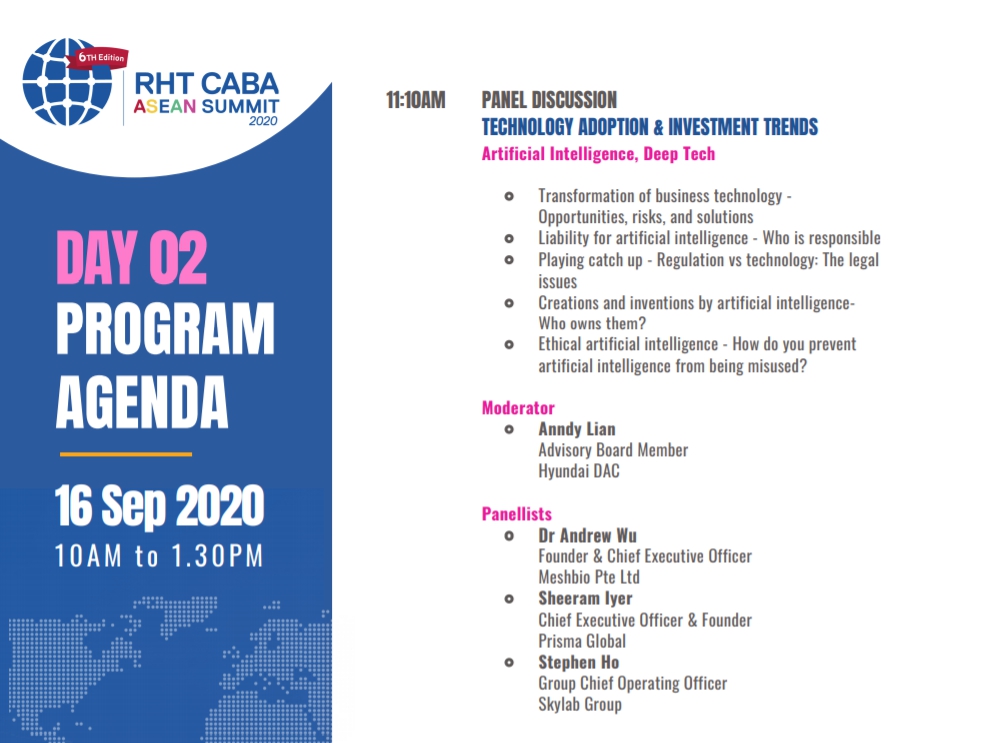
Anndy Lian, Advisory Board Member of Hyundai DAC will moderate a Panel Discussion at the CABA ASEAN Summit 2020 on 16 September 2020. Together with the panellists, they will be talking about technology adoption & investment trends and in particular on artificial intelligence and deep tech.

We will cover the following topics:

> Transformation of business technology – Opportunities, risks, and solutions
> Liability for artificial intelligence – Who is responsible
> Playing catch up – Regulation vs technology: The legal issues
> Creations and inventions by artificial intelligenceWho owns them?
> Ethical artificial intelligence – How do you prevent artificial intelligence from being misused?

You will also be hearing from:
> Dr Andrew Wu, Founder & Chief Executive Officer, Meshbio Pte Ltd
> Sheeram Iyer, Chief Executive Officer & Founder, Prisma Global
> Stephen Ho, Group Chief Operating Officer, Skylab Group

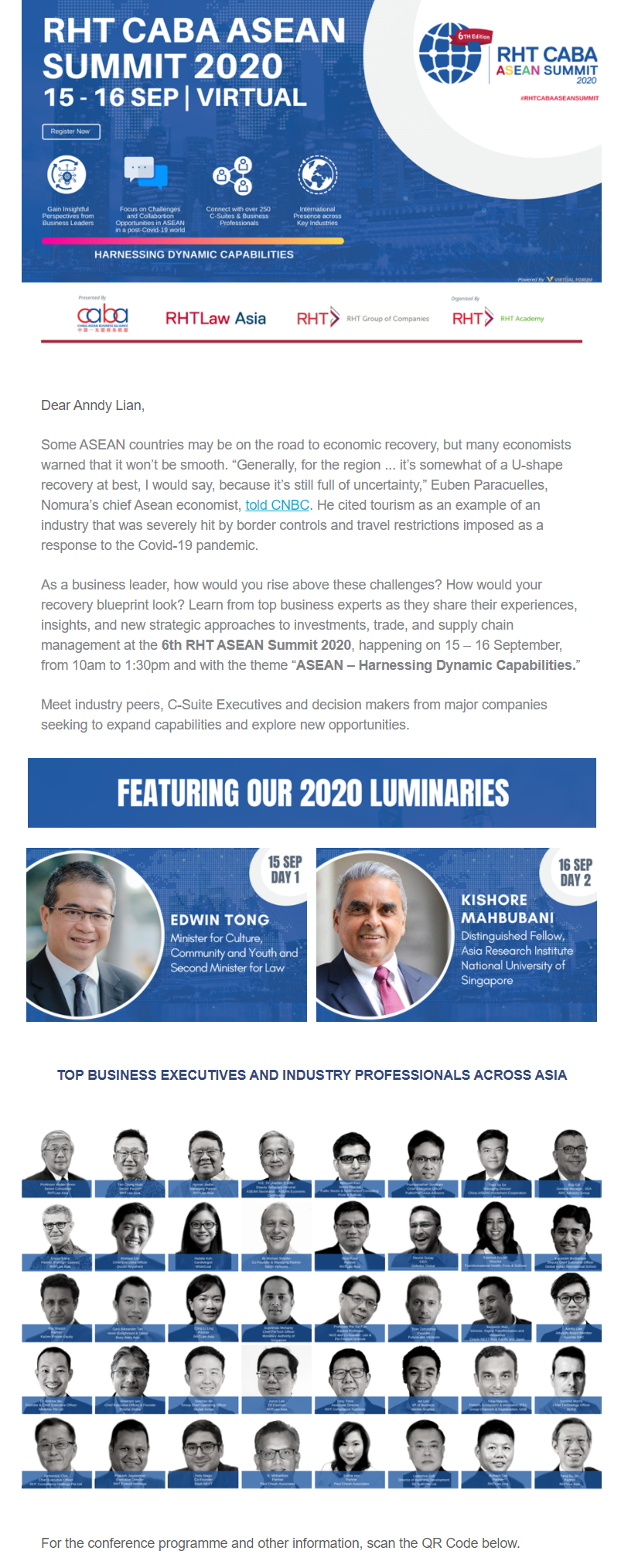
6th RHT CABA ASEAN Summit, with the overarching theme of “ASEAN – Dynamic Capabilities” delivered on a hybrid format on 15-16
September 2020, from 10am to 1:30pm.

This year, we are introducing a new component to the Summit centred on the China-ASEAN Business Alliance (CABA), a platform to promote business ties and collaboration for the China and ASEAN region. A series of insightful CABA forums will be held in the lead up to the Summit.

In 2020, Covid-19 wreaks havoc in all aspects of our lives globally. The health of the world’s population, economy and environment takes centre stage as organisations grapple with an increasingly volatile, uncertain, complex and ambiguous environment. The Summit’s focus on harnessing dynamic capabilities aims to deliver insights that will help businesses and organisations thrive during challenging times. The specially curated programme will dive into sustainability and the environment, healthcare, technology and intelligence. Up to 250 C-Suite Executives, ASEAN business leaders and industry professionals from various economic sectors are expected to attend. Past summits have also attracted the attendance of the diplomatic community and numerous Ministers as the guest-of-honour.

Join them on this 2 days conference,  Minister Edwin Tong, Minister for Culture, Community and Youth and Second Minister for Law will also deliver his keynote speech.

Anndy Lian is an early blockchain adopter and experienced serial entrepreneur who is known for his work in the government sector. He is a best selling book author- “NFT: From Zero to Hero” and “Blockchain Revolution 2030”.

Currently, he is appointed as the Chief Digital Advisor at Mongolia Productivity Organization, championing national digitization. Prior to his current appointments, he was the Chairman of BigONE Exchange, a global top 30 ranked crypto spot exchange and was also the Advisory Board Member for Hyundai DAC, the blockchain arm of South Korea’s largest car manufacturer Hyundai Motor Group. Lian played a pivotal role as the Blockchain Advisor for Asian Productivity Organisation (APO), an intergovernmental organization committed to improving productivity in the Asia-Pacific region.

An avid supporter of incubating start-ups, Anndy has also been a private investor for the past eight years. With a growth investment mindset, Anndy strategically demonstrates this in the companies he chooses to be involved with. He believes that what he is doing through blockchain technology currently will revolutionise and redefine traditional businesses. He also believes that the blockchain industry has to be “redecentralised”.
j j j

Anndy Lian Speaks to Bobby Ong, co-founder of CoinGecko on Blockchain, Cryptocurrencies, DeFi & beyond

Anndy Lian Speaks to Bobby Ong, co-founder of CoinGecko on Blockchain, Cryptocurrencies, DeFi & beyond

Blockcast.cc: Dear Bobby, this is Anndy Lian, I am a governmental blockchain advisor, book author and most recent Board Member of Hyundai DAC. We have in fact met very briefly in Malaysia during one of your meet-up. Good to hear from you again, can you give an introduction of yourself?

Bobby: Sure! I’m the co-founder of CoinGecko, an analytics platform for tracking cryptocurrencies and blockchain assets. CoinGecko was established in April 2014 and is the largest cryptocurrency data aggregator in the world.

CoinGecko provides comprehensive information derived from thousands of data points such as price, trading volume, market capitalization, developer strength, community statistics, and more. We currently track over 7,000 tokens from more than 400 exchanges.

Blockcast.cc: Tell us how you started CoinGecko?

Bobby: I met my co-founder, TM Lee in 2013. We were both interested in Bitcoin and were trading some alternative cryptocurrencies. We wanted some additional data such as community and developer data that was not available anywhere else. We decided to track these data on a website and make these data available for other people as well. This was how CoinGecko got started.


Blockcast.cc: What is your vision and mission for CoinGecko? What do you aim to
achieve in the long run?

Bobby: Our mission is to empower the cryptocurrency community with a 360-degree overview of the crypto market. We believe that in the future, anything of value that can be tokenized will be tokenized. We are building the infrastructure needed to track this decentralized future where we will have millions of tokens trading in the world and we aim to help traders get the relevant information for these tokens.


Blockcast.cc: I have openly commented on how the metrics do not work well in today’s context where many of the projects/ exchanges washed their trades. How do you see this? How can this be improved?

Bobby: Yes, we used to sort exchanges by trading volume. However, by early-2019, we started noticing that many exchanges were conducting wash trading and faking their trading volume numbers to appear larger and more liquid than what they actually are. We were not happy that the results for exchanges were no longer accurate and felt a deep responsibility to our users not to divert them to these small exchanges faking their volume.

Thus in May 2019, we introduced an algorithm to rank exchanges called Trust Score. This algorithm looks at multiple metrics for exchanges such as bid/ask spread, orderbook depth, web traffic estimate, exchange API quality, AML/KYC compliance and cybersecurity practices to give a holistic overview of each exchange’s quality. Exchanges are graded on a 1-10 scale and many of the exchanges conducting wash trading were no longer ranked at the top on CoinGecko.


Blockcast.cc: How is your ranking metrics compared to other similar platforms?

Bobby: We were the first crypto data aggregator to move away from ranking exchanges using trading volume. We saw how this metric had been manipulated by many non-regulated exchanges and introduced Trust Score to look at other liquidity based metrics.

Our metrics take into account several factors mentioned above such that it is holistic and robust. It does not use anyone single factor that can be easily manipulated by exchanges. We are also constantly looking to improve Trust Score and have done a few improvements since our launch.


Blockcast.cc: Will there be a chance that CoinGecko will transform into a wallet or an exchange? If no, will the group most likely to invest indirectly into the ecosystem?

Bobby: We view wallets and exchanges as our partners and have no plans to offer either of the above services for the time being.

If there are interesting opportunities to invest, we may consider it on a personal capacity as CoinGecko does not currently invest in any companies directly.


Blockcast.cc: What is your personal opinion of the blockchain and crypto industry? What is the future like?

Bobby: We view the blockchain and crypto industry as a multi-decade growth industry similar to how the Internet industry was in the early-1990s. There are tremendous opportunities offered in this space. It is still very hard for the average person to use crypto apps and as these apps get easier, faster, cheaper to use, it is expected that the mainstream audience will start using them and fuel growth in the years to come.

Blockchain and crypto industry offers permissionless innovation and there will be many interesting protocols and applications launched in the future. We view a future where there will be millions of tokens and we are building the foundation needed to support this future.


Blockcast.cc: How do you see Bitcoin, do you think Bitcoin will go to a value of $100,000 per coin like some said?

Bobby: Yes, I don’t see why Bitcoin will not go to $100,000 in the next few bull runs. Can’t tell when but eventually in the future. Bitcoin’s price is highly speculative by nature.


Blockcast.cc: Apart from Bitcoin, can you name 5 more coins that you see huge potential?

Bobby: I am particularly interested in seeing how Ethereum will perform as most of the innovations are coming on top of the Ethereum platform such as Decentralized Finance.
I am also interested to see how exchange tokens such as Binance Coin perform. Will it evolve from a fee-burn model or convert into some sort of governance model in the future.
I am also paying some attention to governance tokens such as Maker, Kyber and Compound. These governance token models will probably be something that will be adopted by many token teams in the future.


Blockcast.cc: Please share an inspiring quote for our readers.

Bobby: I like this quote by Tony Fernandes, CEO of AirAsia:

“Believe the unbelievable, dream the impossible and never take no for an answer.”


Blockcast.cc: Tan Sri Dr. Fernades is indeed an inspiring legend in the South East Asia Market. I have the honour to meet him in Singapore over dinner many years ago. He is an industry changer. Thanks for your time Bobby. Your insights are great. Keep up the good work for the crypto industry. 


Original Source: https://blockcast.cc/interviews/blockcast-cc-in-conversation-with-bobby-ong-co-founder-of-coingecko-believe-the-unbelievable-dream-the-impossible-and-never-take-no-for-an-answer/

Anndy Lian is an early blockchain adopter and experienced serial entrepreneur who is known for his work in the government sector. He is a best selling book author- “NFT: From Zero to Hero” and “Blockchain Revolution 2030”.

Currently, he is appointed as the Chief Digital Advisor at Mongolia Productivity Organization, championing national digitization. Prior to his current appointments, he was the Chairman of BigONE Exchange, a global top 30 ranked crypto spot exchange and was also the Advisory Board Member for Hyundai DAC, the blockchain arm of South Korea’s largest car manufacturer Hyundai Motor Group. Lian played a pivotal role as the Blockchain Advisor for Asian Productivity Organisation (APO), an intergovernmental organization committed to improving productivity in the Asia-Pacific region.

An avid supporter of incubating start-ups, Anndy has also been a private investor for the past eight years. With a growth investment mindset, Anndy strategically demonstrates this in the companies he chooses to be involved with. He believes that what he is doing through blockchain technology currently will revolutionise and redefine traditional businesses. He also believes that the blockchain industry has to be “redecentralised”.

j j j