
Is Polymarket Crypto’s Breakout App?

Is Polymarket Crypto’s Breakout App?

Polymarket, launched in 2020, has quickly gained attention as a decentralized information markets platform built on blockchain technology. At its core, it allows users to trade on the outcomes of real-world events, from political elections to sporting events and even scientific breakthroughs.

While prediction markets are not a new concept, their integration with cryptocurrency and blockchain technology sets it apart from traditional platforms.

The premise is simple yet powerful: by allowing individuals to put their money where their mouth is, Polymarket aims to create a more accurate reflection of collective knowledge and sentiment than traditional polling or expert opinions.

This concept, often referred to as the “wisdom of the crowd,” has shown promise in various fields, from finance to meteorology.

Why a Crypto-Based Prediction Market is Useful

One of the primary advantages of Polymarket’s crypto-based approach is its potential for global accessibility. Traditional prediction markets often face regulatory hurdles and geographical restrictions, limiting their user base and, consequently, the diversity of opinions they can capture. By using blockchain technology and cryptocurrency, it can theoretically operate on a truly global scale, allowing participants from around the world to contribute their insights and capital.

The use of smart contracts on the Ethereum blockchain enables the platform to operate with a high degree of transparency and automation. This reduces the need for intermediaries and potentially lowers operational costs, which could translate to better odds for participants compared to traditional betting platforms.

The crypto foundation also allows for near-instantaneous settlements and withdrawals, a significant improvement over traditional financial systems that may take days to process transactions. This speed and efficiency could make them more attractive to users who value quick access to their funds.

Reliability as a ‘Source of Truth’

One of Polymarket’s most intriguing aspects is its potential to serve as a reliable source of truth and sentiment. The theory goes that when people have a financial stake in the outcome, they are more likely to make predictions based on genuine knowledge and careful analysis rather than personal biases or wishful thinking.

Early indications suggest that Polymarket has shown promise in this regard. For instance, I remember how during the 2020 U.S. presidential election, its predictions closely mirrored the actual outcomes in many states, often outperforming traditional polls.

This accuracy has caught the attention of analysts and decision-makers, who are increasingly looking to prediction markets as a complement to traditional forecasting methods.

It is crucial to note that Polymarket is still a relatively young platform, and its long-term reliability as a truth oracle remains to be seen. As with any prediction market, there’s always the risk of manipulation or the influence of irrational exuberance, which could skew results.

What Polymarket Could Do Better: Potential Pitfalls

Polymarket has implemented several measures to protect the integrity of its markets and prevent manipulation. These include limits on the amount that can be wagered on a single outcome, which helps to prevent wealthy individuals or groups from unduly influencing the market.

The platform also employs a system of market resolvers — trusted individuals or organizations responsible for determining the final outcome of events — to ensure fair and accurate resolutions.

Despite these safeguards, concerns remain about the potential for market manipulation. Critics argue that determined actors with significant resources could still potentially influence market outcomes, especially in markets with lower liquidity. There’s also the risk of insider trading, where individuals with privileged information could unfairly profit from their knowledge.

Another potential pitfall is the challenge of accurately defining and resolving complex real-world events. While some outcomes are straightforward (like the winner of a sports match), others can be more nuanced and open to interpretation. This ambiguity could lead to disputes and erode trust in the platform if not handled carefully.

Leveraged Betting: A Double-Edged Sword

Recently, Polymarket announced plans to introduce leveraged betting, allowing users to amplify their potential gains (and losses) by borrowing funds to increase their position sizes. While this feature could attract more sophisticated traders and potentially increase market liquidity, it has also raised concerns among some observers.

The primary worry is that leveraged betting could exacerbate the risks associated with prediction markets. It could lead to more volatile price swings and potentially increase the likelihood of market manipulation.

There’s also the concern that it could encourage reckless behavior among less experienced users, who might not fully understand the risks involved in leveraged trading.

Proponents of the feature argue that it will make markets more efficient by allowing users to express stronger convictions in their predictions. They also point out that leveraged trading is common in other financial markets and that responsible implementation with appropriate risk management tools could mitigate potential downsides.

Accessibility for Non-Crypto Natives

One of the challenges Polymarket is facing – and indeed many crypto-based platforms – is accessibility for users who are not familiar with cryptocurrency. While the crypto-savvy may find them intuitive, the average person might be intimidated by the need to acquire and manage cryptocurrency, understand blockchain concepts, and navigate decentralized finance interfaces.

Polymarket made efforts to simplify the onboarding process, including partnerships with fiat-to-crypto on-ramps that allow users to buy cryptocurrency directly on the platform. It has also worked on improving its user interface to make it more intuitive for newcomers.

In my opinion, there is still a significant learning curve involved, which could limit its potential to reach a truly mainstream audience. The complexity of crypto transactions, including gas fees and wallet management, remains a barrier for many potential users.

Regulatory Challenges on the Horizon

As Polymarket has gained prominence, it has also attracted the attention of regulators. In January 2022, the platform reached a $1.4 million settlement with the U.S. Commodity Futures Trading Commission (CFTC) over allegations of operating an unregistered derivatives trading platform. As part of the settlement, the founders agreed to shut down markets that did not comply with regulations and to seek proper registration.

More recently, some U.S. lawmakers have moved to clamp down on election betting platforms. While these efforts are not specifically targeted at Polymarket, they highlight the uncertain regulatory environment in which the platform operates.

The regulatory challenges are significant. Prediction markets occupy a gray area in many jurisdictions, often straddling the line between gambling and financial products. The use of cryptocurrency adds another layer of complexity as regulators around the world are still grappling with how to approach digital assets.

These regulatory uncertainties pose a risk for users. There’s always the possibility that regulatory action could disrupt the platform’s operations or even force it to cease operations in certain jurisdictions. Users should be aware of these risks and stay informed about the evolving regulatory landscape.

The Future of Polymarket: Breakout App or Niche Platform?

As we consider whether Polymarket is truly crypto’s breakout app or just another gambling platform, the answer is not straightforward. It has certainly demonstrated the potential of blockchain-based prediction markets to provide valuable insights and potentially serve as a reliable source of truth on a wide range of topics.

The platform’s ability to aggregate global knowledge and sentiment in a transparent and efficient manner is genuinely innovative. If Polymarket can continue to improve its accuracy and build trust among users and observers, it could indeed become a powerful tool for forecasting and decision-making across various fields.

The line between prediction markets and gambling is often blurry. While prediction markets position themselves as information markets, wagering on outcomes inevitably carries an element of gambling. This association could limit their acceptance in more conservative circles or jurisdictions with strict gambling laws.

That said, it’s worth noting that many groundbreaking technologies have faced similar challenges in their early days. The internet itself was once viewed with skepticism by many who failed to see its transformative potential. Polymarkets and blockchain-based prediction markets, in general, maybe at a similar juncture.

The Bottom Line

While it may be premature to declare Polymarket as crypto’s definitive breakout app, it would be equally misguided to dismiss it as just another gambling platform. It represents a fascinating experiment in harnessing blockchain technology and market mechanisms to create a potentially powerful forecasting tool.

The platform’s ability to aggregate global knowledge, provide rapid feedback on predictions, and operate with a high degree of transparency are all significant innovations.

If it can navigate the regulatory landscape, improve accessibility for non-crypto users, and maintain the integrity of its markets, it has the potential to become a valuable resource for researchers, policymakers, and decision-makers across various fields.

The path forward is not without challenges. I will continue to monitor Polymarket’s development with both enthusiasm for its potential and a critical eye towards its challenges. It is undoubtedly pushing the boundaries of what’s possible at the intersection of blockchain technology, crowd wisdom, and forecasting.

The coming years will be crucial in determining whether Polymarket can transcend its current status and truly revolutionize how we predict and understand future events.

As it stands, Polymarket represents an intriguing glimpse into a possible future where decentralized, blockchain-based platforms play a significant role in shaping our understanding of the world around us.


Source: https://www.techopedia.com/news/is-polymarket-cryptos-breakout-app

 

Anndy Lian is an early blockchain adopter and experienced serial entrepreneur who is known for his work in the government sector. He is a best selling book author- “NFT: From Zero to Hero” and “Blockchain Revolution 2030”.

Currently, he is appointed as the Chief Digital Advisor at Mongolia Productivity Organization, championing national digitization. Prior to his current appointments, he was the Chairman of BigONE Exchange, a global top 30 ranked crypto spot exchange and was also the Advisory Board Member for Hyundai DAC, the blockchain arm of South Korea’s largest car manufacturer Hyundai Motor Group. Lian played a pivotal role as the Blockchain Advisor for Asian Productivity Organisation (APO), an intergovernmental organization committed to improving productivity in the Asia-Pacific region.

An avid supporter of incubating start-ups, Anndy has also been a private investor for the past eight years. With a growth investment mindset, Anndy strategically demonstrates this in the companies he chooses to be involved with. He believes that what he is doing through blockchain technology currently will revolutionise and redefine traditional businesses. He also believes that the blockchain industry has to be “redecentralised”.


j j j

Public sector IT strategies 2024: Leveraging AI and Blockchain for transforming governance

Public sector IT strategies 2024: Leveraging AI and Blockchain for transforming governance

As we look to the future, it’s clear that the public sector IT leaders who successfully navigate the integration of AI and blockchain will be well-positioned to deliver transformative changes in governance.

We’re seeing a huge shift in how governments are using technology. It’s not just about upgrading computers anymore, it’s about using powerful tools like AI and blockchain to completely change how things work. This is a chance to make governments more efficient, transparent, and trustworthy.

Think of all the ways AI is already being used: streamlining welfare, making immigration decisions fairer, catching fraudsters, planning cities, and even helping doctors. And this is just the beginning!

But there are worries too. Can we trust AI to be fair and unbiased? That’s where blockchain comes in. It’s like a digital ledger that keeps track of everything, making sure AI decisions are transparent and accountable.

Imagine a world where:

  • Every government decision made by AI is recorded and can be checked by anyone, ensuring fairness and stopping corruption.
  • AI analyses huge amounts of data to help governments understand what citizens need and provide better services.
  • Cities use AI and blockchain to manage traffic, energy, and waste more efficiently

The adoption of AI in government operations has already begun to yield significant benefits across various domains. From streamlining welfare payments to optimising immigration decisions, AI’s impact is far-reaching. Public servants are harnessing its capabilities to detect fraud, plan infrastructure projects, respond to citizen queries, assist in bail hearings, triage healthcare cases, and even establish drone paths. These applications merely scratch the surface of AI’s potential in the public sector.

However, the integration of AI into existing systems is not without its challenges. Concerns about transparency, accountability, and the potential for bias in AI decision-making processes have led some governments to approach this technology with caution. This is where blockchain technology enters the picture, offering a solution that addresses these concerns while amplifying the benefits of AI.

Incorporating Blockchain into AI-driven government systems

Blockchain, with its inherent characteristics of immutability, transparency, and decentralisation, provides a robust framework for ensuring the integrity and traceability of AI-driven processes. By keeping an unalterable record of all changes and decisions made by AI systems, blockchain technology can serve as a crucial accountability mechanism. This symbiotic relationship between AI and blockchain has the potential to create a new paradigm in public sector IT – one that combines the efficiency and insights of AI with the trust and transparency of blockchain.

The AI Strategy for Government, as outlined by various forward-thinking administrations, presents a vision where government agencies leverage AI to deliver high-impact outcomes in their core business. This strategy typically encompasses five key recommendations:

  • Identifying common AI applications that can be proliferated across different departments and agencies.
  • Pinpointing signature AI use cases to demonstrate tangible impact and build public confidence.
  • Productionising AI tools by building centralised infrastructure and resources.
  • Proliferating AI capabilities by broadening and deepening technical expertise within the public sector workforce.
  • Strengthening trust in the government’s use of AI by establishing robust governance frameworks.

These recommendations provide a solid foundation for the integration of AI into public sector operations. However, the addition of blockchain technology can significantly enhance this strategy, addressing some of the key concerns associated with AI adoption in government.

One of the primary advantages of incorporating blockchain into AI-driven government systems is the establishment of an immutable audit trail. Every decision made by an AI system can be recorded on the blockchain, creating a transparent and tamper-proof record. This not only ensures accountability but also allows for thorough scrutiny of AI decision-making processes, helping to identify and mitigate potential biases or errors.

The use of smart contracts on blockchain platforms can help align AI systems with their primary tasks and objectives. Smart contracts can be programmed to enforce specific rules and conditions, ensuring that AI systems operate within predefined parameters. This creates a system of checks and balances, mitigating the risk of AI systems deviating from their intended purposes or making unauthorised decisions.

The synergy between AI and blockchain extends beyond mere record-keeping and accountability. AI can analyse the vast amounts of data stored on blockchain networks to derive valuable insights for policymaking. By processing citizen feedback, transaction data, and other relevant information stored on the blockchain, AI systems can help governments make more informed, data-driven decisions that are responsive to the needs and preferences of their citizens.

Transforming public services with AI and Blockchain

This data-driven approach to governance has the potential to transform how public services are delivered. For instance, AI algorithms could analyse blockchain-stored data on citizens’ interactions with various government services to identify bottlenecks, inefficiencies, or areas for improvement. This information could then be used to optimise service delivery, potentially leading to more personalised, responsive, and anticipatory public services.

In the area of policy-making and planning, the combination of AI and blockchain can provide governments with unprecedented capabilities. AI’s predictive analytics, when applied to the wealth of data securely stored on blockchain networks, can offer more accurate forecasts and deeper insights into societal trends. This could enable governments to anticipate future challenges, from demographic shifts to economic fluctuations, and develop proactive policies to address them.

The potential applications of this technology duo are vast and varied. In the field of public finance, for instance, AI could analyse blockchain-recorded transaction data to detect patterns indicative of fraud or tax evasion, while the immutability of blockchain ensures the integrity of financial records. In healthcare, AI could process anonymised patient data stored on blockchain networks to identify public health trends or predict disease outbreaks, all while maintaining patient privacy and data security.

In the domain of smart cities, the convergence of AI, blockchain, and spatial computing presents exciting possibilities. AI algorithms could analyse data from IoT devices recorded on blockchain networks to optimise traffic flow, energy consumption, and waste management. The immutability and transparency of blockchain would ensure the integrity of this data, while smart contracts could automate various city operations based on predefined conditions.

It’s crucial to acknowledge that the integration of AI and blockchain in public sector IT is not without challenges. Technical hurdles, such as scalability issues in blockchain networks and the computational demands of AI systems, need to be addressed. There are also important ethical considerations, particularly around data privacy and the potential for surveillance. The successful implementation of these technologies requires significant investment in infrastructure and human capital. Governments need to prioritise the development of AI and blockchain expertise within their workforce, potentially through partnerships with academic institutions and the private sector.

Public acceptance and trust are also critical factors. Governments must be transparent about how they’re using these technologies and provide clear explanations of how AI-blockchain systems make decisions that affect citizens’ lives. Public education initiatives may be necessary to help citizens understand the benefits and limitations of these technologies.

In Conclusion

Despite these challenges, I believe the potential benefits of integrating AI and blockchain in public sector IT far outweigh the obstacles. This technological convergence offers a path towards more efficient, transparent, and responsive governance – a goal that should be at the forefront of any public sector IT strategy.

As we look to the future, it’s clear that the public sector IT leaders who successfully navigate the integration of AI and blockchain will be well-positioned to deliver transformative changes in governance. By harnessing the analytical power of AI and the trust-building capabilities of blockchain, governments can create a new paradigm of public service – one that is more efficient, more accountable, and more attuned to the needs of citizens.

In conclusion, the focus on integrating AI with existing systems and adopting blockchain technology in the public sector represents a forward-thinking approach to governance in the digital age. This strategy has the potential to enhance decision-making, improve service delivery, optimise internal operations, and strengthen public trust in government institutions. As these technologies continue to evolve and mature, we can expect to see increasingly sophisticated applications that redefine the relationship between citizens and their governments.

The journey towards fully realising the potential of AI and blockchain in public sector IT will undoubtedly be complex and challenging. It will require sustained commitment, significant resources, and a willingness to embrace change and innovation. However, for those governments willing to embark on this journey, the rewards promise to be transformative – ushering in a new era of smart, responsive, and trustworthy governance that is well-equipped to meet the challenges of the 21st century.


Source: https://ciosea.economictimes.indiatimes.com/blog/public-sector-it-strategies-2024-leveraging-ai-and-blockchain-for-transforming-governance/113050118

Anndy Lian is an early blockchain adopter and experienced serial entrepreneur who is known for his work in the government sector. He is a best selling book author- “NFT: From Zero to Hero” and “Blockchain Revolution 2030”.

Currently, he is appointed as the Chief Digital Advisor at Mongolia Productivity Organization, championing national digitization. Prior to his current appointments, he was the Chairman of BigONE Exchange, a global top 30 ranked crypto spot exchange and was also the Advisory Board Member for Hyundai DAC, the blockchain arm of South Korea’s largest car manufacturer Hyundai Motor Group. Lian played a pivotal role as the Blockchain Advisor for Asian Productivity Organisation (APO), an intergovernmental organization committed to improving productivity in the Asia-Pacific region.

An avid supporter of incubating start-ups, Anndy has also been a private investor for the past eight years. With a growth investment mindset, Anndy strategically demonstrates this in the companies he chooses to be involved with. He believes that what he is doing through blockchain technology currently will revolutionise and redefine traditional businesses. He also believes that the blockchain industry has to be “redecentralised”.
j j j

Blockchain & AI Change the Shape of Government in 2024

Blockchain & AI Change the Shape of Government in 2024

As we venture into the heart of 2024, information technology is undergoing a seismic shift. Government IT chiefs are grappling with a dual challenge: staying abreast of cutting-edge tech while harnessing its power to boost efficiency, security, and innovation.

This year’s standout trend? blockchain meeting artificial intelligence (AI) to reshape public sector IT strategies.

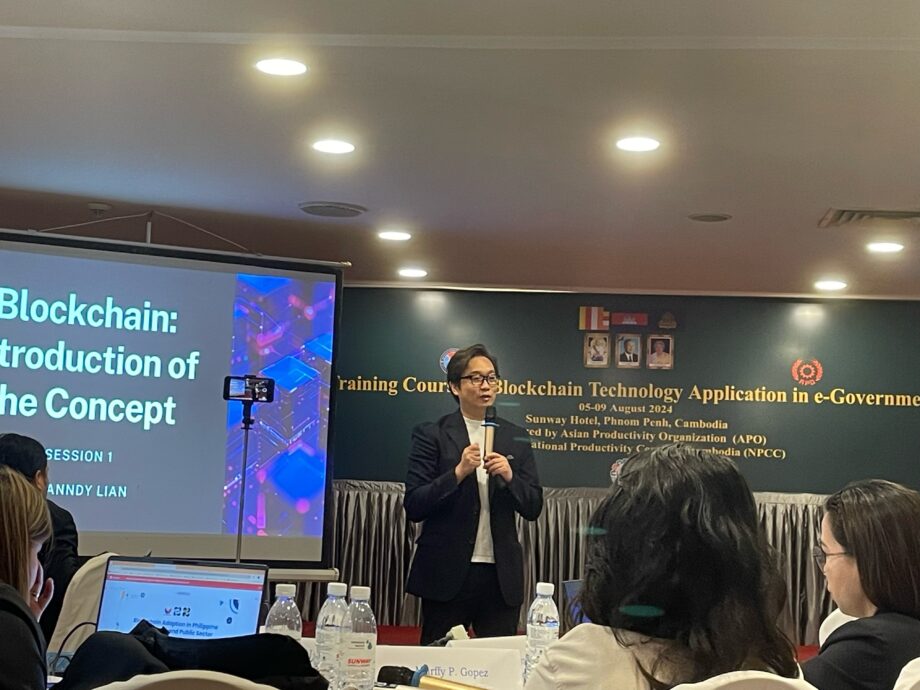
A recent workshop on Blockchain in e-Government, held in Cambodia’s bustling capital from August 5-9, 2024, highlighted the growing fascination with blockchain among state bodies.

The event drew delegates from nine nations and boasted the presence of dignitaries like H.E. Phork Sovanrith, a top official from MISTI and Cambodia’s APO Director, and highlighted blockchain’s pivotal role in molding tomorrow’s digital government services.

As the expert speaker, I witnessed firsthand the palpable excitement surrounding blockchain. The lively debates and probing questions revealed a keen appetite among public sector representatives for blockchain adoption. This shift isn’t fleeting; it marks a profound change in governmental attitudes toward technology.

Key Takeaways

  • Blockchain and AI are beginning to change how public sector IT works, offering security, efficiency, and innovation.
  • The Cambodia workshop in August highlighted global interest in blockchain’s role in transforming e-government services.
  • Blockchain’s transparency and AI’s analytical power can turbo-charge government operations and citizen engagement.
  • There are challenges in adopting these technologies — scalability, interoperability, and ensuring inclusive access among them.
  • Successful e-government transformation hinges on strategic planning, collaboration, and the ethical implementation of blockchain and AI.

Blockchain’s allure for the public sector is multifaceted. At its core, it offers a transparent, decentralized, and tamper-proof ledger system, significantly bolstering the security and integrity of government data and transactions. In our era of sophisticated cyberthreats, blockchain’s security features present an enticing shield for sensitive information.

Furthermore, blockchain’s capacity to streamline operations, slash red tape, and boost transparency aligns perfectly with e-government objectives. Its potential applications span from land registries and identity management to voting systems and public procurement.

Yet, blockchain’s true potential in e-government lies in its synergy with other emerging technologies, particularly AI. This powerful combination could spawn highly efficient, secure, and intelligent systems, revolutionizing public services.

Picture AI algorithms sifting through blockchain-stored data, uncovering patterns, forecasting trends, and making informed decisions. This could lead to more responsive and proactive government services. For instance, an AI-enhanced blockchain system could automatically flag and prevent fraud in public procurement, saving taxpayer money and ensuring fair competition.

Moreover, the AI-blockchain duo could supercharge citizen engagement in governance. Imagine smart contracts on a blockchain paired with AI-powered interfaces, creating intuitive, personalized e-government services. Citizens could interact using everyday language while AI ensures accurate processing and blockchain recording of their requests.

The enthusiasm for these technologies isn’t confined to one region. The diverse attendance at the Cambodia workshop, with participants from nine countries, signals global recognition of blockchain’s potential. This international collaboration is crucial for developing standards and best practices to facilitate widespread blockchain adoption in e-government.

However, the path to blockchain integration in the public sector isn’t without hurdles. Scalability, interoperability, and regulatory compliance are key challenges. There’s also an urgent need for capacity building and skill development within government agencies to implement and manage blockchain solutions effectively.

Looking ahead, it’s clear that blockchain and AI will remain focal points for IT leaders’ strategies. The public sector stands to gain significantly from these technologies. However, success hinges on a strategic approach that considers not just technical aspects but also organizational and cultural shifts needed to fully adopt these technologies.

For public sector IT leaders, key priorities should include developing clear blockchain strategies, investing in AI capabilities, fostering collaboration, prioritizing security, focusing on user experience, addressing ethical considerations, and maintaining agility in the face of rapid technological change.

It Won’t Be a Smooth Ride Though

The enthusiasm observed at the Cambodia workshop is encouraging, suggesting we’re on the brink of a major transformation in government operations and service delivery. However, it’s crucial to temper this excitement with a realistic understanding of the challenges ahead.

Implementing blockchain and AI solutions at a governmental level is a complex undertaking requiring careful planning, substantial resources, and, often, legislative changes. It’s not just about adopting new technologies; it’s about reimagining the delivery of government services and citizen-state interactions.

As governments rush to adopt these technologies, there’s a risk of creating a digital divide. Not all citizens may have equal access to or understanding of these new systems. IT leaders must ensure that blockchain and AI adoption doesn’t inadvertently exclude segments of the population.

Despite these challenges, the potential benefits of blockchain and AI in e-government are too significant to ignore. These technologies promise more efficient, transparent, and responsive government services. They can help rebuild trust in public institutions by providing verifiable records of government actions and decisions.

The interest shown by public sector representatives at the Cambodia workshop is a positive sign, indicating a willingness to learn and adapt. However, this enthusiasm must be channeled into concrete action plans and sustained efforts to realize the full potential of these technologies.

As we progress, it will be fascinating to see how different countries approach blockchain and AI adoption in their e-government initiatives. Will we witness a race to become blockchain-enabled smart nations? Or will the adoption be more measured and cautious?

What’s certain is that blockchain and AI are no longer just buzzwords or experimental technologies. They’re becoming integral to IT strategies, particularly in the public sector. The focus now should be on responsible and effective implementation that truly serves citizens’ needs.

The Bottom Line

In conclusion, as IT leaders map out their strategies for the coming years, blockchain and AI will undoubtedly be at the forefront. The convergence of these technologies presents an unprecedented opportunity to transform e-government services. However, success will depend on more than just technological prowess. It will require visionary leadership, collaborative efforts, and a commitment to ethical and inclusive implementation.

The journey towards blockchain and AI-enabled e-government has just begun. The enthusiasm witnessed at events like the Cambodia workshop is just the first step. The real test lies in translating this enthusiasm into tangible improvements in government services and citizen experiences. As we stand at this technological crossroads, one thing is certain: the future of e-government is exciting, and it’s powered by blockchain and AI.


Source: https://www.techopedia.com/blockchain-ai-in-government

Anndy Lian is an early blockchain adopter and experienced serial entrepreneur who is known for his work in the government sector. He is a best selling book author- “NFT: From Zero to Hero” and “Blockchain Revolution 2030”.

Currently, he is appointed as the Chief Digital Advisor at Mongolia Productivity Organization, championing national digitization. Prior to his current appointments, he was the Chairman of BigONE Exchange, a global top 30 ranked crypto spot exchange and was also the Advisory Board Member for Hyundai DAC, the blockchain arm of South Korea’s largest car manufacturer Hyundai Motor Group. Lian played a pivotal role as the Blockchain Advisor for Asian Productivity Organisation (APO), an intergovernmental organization committed to improving productivity in the Asia-Pacific region.

An avid supporter of incubating start-ups, Anndy has also been a private investor for the past eight years. With a growth investment mindset, Anndy strategically demonstrates this in the companies he chooses to be involved with. He believes that what he is doing through blockchain technology currently will revolutionise and redefine traditional businesses. He also believes that the blockchain industry has to be “redecentralised”.
j j j