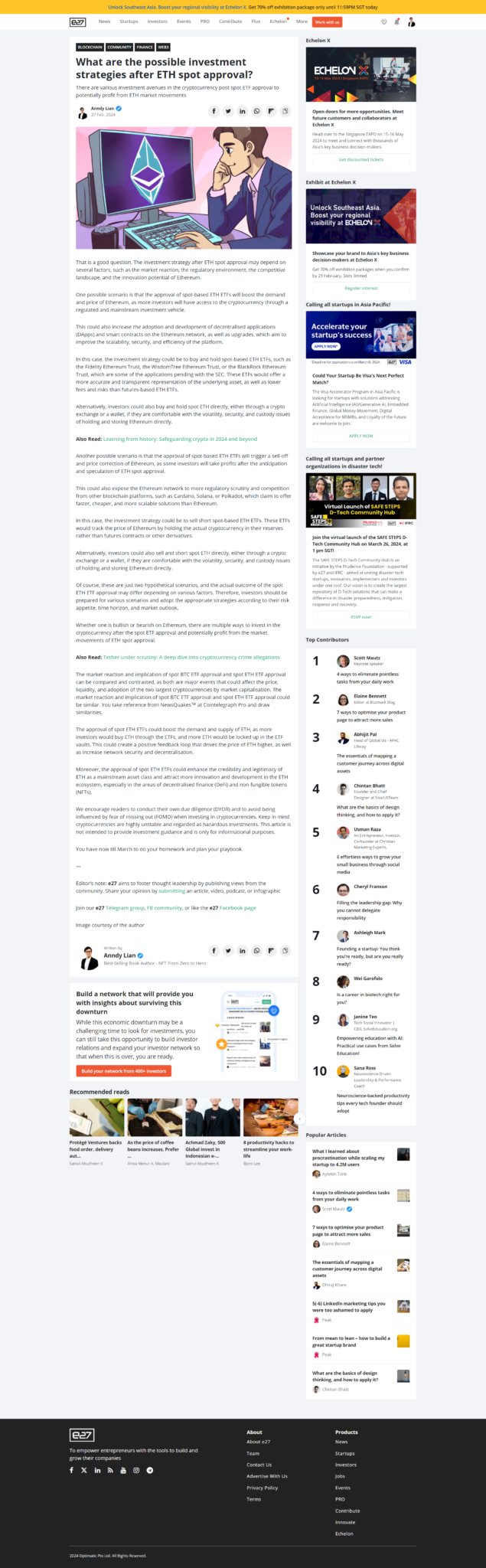
What are the possible investment strategies after ETH spot approval?

What are the possible investment strategies after ETH spot approval?

That is a good question. The investment strategy after ETH spot approval may depend on several factors, such as the market reaction, the regulatory environment, the competitive landscape, and the innovation potential of Ethereum.

One possible scenario is that the approval of spot-based ETH ETFs will boost the demand and price of Ethereum, as more investors will have access to the cryptocurrency through a regulated and mainstream investment vehicle.

This could also increase the adoption and development of decentralised applications (DApps) and smart contracts on the Ethereum network, as well as upgrades, which aim to improve the scalability, security, and efficiency of the platform.

In this case, the investment strategy could be to buy and hold spot-based ETH ETFs, such as the Fidelity Ethereum Trust, the WisdomTree Ethereum Trust, or the BlackRock Ethereum Trust, which are some of the applications pending with the SEC. These ETFs would offer a more accurate and transparent representation of the underlying asset, as well as lower fees and risks than futures-based ETH ETFs.

Alternatively, investors could also buy and hold spot ETH directly, either through a crypto exchange or a wallet, if they are comfortable with the volatility, security, and custody issues of holding and storing Ethereum directly.

Another possible scenario is that the approval of spot-based ETH ETFs will trigger a sell-off and price correction of Ethereum, as some investors will take profits after the anticipation and speculation of ETH spot approval.

This could also expose the Ethereum network to more regulatory scrutiny and competition from other blockchain platforms, such as Cardano, Solana, or Polkadot, which claim to offer faster, cheaper, and more scalable solutions than Ethereum.

In this case, the investment strategy could be to sell short spot-based ETH ETFs. These ETFs would track the price of Ethereum by holding the actual cryptocurrency in their reserves rather than futures contracts or other derivatives.

Alternatively, investors could also sell and short spot ETH directly, either through a crypto exchange or a wallet, if they are comfortable with the volatility, security, and custody issues of holding and storing Ethereum directly.

Of course, these are just two hypothetical scenarios, and the actual outcome of the spot ETH ETF approval may differ depending on various factors. Therefore, investors should be prepared for various scenarios and adopt the appropriate strategies according to their risk appetite, time horizon, and market outlook.

Whether one is bullish or bearish on Ethereum, there are multiple ways to invest in the cryptocurrency after the spot ETF approval and potentially profit from the market movements of ETH spot approval.

The market reaction and implication of spot BTC ETF approval and spot ETH ETF approval can be compared and contrasted, as both are major events that could affect the price, liquidity, and adoption of the two largest cryptocurrencies by market capitalisation. The market reaction and implication of spot BTC ETF approval and spot ETH ETF approval could be similar. You take reference from NewsQuakes™ at Cointelegraph Pro and draw similarities.

The approval of spot ETH ETFs could boost the demand and supply of ETH, as more investors would buy ETH through the ETFs, and more ETH would be locked up in the ETF vaults. This could create a positive feedback loop that drives the price of ETH higher, as well as increase network security and decentralisation.

Moreover, the approval of spot ETH ETFs could enhance the credibility and legitimacy of ETH as a mainstream asset class and attract more innovation and development in the ETH ecosystem, especially in the areas of decentralised finance (DeFi) and non-fungible tokens (NFTs).

We encourage readers to conduct their own due diligence (DYOR) and to avoid being influenced by fear of missing out (FOMO) when investing in cryptocurrencies. Keep in mind cryptocurrencies are highly unstable and regarded as hazardous investments. This article is not intended to provide investment guidance and is only for informational purposes.

You have now till March to do your homework and plan your playbook.


Source: https://e27.co/what-are-the-possible-investment-strategies-after-eth-spot-approval-20240223/

Anndy Lian is an early blockchain adopter and experienced serial entrepreneur who is known for his work in the government sector. He is a best selling book author- “NFT: From Zero to Hero” and “Blockchain Revolution 2030”.

Currently, he is appointed as the Chief Digital Advisor at Mongolia Productivity Organization, championing national digitization. Prior to his current appointments, he was the Chairman of BigONE Exchange, a global top 30 ranked crypto spot exchange and was also the Advisory Board Member for Hyundai DAC, the blockchain arm of South Korea’s largest car manufacturer Hyundai Motor Group. Lian played a pivotal role as the Blockchain Advisor for Asian Productivity Organisation (APO), an intergovernmental organization committed to improving productivity in the Asia-Pacific region.

An avid supporter of incubating start-ups, Anndy has also been a private investor for the past eight years. With a growth investment mindset, Anndy strategically demonstrates this in the companies he chooses to be involved with. He believes that what he is doing through blockchain technology currently will revolutionise and redefine traditional businesses. He also believes that the blockchain industry has to be “redecentralised”.

j j j

How ZKPs Can Revolutionize the GameFi Market

How ZKPs Can Revolutionize the GameFi Market

GameFi, or financialized gaming, is one of the blockchain industry’s most exciting and innovative segments. It combines elements of gaming, decentralized finance (DeFi), and non-fungible tokens (NFTs) to create immersive and rewarding experiences for players. It enables players to own, trade, and monetize their in-game assets and currencies and participate in the governance and development of the games they play. It also offers new opportunities for game developers, who can leverage blockchain technology to create more engaging, fair, and transparent gaming ecosystems.

As we all know, GameFi also faces some significant challenges and limitations, especially regarding scalability, privacy, and security. As the number of GameFi projects and users grows, so does the demand for fast, cheap, and secure transactions on the blockchain. However, most blockchain networks today suffer from low throughput, high fees, and congestion, which can negatively affect the user experience and adoption. Moreover, many GameFi applications require users to reveal their personal and financial information on the public ledger, which can expose them to various risks, such as identity theft, fraud, hacking, and censorship.

This is where zero-knowledge proofs (ZKPs) come in. ZKPs are a cryptographic technique that allows one party to prove to another that a statement is true without revealing any information beyond the validity of the statement. For example, Alice can prove to Bob that she knows the password to a website without revealing the password itself. ZKPs can be used to create more scalable, private, and secure solutions for GameFi and other blockchain applications.

How ZKPs Can Address the Limitations of Web2.5 and Web3 Gaming Models

To understand how ZKPs can benefit GameFi, comparing the current gaming models, Web2.5 and Web3 is useful.

Web2.5 gaming refers to the traditional online gaming model, where games are hosted on centralized servers controlled by game developers or publishers. In this model, players have no real ownership or control over their in-game assets and currencies, which are stored in the game databases and can be modified or deleted at any time by the game operators. Players have to trust the game operators to provide fair and secure gameplay and protect their personal and financial data. Such a model is also limited by the capacity and performance of the centralized servers, which can result in latency, downtime, and hacking.

Web3 gaming refers to the emerging blockchain-based gaming model, where games are hosted on decentralized networks powered by smart contracts and distributed nodes. In this model, players have full ownership and control over their in-game assets and currencies, represented by NFTs and crypto tokens on the blockchain. Likewise, players can verify the fairness and security of the gameplay and the authenticity and scarcity of the in-game assets by checking the transparent and immutable ledger. It also enables interoperability and composability, meaning players can use their in-game assets and currencies across different games and platforms.

There are drawbacks to Web3 gaming, mainly related to scalability, privacy, and security. As mentioned earlier, most blockchain networks today cannot handle the high volume and frequency of transactions required by GameFi applications, leading to slow, expensive, and unreliable transactions. Furthermore, most blockchain networks today cannot protect the privacy and security of the users, who have to expose their identities, balances, and activities on the public ledger, making them vulnerable to various attacks and threats.

ZKPs can help overcome these challenges by enabling more scalable, private, and secure solutions for Web3 gaming. For instance, ZKPs can be used to create layer-2 solutions, such as zk-rollups, that can process thousands of transactions off-chain while only submitting a single proof on-chain, thus reducing the load and cost on the main chain. It can also be used to create privacy-preserving solutions, such as zk-SNARKs, that can hide the details of the transactions, such as the sender, receiver, amount, and asset type, while still proving their validity on the blockchain. It can also be used to create security-enhancing solutions, such as zk-STARKs, that can resist quantum attacks and do not require trusted setup assumptions.

How ZKPs Can Influence the Development of Digital Economies and the Management of Virtual Assets in GameFi Projects

By enabling more scalable, private, and secure solutions for Web3 gaming, ZKPs can also influence the development of digital economies and the management of virtual assets in GameFi projects. Here are some of the possible implications and benefits of ZKPs for GameFi:

  • ZKPs can enable more efficient and inclusive digital economies where players can access and participate in various GameFi applications regardless of location, device, or network. It can also enable more diverse and dynamic digital economies, where players can create and exchange different types of in-game assets and currencies and interact with other blockchain applications, such as DeFi, NFTs, and DAOs.
  • ZKPs can enable more private and secure digital economies, where players can protect their personal and financial data, as well as their in-game assets and currencies, from unauthorized access and misuse. It can also enable more flexible and customizable digital economies, where players can choose the level of privacy and security they want for their transactions, depending on their preferences and needs.
  • ZKPs can enable more innovative and competitive digital economies where game developers can leverage the power and potential of blockchain technology to create more engaging, fair, and transparent gaming ecosystems. It can also enable more collaborative and cooperative digital economies, where game developers can collaborate and share resources and best practices to improve the quality and diversity of GameFi products.

Which Sector of the GameFi Industry Could Lead the New Market Stage

The GameFi industry comprises various sectors, such as iGaming, action games, move-to-earn, and others, each with its characteristics, challenges, and opportunities. While it is hard to predict which sector will lead the new market stage, it is possible to identify some of the factors that could influence the growth and success of each sector, such as:

  • The demand and popularity of the games among the players, as well as the potential to attract and retain new and existing users.
  • The quality and innovation of the games and the ability to provide immersive and rewarding gameplay experiences.
  • The integration and compatibility of the games with blockchain technology, as well as the ability to leverage the benefits of GameFi, such as ownership, interoperability, and governance.
  • The scalability and performance of the games, as well as the ability to handle the high volume and frequency of transactions and interactions.
  • The privacy and security of the games, as well as the ability to protect the users and their in-game assets and currencies from various risks and threats.

Based on these factors, one could argue that the move-to-earn sector could lead the new market stage, as it has shown strong growth and potential in the past year. Move-to-earn games reward players for moving or exercising in the real world, such as walking, running, cycling, or dancing.

Move-to-earn games have several advantages over other sectors, such as:

  • They have a large and untapped market, as they appeal to a wide range of users, from casual gamers to fitness enthusiasts and people who want to improve their health and well-being.
  • They have a high retention rate, incentivizing users to keep playing and moving and competing and cooperating with other players, creating a strong sense of community and loyalty.
  • They have a low entry barrier, as they do not require expensive or sophisticated equipment or devices but rather use the users’ smartphones or wearable devices, which are widely available and accessible.
  • They have a positive social and environmental impact, encouraging users to adopt a more active and healthy lifestyle and reduce their carbon footprint and pollution.

However, move-to-earn games also face some challenges and limitations, such as:

  • They have a high dependency on the users’ physical location and condition, as well as on the weather and other external factors, which can affect the availability and quality of the gameplay.
  • They have a high risk of fraud and cheating, as users can manipulate or falsify their movement data by using bots, hacks, or spoofing to gain unfair advantages or rewards.
  • They have a high demand for scalability and privacy, as they need to process and verify a large amount of movement data and protect the users’ personal and biometric data, which can be sensitive and valuable.

ZKPs can help address these challenges and limitations by enabling more scalable, private, and secure solutions for move-to-earn games. For example, ZKPs can create verifiable proofs of movement, proving that the users have moved a certain distance or performed a certain activity without revealing their exact location or identity. It can also create privacy-preserving rewards that can distribute in-game assets and currencies to the users without disclosing their balances or transactions.

What Other Technology Developments Could Help for the Surge in the GameFi Market

Besides ZKPs, other technology developments could help with the surge in the GameFi market, such as:

  • Layer-1 and layer-2 developments aim to improve blockchain networks’ scalability, performance, and interoperability by using different consensus mechanisms, sharding techniques, or sidechains. Some examples of layer-1 and layer-2 developments are Ethereum 2.0, PolkadotPolygon, and Optimism.
  • Account abstraction simplifies and enhances the user experience and security of blockchain applications by allowing users to interact with smart contracts without managing their private keys, addresses, or gas fees. Some of the examples of account abstraction are MetaMask Argent, and Authereum.

These technology developments could complement and synergize with ZKPs, to create more scalable, private, and secure solutions for GameFi, as well as other blockchain applications.

Conclusion

GameFi is a rapidly growing and evolving segment of the blockchain industry that offers new possibilities and opportunities for both players and game developers. However, GameFi also faces some significant challenges and limitations, especially in terms of scalability, privacy, and security.

ZKPs are a powerful and promising cryptographic technique that can help overcome these challenges and limitations by enabling more scalable, private, and secure solutions for Web3 gaming. It can also influence the development of digital economies and the management of virtual assets in GameFi projects by enabling more efficient, inclusive, diverse, dynamic, flexible, and customizable digital economies. ZKPs can also enable more innovative, competitive, collaborative, and cooperative digital economies by enabling game developers to leverage the power and potential of blockchain technology to create more engaging, fair, and transparent gaming ecosystems.

ZKPs, along with other technology developments, such as layer-1 and layer-2 developments and account abstraction, could revolutionize the GameFi market and pave the way for the future of gaming.


Source: https://za.investing.com/analysis/how-zkps-can-revolutionize-the-gamefi-market-200594928

Anndy Lian is an early blockchain adopter and experienced serial entrepreneur who is known for his work in the government sector. He is a best selling book author- “NFT: From Zero to Hero” and “Blockchain Revolution 2030”.

Currently, he is appointed as the Chief Digital Advisor at Mongolia Productivity Organization, championing national digitization. Prior to his current appointments, he was the Chairman of BigONE Exchange, a global top 30 ranked crypto spot exchange and was also the Advisory Board Member for Hyundai DAC, the blockchain arm of South Korea’s largest car manufacturer Hyundai Motor Group. Lian played a pivotal role as the Blockchain Advisor for Asian Productivity Organisation (APO), an intergovernmental organization committed to improving productivity in the Asia-Pacific region.

An avid supporter of incubating start-ups, Anndy has also been a private investor for the past eight years. With a growth investment mindset, Anndy strategically demonstrates this in the companies he chooses to be involved with. He believes that what he is doing through blockchain technology currently will revolutionise and redefine traditional businesses. He also believes that the blockchain industry has to be “redecentralised”.
j j j

ERC-404: Fad or Game-Changer?

ERC-404: Fad or Game-Changer?

Ethereum is a platform that enables developers to create decentralized applications (DApps) using smart contracts, which are self-executing code that can enforce rules and logic. One of the most popular types of DApps on Ethereum are those that deal with tokens, which are digital assets that can represent anything from currencies to collectibles.

There are different standards for creating tokens on Ethereum, such as ERC-20 for fungible tokens and ERC-721 for non-fungible tokens (NFTs). Fungible tokens are interchangeable and divisible, meaning that one token of the same type equals another. For example, one ether (ETH) is equal to another ether. NFTs are unique and indivisible, meaning that each token has its own identity and characteristics. For example, one CryptoKitty is different from another CryptoKitty.

However, there are some limitations and challenges with these existing standards. For instance, ERC-20 tokens lack NFTs’ metadata and customization features, while ERC-721 tokens suffer from low liquidity and high transaction costs due to their rarity and indivisibility. Moreover, there is no easy way to bridge the gap between fungible and non-fungible tokens or create hybrid tokens with both properties.

A New Standard

This is where ERC-404 comes in. This is an unofficial token standard proposed by the Pandora team, a group of developers who launched an NFT collection based on this standard. ERC-404 aims to combine the best of both worlds by treating tokens as fungible or non-fungible, depending on the context and the user’s preference. It also enables unique burn and mint mechanics, creating interesting dynamics and incentives for token holders.

One of the main features of ERC-404 is that it allows tokens to be fractionalized and merged. This means a user can buy or sell a fraction of a token instead of buying or selling the whole token. For example, if a user owns one Pandora token, an ERC-404 token, they can sell 0.1 of it to another user and keep the remaining 0.9. The 0.1 token will still have the same metadata and characteristics as the original token but not the corresponding NFT attached to it. The NFT will only be minted when the user owns a full token or merges their fractions to form a full token.

This feature can create more liquidity and accessibility for NFTs, as users can trade them in smaller units at lower prices. It can also create more diversity and variety for fungible tokens, as users can customize them with different metadata and attributes. For example, a user can create a token representing their favorite sports team and add their logo, colors, and stats. They can then trade it with other fans or use it to access exclusive content or rewards.

Another feature of ERC-404 is that it allows tokens to be burned and minted in different ways. This means a user can destroy their token and create a new one with different properties or create a new one from scratch. For example, if a user owns a Pandora token representing a dragon, they can burn it and mint a new one representing a unicorn. They can also mint a new token without burning an existing one, as long as they pay a fee to the Pandora contract.

This feature can create more innovation and experimentation for token creation, as users can explore different possibilities and combinations. It can also create more value and scarcity for tokens, as users can create unique and rare tokens with high demand and low supply. Another example is a user can create a token that represents a celebrity and add their signature, photo, and voice to it. They can then sell it to their fans or use it to access exclusive content or rewards.

Opening Pandora’s NFT

ERC-404 is a novel and exciting token standard that can potentially revolutionize Ethereum’s token economy. It can create more flexibility and functionality for both fungible and non-fungible tokens, and enable new use cases and applications for them. It can also create more opportunities and challenges for token creators and users, as they can experiment with different token designs and dynamics.

Remember that this is also a very experimental and risky token standard that the Ethereum community has not officially approved or adopted. As mentioned in my blog, it has not been thoroughly tested or audited, and it may have security vulnerabilities or technical issues. It may also face legal or regulatory hurdles, as it may violate intellectual property rights or other laws. Moreover, it may not be compatible or interoperable with other token standards or platforms and may face competition or opposition from other token projects.

Pandora is the first and most prominent token that uses ERC-404, and it has been experiencing a massive surge in popularity and price in the past few days. CoinMarketcap has a separate section called ERC-404 on its main page, with other trending categories such as Solana, Gaming, and DePin.

Pandora is a collection of 404 unique NFTs that represent different mythical creatures, such as dragons, unicorns, and phoenixes. Each Pandora token can be fractionalized and merged and can be burned and minted to create new NFTs. Pandora also has a governance system that allows token holders to vote on the future development and direction of the project.

It has attracted much attention and hype from the crypto community as it showcases the potential and innovation of ERC-404. It has also attracted a lot of speculation and investment from the crypto market, as it has seen a huge increase in its value and volume. According to CoinGecko, Pandora has a market cap of over $175 million and a price of over $16,000 per token as of February 7, 2024. It has also seen a growth of over 2000% in the past week, making it one of the best-performing tokens in the crypto space.

However, Pandora is also a volatile and speculative token that has not proven its long-term viability or sustainability. It has not established a clear vision or roadmap or delivered any concrete products or services. It has also faced much criticism and skepticism from the crypto community, as it has been accused of being a scam, a Ponzi scheme, or a copycat of other NFT projects. It has also faced much competition and pressure from other token projects, especially those that use official or more established token standards.

In conclusion, ERC-404 and Pandora are fascinating and controversial token projects that have generated a lot of buzz and debate in the crypto world. They have both demonstrated the power and potential of token innovation and experimentation and exposed token adoption and regulation risks and challenges. They have created much value and opportunity for token creators and users. Still, they have also created a lot of uncertainty and speculation for token investors and traders. They have both been bullish and excited in the short term but also uncertain and unproven in the long term.

My opinion on ERC-404 and Pandora is that they are worth watching and learning from but worth being cautious and critical of. I think they are both game-changers in the token space and both fads in the token market at this point in time. So, do you think it is a game-changer or a fad?

Source: https://www.blockhead.co/2024/02/17/erc-404-a-game-changer-or-a-fad/

Anndy Lian is an early blockchain adopter and experienced serial entrepreneur who is known for his work in the government sector. He is a best selling book author- “NFT: From Zero to Hero” and “Blockchain Revolution 2030”.

Currently, he is appointed as the Chief Digital Advisor at Mongolia Productivity Organization, championing national digitization. Prior to his current appointments, he was the Chairman of BigONE Exchange, a global top 30 ranked crypto spot exchange and was also the Advisory Board Member for Hyundai DAC, the blockchain arm of South Korea’s largest car manufacturer Hyundai Motor Group. Lian played a pivotal role as the Blockchain Advisor for Asian Productivity Organisation (APO), an intergovernmental organization committed to improving productivity in the Asia-Pacific region.

An avid supporter of incubating start-ups, Anndy has also been a private investor for the past eight years. With a growth investment mindset, Anndy strategically demonstrates this in the companies he chooses to be involved with. He believes that what he is doing through blockchain technology currently will revolutionise and redefine traditional businesses. He also believes that the blockchain industry has to be “redecentralised”.

j j j