Understanding the Interplay of AI and Crypto

Understanding the Interplay of AI and Crypto

In the intersection of artificial intelligence (AI) and the cryptocurrency universe, we are witnessing an evolving landscape teeming with innovation and transformation. Prominent among the outcomes of this fusion is the advent of AI-powered trading platforms, such as Bybit’s ToolsGPT. These platforms utilize sophisticated AI algorithms and intricate data analytics to provide real-time insights and predictive models, extending their utility to both experienced traders and newcomers to the space.

Beyond the confines of trading, the sphere of influence of AI stretches into novel realms, giving rise to AI-guided entities that introduce novel dimensions of interaction, thereby blurring the traditional lines that separate human users from AI personifications. This interplay between humans and AI doesn’t just foster communities; it lights the fuse for innovative economic models within the cryptocurrency ecosystem.

Revamping finance with central bank digital currencies

Central bank digital currencies (CBDCs) have instigated a transformative paradigm shift that deeply resonates throughout the financial arena. These innovative digital currencies come imbued with the inherent capacity to redefine the very essence of transactions, heralding a new period defined by unparalleled levels of traceability, accountability, and tax compliance.

Within the context of cryptocurrencies, CBDCs facilitate an unprecedented infusion of transparency, effectively sealing the rift that has long divided traditional finance from the nascent realm of digital currencies. Noteworthy is the meticulous capability of CBDCs to trace and authenticate financial transactions, affording a sweeping overview of economic flows that surpasses the narrow scope of individual transactions, thereby offering a holistic understanding of macroeconomic dynamics.


Decentralization and privacy in lockstep

Long hailed as an enduring cornerstone of the cryptocurrency milieu, the notion of decentralization is now entering a transformative phase, prompted by the burgeoning popularity of decentralized applications (dApps) and the rapid expansion of peer-to-peer networks. In this new epoch, we find ourselves residing in a landscape marked by an intricate balance between the extension of surveillance and nuanced governance. The advancement of these systems is guided by a deep-rooted comprehension of the delicate equilibrium required between the mandates of privacy and security, all while diligently conforming to established regulatory frameworks.
The Ascendance of Decentralized Governance

As the ecosystem of decentralized applications and networks continues to thrive, a captivating trend is beginning to surface—the rise of decentralized governance models. This signifies a groundbreaking approach to decision-making, one that is firmly anchored in collaborative methodologies, ensuring that a complex mosaic of stakeholders is seamlessly integrated into the governance fabric of each consequential decision. The confluence of rapidly evolving decentralized technologies with the regulatory capacities offered by artificial intelligence acts as a powerful catalyst, propelling the cryptocurrency universe towards an environment that is both meticulously organized and inherently automated.


NFTs pave the path for digital collectibles and beyond

Non-fungible tokens (NFTs) have vaulted into the limelight, challenging traditional conceptions of digital ownership and artistic creation. While the marketplace for NFTs has exhibited fluctuating patterns, their broader acceptance continues to surge, fueled by strategic collaborations with recognized brands and organizations. But the influence of NFTs extends beyond the conventional boundaries of art and collectibles, infiltrating sectors like real estate, healthcare records, and legal documentation, thus potentially revolutionizing industries that fundamentally rely on trust and provenance.


The conflux of AI and decentralization

Web4 represents the next evolutionary leap in the trajectory of the decentralized Internet (often referred to as Web3). It sketches out a visionary framework that envisages a world where AI’s computational prowess collaboratively intermingles with well-established decentralized technologies. This confluence represents more than mere technological evolution; it signifies a profound transformation in how decision-making is orchestrated within the digital sphere. In this intricate choreography, AI functions as a catalyst, bestowing decentralized networks with unparalleled capabilities, courtesy of its proficiency in data processing, pattern recognition, and real-time insight generation.


Blockchain’s reach into commodities

The advent of security tokens, or STOs, is revolutionizing the representation of financial assets within the blockchain infrastructure. This transformation of traditional securities into tokenized forms serves as a keystone in bridging conventional finance with cutting-edge blockchain technology. Beyond securities, the domain of commodities trading is witnessing a renaissance facilitated by blockchain technology. Tokenization methods are democratizing access to a broader spectrum of investors by offering fractional ownership, thereby potentially reshaping the global trade landscape.


Embracing regulations and institutional adoption

In the fluid panorama of cryptocurrency regulation, clarity in legislative frameworks is emerging as a potent catalyst, igniting institutional interest in this relatively uncharted digital frontier. Far from being solely about financial growth, the allure of cryptocurrencies lies in their potential to upend conventional investment models. With crystallizing regulatory guidelines, these entities are not merely edging closer to the cryptocurrency space but are making deliberate inroads, driven by newfound confidence and strategic intentions to diversify their investment portfolios.

In sum, the future of cryptocurrencies and their underlying technologies is a complex tapestry, embroidered with threads of artificial intelligence, regulatory maturation, and innovative blockchain applications. As we continue to witness these trends unfurl, the world of cryptocurrency stands on the precipice of a comprehensive metamorphosis—one that promises to upend traditional finance and stretch the boundaries of what is conceivable within the digital universe.

This article has been extracted from “The Future of Crypto: What are the next big trends?” with JCI Ventures on August 22, 2023.


Source: https://intpolicydigest.org/understanding-the-interplay-of-ai-and-crypto/

Anndy Lian is an early blockchain adopter and experienced serial entrepreneur who is known for his work in the government sector. He is a best selling book author- “NFT: From Zero to Hero” and “Blockchain Revolution 2030”.

Currently, he is appointed as the Chief Digital Advisor at Mongolia Productivity Organization, championing national digitization. Prior to his current appointments, he was the Chairman of BigONE Exchange, a global top 30 ranked crypto spot exchange and was also the Advisory Board Member for Hyundai DAC, the blockchain arm of South Korea’s largest car manufacturer Hyundai Motor Group. Lian played a pivotal role as the Blockchain Advisor for Asian Productivity Organisation (APO), an intergovernmental organization committed to improving productivity in the Asia-Pacific region.

An avid supporter of incubating start-ups, Anndy has also been a private investor for the past eight years. With a growth investment mindset, Anndy strategically demonstrates this in the companies he chooses to be involved with. He believes that what he is doing through blockchain technology currently will revolutionise and redefine traditional businesses. He also believes that the blockchain industry has to be “redecentralised”.

j j j

Is There a Need for a Third Exchange License in Hong Kong?

Is There a Need for a Third Exchange License in Hong Kong?

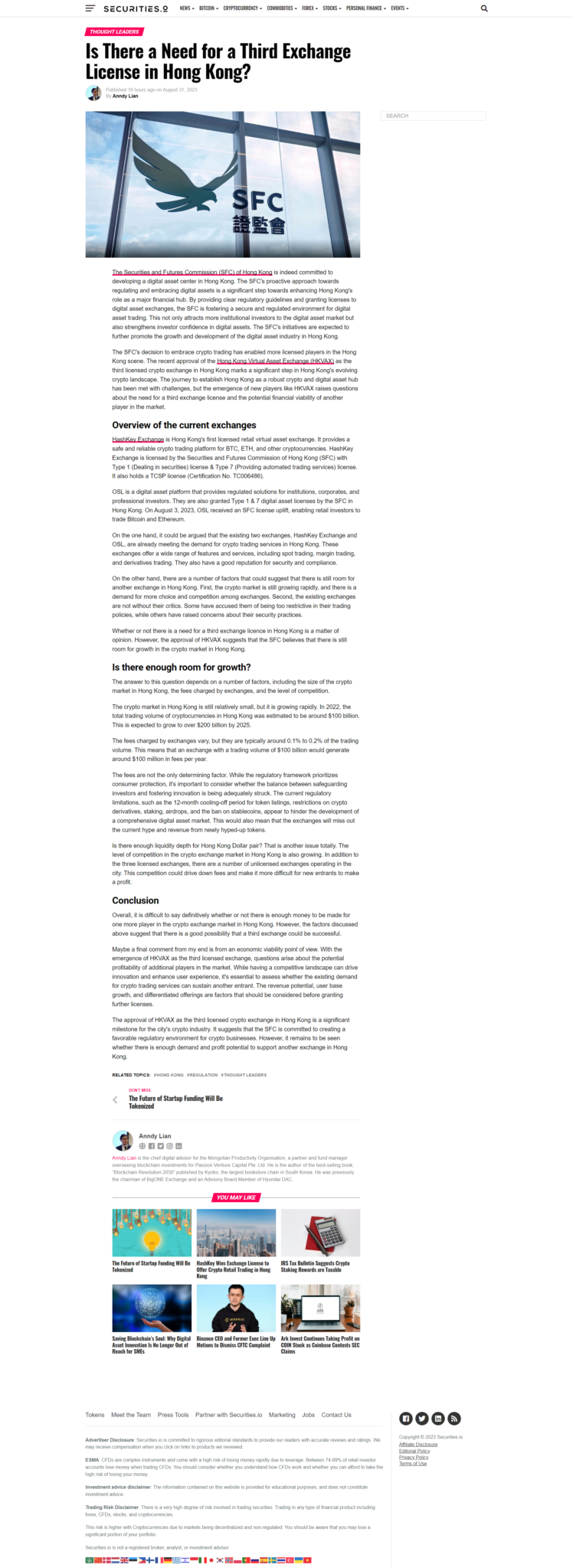
The Securities and Futures Commission (SFC) of Hong Kong is indeed committed to developing a digital asset center in Hong Kong. The SFC’s proactive approach towards regulating and embracing digital assets is a significant step towards enhancing Hong Kong’s role as a major financial hub. By providing clear regulatory guidelines and granting licenses to digital asset exchanges, the SFC is fostering a secure and regulated environment for digital asset trading. This not only attracts more institutional investors to the digital asset market but also strengthens investor confidence in digital assets. The SFC’s initiatives are expected to further promote the growth and development of the digital asset industry in Hong Kong.

The SFC’s decision to embrace crypto trading has enabled more licensed players in the Hong Kong scene. The recent approval of the Hong Kong Virtual Asset Exchange (HKVAX) as the third licensed crypto exchange in Hong Kong marks a significant step in Hong Kong’s evolving crypto landscape. The journey to establish Hong Kong as a robust crypto and digital asset hub has been met with challenges, but the emergence of new players like HKVAX raises questions about the need for a third exchange license and the potential financial viability of another player in the market.

Overview of the current exchanges

HashKey Exchange is Hong Kong’s first licensed retail virtual asset exchange. It provides a safe and reliable crypto trading platform for BTC, ETH, and other cryptocurrencies. HashKey Exchange is licensed by the Securities and Futures Commission of Hong Kong (SFC) with Type 1 (Dealing in securities) license & Type 7 (Providing automated trading services) license. It also holds a TCSP license (Certification No. TC006486).

OSL is a digital asset platform that provides regulated solutions for institutions, corporates, and professional investors. They are also granted Type 1 & 7 digital asset licenses by the SFC in Hong Kong. On August 3, 2023, OSL received an SFC license uplift, enabling retail investors to trade Bitcoin and Ethereum.

On the one hand, it could be argued that the existing two exchanges, HashKey Exchange and OSL, are already meeting the demand for crypto trading services in Hong Kong. These exchanges offer a wide range of features and services, including spot trading, margin trading, and derivatives trading. They also have a good reputation for security and compliance.

On the other hand, there are a number of factors that could suggest that there is still room for another exchange in Hong Kong. First, the crypto market is still growing rapidly, and there is a demand for more choice and competition among exchanges. Second, the existing exchanges are not without their critics. Some have accused them of being too restrictive in their trading policies, while others have raised concerns about their security practices.

Whether or not there is a need for a third exchange licence in Hong Kong is a matter of opinion. However, the approval of HKVAX suggests that the SFC believes that there is still room for growth in the crypto market in Hong Kong.

Is there enough room for growth?

The answer to this question depends on a number of factors, including the size of the crypto market in Hong Kong, the fees charged by exchanges, and the level of competition.

The crypto market in Hong Kong is still relatively small, but it is growing rapidly. In 2022, the total trading volume of cryptocurrencies in Hong Kong was estimated to be around $100 billion. This is expected to grow to over $200 billion by 2025.

The fees charged by exchanges vary, but they are typically around 0.1% to 0.2% of the trading volume. This means that an exchange with a trading volume of $100 billion would generate around $100 million in fees per year.

The fees are not the only determining factor. While the regulatory framework prioritizes consumer protection, it’s important to consider whether the balance between safeguarding investors and fostering innovation is being adequately struck. The current regulatory limitations, such as the 12-month cooling-off period for token listings, restrictions on crypto derivatives, staking, airdrops, and the ban on stablecoins, appear to hinder the development of a comprehensive digital asset market. This would also mean that the exchanges will miss out the current hype and revenue from newly hyped-up tokens.

Is there enough liquidity depth for Hong Kong Dollar pair? That is another issue totally. The level of competition in the crypto exchange market in Hong Kong is also growing. In addition to the three licensed exchanges, there are a number of unlicensed exchanges operating in the city. This competition could drive down fees and make it more difficult for new entrants to make a profit.

Conclusion

Overall, it is difficult to say definitively whether or not there is enough money to be made for one more player in the crypto exchange market in Hong Kong. However, the factors discussed above suggest that there is a good possibility that a third exchange could be successful.

Maybe a final comment from my end is from an economic viability point of view. With the emergence of HKVAX as the third licensed exchange, questions arise about the potential profitability of additional players in the market. While having a competitive landscape can drive innovation and enhance user experience, it’s essential to assess whether the existing demand for crypto trading services can sustain another entrant. The revenue potential, user base growth, and differentiated offerings are factors that should be considered before granting further licenses.

The approval of HKVAX as the third licensed crypto exchange in Hong Kong is a significant milestone for the city’s crypto industry. It suggests that the SFC is committed to creating a favorable regulatory environment for crypto businesses. However, it remains to be seen whether there is enough demand and profit potential to support another exchange in Hong Kong.


Source: https://www.securities.io/is-there-a-need-for-a-third-exchange-license-in-hong-kong/

Anndy Lian is an early blockchain adopter and experienced serial entrepreneur who is known for his work in the government sector. He is a best selling book author- “NFT: From Zero to Hero” and “Blockchain Revolution 2030”.

Currently, he is appointed as the Chief Digital Advisor at Mongolia Productivity Organization, championing national digitization. Prior to his current appointments, he was the Chairman of BigONE Exchange, a global top 30 ranked crypto spot exchange and was also the Advisory Board Member for Hyundai DAC, the blockchain arm of South Korea’s largest car manufacturer Hyundai Motor Group. Lian played a pivotal role as the Blockchain Advisor for Asian Productivity Organisation (APO), an intergovernmental organization committed to improving productivity in the Asia-Pacific region.

An avid supporter of incubating start-ups, Anndy has also been a private investor for the past eight years. With a growth investment mindset, Anndy strategically demonstrates this in the companies he chooses to be involved with. He believes that what he is doing through blockchain technology currently will revolutionise and redefine traditional businesses. He also believes that the blockchain industry has to be “redecentralised”.

j j j

Worldcoin is amidst a World War. Here’s How it Can Fight Back

Worldcoin is amidst a World War. Here’s How it Can Fight Back
  • The project that scans the users’ iris to validate their identity is facing significant regulatory battles in many countries.
  • Worldcoin must provide concise information outlining how data will be collected, used, and stored.

Worldcoin, an innovative project with a vision of establishing a global identity and financial network, aims to revolutionize the way we perceive digital identity and currency. Founded on the ambitious goal of granting majority ownership of this network to humanity, Worldcoin endeavors to unleash economic potential, ensure online privacy, enable democratic processes, and even lay the foundation for a Universal Basic Income funded by AI.

At its core, Worldcoin comprises two crucial elements: World ID, a privacy-focused digital identity network utilizing ‘proof of personhood’, and WLD, its digital currency. The World App serves as the main interface to World ID and the Worldcoin Protocol, developed by Tools for Humanity (TFH).

‘Proof of personhood’ forms the heart of Worldcoin’s concept, verifying individual human status and uniqueness. Successful implementation of World ID could set a global standard for validating personhood and overcome challenges in online voting as well as value distribution.

Worldcoin’s foundational principles include emphasizing ‘proof of personhood’ in the AI era, aligning network incentives for genuine human involvement, and drawing parallels with Bitcoin and Ethereum’s security models. However, challenges arise, particularly regarding the collection, handling, and privacy of biometric data.

World ID, backed by the Orb biometric device, offers a privacy-focused way to verify individual identity. While it promises enhanced security through unique biometric markers, it raises concerns about data storage and ethical usage. The diversity of data privacy regulations worldwide adds complexity, prompting concerns and regulatory scrutiny in countries like Kenya, the United Kingdom, India, and the United States.

Kenya suspended Worldcoin’s activities due to security, privacy, and financial issues, raising questions about data handling, ownership, and legality.

Additionally, The Information Commissioner’s Office, the U.K.’s data protection regulator, has said that it is “examining” the project and “making further inquiries” about its data collection practices. While India’s central bank, The Reserve Bank of India, has warned that Worldcoin is not legal tender and that using it as a payment instrument is illegal. Also, The U.S. Securities and Exchange Commission has not yet commented on Worldcoin, but some experts believe it could be classified as a security, subjecting it to stricter regulations.

In a world embracing digital transformation, Worldcoin’s proposal signifies a paradigm shift in identity and finance. However, the controversial aspects surrounding biometric data and regulatory challenges highlight the need for transparency, robust safeguards, and respectful adherence to privacy laws.

As Worldcoin strives to redefine the digital landscape, its journey underscores the intricate balance between innovation and ethical responsibility. The project’s success hinges on its ability to address concerns, collaborate with regulators, and ensure data security, providing a future where digital identity and financial networks coexist harmoniously on a global scale.

Vigilant in Avoiding Exploitation

To address privacy and data collection challenges, the project should prioritize enhanced transparency regarding its data collection and usage practices. Worldcoin must provide clear and concise information that outlines how data will be collected, used, and stored. It should obtain informed consent from individuals prior to collecting their biometric data is essential. Ensuring that individuals fully comprehend the implications of data sharing and voluntarily provide consent is paramount.

Worldcoin must be vigilant in avoiding any exploitation of vulnerable populations. The project’s marketing and recruitment strategies should adhere to ethical principles and avoid targeting those who may be more susceptible.

Also, collaboration with regulatory bodies is imperative. By engaging with regulators transparently and cooperatively, the project can effectively address any concerns raised and ensure compliance with relevant regulations.

Apart from tackling privacy concerns, Worldcoin can also strengthen its industry footprint to boost legitimacy. It can collaborate with organizations specializing in privacy and data protection that could aid in developing and implementing robust best practices for data collection and utilization.

Additionally, it should create a framework for data governance that would reinforce responsible and ethical data use, further safeguarding individuals’ information. Another step could be prioritizing investments in robust security measures is essential to prevent unauthorized access and misuse of sensitive data. And educating the public about the project’s objectives, practices, and safeguards is crucial for building trust and fostering understanding among potential users.

Casting a Shadow

The emergence of Worldcoin presents a captivating vision of a globally connected identity and financial network underpinned by innovative concepts like ‘proof of personhood’ and biometric authentication. The potential benefits encompass economic opportunities, enhanced online security, and even transformative social initiatives like a Universal Basic Income funded by AI.

Nevertheless, the project has encountered its share of controversy, primarily revolving around collecting and managing sensitive biometric data. While using biometric markers for identity verification holds promise, concerns about data privacy, security, and ethical considerations have cast a shadow over Worldcoin’s ambitious goals.

Source: https://www.financemagnates.com/cryptocurrency/worldcoin-is-amidst-a-world-war-heres-how-it-can-fight-back/

Anndy Lian is an early blockchain adopter and experienced serial entrepreneur who is known for his work in the government sector. He is a best selling book author- “NFT: From Zero to Hero” and “Blockchain Revolution 2030”.

Currently, he is appointed as the Chief Digital Advisor at Mongolia Productivity Organization, championing national digitization. Prior to his current appointments, he was the Chairman of BigONE Exchange, a global top 30 ranked crypto spot exchange and was also the Advisory Board Member for Hyundai DAC, the blockchain arm of South Korea’s largest car manufacturer Hyundai Motor Group. Lian played a pivotal role as the Blockchain Advisor for Asian Productivity Organisation (APO), an intergovernmental organization committed to improving productivity in the Asia-Pacific region.

An avid supporter of incubating start-ups, Anndy has also been a private investor for the past eight years. With a growth investment mindset, Anndy strategically demonstrates this in the companies he chooses to be involved with. He believes that what he is doing through blockchain technology currently will revolutionise and redefine traditional businesses. He also believes that the blockchain industry has to be “redecentralised”.

j j j