Who owns the most voyager crypto? VGX tokens are also distributed among troubled platform’s customers

Who owns the most voyager crypto? VGX tokens are also distributed among troubled platform’s customers

Voyager Digital has been making headlines ever since the crypto platform filed for Chapter 11 bankruptcy protection in July 2021. The company is engaged in ongoing court proceedings.

Here we take a look at the voyager (VGX) tokens circulating supply and analyse who owns the most VGX.

Voyager Digital: Origins & token history

Voyager Digital is a US-based cryptocurrency platform that was founded in 2017 by a team of finance and technology industry veterans, including the firm’s CEO Stephen Ehrlich, chairman Philip Eytan and Gaspard de Dreuzy, a serial entrepreneur.

In addition to being a crypto company, Voyager Digital is a publicly traded company listed on the Toronto Stock Exchange (TSX) since 2021 under the ticker VOYG.

As of September 2022, the company hosts over 100 different digital assets through its mobile application and allows clients to earn rewards of up to 12% annually on more than 40 cryptocurrencies.

The Voyager token (VGX) is the platform’s native cryptocurrency. It’s designed to reward customers for their loyalty. It was based on the Ethos Token. In 2019, Voyager acquired Ethos.io and incorporated the team, technology and native token into its ecosystem.

Until 2020, Voyager operated with a multi-token functionality. After 2020, the company integrated its native tokens into a new single token model known as VGX 2.0. Today, VGX maintains a presence on the Ethereum blockchain as an ERC20 cryptocurrency.

According to the project’s whitepaper, Voyager utilises the VGX 2.0 token to boost the platform’s adoption and functionality. Holding VGX allowed users to earn 7% staking rewards and raise their earnings by joining the Voyager Loyalty Program.

The VGX token was met with enthusiasm. The price rose to an all-time high of $11.02 just six months after the token launched in 2017. The bullish run was short-lived, and the price fell by 96.7% to $0.3678 by August 2018.
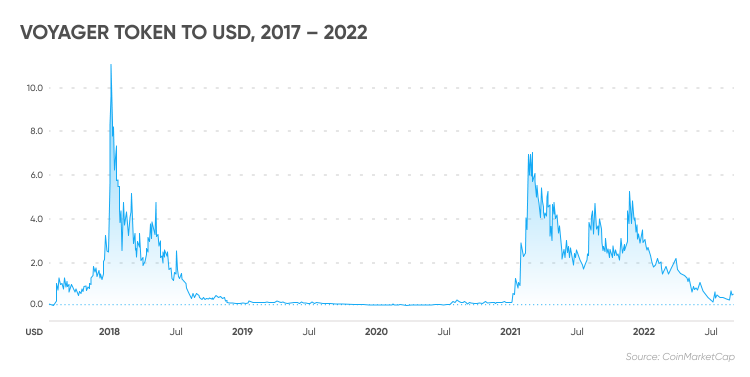
Voyager token to USD, 2017 – 2022

The next big jump took place between January and February 2021, when VGX surged 3,267% to $6.9023, from levels as low as $0.2. Around this time, the Uniswap (UNI) token became available on the Voyager platform.

On 22 November 2021, VGX surged to $5 amid a positive general crypto market sentiment, however, this was the token’s last peak as it embarked on a bearish run. But since its November high, the VGX has lost more than 75% of its value, sliding down to $0.9188.

Latest voyager crypto news

In July 2021 Voyager filed for Chapter 11 bankruptcy protection, as it was heavily affected by the global crypto crash. Since then, the company has been in and out of court proceedings.

As Voyager moves through the Chapter 11 bankruptcy process, latest filings revealed on 8 September that the company will auction off the remainder of its assets on 13 September. The results of the auction will become final during a court hearing approving them on 29 September.

In the latest voyager token news, potential buyers remained unnamed. However, bids previously made by the crypto trading platform FTX were made public. FTX said in a press release on 22 July that it would buy Voyager’s assets and loans at cash value and open accounts for Voyager customers on FTX. This proposal, however, was branded a “low-ball” bid by Voyager’s lawyers.

In a second-day hearing presentation on 4 August, the company stated that it had received “higher and better” buyout offers. As of 12 September, Voyager said that it was contacted by 88 potentially interested buyers and was in “active discussions” with 20.

Who owns the most Voyager crypto?

So, who owns the most Voyager crypto and how is the token distributed?

When Voyager decided to integrate its tokens (VGX and LGO (the native token of a company Voyager acquired) into one, VGX was exchanged for VGX 2.0 (now known as VGX) at a 1:1 rate. LGO’s exchange rate to VGX 2.0 was 6.5356340619:1.

The circulating supply of VGX tokens stood at 222 million. The circulating supply of LGO was over 33 million. Following the token swap, Voyager chose to mint a growth pool of tones on an annual basis to power Voyager Loyalty Program rewards, as well as fund promotional campaigns for new and existing customers.

Hence, 40 million new tokens were minted in the first year since the integration, 20 million will be minted in the second year and 10 million between the third and eight years.

According to data provided by CoinMarketCap, the total and circulating supply of VGX, as of 12 September, surpassed 278 million tokens. The maximum supply stood at 297 million.

Voyager also introduced a new initiative called the Voyager Loyalty Program, which Voyager customers can qualify for by maintaining a number of VGX tokens in their accounts. The programme has three tiers:

  • Adventurer – customers holding over 500 VGX
  • Explorer – customers holding over 5,000 VGX
  • Navigator – customers holding over 20,000 VGX

The more VGX customers stake, the higher they move up these tier categories and the more rewards they earn with each tier.

So, who owns the most Voyager crypto?

Over the last few months, VGX whales have gradually reduced their holdings. However, data revealed by etherscan.io showed that the top 100 VGX token holders, as of 12 September, collectively owned 97.62% of the total supply in circulation.

The website noted that the top account holding the most voyager tokens owned 93.9% of the circulating supply, which amounted to 208 million VGX tokens worth $191m, as of 12 September. According to the website, the account’s address is 0x933bb73de8fcfb74415fbc99561623c593bf3b61.

The second biggest VGX whale owned 1.9% of the total circulating supply, amounting to four million VGX tokens.

The third biggest VGX holder was an account under the address ‘Binance 8’ that held around 0.18% of the total circulating supply, amounting to around 395,757 tokens.

The fourth and fifth biggest voyager coin whales owned around 0.14% of the total circulating supply.

Final thoughts

While knowing who owns voyager crypto may be useful for the coin’s enthusiasts, it shouldn’t be used as a sole reason to trade. Nearly all of the maximum VGX supply is in circulation, as of the time of writing (12 September), which could lead to the possibility of greater volatility. Investors are warned to exercise caution.

According to Invezz’s analyst Crisous Nyaga, “uncertainty about the Voyager collapse and low volume trading could lead to market manipulation.

“The coin’s future is uncertain and it will depend on the outcome of the bankruptcy proceedings. If the firm moves completely out of business, there is a possibility that the VGX token will not survive. On the other hand, if it is acquired, there is a possibility that the coin will continue doing well.”

Anndy Lian, chief digital advisor at the Mongolian Productivity Organisation and the author of NFT: From Zero to Hero, told Capital.com that retail investors are buying VGX based on rumours that the company will be acquired by either Binance or FTX.

“I noted that the current investors are still working very hard promoting in different channels with the hope of making the VGX a more viable choice for new investors and perhaps drawing more attention so that the buyout can complete faster. These are positive signs from the community members who want the token to do well and resume their staking and cashback rewards,” he stressed.

Note that analysts’ predictions and opinions can be wrong. Always conduct your own due diligence before trading. And never invest or trade money you cannot afford to lose.


Source: https://capital.com/voyager-who-owns-most-vgx-crypto-tokens

Anndy Lian is an early blockchain adopter and experienced serial entrepreneur who is known for his work in the government sector. He is a best selling book author- “NFT: From Zero to Hero” and “Blockchain Revolution 2030”.

Currently, he is appointed as the Chief Digital Advisor at Mongolia Productivity Organization, championing national digitization. Prior to his current appointments, he was the Chairman of BigONE Exchange, a global top 30 ranked crypto spot exchange and was also the Advisory Board Member for Hyundai DAC, the blockchain arm of South Korea’s largest car manufacturer Hyundai Motor Group. Lian played a pivotal role as the Blockchain Advisor for Asian Productivity Organisation (APO), an intergovernmental organization committed to improving productivity in the Asia-Pacific region.

An avid supporter of incubating start-ups, Anndy has also been a private investor for the past eight years. With a growth investment mindset, Anndy strategically demonstrates this in the companies he chooses to be involved with. He believes that what he is doing through blockchain technology currently will revolutionise and redefine traditional businesses. He also believes that the blockchain industry has to be “redecentralised”.


j j j

With Ethereum ‘Merge’ around the corner, what happens to Bitcoin?

With Ethereum ‘Merge’ around the corner, what happens to Bitcoin?

I shared this with Murtuza over the weekend. The shift to PoS does add pressure to Bitcoin’s energy consumption issue. The amount of energy consumed is one of the key criticism and when Ethereum shifted to PoS completely next week, Bitcoin will become the only top dog left to be on PoW. All eyes will be on Bitcoin. The green experts will find ways to scrutinize Bitcoin. The regulators will find ways to control Bitcoin and targeting PoW seems to be the right move.

The second thing I want to point out is about the perception of Bitcoin. In the longer term, say 30 years down the road when Bitcoin issuance is near zero, another problem we need to face is how the blockchain stays secure. As Ethereum abandons PoW and stating their standpoint, I think this issue will become a spotlight and can indirectly giving the perception that Bitcoin will be unstable and will not be a real asset in the future.

In my humble opinion, we need to solve the issues step by step. Perhaps new protocol innovation can change that.

Another friend of mine also shared this with me on the phone. And I do agree with him too.

“As long as Bitcoin stays in the number 1 position and Satoshi remains a mystery, Ethereum’s shift to PoS will not put a dent in Bitcoin to any image. Regulators can find fault with Ethereum, because their founder is in sight, well not Satoshi.

Ethereum’s price has outperformed Bitcoin in recent weeks because everyone is hopeful that the merge will enhance the blockchain, but its not and also environmentally friendly. But as we all know, the environmental angle will not last long. Ethereum had fallen so badly compared to Bitcoin since the end of last year. This narrative will not stand.”

With Ethereum ‘Merge’ around the corner, what happens to Bitcoin?

The Ethereum upgrade may bring more regulatory scrutiny on Bitcoin for its energy consumption. While there could be pressure on Bitcoin, there won’t be much of an overall impact, some experts say.

There seems to be no certainty on how Bitcoin, the dominant cryptocurrency, will be affected once Ethereum, the second-largest digital currency, completes its upgrade to a more energy-efficient network.

Ethereum founder Vitalik Buterin has said the upgrade, known as The Merge, is anticipated September 13-15, when it will conclude the shift from the energy-guzzling Proof Of Work (PoW) consensus to the Proof of Stake (PoS) validation method.

Ethereum, with a market capitalisation of $204 billion – half that of Bitcoin – started the first phase of the upgrade last week as it targets building a dependable decentralised ecosystem for the financial future.

In the PoS system, participants known as validators lock in their holdings of cryptocurrency or crypto token (their stake) to the blockchain to validate new transactions and earn rewards. However, they could lose their stake if their validation is inaccurate or fraudulent.

This contrasts with PoW, which uses a lot of energy to mine tokens by using computers to solve mathematical equations. The high energy consumption is a serious drawback for PoW, which continues to be the foundation of Bitcoin mining.

Pressure on Bitcoin

The energy issue is not the only macroeconomic risk for the crypto ecosystem. Other matters such as political unrest, high inflation rates, and hawkish national monetary policies are said to also have led to the present bear market.

Bitcoin reached an all-time high price of $69,000 in November 2021. Since then, the world economy has been struggling and this has caused a sharp decline in the price of Bitcoin (almost 70 percent) and other cryptocurrencies.

The short-term price forecast for the most popular cryptocurrency is still unclear as Bitcoin’s price fluctuates and hovers around $21,000 per coin.

While it is not clear what might aid Bitcoin’s recovery, Ethereum’s network upgrade, which seeks to position its ecosystem as the currency of the future, may put even more pressure on Bitcoin’s usefulness as volatility continues to alarm mainstream investors.

According to Anndy Lian, the author of NFT: From Zero to Hero, the shift to PoS does add pressure to Bitcoin’s energy consumption issue.

“Green experts will find ways to scrutinise Bitcoin. The regulators will find ways to control Bitcoin and targeting PoW seems to be the right move,” Lian said.

He added that over the course of the next three decades, when Bitcoin issuance is near zero, another problem will be how the blockchain stays secure.

“This issue (of Bitcoin’s PoW consensus) will become a spotlight and can indirectly give the perception that Bitcoin will be unstable and will not be a real asset in the future. In my humble opinion, we need to solve the issues step by step. Perhaps new protocol innovation can change that,” Lian said.

“Bitcoin isn’t likely to become more sustainable any time soon,” said Digiconomist, a science and technology publication that tracks Bitcoin energy consumption. The findings gained support after China tightened down on cryptocurrency mining, which sharply reduced the proportion of renewable energy sources used to run the network.

According to Alex de Vries, a researcher and critic of cryptocurrencies, “Bitcoin got dirtier after the Chinese mining crackdown in 2021.”

Hard to change

Ali Merchant, lead developer relations engineer at Akash Network, which works in cloud computing, said that as lucrative as it may sound, changing Bitcoin from PoW to PoS is technically very challenging.

“Even if a group of people decided to implement that change, it would be very difficult to get more than 51 percent of the votes on a network. Pair that up with Bitcoin Maxis who think that PoS could compromise the decentralisation of Bitcoin. To add to that, people who make tons of money out of Bitcoin farming will most likely oppose this kind of proposal,” he said.

This would be true of the Ethereum network, too. Ethereum will also be forked, with one chain continuing to PoW-based validation. Thus, it would be naive to conclude that all PoW chains can be migrated to PoS.

Should Bitcoin too migrate to PoS, it would make some people very upset, although there could be increased adoption of the coin as it would be more eco-friendly.

“Bitcoin migration isn’t coming anytime soon. If it does, it might just see a spike in trading volumes,” Merchant said.

After the Ethereum integration, only 23 percent of the total crypto volumes will be based on PoW, mostly Bitcoin. Regulators will now search for ways to regulate cryptocurrency, with the apparent first step being to target PoW.

Bitcoin’s reputation as a power hog continues to be one of its weaknesses.

In contrast to PoW, which cannot be utilised for the metaverse or non-fungible tokens (NFTs), Ethereum is establishing the framework for PoS. However, other cryptocurrencies may create new protocols and governance models.

With Bitcoin’s future being uncertain, competition, regulation, and energy issues are only a few of the elements at play.

“If we look at investor trends, however, no one holds their bigger capital in Ethereum – people will hold big capital in Bitcoin,” said Raj Kapoor, founder of the India Blockchain Alliance. “Bitcoin will always be like digital gold and Ethereum like fiat money, so while there would be a dip in Bitcoin prices, there would not be much of an impact.”

However, Kapoor said a sharp dip could be expected in the immediate term. The fear that the Bitcoin network may be “regulated away” may also cause the price of Bitcoin to move lower, he said.

Source: https://www.moneycontrol.com/news/business/cryptocurrency/with-ethereum-merge-around-the-corner-what-happens-to-bitcoin-9165191.html

Anndy Lian is an early blockchain adopter and experienced serial entrepreneur who is known for his work in the government sector. He is a best selling book author- “NFT: From Zero to Hero” and “Blockchain Revolution 2030”.

Currently, he is appointed as the Chief Digital Advisor at Mongolia Productivity Organization, championing national digitization. Prior to his current appointments, he was the Chairman of BigONE Exchange, a global top 30 ranked crypto spot exchange and was also the Advisory Board Member for Hyundai DAC, the blockchain arm of South Korea’s largest car manufacturer Hyundai Motor Group. Lian played a pivotal role as the Blockchain Advisor for Asian Productivity Organisation (APO), an intergovernmental organization committed to improving productivity in the Asia-Pacific region.

An avid supporter of incubating start-ups, Anndy has also been a private investor for the past eight years. With a growth investment mindset, Anndy strategically demonstrates this in the companies he chooses to be involved with. He believes that what he is doing through blockchain technology currently will revolutionise and redefine traditional businesses. He also believes that the blockchain industry has to be “redecentralised”.
j j j

XRP to USD forecast: Can Ripple price finally reverse long-term downward trend?

XRP to USD forecast: Can Ripple price finally reverse long-term downward trend?

Ripple is one of the most talked about coin.

– What has been affecting the Ripple coin price recently?

The on-going, never ending and changing lawsuit is one of the key uncertainties. SEC has a different angled strategy against Ripple through Wahi complaint. This added insider trading allegations against 2 other Coinbase employees and putting 9 other cryptocurrencies as securities. If the SEC wins the case, this would set a precedent and would cause more problems for the crypto industry as a whole.

This outcome for Ripple might affect their On-Demand Liquidity (ODL) service. And if U.S. banks are not going with the ODL plans, this will then weaken Ripple’s CBDC setup and investors will not be very happy.

– Where could the token be headed in the future

According to CoinMarketCap price prediction function, 1222 users voted and predicted that the price of XRP will be around $0.4905 by 30 September 2022. This is a 47.86% increase in the current price. I must say that the supporters are still considerably bullish on the coin and hope they can get out of the lawsuit quickly.

I am more realistic at this point. I hope to see more signed partnerships that are actually useful, not for PR purposes and see more real implementations in a larger manner, not purely news on how they help streamline Japan-Thailand money transfers. I hope to see more details. I am sure the investors at large want to see more too.


XRP to USD forecast: Can Ripple price finally reverse long-term downward trend?


Ripple (XRP/USD) is among the top 10 largest cryptocurrencies by market capitalisation. Dubbed a “better alternative to bitcoin”, Ripple aims to futurise global payments.

However, in recent years the company has been caught in the midst of a US Securities and Exchange Commission (SEC) filing, with its native cryptocurrency, XRP, struggling to reach past highs…for over four years.

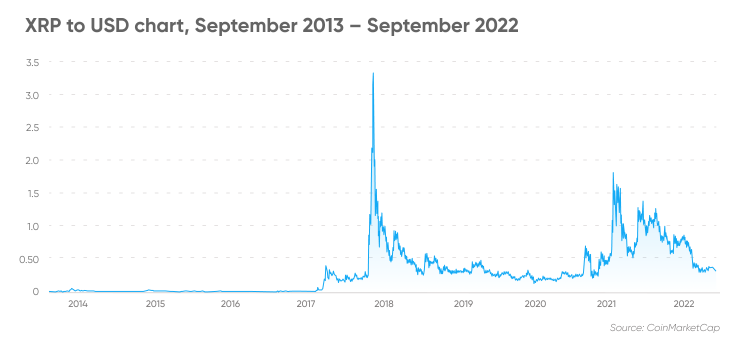
Down by 90.3 % since its 2018 all-time high of $3.3778, at the time of writing (5 September) the XRP to USD exchange rate stood at $0.3275. Can the token repeat the record levels, and what is the latest news on the SEC case?

What is XRP/USD and Ripple?

Ripple was created in 2011 by engineers David Schwartz, Jed McCaleb and Arthur Britto. They began developing the XRP Ledger (XRPL),  a decentralised, permissionless, open-source, public blockchain.

The Ripple platform is a payment settlement system and currency exchange network using XRP Ledger Consensus Protocol. The network prides itself in its transaction speed, which according to its website, can take between three and five seconds and has low transaction fees that are “typically” under $0.01.

Ripple’s distributed consensus mechanism uses designated servers called validators, who have to agree on the order and outcome of transactions on the platform to enable them. Transactions are made in XRP coins, the platform’s native cryptocurrency.

The token can be sent to other users directly without the need of a central intermediary. XRP coins are freely exchanged on the open market and used in the real world for enabling cross-border payments and microtransactions.

Upon the token’s launch, XRPL’s founders gifted 80 billion XRP to the company. Ripple has since put the majority in escrow. As of August 2022, 44bn tokens remain in escrow.


What is your sentiment on XRP/USD?

XRP/USD price analysis

Unlike many of its rival cryptocurrencies that gained popularity in late 2021, XRP achieved its first success in the early months of 2018 as it was teaming up with a number of legacy financial institutions, like American Express and Santander. The token spiked to the all-time high of $3.3778 in January 2018, yet the rally was short-lived as XRP fell below $1 in late February. XRP to USD chart, September 2013 – September 2022

After two years of fluctuating between $0.60 and $0.10, the XRP coin price rebounded to $1.8391 on 14 April 2021 amid wider cryptocurrency bull run.

Throughout the remainder of 2021, the XRP to USD chart suffered fluctuations, rising as high as $1.3894 at the start of September 2021 and dropping as low as $0.7993 by mid-December.

At the start of 2022, XRP was holding steady at $0.80. It dropped to $0.30 as Russia’s invasion of Ukraine and surging inflation started to affect broader cryptocurrency sentiment. As of 5 September, the current exchange rate of XRP to USD stood at $0.3275.


SEC’s case against Ripple

In December 2020, Ripple found itself in the midst of a SEC filing, which accused the company’s top executives, co-founder Christian Larsen and CEO Bradley Garlinghouse, of misleading XRP investors by selling $1.3bn worth of coins without reporting to the commission. The SEC had also accused the executives of profiting from the trade by around $600m.

In March 2022, the court denied the SEC’s request to strike Ripple’s fair notice defence, which argued that contrary to the case, the company did not receive a fair warning that its sales of XRP coins could be in violation of security laws.

In July 2022, Ripple won a ruling that will allow the company to access emails from the SEC about a 2018 speech where a former official declared that Ethereum was not a security. The evidence could help Ripple in arguing that XRP cannot be labelled as such. The SEC, however, continued to battle this ruling and filed a brief arguing that the speech drafts “are not relevant to any claim or defense in this case”.

On 19 August, Ripple filed a motion to seal the identities of non-parties, some company employees and the personal financial information of employees. The SEC replied, clarifying that in doing so, it “does not concede that the above categories of information should properly be sealed for summary judgement briefing, and reserves its rights to oppose similar sealing requests for summary judgement.”

The judge granted the SEC’s request to file a 90-page long reply to its motion that seeks to exclude the testimony of Ripple Labs’ witnesses.

The outcome of the court proceedings could remain the key factor affecting the movements on the XRP chart. As of 5 September, analysts and investors await 9 September, when both parties are expected to seal any portion of the filings together with proposed redaction.

Responses to the motion must be submitted by 16 September. Motions for summary judgement are expected by 15 September,  and any opposition to that must be received by 18 October and answered by 15 November. The coming months will be of great importance for Ripple enthusiasts.

“The ongoing, never ending and changing lawsuit is one of the key uncertainties. SEC has a different angled strategy against Ripple through Wahi complaint. This added insider trading allegations against two other Coinbase employees and put nine other cryptocurrencies as securities,” said Anndy Lian, chief digital advisor of the Mongolian Productivity Organisation.
“If the SEC wins the case, this would set a precedent and would cause more problems for the crypto industry as a whole,” he told Capital.com.

On 21 July, the SEC filed a complaint against Ishan Wahi,  Coinbase’s manager in its assets and investing products division, and two other employees, accusing them of insider trading and securities fraud. In the filing, the commission noted that the nine coins Wahi and other defendants traded were “crypto asset securities”.


XRP to USD forecast for 2022 and beyond

Despite the latest downward price action, algorithm-based forecasting service Wallet Investor gave a bullish XRP to USD crypto exchange rate prediction as of 5 September. The site noted that XRP is “an outstanding long-term investment”, adding that it has a long-term earning potential amounting to 284.71%.

Based on its analysis of past price performance, Wallet Investor predicted that the token could trade at $0.517 in 2023 and reach $1.258 by 2027.

DigitalCoinPrice supported the positive XRP to USD future exchange rate forecast at the time of writing, expecting the token to grow to $0.48 by the end of 2022 and reach $1.50 by the end of 2025.

By the end of 2027, the site predicted that the exchange rate of XPR to USD could reach $1.63. The website’s long-term forecast for the token showed that the cryptocurrency could surge to $4.63 by 2030.

Mark Fidelman, founder of SmartBlocks, was bullish on XRP to USD exchange rate, yet noted that the outcome of the SEC case will play a crucial role in shaping Ripple’s future.

“If [Ripple wins] the lawsuit, it should be heading back up to over a buck by the end of year, maybe more…It’s more effective and more efficient than anything that the banks are doing, so it should scare the banks and should help crypto,” he told Capital.com.

Note that predictions about the future of XRP can be wrong. Forecasts and analyst expectations shouldn’t be used as a substitute for your own research. Always conduct your own due diligence looking at the latest news, price charts.  technical and fundamental analysis.

Remember that past performance does not guarantee future returns. And never trade money that you cannot afford to lose.


Source: https://capital.com/xrp-usd-forecast-dollar-ripple-price

Anndy Lian is an early blockchain adopter and experienced serial entrepreneur who is known for his work in the government sector. He is a best selling book author- “NFT: From Zero to Hero” and “Blockchain Revolution 2030”.

Currently, he is appointed as the Chief Digital Advisor at Mongolia Productivity Organization, championing national digitization. Prior to his current appointments, he was the Chairman of BigONE Exchange, a global top 30 ranked crypto spot exchange and was also the Advisory Board Member for Hyundai DAC, the blockchain arm of South Korea’s largest car manufacturer Hyundai Motor Group. Lian played a pivotal role as the Blockchain Advisor for Asian Productivity Organisation (APO), an intergovernmental organization committed to improving productivity in the Asia-Pacific region.

An avid supporter of incubating start-ups, Anndy has also been a private investor for the past eight years. With a growth investment mindset, Anndy strategically demonstrates this in the companies he chooses to be involved with. He believes that what he is doing through blockchain technology currently will revolutionise and redefine traditional businesses. He also believes that the blockchain industry has to be “redecentralised”.

j j j