Cosmos crypto price prediction: Where next after Terra’s crash?

Cosmos crypto price prediction: Where next after Terra’s crash?

ATOM, the native token of the Cosmos network, saw a bullish run in 2021, surging 453.3%.  In the beginning of 2022 the token continued the momentum, rising above $40. But, the surge was short-lived amid negative sentiment in the cryptocurrency markets fuelled by Russia’s invasion of Ukraine.

The crash of the LUNA token and the TerraUSD (UST) stablecoin at the start of May 2022, both based on the Cosmos network, were also key driving points in the cosmos cryptocurrency’s decline.

Where is the token headed now? Here we take a look at what factors are shaping the cosmos crypto forecast for 2022 and beyond.

What is cosmos (ATOM)?

Coined as “the Internet of Blockchains” by its founding team, Cosmos aims to build an ecosystem of independent interconnected blockchains, allowing them to “interoperate while retaining their security properties”. It was co-founded by Jae Kwon and Ethan Buchman in 2016.

Blockchains can interact through its architecture of zones. Users can build multi-asset public Proof-of-Authority (PoA) and Proof-of-Stake (PoS) blockchains, like the Cosmos Hub.

Through this the network aims to solve a number of limitations of cryptocurrencies, including scalability, usability and sovereignty. The end goal, the platform’s website notes, “is to create an Internet of Blockchains, a network of blockchains able to communicate with each other in a decentralised way.”

The network’s focus on customisability and interoperability sets it apart from other projects.

Cosmos is based on the Tendermint Byzantine Fault Tolerance (BFT) consensus algorithm designed to ensure finality, order consistency and optional availability. The network also consists of the Cosmos SDK, an industry standard for building blockchains.

Cosmos’ IBC (inter blockchain communication) allows blockchains within the ecosystem to connect so that they can transfer tokens and other data between one another frictionlessly and seamlessly.

In addition, users can also create marketplaces allowing for permissionless global trade. They can build autonomous application-specific blockchains, rather than smart contracts, to avoid high transaction fees and network congestion.

Moreover, users can also create games with unique collectibles in the form of non-fungible tokens (NFTs) and character upgrades that they can monetise without third-party approval or app store fees.

According to the network’s website, there are currently (30 May) 265 apps and services on Cosmos, including the Binance Chain (BNB), Terra (LUNA) and Crypto.org (CRO), with over $66bn of digital assets under management.

While the Cosmos Hub is a multi-asset distributed ledger, it offers ATOM, its native token. ATOM is the only staking token of the Cosmos Hub, and acts as a licence, allowing holders to vote, validate or delegate to other validators.

The token can also be used to pay for fees on the platform to mitigate spam, similar to Ethereum’s ETH. The token provides security to the chain, allows holders to earn rewards and vote.

As of 30 May, there are over 289m tokens in circulation, according to CoinMarketCap. The token has a market capitalisation surpassing $2bn and is ranked as the 29th biggest cryptocurrency on the platform.

The bullish run: Technical view

The ATOM cryptocurrency was listed on CoinMarketCap in March 2019. It was trading in bearish territory until the start of 2021. In February 2021, ATOM  surged by 174.2% from the low of $7.3839 to its first peak of $20.25 on 13 February. Between February and May, the token managed to grow an additional 42.1%, reaching above $28 by 9 May 2021.

The ATOM crypto value bottomed out between May and July, dropping by 67% to $9.4857 on 20 July 2021. This bear trend provided an opportunity for a new bull run, which saw the ATOM/USD price surge to the all-time high of $44.54 on 19 September 2021.

The token’s record level came ahead of the platform’s participation at Mainnet 2021, an immersive, agenda-setting summit held annually for crypto industry leaders.
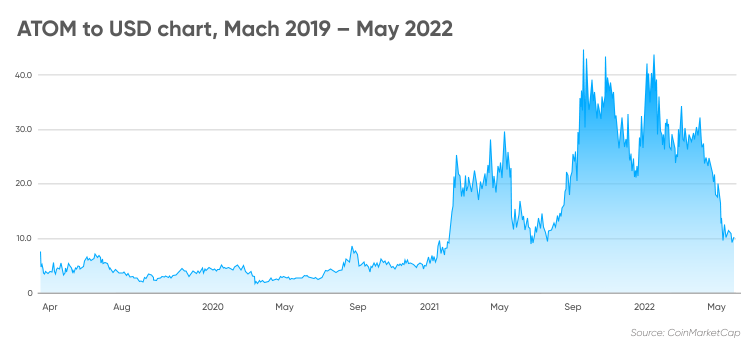
ATOM to USD chart, Mach 2019 – May 2022

ATOM saw new highs once again in October 2021, surging to $43.22 on 26 October 2021 as Cosmos announced that Terra became the latest chain to enable IBC, bringing its native LUNA cryptocurrency as well as its TerraUSD (UST) stablecoin with it.

The cosmos cryptocurrency entered 2022 on a positive note, surging by 97.9% to $41.99 on 4 January 2022 from its $21.22 17 December 2021 low. A second surge followed on 16 January 2022, which saw ATOM’s value rise to $43.61. This was due to several reasons.

Firstly, Cosmos reported to have neared EVM-protocol compatibility, which would allow assets and projects that operate on the Ethereum network to migrate over to Cosmos. Secondly, the project announced that a liquidity staking module was coming to the platform, which would give additional functionality to the stakes chain assets.

That, however, was the last time ATOM was so close to its all-time high as it embarked on a bearish run for the remainder of 2022. Wider negative crypto market sentiment was fuelled by the start of the war between Russia and Ukraine, as well as bitcoin (BTC) falling below $27,000.

What is your sentiment on ATOM/USD?

The token lost around 79% of its value, hitting as low as $9 by mid-May 2022, as seen on the chart above. Today (30 May), the coin is valued at $9.94.

ATOM technical analysis provided by CoinCodex, as of the time of writing (30 May), showed that sentiment on the token was largely bearish.

Relative Strength Index (RSI) reading of 32.5 was neutral yet extremely close to oversold territory. A reading of 30 or below would indicate that the asset has become undervalued and a trend reversal is likely. Meanwhile, the token was trading above its three-day moving average but below its five and 10-day moving averages.

Can ATOM recover?

In the latest cosmos crypto news, the network’s Gravity Bridge announced a number of milestones at the start of March 2022, including the introduction of ATOM with Ethereum DeFi and the Cosmos NFT platform, Stargaze, working with Gravity Bridge to send NFTs from Ethereum to Cosmos.

In April 2022, Cosmos introduced  its Theta upgrade which saw the official launch of Interchain Accounts, a module that has the potential to boost interoperability, traffic and composability.

In May 2022, KYVE, the Web3 data lake solution, joined the Cosmos ecosystem and migrated most of its blockchain protocol from EVM-based chain to the Cosmos SDK-based chain.

At the beginning of May 2022, the prices of the LUNA cryptocurrency and the UST stablecoin crashed, losing over 90% of their values within days. The tokens were based on the Cosmos network.

“As always, the cosmos ecosystem will continue to be a nurturing and safe environment for bold entrepreneurs to bring forth the Internet of Blockchains. Tendermint, IBC and the @cosmos SDK are showing the world how resilient & secure they are under extreme market conditions,” Cosmos said on Twitter during the LUNA crash.

In December 2021, Cosmos promised that its hub will continue to grow in the coming year, announced the launch of interchain security and accounts, more decentralised finance (DeFi) projects and the rise of NFTs.

“Cosmos is not a new token. It has been around since 2017 and has survived through all the down periods. Cosmos constantly remained in the top 50,  although many new investors may not have heard of it as it is not marketed that aggressively unlike Polygon or Binance Smart Chain,” BigOne Exchange chair in Asia, Anndy Lian told Capital.com.

According to Lian, the ATOM token took off because the Cosmos network offers “a simple experience for blockchain developers” with  “easy-to-understand tutorials, tools, and community assistance for developers.”

In 2020, Jae Kwon stepped down from his position as one of the project’s co-founders to focus on a different project. This, according to Lian, is one of the biggest uncertainties for the Cosmos prediction.

“He exited back then after several high-ranked employees left the company in protest of his leadership and it was reported that Kwon’s return to NewTendermint has continued to feud with his former Tendermint colleagues. I am not sure what is the truth and what are the backstories for this, but I think the lack of unity within their group makes this token vulnerable,” he noted.

Lian added that at the moment, ATOM has a strong support around the $9 range.

“Falling below this amount would mean that it may go below its launch price. This could happen too. Apart from the internal risks, I would caution all to look at external risks to manage your portfolio better.”

Cosmos (ATOM) price prediction 2022-2030

Despite the latest downward price action, algorithm-based forecasting service Wallet Investor gave a bullish outlook for its ATOM prediction, as of 30 May, suggesting ATOM is “an awesome long-term investment” with long-term earning potential at 752.13%.

Based on its analysis of past price performance, Wallet Investor’s cosmos coin price prediction suggested that the token could trade at $26.389 in 2023 and $84.685 by 2027.

DigitalCoinPrice also gave a positive ATOM crypto price prediction but saw a much slower pace of growth in future years. The site projected that ATOM could reach the target price of $13.76 by the end of 2022, $18.73 by the end of 2024 and $24.33 by 2025.

By the end of 2027, the site’s cosmos crypto price prediction expected that the coin could reach $34.02. Its long-term ATOM coin price prediction showed the cryptocurrency could trade at $49.10 by 2030.

Note that algorithm-based and analysts’ projections can be wrong. Forecasts and analysts’ expectations shouldn’t be used as substitutes for your own research. Always conduct your own diligence and remember that your decision to trade or invest should depend on your risk tolerance, expertise in the market, portfolio size and goals.

Keep in mind that past performance doesn’t guarantee future returns. And never invest or trade money you cannot afford to lose.


Original Source: https://capital.com/cosmos-atom-price-prediction

Anndy Lian is an early blockchain adopter and experienced serial entrepreneur who is known for his work in the government sector. He is a best selling book author- “NFT: From Zero to Hero” and “Blockchain Revolution 2030”.

Currently, he is appointed as the Chief Digital Advisor at Mongolia Productivity Organization, championing national digitization. Prior to his current appointments, he was the Chairman of BigONE Exchange, a global top 30 ranked crypto spot exchange and was also the Advisory Board Member for Hyundai DAC, the blockchain arm of South Korea’s largest car manufacturer Hyundai Motor Group. Lian played a pivotal role as the Blockchain Advisor for Asian Productivity Organisation (APO), an intergovernmental organization committed to improving productivity in the Asia-Pacific region.

An avid supporter of incubating start-ups, Anndy has also been a private investor for the past eight years. With a growth investment mindset, Anndy strategically demonstrates this in the companies he chooses to be involved with. He believes that what he is doing through blockchain technology currently will revolutionise and redefine traditional businesses. He also believes that the blockchain industry has to be “redecentralised”.

j j j

Hong Kong Regulator Steps Up Awareness Campaign on NFTs

Hong Kong Regulator Steps Up Awareness Campaign on NFTs

My original comments to the reporter look like this. I have added additional insights.

“The Securities and Futures Commission (SFC) must do this ASAP as I do see numerous NFT projects started in Hong Kong that are wrapping securities and derivatives around NFTs. In fact, I have said numerous times in my public speeches that such an act is not grey, it is totally illegal.

Tencent and Ant Group changed the descriptions of NFTs on their platforms to ‘digital collectibles’ to play down their links to cryptocurrencies last year. The bigger boys did their homework way beforehand to avoid any possible issues with regulators in China and Hong Kong.

I urge SFC to take put a hard stop to all the bad actors who are trying to operate regulated activities in Hong Kong or targeting Hong Kong investors using NFT as a workaround.”

Hong Kong Regulator Steps Up Awareness Campaign on NFTs

The Hong Kong Securities and Futures Commission (SFC) has stepped up its awareness campaign on non-fungible tokens (NFTs), cautioning investors against investing in them if they do not fully understand the risks.

“As with other virtual assets, NFTs are exposed to heightened risks including illiquid secondary markets, volatility, opaque pricing, hacking, and fraud. Investors should be mindful of these risks, and if they cannot fully understand them and bear the potential losses, they should not invest in NFTs,” the SFC stated.

The SFC noted that there are a number of NFTs that represent the digital representation of an underlying asset and in which case, it has little role to play in the trading of those assets.

However, the financial regulator said, there are NFTs that are portrayed as securities and these types must be licensed before it is offered to residents.

Assets that push the boundary between collectibles and financial assets, such as fractionalized or fungible NFTs structured as securities or collective investment schemes (CIS) in NFTs, do fall under the SFC’s mandate.

A CIS is an investment arrangement, to pool money around a certain asset or property. The Hong Kong Securities and Futures Ordinance (SFO) requires CIS to be managed in escrow, and its participants do not have day-to-day control over its management. They however are subject to receive profits, income, or other returns.

The solicitation of Hong Kong residents by companies engaged in these activities requires the issuer to obtain a license from the SFC unless an exemption applies.

SFC has mandated a license from Hong Kong residents who wish to issue fractionalized NFTs or to target local investors or be subject to certain authorization requirements under the SFO.

Anndy Lian, chairman, BigONE exchange, says a few well-known corporations that are based in China changed the descriptions of NFTs on their platforms to ‘digital collectibles’ to play down their links to cryptocurrencies last year.

“They did their homework way beforehand to avoid any possible issues with regulators in China and Hong Kong. I urge SFC to put a hard stop to all the bad actors who are trying to operate regulated activities in Hong Kong or target Hong Kong investors using NFT as a workaround,” Lian says.

Raj Kapoor, chief advisor of crypto advisory firm Acryptoverse says security issues are just a major legal concern when it comes to NFTs and that each different NFT model presents a unique legal issue.

“License uncertainty is another risk while IP ownership many a time is opaque. Copyright Infringement raises concerns as well. Deceptive and unlawful trade practices for misrepresentation of ownership of the work underlying an NFT is also a deep risk factor,” he added.

Money Laundering including self laundering is another as potential criminals purchase an NFT with illicit funds, transact with themselves to create records of sales on the blockchain, then sell to another party using clean funds.


Original Source: https://uk.investing.com/news/cryptocurrency-news/hong-kong-regulator-steps-up-awareness-campaign-on-nfts-2665065

Anndy Lian is an early blockchain adopter and experienced serial entrepreneur who is known for his work in the government sector. He is a best selling book author- “NFT: From Zero to Hero” and “Blockchain Revolution 2030”.

Currently, he is appointed as the Chief Digital Advisor at Mongolia Productivity Organization, championing national digitization. Prior to his current appointments, he was the Chairman of BigONE Exchange, a global top 30 ranked crypto spot exchange and was also the Advisory Board Member for Hyundai DAC, the blockchain arm of South Korea’s largest car manufacturer Hyundai Motor Group. Lian played a pivotal role as the Blockchain Advisor for Asian Productivity Organisation (APO), an intergovernmental organization committed to improving productivity in the Asia-Pacific region.

An avid supporter of incubating start-ups, Anndy has also been a private investor for the past eight years. With a growth investment mindset, Anndy strategically demonstrates this in the companies he chooses to be involved with. He believes that what he is doing through blockchain technology currently will revolutionise and redefine traditional businesses. He also believes that the blockchain industry has to be “redecentralised”.

j j j

加密货币崩盘引发人们对“玩赚游戏”未来的恐惧

加密货币崩盘引发人们对“玩赚游戏”未来的恐惧

上周玩赚游戏 Axie Infinity 收入为 988,400 美元,这是自2021年2月以来该游戏的周收入首次低于 100 万美元。 2021 年 8 月 8 日这一周,Axie Infinity 收入创下超 2.15 亿美元的最高值,从 2021 年 11 月开始,由于 Axie 游戏内代币的发行和销毁机制不平衡,代币贬值,抑制了玩家继续使用游戏的热情,因此导致Axie Infinity 收入稳步下降。

尽管被一些人称为游戏的未来,但玩赚游戏(P2E)面临着艰难的困境。随着加密市场动荡,比特币和以太坊大幅下跌,支持玩赚游戏的代币也受到了打击——Polygon代币从1美元跌至0.5美元,Axie Infinity代币从约30美元跌至20美元,Smooth Love Potion代币首次跌至1美分以下。

在我们深入探讨之前,有必要解释一下玩赚游戏,它们是如何工作的,以及它们为何如此重要。

P2E 游戏的核心是通过将游戏时间和精力与潜在奖励联系起来来激励玩家——可收藏的物品,通常是某种形式的NFT,与加密货币相关联,可以转售以换取现实世界的货币。通过游戏,玩家不仅可以随机赚取收入,还可以在一些游戏中,例如Axie Infinity,克隆、繁殖或创造新的有价值的收藏品。这些游戏在亚洲部分地区(例如菲律宾)广受欢迎,在那里它正在成为帮助人们摆脱贫困的新兴职业。

在过去的两年里,投资者将游戏领域视为一个机会,认为 P2E 游戏将是下一个大事件。

有人认为 P2E 游戏将取代免费游戏 (F2P) 模式,后者见证了从《英雄联盟》到《堡垒之夜》等各种游戏的兴起。根据 DappRadar 的数据,仅在 2022 年第一季度,风险资本家就向工作室和发行商投资了超过 25 亿美元,用于构建玩赚游戏和元宇宙平台。

加密货币的波动性很大。因此,游戏赚取收入引起了人们的注意,在加密货币行业站稳脚跟之前,它将继续潮起潮落。

玩赚游戏存在风险

法律专家警告称,对于有效投资于高风险资产的参与者来说,没有安全网,如果项目失败或资产市场枯竭,他们非常容易受到攻击。

随着全球监管机构寻求控制加密货币本身,几乎没有人对 NFT 或P2E游戏的相对利基分支进行监管,这些游戏通常使用游戏中的加密代币,然后可以兑现为传统货币。

伦敦律师事务所 Fladgate 的加密货币助理 David Lee 说,“在这样的项目中存储任何价值都是有风险的。基于区块链的游戏的收益通常是通过以项目的原生代币支付的奖励来实现的。”

代币或游戏中资产的价值都没有保证,因为它们的价值通常由市场供需决定。这意味着价格可能会出现大幅波动,如果项目变得不那么受欢迎或被遗弃,那么这些资产就有可能变得一文不值。

然而,这些游戏的倡导者表示,成功是建立在技能、策略和运气等因素的综合之上的。

去年,Axie Infinity被吹捧为主流区块链应用的最佳候选者之一。这款游戏由越南开发商Sky Mavis于2018年推出,在加密货币世界大受欢迎。它为一些玩家提供了全职工作前景,而 Sky Mavis 在由 Andreessen Horowitz 领导的 1.52 亿美元融资后估值为 30 亿美元。Axie Infinity应该预示着围绕加密构建的玩赚游戏的新时代。

一年后,Axie 未来看起来更加坎坷。

Sky Mavis 的 Ronin 区块链遭受了灾难性的黑客攻击,在身份不明的黑客手中损失了超过 6 亿美元,并且由于 Sky Mavis 冻结了 Ronin 交易,玩家的资金陷入了困境。在此之前,Sky Mavis 就面临着关于其长期可持续性的更大问题。 Axie Infinity 的游戏世界将随心所欲的加密货币市场与大型多人游戏的复杂经济运作相结合。而且,当它试图通过一款新的免费游戏来重塑自己时,这种情况让我们得以一窥当炒作达到极限时会发生什么。

玩赚游戏的未来之路

Axie Infinity在市场上的领先成功(2021年第三季度总收入为7.816亿美元,到2021年底其代币价格创下历史新高 155 美元),在黑客攻击后现在看起来是否受到了威胁?事实上,它的用户参与度(以日活跃用户数衡量)已经从去年11月的峰值下降了40%。综上所述,这是否意味着围绕这个新兴行业的炒作被夸大了?

一些主要采用障碍包括加密游戏平台使用的以太坊速度缓慢,由于以太坊的高gas费而导致购买NFT的高成本,更不用说它对环境的影响了。但从增长的角度来看,或许更能说明问题的是,很少有大型游戏开发商涉足这一领域。一个关键的障碍是创新游戏模式本身的关键盈利性质:从 100% 的游戏内经济销售额流向开发者的模式,转变为玩家社区赚取更大比例的交易量的模式,很难让人接受。换句话说,这意味着在一个去中心化的生态系统中,开发者对游戏中的经济控制较少。

Block Games 的增长主管 Rasa Petuch 在接受采访时表示,为了让玩赚游戏的行业发展,需要有大量的常规游戏玩家涌入,而目前用户主要是为了赚钱而不是玩游戏,而开发者专注于游戏代币经济学而不是游戏本身。 Petuch 说:“传统游戏玩家还没有出现,因为一方面,游戏还没有出现,而且许多传统游戏玩家都持怀疑态度”。

她认为,当该行业出现真正优质且有趣的游戏时,玩赚游戏会真正改变。她说, “这是我一直在考虑的一点,另一点是关于主机游戏的。他们还没有为区块链做好准备,他们是整个游戏行业的重要组成部分。”

在 Electronic Arts 最近的财报电话会议上,首席执行官 Andrew Wilson 表示,虽然 NFT 和游戏赚钱市场还处于早期阶段,但它确实指向了游戏的未来发展。Wilson说,“在某种程度上,有很多炒作。但我确实认为这将成为我们行业未来的重要组成部分。”

BigONE Exchange董事长 Anndy Lian 表示,尽管 NFT 的总体市场与 2021 年相比正在放缓,但需求水平仍然在增长。2 月份 NFT 销售额突破 40 亿美元。Lian说, “我相信,P2E游戏的增长潜力很大。现在是对大型游戏工作室和游戏机制造商的主导地位进行调整的时候了。玩赚不仅对游戏玩家有好处,对希望以新方式在更公平的竞争环境中竞争的未来开发者也是如此。”


Original Source: https://finance.sina.cn/blockchain/2022-06-07/detail-imizmscu5498284.d.html?from=wap

Anndy Lian is an early blockchain adopter and experienced serial entrepreneur who is known for his work in the government sector. He is a best selling book author- “NFT: From Zero to Hero” and “Blockchain Revolution 2030”.

Currently, he is appointed as the Chief Digital Advisor at Mongolia Productivity Organization, championing national digitization. Prior to his current appointments, he was the Chairman of BigONE Exchange, a global top 30 ranked crypto spot exchange and was also the Advisory Board Member for Hyundai DAC, the blockchain arm of South Korea’s largest car manufacturer Hyundai Motor Group. Lian played a pivotal role as the Blockchain Advisor for Asian Productivity Organisation (APO), an intergovernmental organization committed to improving productivity in the Asia-Pacific region.

An avid supporter of incubating start-ups, Anndy has also been a private investor for the past eight years. With a growth investment mindset, Anndy strategically demonstrates this in the companies he chooses to be involved with. He believes that what he is doing through blockchain technology currently will revolutionise and redefine traditional businesses. He also believes that the blockchain industry has to be “redecentralised”.

j j j