Hong Kong isn’t the loophole Chinese crypto firms think it is

Hong Kong isn’t the loophole Chinese crypto firms think it is

China’s crypto ban has been in place since 2021, but that hasn’t stopped companies from chasing what they believe are ways to reenter.

Hyped-up stablecoin announcements in Hong Kong and overseas listings that hint at digital assets are just some of the ways companies are testing boundaries. Each time, Beijing responds with fresh warnings — a stark reminder that China’s crypto U-turn isn’t around the corner.
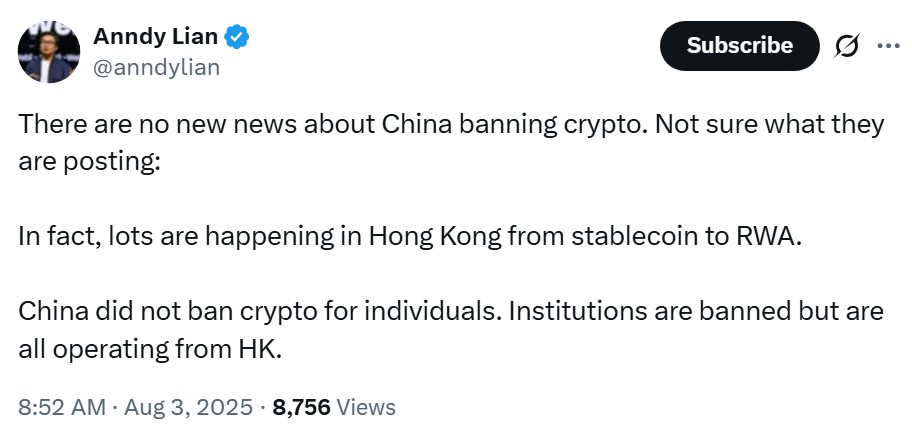
Crypto industry watcher observes RWA and stablecoin activity rising in Hong Kong
Hong Kong’s RWA and stablecoin activity picked up as new licensing rules took effect. (Anndy Lian)

The latest warning reportedly came from the China Securities Regulatory Commission, which advised companies to pause real-world asset ventures in Hong Kong. It followed a state-owned company scrubbing announcements about tokenizing bonds and other enterprises revealing RWA projects, piling on recent warnings against stablecoins after Hong Kong introduced its licensing framework.

To understand why these illusions of loopholes keep appearing — and why they collapse — Magazine spoke with Joshua Chu, co-chair of the Hong Kong Web3 association.

This conversation has been edited for clarity and length.

Magazine: Crypto has been banned for years in China, so why do regulators keep issuing fresh warnings?
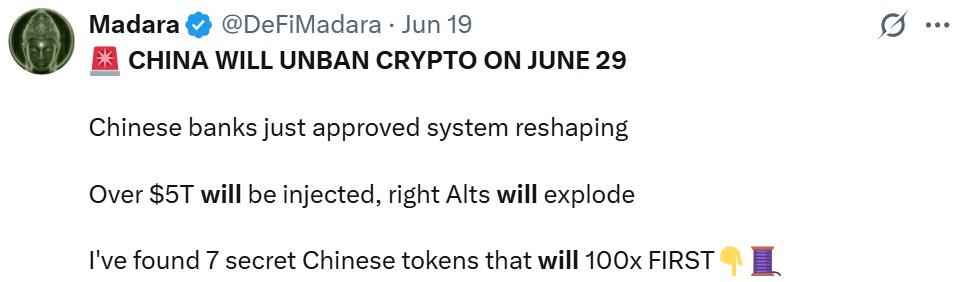
China crypto ban reversal rumor
Countless social media accounts predicted Beijing would reverse its crypto ban, but it hasn’t moved so far. (DeFiMadara)

Chu: The challenge is that many new lawyers in Hong Kong moving into Web3 don’t have much experience with cross-border issues. That’s created fragmentation and a lot of confusion. Some journalists and lawyers even claimed there was a 180-degree reversal on crypto policy. China doesn’t do 180-degree turns in policy. The only U-turn in recent memory was the rollback of COVID-19 mandates.

The crypto ban from 2021 is a good example: Speculative assets are not meant for the retail sector. The People’s Republic of China is still a communist country, and if an unsophisticated investor loses money gambling on crypto, in the government’s view, that’s losing money for the state. That’s why the only entities we’ve seen handling crypto assets are the government or state-owned enterprises.

Magazine: How do you explain this cycle where Chinese firms repeatedly attempt to enter a trendy crypto venture through Hong Kong, only for mainland regulators to push back?

Chu: The issue is how they’re doing it. Even big companies with money can act in a less-than-sophisticated way. There’s a difference between state-owned enterprises and private institutions. The government is comfortable with blockchain infrastructure and foreign direct investment. What it won’t tolerate is speculation because speculation equals bubbles.

That’s why regulators crack down on projects designed to hype markets or pull value from retail investors. It’s the same logic behind China’s real estate policy: Buying to live in is fine, but speculation isn’t. You can think of it as a parental style of governance: Just as parents wouldn’t let children gamble with family savings, the state won’t let retail investors gamble away wealth in crypto.

Crypto Is Alive and Well, Though Skeptics Say It’s ‘Not Money’

At the end of the day, companies see profit potential, which is why they want in. But regulators will only support ventures that are sophisticated, compliant and responsible. That’s also why Hong Kong can hold itself out as one of the world’s top three financial hubs — its reputation depends on keeping the system clean, and the same principle applies to virtual assets.
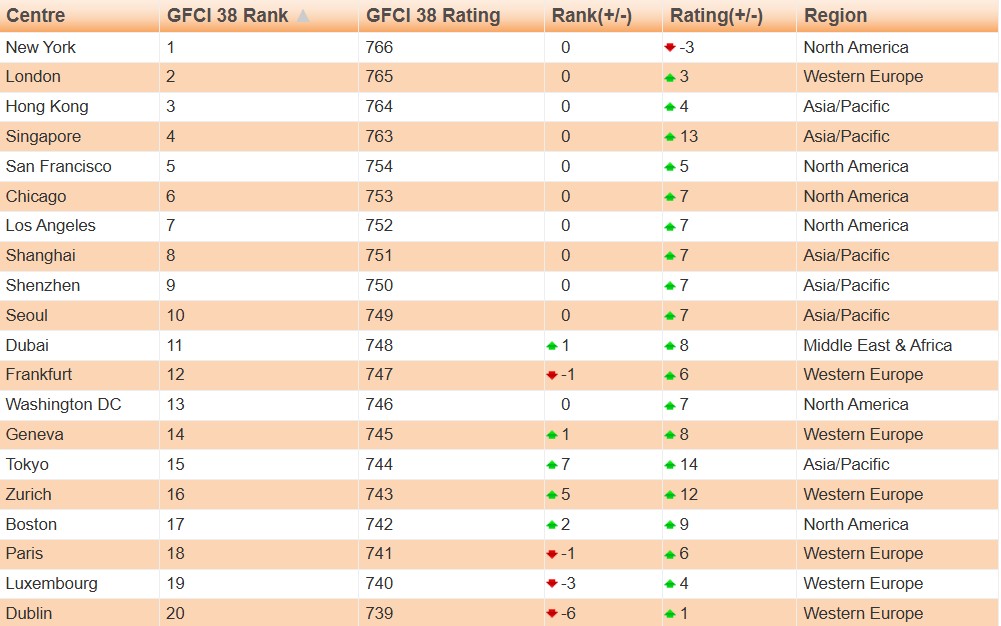
New York tops Long Finance's 2025 Global Financial Centres Index, followed by London, then Hong Kong
Hong Kong aims to strengthen its financial center rating through cryptocurrencies. (Long Finance)

Magazine: Isn’t the real problem that Chinese firms are hunting for loopholes and Hong Kong lawyers aren’t equipped to stop them?

Chu: Unfortunately, that happens a lot. If your whole business is founded on loopholes, you’re already on shaky ground. Regulators don’t create loopholes for you to exploit; they expect you to build something sustainable and compliant.

But because of the 2021 crypto ban, you have an entire market that’s been shut out. Human psychology kicks in, and people think: “Maybe this is my way back in.” That’s why you see companies making loud announcements before they’ve even filed an application. Take the stablecoin regime: Some firms were hyping plans to apply for licenses just to pump their stock price. Naturally, regulators step in.
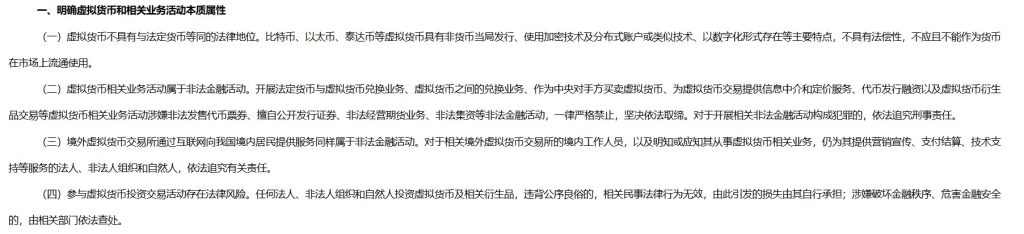
A screenshot of China's crypto ban statement in mandarin
China’s 2021 crypto ban defines crypto-related businesses as illegal financial activities. (China State Administration of Foreign Exchange)

We’ve seen this pattern before. When initial coin offerings were being sold as a cheaper alternative to initial public offerings, companies said you didn’t need a prospectus or compliance. But there’s a reason those safeguards exist: to protect investors. So, when players start cutting corners and shouting about it, it draws scrutiny. And that’s when clampdowns happen.

Magazine: When Chinese firms listed in Hong Kong or the US gain crypto exposure, is this regulatory arbitrage?

Chu: When a Chinese company lists on Nasdaq, it’s absorbing foreign investment, which triggers a different response than if it were raising funds domestically. The real question is how they structure these RWA or tokenization projects.

If they’re putting Chinese corporate data on a public blockchain, that creates cross-border data transfer issues. Remember, even listed companies have run into problems with US auditors because of China’s strict rules on what information can leave the country. Blockchain raises those concerns all over again.

There’s also the financial side. Many of these treasury strategies look risky, especially when driven by institutional FOMO at the peak of a bull cycle. Without strong internal risk controls, volatility can overwhelm the market cap of these firms. That’s exactly the kind of contagion risk regulators want to avoid.

If that happens, the scrutiny won’t just come from Beijing; it will come from the SEC as well.


Source: https://cointelegraph.com/magazine/hong-kong-isnt-loophole-chinese-crypto-firms-think/

Anndy Lian is an early blockchain adopter and experienced serial entrepreneur who is known for his work in the government sector. He is a best selling book author- “NFT: From Zero to Hero” and “Blockchain Revolution 2030”.

Currently, he is appointed as the Chief Digital Advisor at Mongolia Productivity Organization, championing national digitization. Prior to his current appointments, he was the Chairman of BigONE Exchange, a global top 30 ranked crypto spot exchange and was also the Advisory Board Member for Hyundai DAC, the blockchain arm of South Korea’s largest car manufacturer Hyundai Motor Group. Lian played a pivotal role as the Blockchain Advisor for Asian Productivity Organisation (APO), an intergovernmental organization committed to improving productivity in the Asia-Pacific region.

An avid supporter of incubating start-ups, Anndy has also been a private investor for the past eight years. With a growth investment mindset, Anndy strategically demonstrates this in the companies he chooses to be involved with. He believes that what he is doing through blockchain technology currently will revolutionise and redefine traditional businesses. He also believes that the blockchain industry has to be “redecentralised”.

j j j

Asia-Pacific leads boom in crypto transactions amid regulatory hurdles: report

Asia-Pacific leads boom in crypto transactions amid regulatory hurdles: report

The Asia-Pacific region has become the world’s fastest-growing hub for cryptocurrency transactions, with on-chain activity surging despite inconsistent oversight and varied pathways to adoption, according to a new report.

Analysts say the trend reflects not only diverse use cases – from remittances and savings to gaming and speculative trading – but also regulatory uncertainty across the region, which could limit long-term potential even as momentum builds.

The report, released on Wednesday by blockchain analytics firm Chainalysis, found that during the 12 months ending June 2025, Asia-Pacific had emerged as the fastest-growing region for on-chain crypto activity, with a 69 per cent year-over-year increase in value received.

Total crypto transaction volume in the region grew from US$1.4 trillion to US$2.36 trillion, driven by robust engagement across major markets including India, Vietnam and Pakistan.

Monthly on-chain value received grew from about US$81 billion in July 2022 to peak at US$244 billion in December 2024, a threefold increase over 30 months. Transaction volumes have since remained robust at above US$185 billion per month through mid-2025.

In contrast to North America, where cryptocurrency activity is largely driven by institutional investment, Asia-Pacific’s growth is fuelled by broader, more retail-oriented demand, according to Chengyi Ong, head of Asia-Pacific policy at Chainalysis.

The report cites Japan, Indonesia, South Korea, India and Vietnam as among the nations spearheading transaction growth in the Asia-Pacific, fuelled by a combination of supportive policies to use cases.

“Mature markets like Singapore and Hong Kong remained relatively stable in terms of on-chain value transferred,” Ong said.

In the top market India, the digital currency is meeting a large diaspora’s remittance needs while young adults have embraced crypto trading as supplementary income, the report says.

“India has a large and technologically savvy population where young students experiment with blockchain and coding, and it also has unmet financial needs for income, investments, and cross-border transfers,” Ong said. “These are conditions in which cryptocurrency can gain traction.”

In South Korea, the second-largest Asia-Pacific market, trading in crypto is becoming as common as trading in shares, while new rules like the 2024 Virtual Asset User Protection Act are reshaping activity on major domestic exchanges, according to the report.

Vietnam, in third, showed crypto as everyday infrastructure for remittances, gaming and savings rather than speculation, the report added, while Pakistan added a fourth archetype with a young, mobile-first population embracing cryptos for remittances and investments.

Anndy Lian, a Singapore-based intergovernmental blockchain adviser, noted that key contributors to crypto’s rapid growth included adoption in emerging markets such as India, Pakistan and Vietnam for practical use, such as remittances, to provide a financial tool to unbanked populations – people without their own bank accounts – in the region.

“High mobile penetration and internet expansion have democratised entry, enabling retail investors to engage with centralised exchanges and decentralised protocols amid economic volatility,” Lian said.

Institutional interest in the digital currency has also risen, fuelled by progressive hubs like Singapore and Hong Kong which offer clearer fintech ecosystems, according to Lian, while emerging economies such as Indonesia and the Philippines also use crypto to boost financial inclusion.

Cryptocurrency, which works as a decentralised digital currency using blockchain technology to securely record transactions on a shared, unchangeable digital ledger, is being seen by observers as a means to transparently send money to remote populations with little access to banking.

The region’s uneven approach to regulation of cryptos, however, hampers its potential use, experts warn.

“Regulatory concerns in Apac’s [the Asia-Pacific’s] crypto landscape are pronounced, arising from inconsistent and fragmented frameworks that amplify risks while stifling balanced growth,” Lian said.

While Singapore provides comprehensive licensing for virtual asset providers, India’s levy of a 30 per cent tax on cryptocurrency gains means investors and businesses face uncertainty and systemic risks of over-regulation, according to Lian.

Experts say India’s approach to cryptos stems from anti-money laundering and countering terrorism financing, but the country would gain from broader regulation dealing with consumer protection, financial prudence and market conduct.

Lian noted that there were concerns among policymakers as the Asia-Pacific region had emerged as a hotspot for crypto scams and frauds globally.

“Broader issues include money-laundering vulnerabilities in less-regulated markets like the Philippines or Vietnam, where rapid growth exposes unbanked users to exploitation,” he said.

Crypto rules vary across the region, from rigorous oversight in Japan to light-touch regulation in Indonesia.

Lian warned, however, that the lack of uniformity risked regulatory arbitrage – exploiting differences or gaps in regulations across different jurisdictions – and hampered cross-border compliance,

He called on policymakers to address these issues to mitigate threats without curbing the region’s crypto potential, noting that policy coordination “is essential to streamline crypto transactions, reduce fragmentation, and harness the region’s growth potential sustainably”.


Source: https://www.scmp.com/week-asia/economics/article/3326725/asia-pacific-leads-boom-crypto-transactions-amid-regulatory-hurdles-report

Anndy Lian is an early blockchain adopter and experienced serial entrepreneur who is known for his work in the government sector. He is a best selling book author- “NFT: From Zero to Hero” and “Blockchain Revolution 2030”.

Currently, he is appointed as the Chief Digital Advisor at Mongolia Productivity Organization, championing national digitization. Prior to his current appointments, he was the Chairman of BigONE Exchange, a global top 30 ranked crypto spot exchange and was also the Advisory Board Member for Hyundai DAC, the blockchain arm of South Korea’s largest car manufacturer Hyundai Motor Group. Lian played a pivotal role as the Blockchain Advisor for Asian Productivity Organisation (APO), an intergovernmental organization committed to improving productivity in the Asia-Pacific region.

An avid supporter of incubating start-ups, Anndy has also been a private investor for the past eight years. With a growth investment mindset, Anndy strategically demonstrates this in the companies he chooses to be involved with. He believes that what he is doing through blockchain technology currently will revolutionise and redefine traditional businesses. He also believes that the blockchain industry has to be “redecentralised”.

j j j

The rate cut rally: Earnings, gold, and Bitcoin in the balance

The rate cut rally: Earnings, gold, and Bitcoin in the balance

History shows that equities often deliver solid gains in the year following the start of such cycles, with the S&P 500 averaging around 14 per cent returns over 12 months based on past data from various cycles. Yet the initial month after the first cut tends to bring choppiness, as markets adjust to shifting monetary policy.

In this case, equities rallied strongly leading up to the cut, pushing the S&P 500 up 15 per cent in the past six months and a whopping 32 per cent from its yearly lows. I see this preemptive surge as a sign of market optimism, but it also raises flags for potential consolidation ahead.

Investors priced in these cuts long ago, so the real test comes from upcoming events like speeches from 10 FOMC governors and the PCE inflation report due on September 26. If inflation data surprises on the upside, volatility could spike, reminding everyone that even dovish Fed actions carry risks in an economy where growth projections and unemployment trends diverge sharply.

Fund managers’ bold bets on risk assets

Fund managers continue to lean heavily into risk assets, particularly equities, despite nagging worries about persistent inflation and a weakening US dollar. This positioning strikes me as bold, perhaps overly so, given the mixed signals from the broader economy. Many in the industry view artificial intelligence as a deflationary force that could counter current inflationary pressures, an idea that holds water when you consider how AI efficiencies might drive down costs in sectors like manufacturing and services.

Gold’s performance this year underscores these tensions, with prices surging 38 per cent year-to-date amid buoyant rate-cut expectations and geopolitical uncertainties. Research into recent gold price drivers points to factors like central bank buying, trade tensions, and lower interest rates making the metal more appealing as a hedge.

However, fund flows indicate much of this buying stems from speculation rather than genuine hedging, and professional asset managers maintain low exposure to gold and digital assets. In my view, this creates intriguing opportunities for savvy investors to buy on dips, especially as gold hit US$3685.30 per ounce recently. The under-allocation by institutions suggests room for further upside if economic headwinds intensify, but it also warns against chasing the rally without careful consideration.

Balancing strategy: Barbell approach and diversification

Strategic advice in this environment boils down to respecting the Fed’s direction without blindly following the herd. The central bank’s dovish stance supports companies with strong earnings growth, yet piling into mega-cap tech stocks at current valuations feels precarious. A barbell approach makes sense here, where you hold core positions in quality names, add selectively during pullbacks, and diversify into global themes and yield-focused plays.

Singapore’s yield stocks stand out, having outperformed the S&P 500 over both five- and ten-year periods, which bolsters the argument for regional diversification beyond US borders. I favour this strategy because it balances growth potential with income stability, particularly in a world where US-centric portfolios risk overexposure to domestic policy shifts.

With the Fed projecting more cuts on October 29 and December 12, lower rates could fuel corporate borrowing and expansion, but diverging economic indicators demand vigilance. Unemployment might tick up if growth slows more than expected, potentially pressuring equities despite the supportive policy backdrop.

Macro shifts and geopolitical influences

Turning to the broader macro picture, global risk sentiment holds firm thanks to the allure of additional rate cuts enhancing corporate earnings outlooks. The week ahead features the high-level General Debate at the 80th UN General Assembly starting Tuesday, with President Trump addressing the opening session and Fed Chair Powell discussing the economic outlook. These events could inject fresh narratives into markets, especially amid positive developments in US-China relations.

President Trump’s recent conversation with Chinese leadership led to a deal on the popular Chinese-owned social media app TikTok, allowing it to continue operations in the US under new controls, which eased some trade anxieties. Wall Street responded enthusiastically, with major indices hitting record highs on Friday, the Dow Jones up 0.37 per cent, S&P 500 up 0.49 per cent, and Nasdaq up 0.72 per cent.

Treasury yields edged higher, the 10-year at 4.127 per cent and the 2-year at 3.572 per cent, reflecting a mix of growth optimism and inflation watchfulness. The dollar index climbed 0.30 per cent to 97.64, while gold rose 1.1 per cent on rate-cut bets. Brent crude dipped 1.1 per cent to US$66.68 per barrel following EU sanctions on Russian oil vessels and buyers, highlighting ongoing energy market fragilities. Asian equities showed mixed results Friday and in early trading today, with US futures pointing to a lower open, suggesting caution amid these crosscurrents.

Bitcoin volatility and regulatory headwinds

Bitcoin’s recent dip adds another layer to the market mosaic, with the cryptocurrency falling 0.93 per cent to US$114,566 over the past 24 hours, lagging the broader crypto market’s 1.91 per cent decline. This underperformance stems from profit-taking after hitting recent highs, technical breakdowns near the US$115,400 resistance level, and regulatory uncertainties.

Drawing from similar patterns in September 2024 analyses, when Bitcoin traded around US$63,000 and faced consolidation phases, the current setup echoes familiar volatility drivers like leverage unwinds and momentum shifts. Over US$176 million in long positions were liquidated as prices tested US$115,000 support, amplifying the drop in a classic liquidity trap where open interest spiked 4.14 per cent to US$937 billion.

Traders piled in near resistance, only to face swift reversals, which I interpret as a healthy correction in an asset that has risen 81 per cent year-to-date. The failure to break above the 23.6 per cent Fibonacci retracement at US$115,400 triggered algorithmic selling, with the MACD histogram still positive at +265 but RSI hovering around 51-53, indicating waning momentum.

Bulls must secure a close above that level to reclaim initiative; otherwise, a breach of US$114,500, the 30-day simple moving average, could cascade toward US$110,000.

Regulatory developments weigh heavily on Bitcoin’s short-term path, presenting a neutral but noisy influence. The US Treasury’s commentary on the GENIUS Act, issued on September 20, emphasises stablecoin regulations requiring full reserves in liquid assets like Treasuries and technological capabilities for freezing assets, aiming to foster innovation while curbing risks. This act, signed into law earlier this year, mandates issuers to comply with federal laws, potentially stabilising the crypto ecosystem but introducing oversight that cools institutional enthusiasm.

Meanwhile, the EU’s MiCA regulation drives exchange consolidation, enforcing consumer protections, market integrity, and restrictions on stablecoin use as exchange mediums, which impacts global flows. Exchanges adapting to MiCA gain credibility and access to unified EU markets, but the compliance shifts have slowed inflows, with ETF volumes dipping and minor outflows from products like GBTC.

In my opinion, these headwinds represent growing pains for the sector; long-term clarity should prove bullish by attracting more institutional capital, yet the immediate uncertainty often halts rallies, as seen in past cycles.

Closing thoughts: Cautious optimism ahead

Overall, the market’s resilience amid the Fed’s pivot impresses me, but I remain cautious about overextended positions in tech and crypto. The historical precedent of positive equity returns post-rate cuts offers encouragement, yet the unique blend of geopolitical events like the UNGA, US-China thawing via the TikTok agreement, and persistent inflation worries calls for measured optimism. Gold’s speculative surge and Bitcoin’s technical wobbles serve as barometers for broader risk appetite, suggesting investors diversify thoughtfully.

The barbell strategy aligns with my view that quality growers paired with yield plays provide a sturdy foundation, especially as Singapore’s outperformance demonstrates the value of global exposure. With PCE data looming and more Fed cuts on the horizon, markets could consolidate, but the underlying dovish support tilts the scales toward gradual upside. Still, chasing crowds in mega-caps or digital assets without waiting for pullbacks risks unnecessary pain; patience often rewards in these environments.

As we head into the final quarter, keeping an eye on unemployment trends and corporate earnings will prove crucial, potentially defining whether this cycle mirrors the average 14 per cent gain or veers into choppier territory. The economy’s divergences remind us that while the Fed guides, real-world data ultimately steers the ship.


Source: https://e27.co/the-rate-cut-rally-earnings-gold-and-bitcoin-in-the-balance-20250922/

Anndy Lian is an early blockchain adopter and experienced serial entrepreneur who is known for his work in the government sector. He is a best selling book author- “NFT: From Zero to Hero” and “Blockchain Revolution 2030”.

Currently, he is appointed as the Chief Digital Advisor at Mongolia Productivity Organization, championing national digitization. Prior to his current appointments, he was the Chairman of BigONE Exchange, a global top 30 ranked crypto spot exchange and was also the Advisory Board Member for Hyundai DAC, the blockchain arm of South Korea’s largest car manufacturer Hyundai Motor Group. Lian played a pivotal role as the Blockchain Advisor for Asian Productivity Organisation (APO), an intergovernmental organization committed to improving productivity in the Asia-Pacific region.

An avid supporter of incubating start-ups, Anndy has also been a private investor for the past eight years. With a growth investment mindset, Anndy strategically demonstrates this in the companies he chooses to be involved with. He believes that what he is doing through blockchain technology currently will revolutionise and redefine traditional businesses. He also believes that the blockchain industry has to be “redecentralised”.

j j j