Web3 is a term that has been gaining popularity in the tech world, especially among the enthusiasts of blockchain, cryptocurrency, and decentralized applications. But what exactly is Web3, and why is it important? How does it differ from the current web, and what are the benefits and challenges of adopting it? And most importantly, what is the future of Web3, and what role will non-fungible tokens (NFTs) play in it?
What is Web3?
This is a concept for the next iteration of the internet, built around decentralization and often incorporating blockchain technologies, such as various cryptocurrencies and non-fungible tokens (NFTs). It is supposed to be a more open, fair, and democratic web, where users have more control over their data, identity, and assets, and where intermediaries and gatekeepers are replaced by peer-to-peer networks and protocols.
Web3 is contrasted with Web2, the current dominant model of the Internet, which is based on centralized platforms and services that provide user-generated content, social media, and e-commerce. Web2 has enabled unprecedented innovation, connectivity, and convenience, but it has also created problems such as data breaches, privacy violations, censorship, misinformation, and monopolization.
It aims to address these problems by leveraging the power of blockchain, a distributed ledger technology that records transactions in a secure, transparent, and immutable way. Blockchain enables the creation of digital assets that are scarce, verifiable, and programmable, such as cryptocurrencies and NFTs. Cryptocurrencies are digital currencies that can be used as a medium of exchange, a store of value, or a unit of account, without the need for a central authority or intermediary. NFTs are unique digital identifiers that can represent ownership and authenticity of any digital or physical item, such as art, music, or collectables.
Web3 also relies on the concept of smart contracts, which are self-executing agreements that are encoded on the blockchain and can perform various functions, such as transferring funds, verifying conditions, or triggering events. Smart contracts enable the creation of decentralized applications (DApps), which are applications that run on a distributed network of nodes, rather than on a single server or company. DApps can provide various services, such as decentralized finance (DeFi), gaming, social media, and more.
What is the main driver for Web3 in 2024?
In my personal view, Web3 is still in its early stages of development, and many challenges and uncertainties need to be overcome before it can achieve mass adoption. Some of these challenges include scalability, interoperability, usability, regulation, and security. However, many factors are driving the growth and innovation of Web3 in 2024, such as:
- The increasing demand for digital sovereignty, privacy, and security, as users become more aware and concerned about the risks and drawbacks of Web2, such as data exploitation, surveillance, manipulation, and censorship. Web3 offers users more control and ownership over their data, identity, and assets, as well as more transparency and accountability over the platforms and services they use.
- The rising popularity and value of cryptocurrencies and NFTs, as more people and institutions recognize their potential as alternative forms of money, investment, and expression. Cryptocurrencies and NFTs enable new ways of creating, exchanging, and storing value, as well as new forms of art, culture, and community.
- The emergence and development of new technologies and standards that enable faster, cheaper, and more efficient transactions and interactions on the blockchain, such as layer-2 solutions, cross-chain bridges, decentralized identifiers, and verifiable credentials. These technologies and standards aim to improve the scalability, interoperability, and usability of Web3, making it more accessible and attractive to a wider audience.
- The support and involvement of various stakeholders, such as developers, entrepreneurs, investors, regulators, and users, who are contributing to the innovation and adoption of Web3. Developers are creating new and improved DApps and protocols that provide various solutions and opportunities for Web3 users. Entrepreneurs are launching new and exciting projects and platforms that leverage the power of Web3. Investors are funding and supporting the growth and development of Web3 projects and platforms. Regulators are providing guidance and clarity on the legal and regulatory aspects of Web3. And users are exploring and experimenting with the various possibilities and benefits of Web3.
Do you think NFTs will have a big comeback?
NFTs are one of the most prominent and controversial aspects of Web3. NFTs have been used to create and trade digital art, music, collectables, and other forms of creative expression, generating billions of dollars in sales and attracting mainstream attention and participation. However, NFTs have also faced criticism and skepticism, due to their environmental impact, legal ambiguity, and speculative nature.
According to Cryptoslam, NFTs experienced a huge boom in 2022, reaching a peak of over $23 billion in sales. As we all know, they also suffered a sharp decline in the following months, dropping to less than $8 billion in sales in the 2023. This was due to various factors, such as market saturation, regulatory uncertainty, technical issues, and fraud.
However, despite the slump, NFTs have shown signs of recovery and resilience in 2024, thanks to several developments and trends, such as:
- The improvement and adoption of more energy-efficient and eco-friendly blockchain technologies, such as proof-of-stake, layer-2 solutions, and carbon offsetting. These technologies aim to reduce the environmental impact and carbon footprint of NFTs, which have been a major source of criticism and concern.
- The emergence and popularity of new and diverse forms and genres of NFTs, such as gaming, metaverse, music, sports, and social media. These forms and genres of NFTs offer more utility, functionality, and interactivity to users, as well as more opportunities for creators, artists, and celebrities.
- The integration and collaboration of NFTs with other Web3 platforms and services, such as DeFi, DAOs, and DEXs. These platforms and services enable new and innovative ways of creating, financing, governing, and exchanging NFTs, as well as enhancing their value and liquidity.
- The recognition and acceptance of NFTs by various institutions, organizations, and individuals, such as museums, galleries, brands, celebrities, and influencers. These entities are using NFTs to showcase, promote, and monetize their work, as well as to engage and reward their fans and followers.
Therefore, I think that NFTs will have a big comeback in 2024, as they continue to evolve and expand their scope and impact. It will not only be a form of digital art, but also a form of digital identity, culture, and economy. It will not only be a niche and novelty but also a norm and necessity. NFTs will not only be a part of Web3 but also a driver of Web3.
Bottom Line
Web3 is a vision for a new and improved internet, where users have more freedom, power, and value. Web3 is driven by various factors, such as the demand for digital sovereignty, the popularity of cryptocurrencies and NFTs, the innovation of new technologies and standards, and the support of various stakeholders. It is also challenged by various obstacles, such as scalability, interoperability, usability, regulation, and security. Web3 is still in its infancy, and its future is uncertain and unpredictable. It is full of potential and promise, and its future is exciting and inspiring.
NFTs are one of the most prominent and controversial aspects of Web3. NFTs have been used to create and trade digital assets, generating billions of dollars in sales and attracting mainstream attention and participation. NFTs have also faced criticism and scepticism, due to their environmental impact, legal ambiguity, and speculative nature. NFTs experienced a huge boom and a sharp decline, but they have shown signs of recovery and resilience in 2024, thanks to several developments and trends, such as the improvement and adoption of more eco-friendly blockchain technologies, the emergence and popularity of new and diverse forms and genres of NFTs, the integration and collaboration of NFTs with other Web3 platforms and services, and the recognition and acceptance of NFTs by various institutions, organizations, and individuals.
Web3 and NFTs are not just technologies, but also movements and cultures. Maybe more WebX will emerge in 2024. Just like Web4 that Anndy Lian talks about, Jack Dorsey on Web5 and Justin Sun on Web6. Anything can happen. They represent a new way of thinking and living in the digital age, where users are empowered, connected, and creative.
Source: https://in.investing.com/analysis/web3-and-nfts-catalysts-for-change-in-the-digital-era-of-2024-200609039
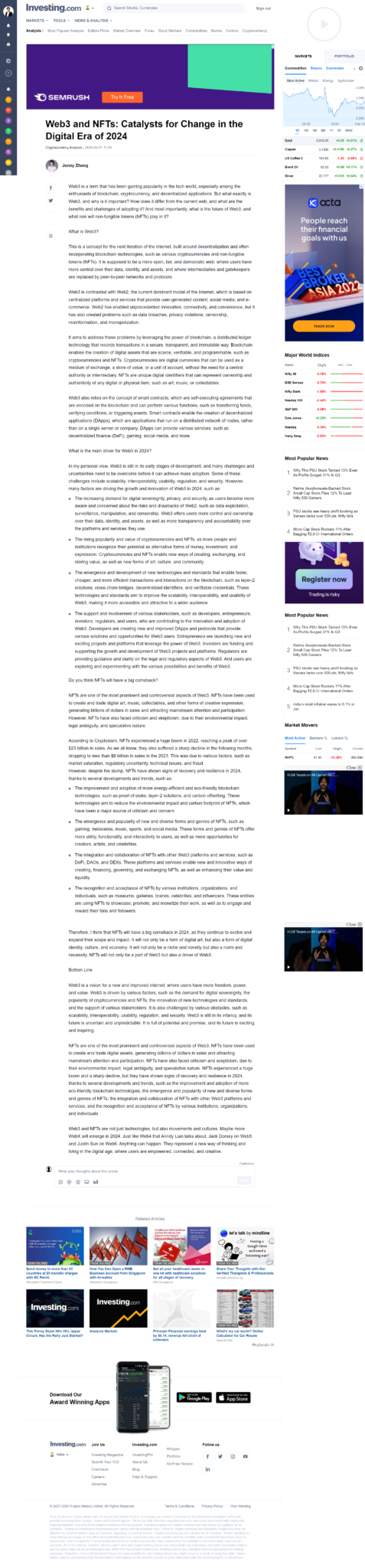

Anndy Lian is an early blockchain adopter and experienced serial entrepreneur who is known for his work in the government sector. He is a best selling book author- “NFT: From Zero to Hero” and “Blockchain Revolution 2030”.
Currently, he is appointed as the Chief Digital Advisor at Mongolia Productivity Organization, championing national digitization. Prior to his current appointments, he was the Chairman of BigONE Exchange, a global top 30 ranked crypto spot exchange and was also the Advisory Board Member for Hyundai DAC, the blockchain arm of South Korea’s largest car manufacturer Hyundai Motor Group. Lian played a pivotal role as the Blockchain Advisor for Asian Productivity Organisation (APO), an intergovernmental organization committed to improving productivity in the Asia-Pacific region.
An avid supporter of incubating start-ups, Anndy has also been a private investor for the past eight years. With a growth investment mindset, Anndy strategically demonstrates this in the companies he chooses to be involved with. He believes that what he is doing through blockchain technology currently will revolutionise and redefine traditional businesses. He also believes that the blockchain industry has to be “redecentralised”.