Holiday liquidity warning signs emerge across stocks gold and crypto markets simultaneously

Holiday liquidity warning signs emerge across stocks gold and crypto markets simultaneously

As we approach the end of the year, US stock futures are holding steady overnight ahead of critical, delayed economic data. Investors brace for a flurry of releases, including the long-awaited third-quarter GDP figures, which promise to fill significant gaps in Wall Street’s understanding of the economy’s current health. Yet market participants largely dismiss the likelihood that these reports will dramatically alter the prevailing narrative around future interest rate cuts.

S&P 500 futures, Nasdaq 100 futures, and Dow Jones Industrial Average futures all traded near the flatline, extending a pattern of stability that has characterised the session. This cautious stance follows three consecutive days of gains for major US indices at the start of the week, a streak that has rekindled optimism about a potential year-end rally.

The S&P 500, in particular, hovers just 0.3 per cent below its all-time high reached earlier this month, a level it had retreated from after several sessions in which investors rotated away from artificial intelligence and technology stocks. The benchmark index’s recent rebound has been fuelled by unexpectedly favourable data from the prior week, including a surprising drop in inflation metrics and a labour market report that showed signs of cooling without signalling distress.

These developments have solidified expectations that the Federal Reserve will begin reducing interest rates in 2026, keeping bets on monetary easing largely intact despite the upcoming data deluge. Traders now view Tuesday’s economic releases as a final opportunity for fresh insights before the Christmas holiday pause, with the delayed Q3 GDP report standing out as a crucial indicator of underlying economic momentum following the federal government shutdown that disrupted regular reporting schedules.

Parallel to the equity market’s measured progress, precious metals continue their remarkable ascent, adding further momentum to an already stunning rally. Gold and silver futures both advanced, building on gains that position these traditional safe-haven assets for their strongest annual performance in over forty years. This sustained strength in bullion markets reflects deep-seated investor concerns about long-term economic stability and the erosive impact of persistent inflation, even as stock indices flirt with record territory.

The divergence between equities and metals underscores a nuanced market psychology where participants simultaneously chase growth-oriented assets while maintaining hedges against potential volatility. Gold’s resilience, in particular, suggests that despite optimism around eventual rate cuts, many institutional and retail investors remain wary of structural economic vulnerabilities.

This precious metals surge comes amid declining real yields and heightened geopolitical tensions, factors that historically bolster demand for non-yielding assets perceived as stores of value during periods of uncertainty. The market’s ability to sustain a prolonged rally in gold and silver, even as stocks recover, highlights a bifurcated investment landscape in which capital flows to both risk assets and traditional havens, depending on shifting risk perceptions across time horizons.

While traditional markets exhibit cautious optimism, the cryptocurrency sector experienced notable turbulence, recording a 0.56 per cent decline over the past twenty-four hours. This pullback represents a risk-off shift following recent gains, interrupting otherwise positive momentum reflected in seven-day and thirty-day trends of plus 1.51 per cent and plus 3.5 per cent, respectively. The immediate dip stems from a confluence of technical and fundamental pressures, beginning with a significant leveraged long squeeze across derivatives markets. Perpetual swap open interest surged 13.31 per cent within a single day to reach US$815.6 billion, creating a fragile foundation of overextended bullish positions.

This vulnerability materialised when Bitcoin failed to breach the psychologically important US$90,500 resistance level, triggering a cascade of forced liquidations. Bitcoin-specific liquidations alone spiked 80.45 per cent to US$83.75 million, overwhelming market liquidity and accelerating the downward momentum. Technical indicators reinforced this fragility, with Bitcoin’s fourteen-day Relative Strength Index plunging to 32.77, signalling oversold conditions yet revealing weak recovery momentum. Funding rates turned negative for many altcoins relative to Bitcoin, registering at negative 0.000948 per cent, a clear indication of overheated long positioning that required correction. Market observers now watch closely whether Bitcoin can defend the US$88,000 support level, as a decisive break below this threshold could unleash another wave of algorithmic selling.

Compounding these technical pressures, institutional activity introduced substantial bearish momentum through large-scale profit-taking. BlackRock executed a significant sell-off, offloading 2,019 Bitcoin valued at approximately US$180 million alongside 29,928 Ethereum tokens worth roughly US$91 million.

These transactions occurred near local price peaks, suggesting strategic institutional exits after recent rallies. This move by the world’s largest asset manager amplified existing selling pressure across crypto markets, particularly impacting Ethereum, which faced the added headwind of substantial exchange-traded fund outflows. Ethereum ETFs witnessed US$555 million in net outflows during the current week, marking the largest weekly withdrawal since October.

Consequently, Ethereum’s market dominance relative to other cryptocurrencies eroded, falling to 12.17 per cent, a decline of 0.4 percentage points week-over-week, as capital rotated toward Bitcoin, perceived as a comparatively safer asset within the digital ecosystem. BlackRock’s actions underscore a recurring pattern where institutional players systematically take profits after strong rallies, introducing volatility that retail investors often absorb. This dynamic highlights the growing influence of traditional finance giants on crypto price action, where large block trades can overwhelm order books optimised for smaller, retail-sized transactions.

Regulatory ambiguity further clouded the crypto market’s outlook, contributing to the recent pullback through delayed policy frameworks and persistent compliance concerns. Specific delays in advancing the US Clarity Act, legislation designed to provide regulatory certainty for digital assets, triggered US$952 million in outflows from crypto-focused investment funds. This capital flight reflects investor frustration with the prolonged uncertainty surrounding legal frameworks, particularly for alternative cryptocurrencies beyond Bitcoin.

Market sentiment metrics captured this anxiety, with the Fear and Greed Index remaining entrenched at 29, a reading categorised as Fear, for the second consecutive trading session. This sustained caution occurs despite Bitcoin’s dominance rising to 58.99 per cent, a trend suggesting that within the crypto ecosystem, Bitcoin increasingly functions as a regulatory safe haven.

Investors appear to favour Bitcoin’s first-mover status and clearer regulatory treatment relative to smaller tokens facing uncertain compliance pathways. The regulatory environment creates a two-tiered market dynamic in which policy delays disproportionately affect altcoins while reinforcing Bitcoin’s position as the primary store of value in digital asset portfolios. This divergence complicates recovery prospects for the broader crypto market, as altcoin performance often depends on regulatory catalysts that remain absent.

The interplay between these three forces, leveraged unwinding, institutional profit-taking, and regulatory stagnation, created a perfect storm for the crypto market’s short-term decline. Yet this dip occurs within a broader context of resilience, evidenced by the positive seven-day and thirty-day trends that suggest underlying demand remains intact.

The derivatives market shows early signs of capitulation, with extreme liquidation levels that could pave the way for stabilisation if Bitcoin holds critical support at US$88,000. Market structure improvements since previous downturns, including reduced exchange leverage caps and more sophisticated institutional custody solutions, may limit the depth of any correction compared to historical precedents.

The key question revolves around whether altcoins can decouple from Bitcoin’s dominance trajectory, which has climbed steadily toward 59.5 per cent. A peak in Bitcoin dominance often precedes broad-based altcoin rallies, but such a shift requires either regulatory breakthroughs or renewed risk appetite that current sentiment metrics do not yet support.

Traders monitor Ethereum ETF flow reversals as a leading indicator of changing institutional sentiment, alongside USDT dominance trends, which reflect stablecoin positioning ahead of anticipated volatility. These metrics provide key insights into whether the current pullback represents a tactical reset or the start of a deeper consolidation phase.

As traditional and digital markets approach the holiday season, their trajectories reveal both contrasts and underlying connections. The stock market’s proximity to record highs coexists with gold’s four-decade rally, reflecting investor strategies that balance growth exposure with inflation hedges.

Meanwhile, crypto markets demonstrate their evolving maturity through institutional participation patterns and sensitivity to macro factors such as regulatory shifts, even as they experience volatility distinct from that of traditional assets. The delayed Q3 GDP data will test the resilience of equity optimism, potentially reinforcing or challenging the narrative of a soft landing that underpins expectations for rate cuts. For precious metals, sustained strength depends on whether inflation proves persistently sticky despite recent encouraging prints.

In crypto, the path forward hinges on technical stabilisation above key support levels and catalysts that could reignite institutional inflows, particularly for Ethereum following its recent outflows. Market participants must navigate these crosscurrents with heightened awareness that holiday-thinned liquidity could amplify reactions to unexpected data or news.

The confluence of year-end positioning, delayed economic updates, and regulatory limbo creates a volatile environment in which risk management takes precedence over aggressive positioning. As the calendar turns, the interplay between monetary policy expectations, regulatory evolution, and technical market structures will determine whether the current cautious optimism across asset classes solidifies into a sustainable foundation for the new year or gives way to renewed uncertainty in a rapidly changing financial landscape.


 

Source: https://e27.co/holiday-liquidity-warning-signs-emerge-across-stocks-gold-and-crypto-markets-simultaneously-20251223/

Anndy Lian is an early blockchain adopter and experienced serial entrepreneur who is known for his work in the government sector. He is a best selling book author- “NFT: From Zero to Hero” and “Blockchain Revolution 2030”.

Currently, he is appointed as the Chief Digital Advisor at Mongolia Productivity Organization, championing national digitization. Prior to his current appointments, he was the Chairman of BigONE Exchange, a global top 30 ranked crypto spot exchange and was also the Advisory Board Member for Hyundai DAC, the blockchain arm of South Korea’s largest car manufacturer Hyundai Motor Group. Lian played a pivotal role as the Blockchain Advisor for Asian Productivity Organisation (APO), an intergovernmental organization committed to improving productivity in the Asia-Pacific region.

An avid supporter of incubating start-ups, Anndy has also been a private investor for the past eight years. With a growth investment mindset, Anndy strategically demonstrates this in the companies he chooses to be involved with. He believes that what he is doing through blockchain technology currently will revolutionise and redefine traditional businesses. He also believes that the blockchain industry has to be “redecentralised”.

j j j

Consequences and Impacts of Blockchain Based Databases on Efficiency and Service Delivery | Turkey

Consequences and Impacts of Blockchain Based Databases on Efficiency and Service Delivery | Turkey

Blockchain technology has been a topic of great interest and discussion across various industries. Its potential to revolutionize efficiency and service delivery has captured the attention of many experts and professionals. In this article, we will explore some intriguing case studies and delve into the impact of blockchain databases on various sectors, highlighting the benefits it can offer in terms of streamlining processes and enhancing overall efficiency.

The Potential of Blockchain Technology
Blockchain technology, often associated with cryptocurrencies like Bitcoin, is a decentralized and immutable digital ledger. It offers a secure and transparent way of recording transactions, making it ideal for various applications beyond cryptocurrencies. The main keyword for this article, “blockchain technology,” will be emphasized to enhance its SEO-friendly aspect.

Blockchain’s Impact on Efficiency and Service Delivery
When it comes to efficiency and service delivery, blockchain technology holds immense potential. Let’s explore some case studies that exemplify how blockchain has transformed processes in different sectors:

Case Study 1: Smart Incorporation with Blockchain in Delaware
In this case study, the US state of Delaware is in the early stages of developing incorporation services on a blockchain-based smart contract system, replacing traditional paper-based processes. This digital approach streamlines the incorporation process, from filing documentation to legal structure, issuing shares, and conducting annual general meetings. By leveraging blockchain technology, the entire process becomes more efficient, reducing the time taken and eliminating manual interventions.

Case Study 2: Venezuela’s Petrol – The First Digital Currency
Venezuela took a groundbreaking step by introducing “petrol,” its digital currency, backed by its vast oil reserves. This move aimed to combat economic challenges, hyperinflation, and depreciation of the national currency. By employing blockchain technology to support the digital currency, Venezuela has enhanced the security and traceability of financial transactions. This has instilled confidence in the platform and stabilized the economy, paving the way for further innovations.

Case Study 3: E-Voting in Denmark
Denmark embraced blockchain technology to revolutionize its electoral process. By using blockchain for e-voting, Denmark introduced a transparent and tamper-proof system that ensures accurate voting results. This move fosters inclusiveness and accessibility, encouraging citizens to actively participate in the democratic process. The implementation aligns with the nation’s commitment to digital innovation and enhances the overall integrity of the election framework.

The Key to Success: Probing, Prioritizing, and Partnering
To harness the full potential of blockchain technology, governments and organizations must adopt a systematic approach:

Probing: Set up a dedicated team to review potential use cases for blockchain technology. The team should assess processes that can benefit from blockchain implementation and focus on areas where immediate and meaningful results can be achieved.

Prioritizing: Identify use cases with the greatest potential for positive impact and prioritize them for implementation. Start with smaller pilot trials to assess the feasibility and benefits before embarking on more extensive projects.

Partnering: Collaboration with the right technology partners is crucial. Seek partners who can provide expertise in blockchain development, technical standards, integration, and collaboration. This will ensure a comprehensive and successful blockchain implementation.

Embracing the Future
In conclusion, blockchain technology holds enormous potential to reshape efficiency and service delivery across various sectors. As we continue to explore and innovate with this technology, we must approach it with a strategic mindset, focusing on meaningful implementations and fostering collaboration between public and private sectors. By doing so, we can unlock the true potential of blockchain and drive positive change for our economies and societies.

This video is part of a consultation session on “Technical Expert Service on Improvement of Public Sector Efficiency Using Blockchain-based Database” by Anndy Lian. The implementing organizations include the Ministry of Industry and Technology of Turkiye and the Asian Productivity Organization. The event was held in Ankara and Bolu, Turkiye, from 4–7 July 2023.

Anndy Lian is an early blockchain adopter and experienced serial entrepreneur who is known for his work in the government sector. He is a best selling book author- “NFT: From Zero to Hero” and “Blockchain Revolution 2030”.

Currently, he is appointed as the Chief Digital Advisor at Mongolia Productivity Organization, championing national digitization. Prior to his current appointments, he was the Chairman of BigONE Exchange, a global top 30 ranked crypto spot exchange and was also the Advisory Board Member for Hyundai DAC, the blockchain arm of South Korea’s largest car manufacturer Hyundai Motor Group. Lian played a pivotal role as the Blockchain Advisor for Asian Productivity Organisation (APO), an intergovernmental organization committed to improving productivity in the Asia-Pacific region.

An avid supporter of incubating start-ups, Anndy has also been a private investor for the past eight years. With a growth investment mindset, Anndy strategically demonstrates this in the companies he chooses to be involved with. He believes that what he is doing through blockchain technology currently will revolutionise and redefine traditional businesses. He also believes that the blockchain industry has to be “redecentralised”.

j j j

27 stats about NFTs in 2022 – who are the big winners

27 stats about NFTs in 2022 – who are the big winners

“Web 3.0 brings endless opportunities to many people, changes lives in Kenya, removes barriers in India and empowers developers in China to service global audiences during the COVID lockdown period. Your gateway to Web 3.0 is just one click away. Let’s innovate.”

– Anndy Lian.


At the beginning of the year, when the crypto market was red hot, it was extremely tough to understand what was going on in the NFT industry.

At the beginning of the year, when the crypto market was red hot, it was extremely tough to understand what was going on in the NFT industry.

The massive influx of collections, new marketplaces, and easy money in the space created the perfect mix of incentives for fraudulent activity. As we know, I published an article in October about NFT wash trading, several “OpenSea killers” were built entirely on fake activity, and not everything was as it seemed when you looked at NFT collection leaderboards. As the market crashed, so did activity across the board (both fake and organic).

But not all was negative. Several highly innovative NFT collections broke the mold of zany PFP images and proved a market for digital, non-fungible art existed.

While there was a proliferation of small collections and grassroots community-building in some corners of the industry (e.g., Solana and Magic Eden), the year also saw consolidation with the birth of the first NFT megacorp in Yuga Labs.

Instead of telling you what to think about 2022 and where the NFT world is heading in 2023, this article has the essential stats from last year so you can create your own analysis.

9 Stats about the NFT Industry

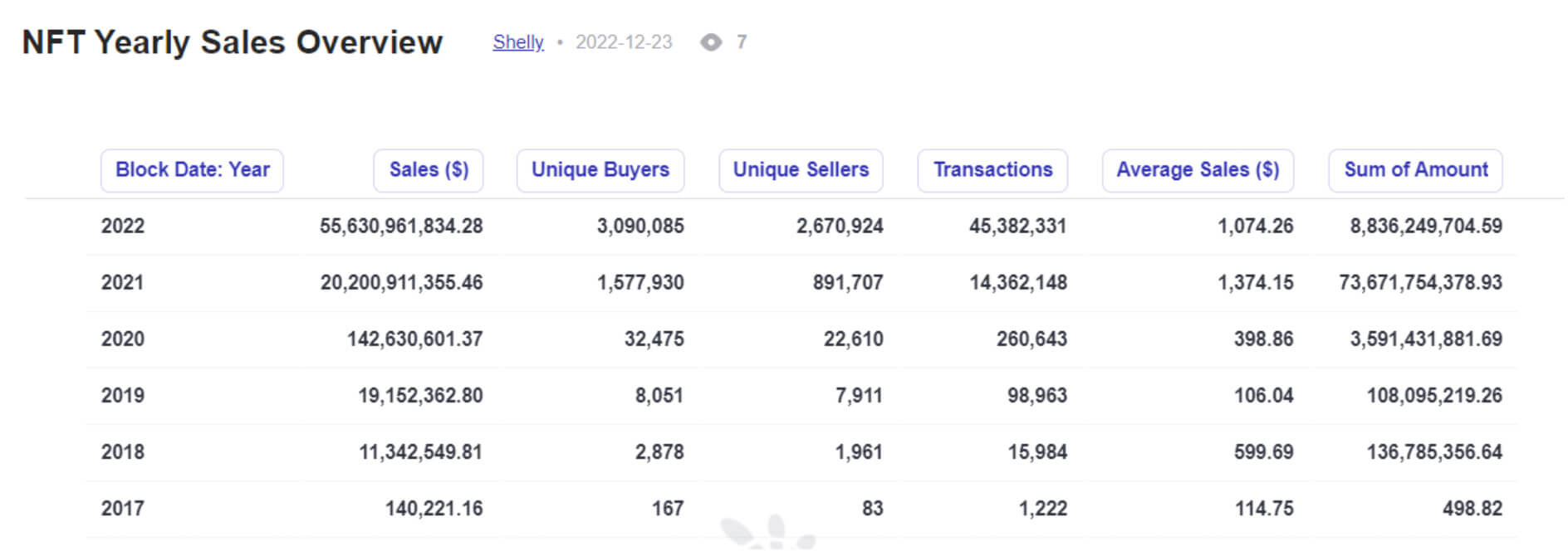
1. Total sales of NFTs in 2022 was $55.5B

This is up 175from $20.2B in 2021. When you compare 2020 to 2022 total sales, it is 390X more.

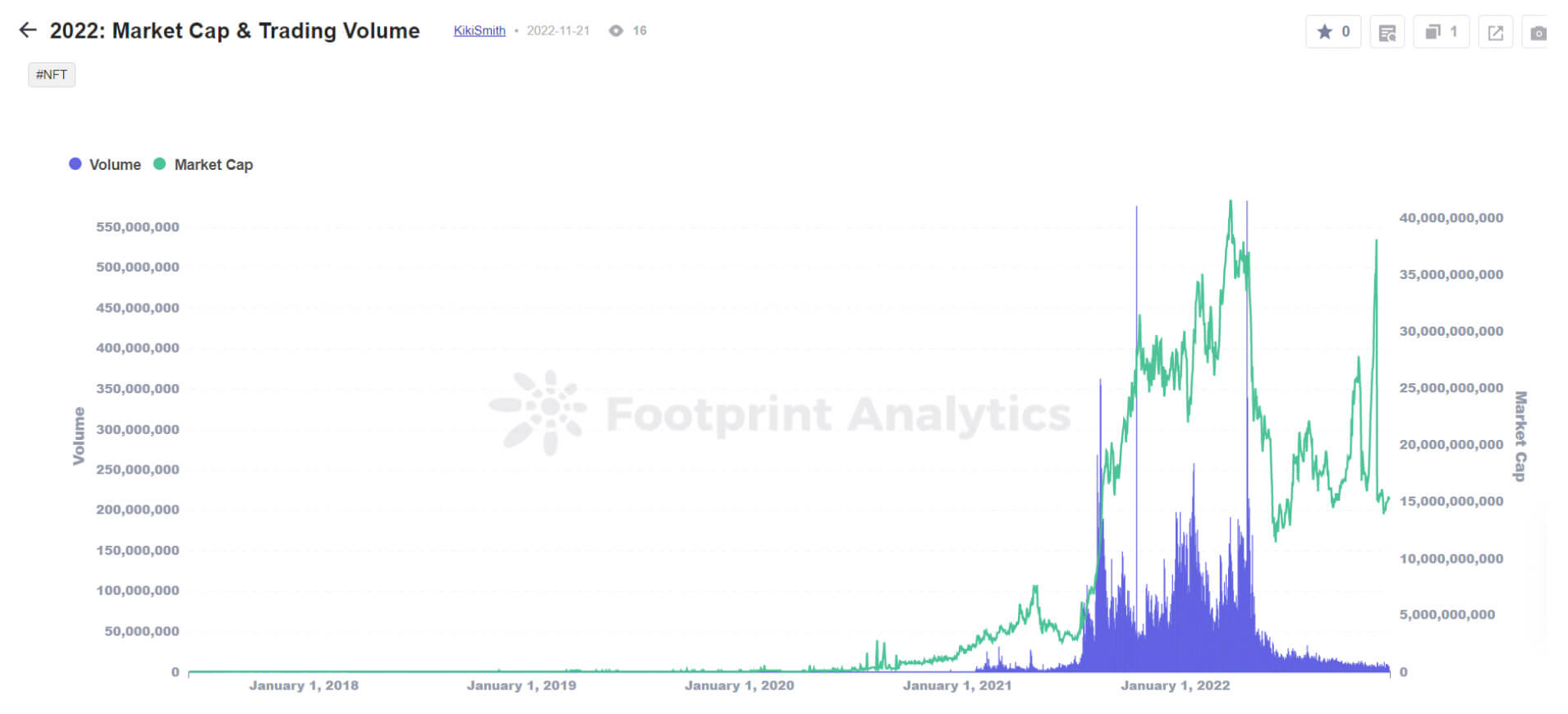
2. The market capitalization of the NFT industry peaked on April 4th at $41.5B

Market capitalization is calculated as the sum of each NFT valued at the greater of its last traded price and the floor price of the collection, respectively. Suspected wash trades have been filtered out.

2022 Market Cap & Trading Volume

3. Roughly 85K NFT collections were launched last year

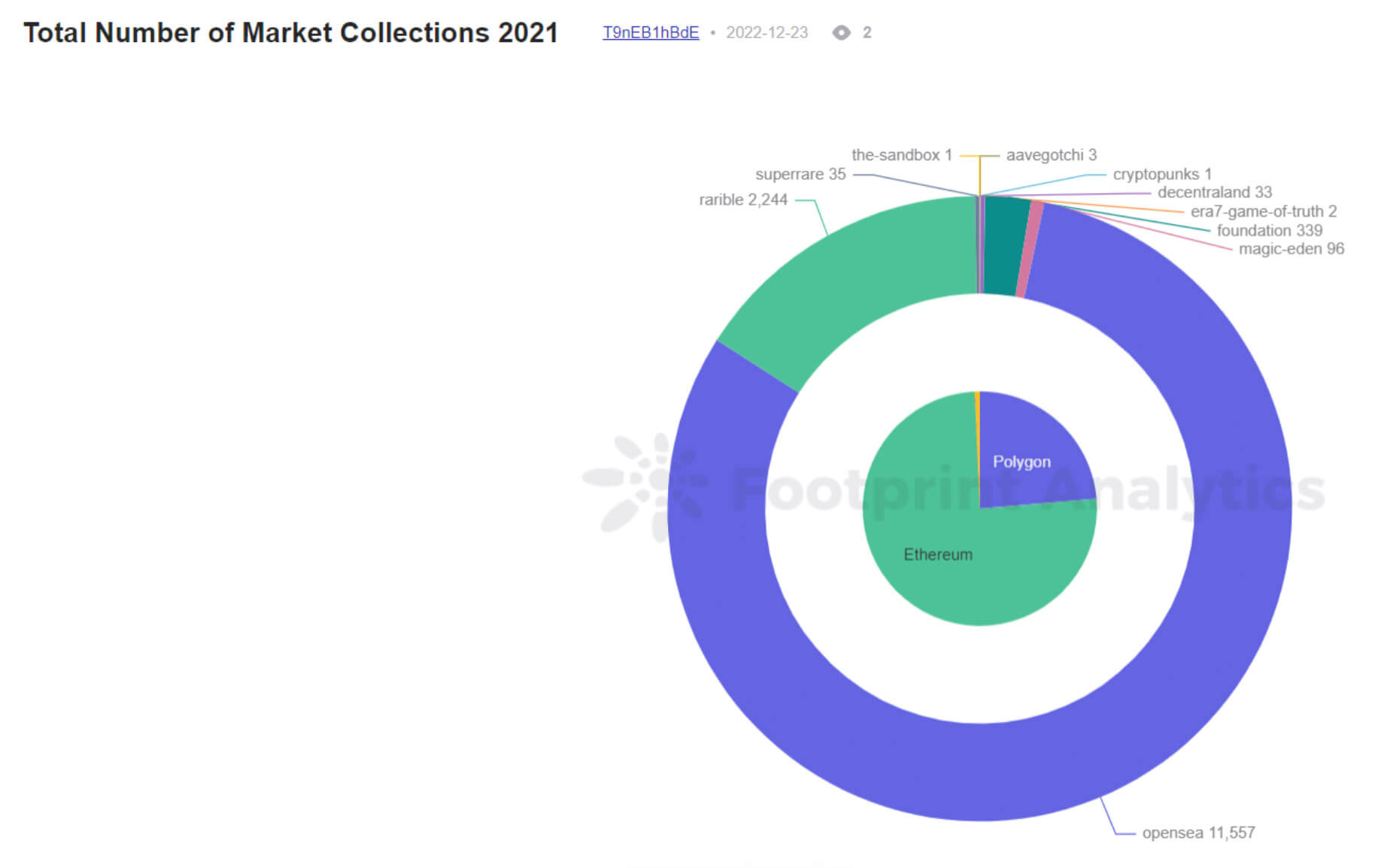
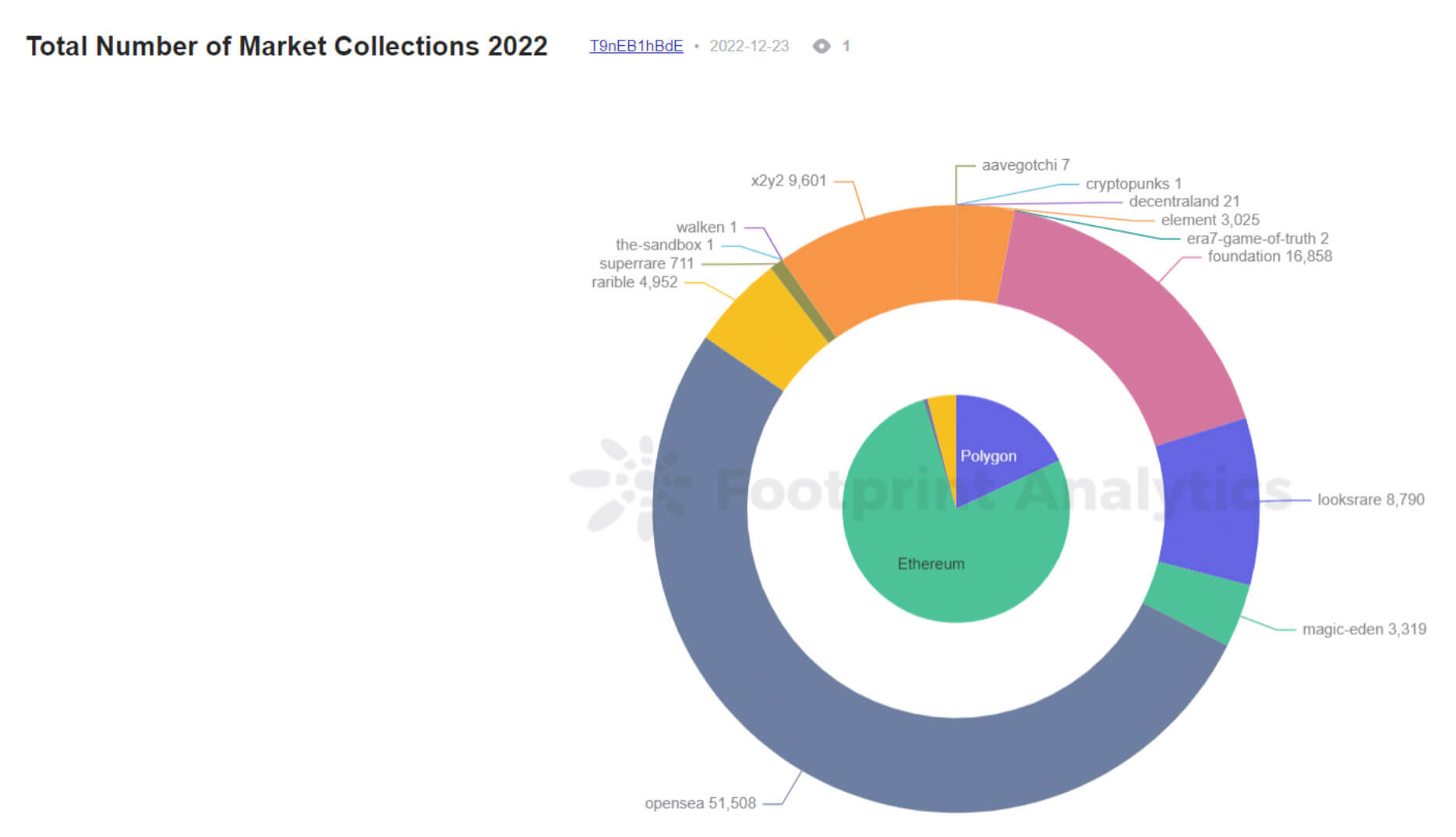
In 2021, there were around 14.5K collections, while the number nearly reached 99K by the end of 2022. Notice that Opensea remains the leader in both years.

Total Number of Market Collections 2021
Total Number of Market Collections 2022
Total Number of Market Collections 2022 / Reference: Total Number of Market Collections 2021 vs Total Number of Market Collections 2022

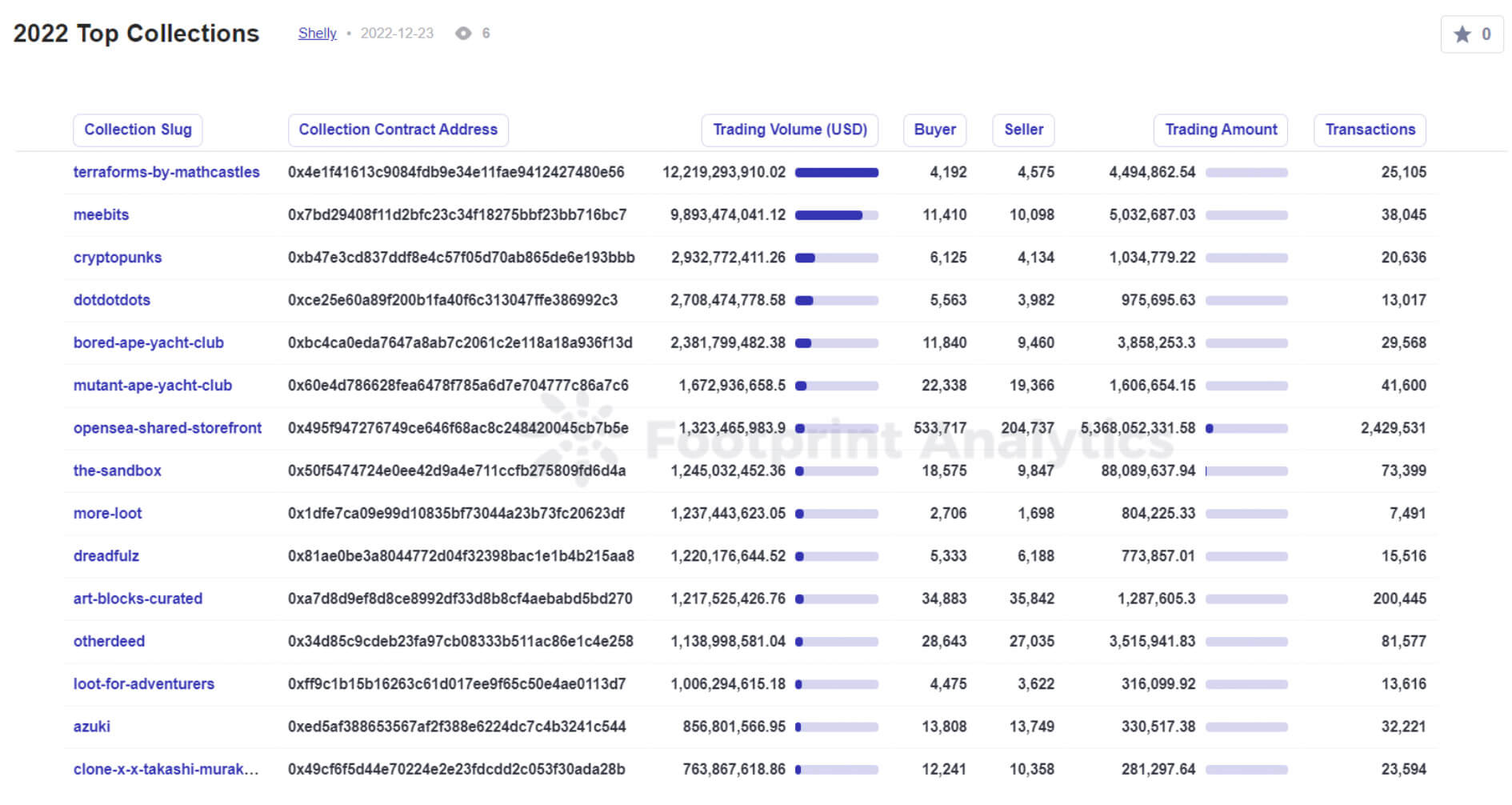
4. About 7,700 collections had trading volume over $100K

Do note that the majority of this activity did not come from a legitimate, organic interest in the project based on the date collected.

2022 Top Collections
2022 Top Collections / Reference: Top Collections 2022

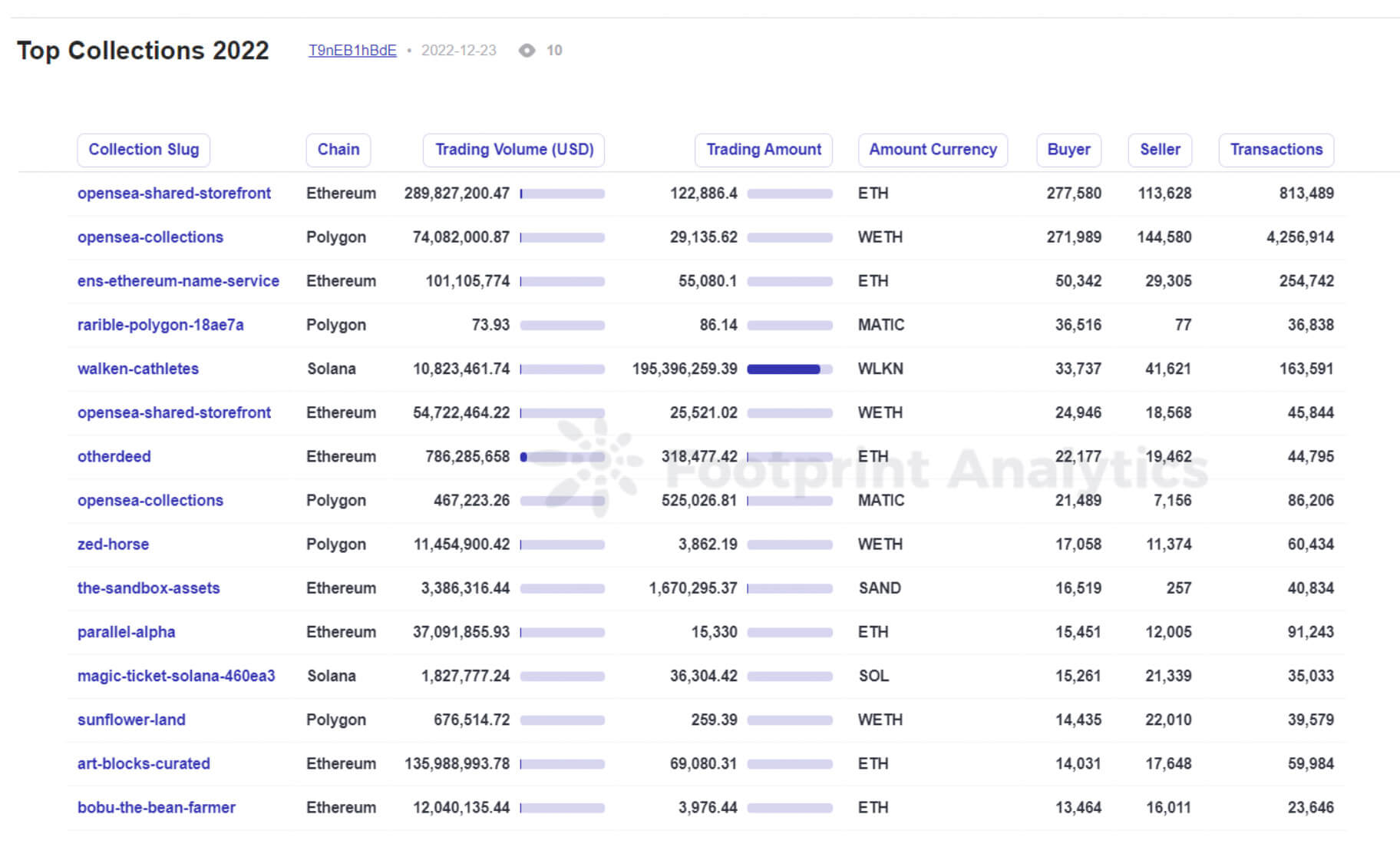
5. Only 2,623 collections had more than 1000 unique buyers

As with all stats in the NFT industry, this one should be taken with a grain of salt due to the significant amount of wash trading, especially during the year’s first half.

Top Collections 2022

Reference: Top Collections 2022

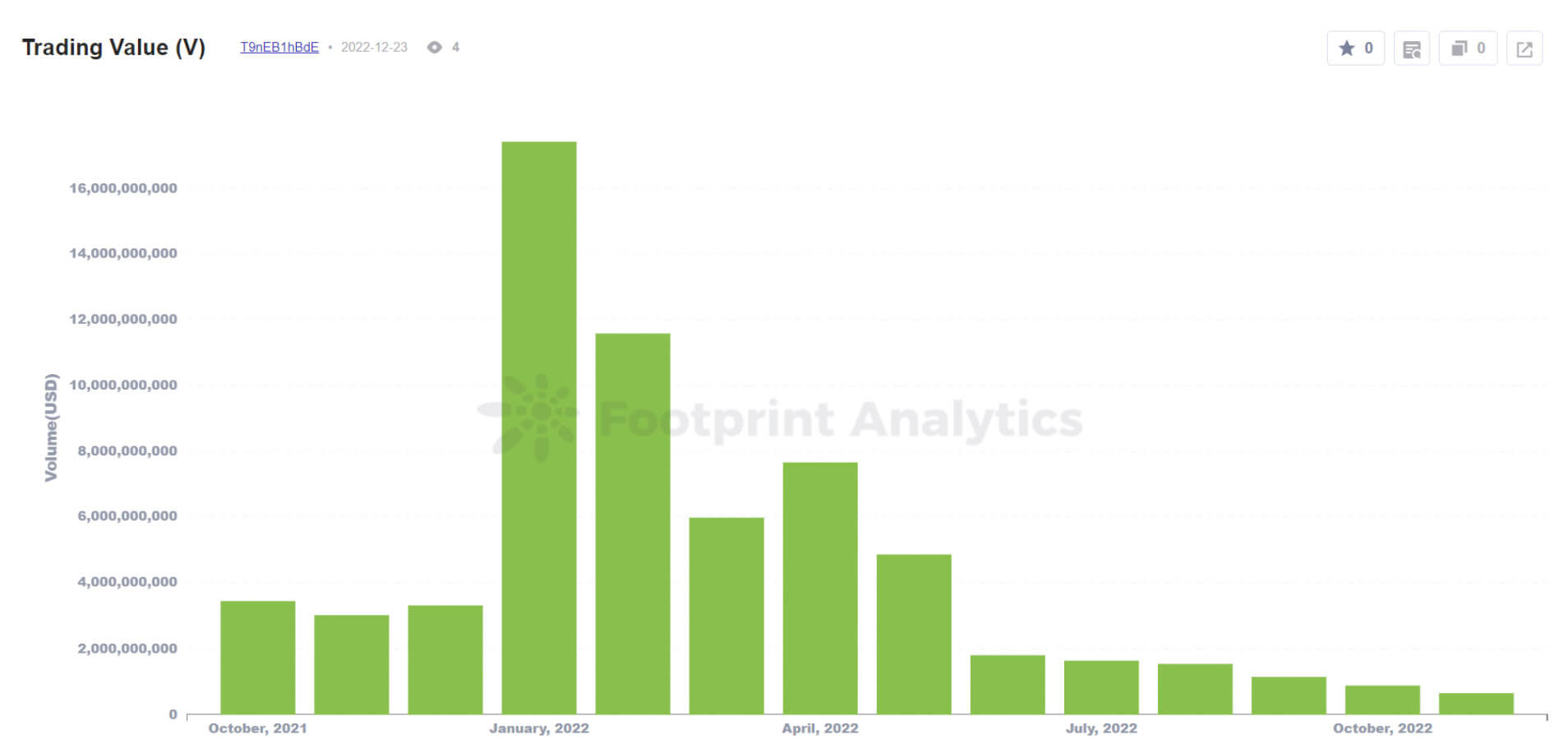
6. NFT trading volume reached its 2022 peak in January, with $17.4B in value

This was more than a 4x jump from the previous month (December 2021). This was also the month when Google searches for the keyword “NFT” reached their all-time high.

NFT Trading Value
NFT Trading Value

Reference: Trading Value (V)

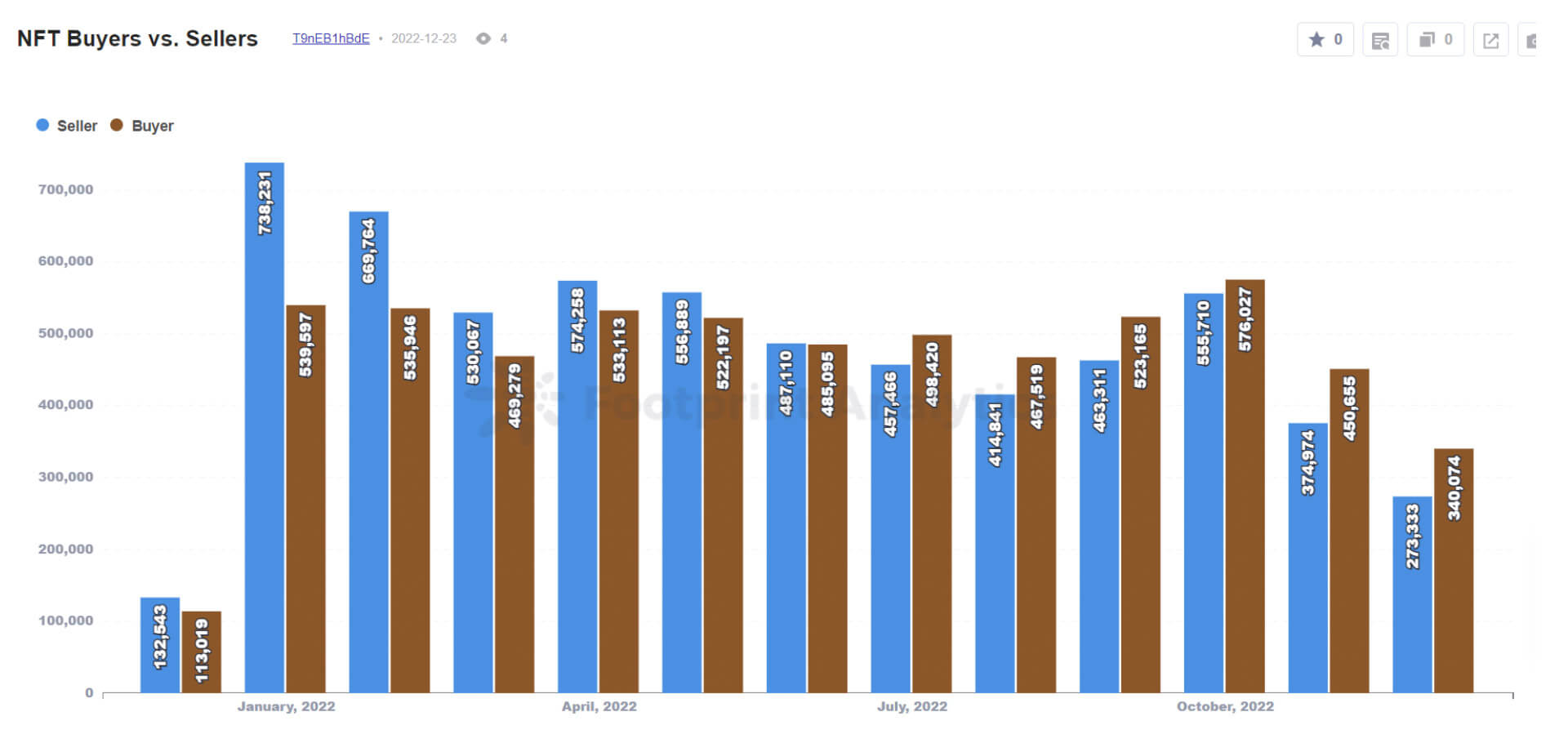
7. The biggest gap between the number of sellers and buyers was in January, with about 200K more sellers than there were buyers.

Yet January was also the hottest month for NFT prices for most major collections, indicating that using these metrics as an analog for supply and demand has flaws.

NFT Buyers vs. Sellers

Reference: NFT Buyers vs. Sellers

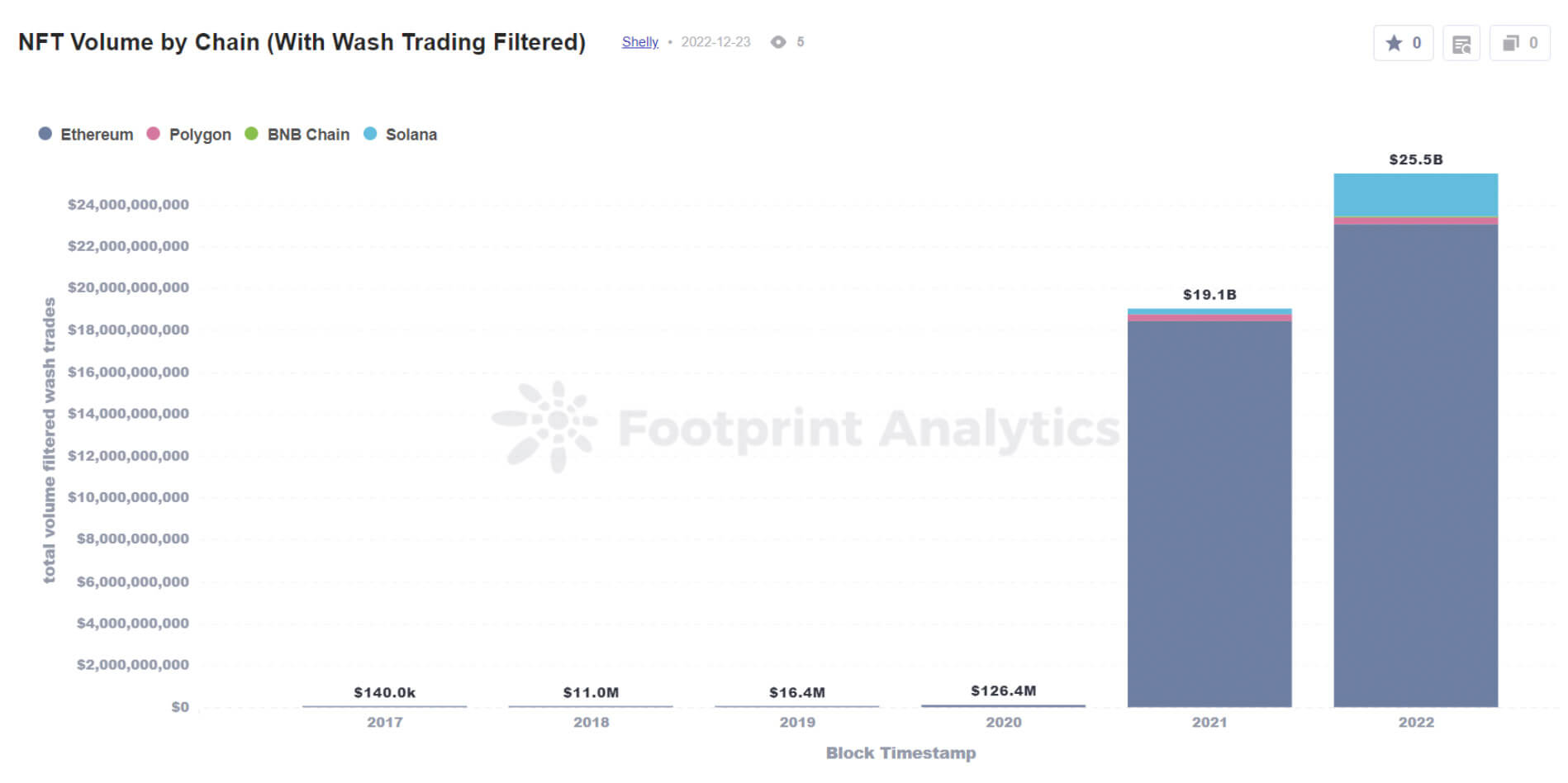
8. Last year, 46% of total NFT trading volume was likely to be caused by wash trading

There are several indicators and filters to detect suspicious activity. To identify these types of transactions, I use Footprint Analytics’ filters to separate transactions to the following formula:

  • a.) Overpriced NFT trades (10x OpenSea Average Price)
  • b.) Collections with 0% royalties (except CryptoPunks and ENS)
  • c.) An NFT bought more than a normal amount of times in a day (currently filtered for more than 3+)
  • d.) An NFT bought by the same buyer address in a short period (currently filtered for 120 minutes)
NFT Volume by Chain
NFT Volume by Chain / Reference: NFT Volume by Chain (With Wash Trading Filtered) vs. NFT Volume By Chain

6 Stats about NFT Collections

9. The collection with the largest market cap by the end of the year was CryptoPunks at $1.1B

Crypto Punks, launched by Larva Labs in 2017, was the first NFT collection to become a household name and have the highest floor price in the industry. Yuga Labs acquired the IP of the collection in March 2022.

Reference: 2022: Top Collections by Market Cap

10. Trading volume of major collections in the Yugaverse—Yuga Labs’ portfolio of products—was $3.1B

This sum includes Bored Ape Yacht Club, Mutant Ape Yacht Club, Bored Ape Kennel Club, Otherside, and CryptoPunks. It excludes Meebits, which had more trading volume than all of these combined,

Reference: Yuga Labs (Trading Volume in 2022)

11. Yuga Labs’ portfolio accounts for about 20% of the total market cap of the entire NFT industry

This sum includes Bored Ape Yacht Club, Mutant Ape Yacht Club, Bored Ape Kennel Club, Otherside, CryptoPunks and Meebits.

12. Without any wash trade filtering, Terraforms by Mathcastles had an astounding $12B in trading volume, more than any other collection, across 11,341 transactions

However, 99.8% of the volume and 46.3% of transactions were detected as wash trading.

Reference: NFT – Collections

13. When filtering out wash trading, CryptoPunks had the highest volume ($2.9B) followed by Bored Ape Yacht Club ($2.3B)

Reference: 2022: Top Collections by volume

14. ArtBlocks Curated was the 4th most traded collection by volume and amassed a market cap $325M

ArtBlocks demonstrated that there is a market for high-end artistic NFTs—it stands out among Yuga PFP projects, and metaverse land NFTs at the top of the rankings

15. There were 7 major collections whose volume was over 95% wash trading

For this stat, “major” means having over $1M in real trading volume. Terraforms by Mathcastles, More Loot, dotdotdots, Dreadfulz, Audioglyphs, CryptoPhunksV2, and Meebits.

6 Stats about Chains and Markets for NFT Projects

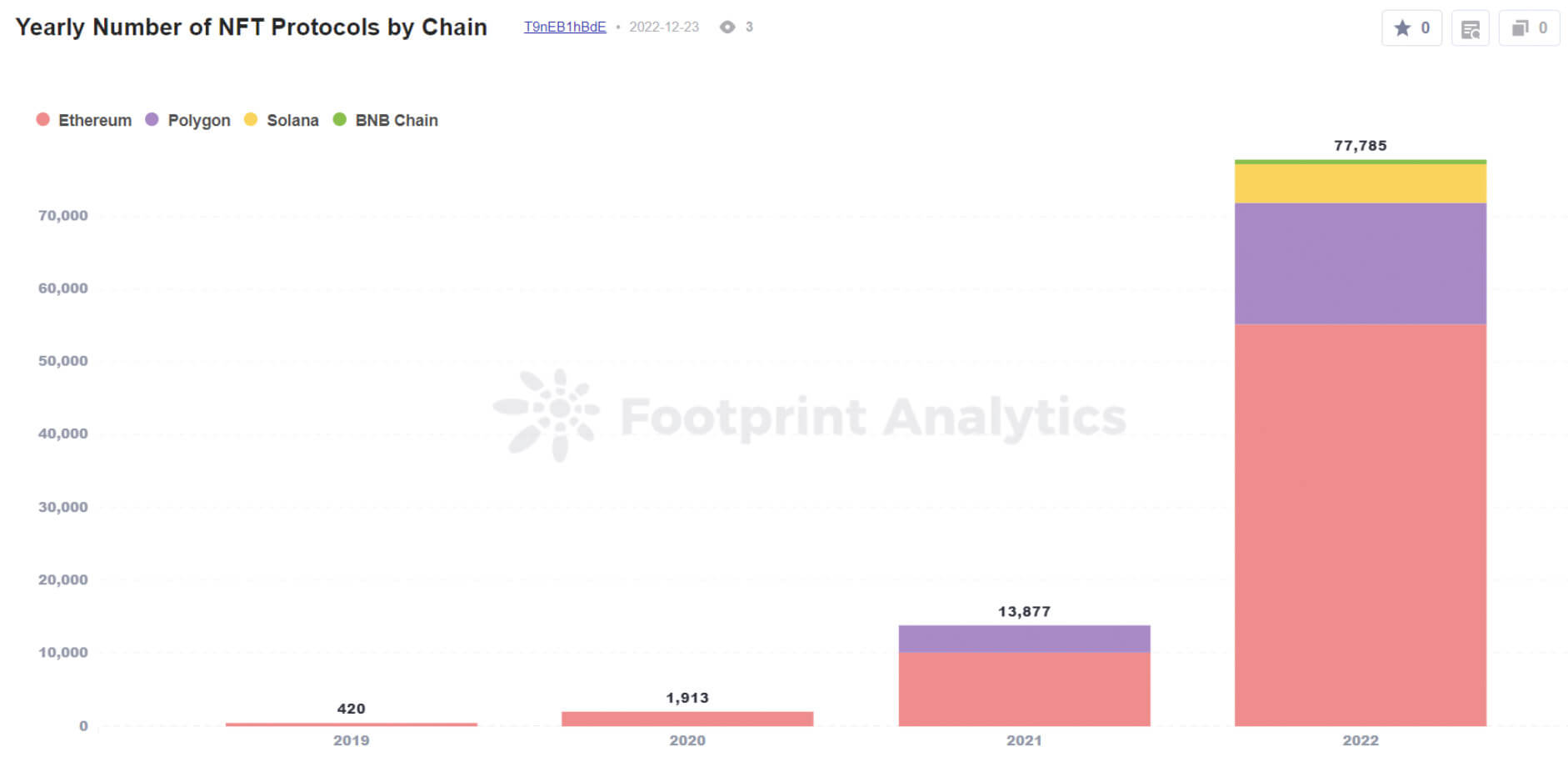
16. Ethereum had 95% percent of volume, 47% of transactions, and 71% of protocols

These figures are almost the same as in 2021. Based on the data, Ethereum is still the most widely used for NFT.

Reference: 2022 Market Share of Transactions by Chain and 2022 Market Share of Trading Volume by Chain and Yearly Number of NFT Protocols by Chain

17. Solana went from having no NFT protocols in 2021 to 5,335 in 2022

Solana is ranked third globally at the point of writing.

Another thing to note is that Ethereum grew from 420 in 2019 to 55,144 in 2022.

Yearly Number of NFT Protocols by Chain
Yearly Number of NFT Protocols by Chain / Reference: Yearly Number of NFT Protocols by Chain

18. OpenSea hosted 53% of all total collections

OpenSea remained the marketplace of choice for Ethereum and Polygon. However, Magic Eden capitalized on its Solana first-mover advantage to be the marketplace of choice for collections on this chain (OpenSea started listing them in April.) Note: a collection can list on multiple marketplaces.

Reference: 2022: Number of Marketplace Collections by Chain

19. Solana had more active users in October, with 411K, than Ethereum, with 392K

While most of the blue-chip collections and collectors transact on OpenSea and Ethereum, Solana built up a sizable community of NFT enthusiasts in 2022. Solana’s active users hovered between 20-45% of the total market share—October was the only month it overtook Ethereum for this metric

Reference: Chain Monthly Active User

20. OpenSea had 96,459 unique wallets make a transaction on the protocol on Feb. 2

This is more transactions than any other marketplace on any other day.

Reference: 2022 Marketplace Daily Active User

21. Over $903M in platform fees were generated on OpenSea, going to both the marketplace and creators

This made OpenSea the most profitable marketplace in terms of fees generated from trading (which went to the platform and are disbursed to creators.)

Reference: Top Marketplaces

6 Stats about NFT Investment & Fundraising

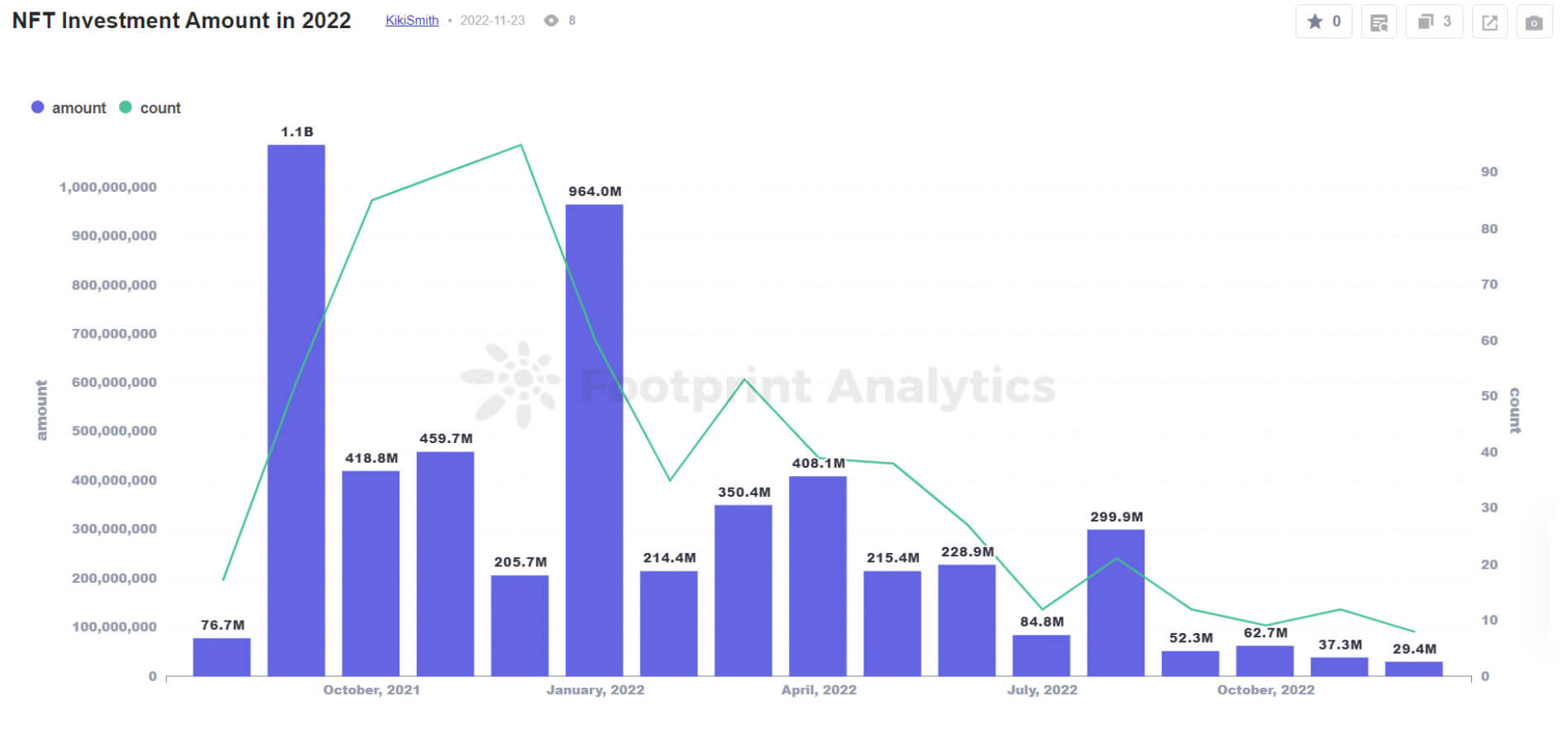
22. The NFT industry received a total of $2.98B in fundraising in 2022

The highest was in January 2022 at $964M. The lowest is in December at $29.4M.

NFT Investment Amount in 2022
NFT Investment Amount in 2022 / Reference: NFT investment Amount in 2022

23. Animoca Brands closed the largest round of the year, $358M led by Liberty City Ventures

Animoca has said it will use the funding for strategic acquisitions and investments, develop its games and metaverse products, and acquire licenses for popular intellectual properties.

Reference: 2022 NFT Fundraising Details

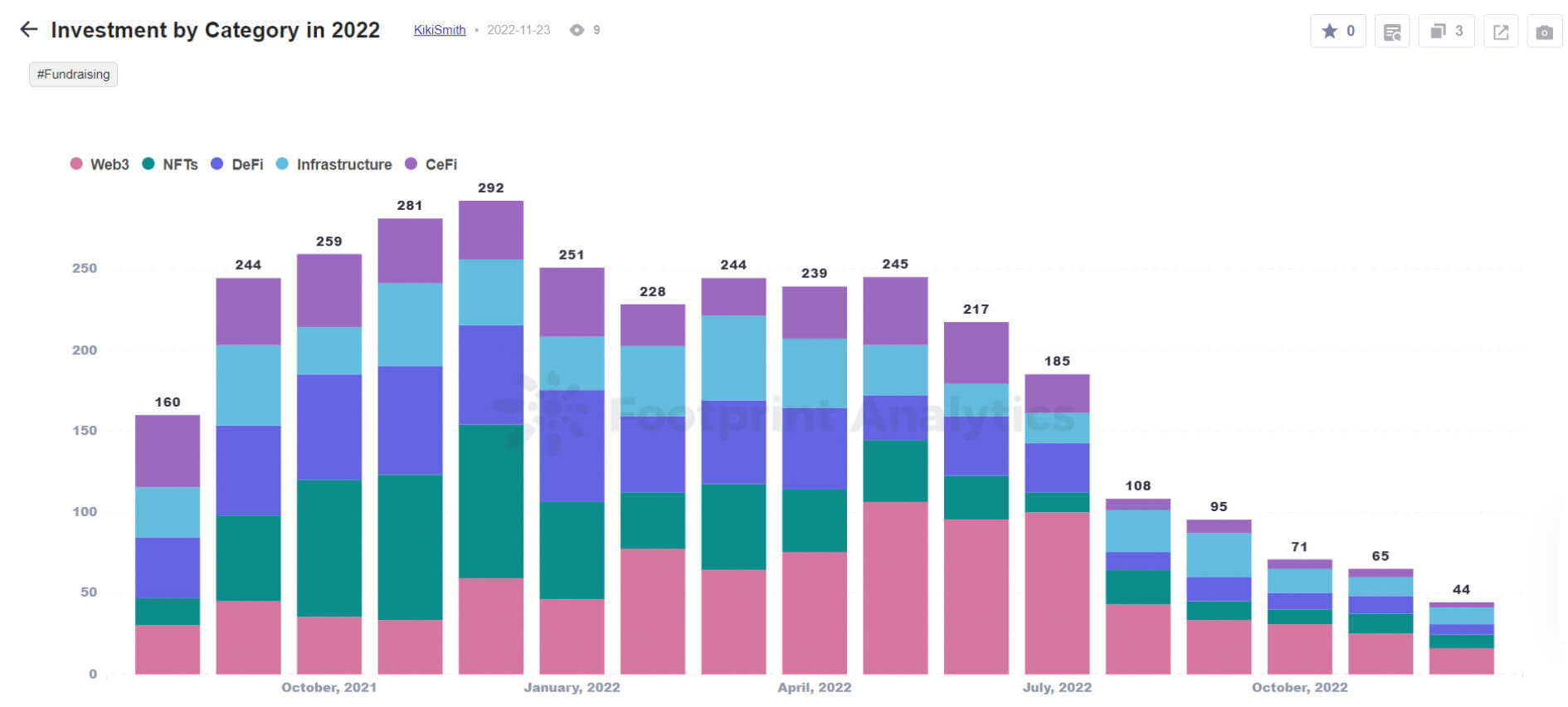
24. There were 1,992 total fundraising rounds in 2022, 756 more than in 2021

Reference: Investment by Category in 2022

25. While NFT-related projects were the most popular category among VCs by the number of rounds, they were the 2nd-least popular in 2022

In 2022, general Web3 projects closed the most rounds (711), followed by DeFi (362), infrastructure (331), NFTs (326), and, finally, CeFi (257).

NFT Investment by Category in 2022
NFT Investment by Category in 2022 / Reference: Investment by Category in 2022

26. Seed rounds made up 81% of total NFT funding rounds

Reference: NFTs Funding Rounds

27. The 2 largest rounds for pure NFT projects went to OpenSea ($300M) and Dapper Labs ($250M)

The OpenSea round was one of only 5 Series C or D rounds in 2022. Dapper Labs is the studio behind the NBA Top Shot collection.

Key Takeaways

As we can see, Web 3.0 is proliferating. NFT is undoubtedly part of the whole Web 3.0 ecosystem. In the Web 3.0 ecosystem, NFTs are often used to facilitate the buying and selling of unique digital assets on decentralized platforms. These platforms use smart contracts to enable transactions without the need for intermediaries. They can facilitate the buying and selling of NFTs and allow NFT holders to earn passive income by lending out their NFTs. There are many use cases to showcase.

Web 3.0 will continue to draw more investment in 2023 based on some of the deal flows I see in the market. OKX Ventures and GSRV co-lead a $2 Million seed round for a Web 3.0 decentralized Identity platform. Binance Labs launched a $500M fund to support promising Web 3.0 projects and start-up firms with great potential earlier this year. Du Jun, the co-founder of cryptocurrency exchange Huobi Global, runs ABCDE Capital, a $400M Web 3.0 venture capital fund is dedicated to investing in web3 builders.

Apart from the crypto firms-led firms, it’s also true that traditional investment companies are beginning to take notice of the Web 3.0 ecosystem and are starting to invest in companies and projects that are working on decentralized technologies, such as blockchain and non-fungible tokens (NFTs).

There are several reasons why traditional investment companies might be interested in investing in web3 technologies. One reason is that the Web 3.0 ecosystem is still in its early stages and has much growth potential. Decentralized technologies have the potential to revolutionize many different industries, from finance and real estate to art and collectibles.

Another reason is that the Web 3.0 ecosystem is relatively uncorrelated with traditional financial markets, which can offer diversification benefits for investors. This can be especially appealing in times of economic uncertainty, when traditional financial markets may be more volatile.

Ending with a quote:

“Web 3.0 brings endless opportunities to many people, changes lives in Kenya, removes barriers in India and empowers developers in China to service global audiences during the COVID lockdown period. Your gateway to Web 3.0 is just one click away. Let’s innovate.” – Anndy Lian.


Source: https://cryptoslate.com/27-stats-about-nfts-in-2022-who-are-the-big-winners/

Anndy Lian is an early blockchain adopter and experienced serial entrepreneur who is known for his work in the government sector. He is a best selling book author- “NFT: From Zero to Hero” and “Blockchain Revolution 2030”.

Currently, he is appointed as the Chief Digital Advisor at Mongolia Productivity Organization, championing national digitization. Prior to his current appointments, he was the Chairman of BigONE Exchange, a global top 30 ranked crypto spot exchange and was also the Advisory Board Member for Hyundai DAC, the blockchain arm of South Korea’s largest car manufacturer Hyundai Motor Group. Lian played a pivotal role as the Blockchain Advisor for Asian Productivity Organisation (APO), an intergovernmental organization committed to improving productivity in the Asia-Pacific region.

An avid supporter of incubating start-ups, Anndy has also been a private investor for the past eight years. With a growth investment mindset, Anndy strategically demonstrates this in the companies he chooses to be involved with. He believes that what he is doing through blockchain technology currently will revolutionise and redefine traditional businesses. He also believes that the blockchain industry has to be “redecentralised”.

j j j