Focusing on TBW peripheral activities: OKX Ventures held an invitation-only event “NIGHT OF THE FUTURE” to discuss new trends in Web3

Focusing on TBW peripheral activities: OKX Ventures held an invitation-only event “NIGHT OF THE FUTURE” to discuss new trends in Web3

Taipei Blockchain Week is bustling this week, gathering blockchain experts and pioneers from around the world to discuss the development trends of the next generation of the internet. On the evening of the 12th, an invitation-only event titled “NIGHT OF THE FUTURE” was co-hosted by OKX Ventures along with several internationally renowned Web3 projects and investment institutions such as SUI, Spacenation, Kronos Research, Orderly Network, Memecore, UXLink, Yei Finance, and Copex. The event featured keynote speeches and fireside chats, delving into the future development directions and trends of the cryptocurrency industry and Web3.

In addition to cutting-edge industry discussions, OKX Ventures also organized various fun activities on-site, showcasing the latest blockchain games from well-known GameFi international projects like Memefi and Spacenation for attendees to experience. A tech-themed opening dance and a fun food and drink menu were also prepared for guests to enjoy. The event attracted over 500 participants, making it the most attended invitation-only event on the first day of TBW.

During the event, OKX Ventures partner Jeff Ren emphasized in his opening speech “NOW and FUTURE of OKX Ventures” that the mission of OKX Ventures is to explore and invest in innovative blockchain projects globally, promoting sustainable development across the industry. As an investment institution deeply rooted in the blockchain industry for many years, we adhere to the strategy of “Innovation + Empowerment.” By integrating OKX’s core resources—including traffic support, trading services, public chain technology, and comprehensive technical support—we have built a complete resource ecosystem that provides comprehensive support to invested projects from early stages to critical development milestones. More importantly, OKX Ventures is not just a financial investor; we also play the dual roles of “discoverer” and “enabler.”

Mr. Jeff Ren, with nearly twenty years of investment experience, stated in his speech that since its establishment, we have invested in over 300 projects across various fields including Layer1, Layer2, DeFi, AI, and GameFi. The year 2024 is expected to be a year of gradual recovery for the blockchain industry, and OKX Ventures has completed over 80 investments this year, covering areas such as the Bitcoin ecosystem, AI, and DePIN (Decentralized Physical Infrastructure Networks). OKX Ventures will continue to allocate resources and capital to projects focused on blockchain infrastructure, GameFi, DeFi, NFTs, and more, to drive technological innovation and industry progress.

Ryan He, Head of Industry Sales at Space Nation, showcased the model and data of Space Nation games in his keynote speech “The Metaverse: A Journey Beyond Gaming,” discussing the future development of the gaming industry.

Vincent Liu, CIO of Kronos Research, discussed the evolving landscape of the cryptocurrency market and the important role of market makers in shaping its future in his keynote speech “Envisioning Crypto in 2025: The Role of Market Makers in Shaping the Future.” Vincent emphasized innovations such as decentralized order books and AI tools that are bridging the gap between centralized and decentralized systems. He also explored the growing collaboration between traditional finance and DeFi, which he believes paves the way for enhanced liquidity and efficiency in centralized models. As cryptocurrencies enter mainstream portfolios, clearer regulations and smarter infrastructure will create a fairer and more accessible market for everyone.

Additionally, Ran Yi, co-founder of Orderly Network, pointed out in his speech “DEXs 3.0: The CEX to DEX Transition” that there is still significant room for optimization in current Web3 trading. By combining the advantages of CEX and DEX to address existing pain points, user trading experiences can be significantly improved. As a cloud liquidity infrastructure project, Orderly Network focuses on integrating cross-chain derivatives liquidity, unifying orders from different chains into an on-chain order book, and creating a unified liquidity ecosystem across chains. This initiative not only effectively addresses the issue of fragmented liquidity across chains but also enhances trading efficiency, provides deeper liquidity pools, and significantly narrows trading spreads.

In the first fireside chat, DA Capital COO Tim Shen, CopeX co-founder Paul, and Alvin from Elite Trading Academy discussed the topic “How Can Communities Become a Strong Support for User Trading?” Tim Shen believes that a good trading community, as demonstrated by the DA Traders Alliance, provides different methods and tools for community users to learn based on their trading levels and experience. For beginners, timely insights from analysts are crucial; we utilize systematic tutorials to help newcomers avoid scams and correctly use cryptocurrency tools, supplemented by daily live broadcasts to build trust within the community and familiarize them with the cryptocurrency market. For community users with a foundational understanding, we provide market hot topics and project research filtered and observed by our investment research personnel, thereby eliminating information asymmetry in cryptocurrency.

CopeX co-founder Paul stated that professionalism is fundamental in building a community; KOLs must have a certain level of understanding of trading to lead users effectively. Education and interaction are also very important, as trading often involves a lot of downtime, making the process tedious and boring. Finding ways to make this process interesting and continuously providing content to users is a challenge for every community. Finally, tools are also very important; for example, CopeX can facilitate smoother trading for users, quickly obtain market information, and make it easier for KOLs and teams to manage communities while also generating additional income, which can be a significant incentive for users to join the community.

Alvin from Elite Trading Academy believes that a valuable trading community is centered around providing reliable information, professional guidance, and valuable discussions. In our Elite Trading Academy, leaders must have practical experience to provide accurate market analysis, helping users understand the essence of the market. The community should focus on learning, understanding user needs, and providing systematic content tailored to beginners or experienced investors. More importantly, the learning environment is a key factor influencing the community; given the fast-paced market changes, it should provide timely answers and perspectives to help users view the market correctly. I also believe that the core of managing a community lies in positioning and structural design; only with clear positioning can we attract the corresponding demographic.

The value of a community lies not just in providing information, but in establishing a complete knowledge system through good management strategies, structured learning, long-term practical exercises, and the integration of data and analytical tools, helping each user find their growth direction and making the community itself a long-term partner they can rely on.

The second fireside chat, hosted by Alex from Blocktempo, titled “What’s the Future of Gaming and Mini Apps,” discussed the future of GameFi and mini apps in the context of current popular Telegram discussions.

Anndy Lian from Memecore believes that in the past few years, many developers have tried to bring Web2 users into Web3 through gaming. He believes that MEME culture has untapped potential to accelerate this transition. Through MemeCore, our goal is to leverage the power of MEME to drive mass adoption, spark creativity, and expand the possibilities in the Web3 space. We aim not only to achieve product development but also to reimagine how people interact with blockchain networks.

CashCashBot founder “Sabi Ge” stated that MiniApps have already been validated in the Web2 market on platforms like WeChat and Douyin, and will soon be replicated on TG, LINE, TikTok, and other platforms. Mini-games previously seen on WeChat and Douyin will migrate to new platforms to capture new traffic and monetization opportunities. There are already professional studios developing Tap to Earn mini-games, which are just the initial, most basic steps. Interactive games, social mini-programs, and AI application mini-programs will definitely emerge in the future, all infused with Web3 value empowerment.

Darren from Space Nation delved into the future of MMORPGs and the role of virtual economies. He explained how Spacenation simplifies existing gaming models using blockchain technology rather than reinventing the wheel.

“We’re not inventing something new; we’re just simplifying what already works.”

He cited examples like “World of Warcraft,” where players have been trading assets and accounts for years. He believes that blockchain provides a more efficient and secure way to manage these transactions.

Darren also emphasized the importance of a strong in-game economy for the success of MMORPGs. He pointed out that many games fail due to economic collapse, leading to decreased player engagement.

As Bitcoin is expected to surpass $100,000 in 2024, more countries and industries are purchasing and storing Bitcoin, and research on international blockchain applications and payment tools is accelerating, showcasing the broad prospects of blockchain technology on a global scale.


Source: https://www.chaincatcher.com/en/article/2158286


Anndy Lian is an early blockchain adopter and experienced serial entrepreneur who is known for his work in the government sector. He is a best selling book author- “NFT: From Zero to Hero” and “Blockchain Revolution 2030”.

Currently, he is appointed as the Chief Digital Advisor at Mongolia Productivity Organization, championing national digitization. Prior to his current appointments, he was the Chairman of BigONE Exchange, a global top 30 ranked crypto spot exchange and was also the Advisory Board Member for Hyundai DAC, the blockchain arm of South Korea’s largest car manufacturer Hyundai Motor Group. Lian played a pivotal role as the Blockchain Advisor for Asian Productivity Organisation (APO), an intergovernmental organization committed to improving productivity in the Asia-Pacific region.

An avid supporter of incubating start-ups, Anndy has also been a private investor for the past eight years. With a growth investment mindset, Anndy strategically demonstrates this in the companies he chooses to be involved with. He believes that what he is doing through blockchain technology currently will revolutionise and redefine traditional businesses. He also believes that the blockchain industry has to be “redecentralised”.

j j j

NCET cracks down on illicit activities in cryptocurrency market

NCET cracks down on illicit activities in cryptocurrency market

Multiple news outlets have reported that the US Department of Justice (DOJ) is increasing its efforts to combat illicit activities and criminal behaviour, such as money laundering, within cryptocurrency exchanges and platforms. To this end, the DOJ’s national cryptocurrency enforcement team (NCET) is focusing its attention not only on exchanges but also on crypto mixers and decentralised finance (DeFi) platforms that engage in unlawful acts.

NCET’s focus

The NCET’s focus on cryptocurrency-related crimes highlights the United States government’s efforts to regulate the cryptocurrency market. The NCET aims to prevent criminals from using digital assets to carry out illegal activities and to ensure the safety and fairness of the cryptocurrency market for investors. The increased efforts of the NCET and other regulatory bodies to combat cryptocurrency fraud and criminal activity indicate the growing importance of regulation in the cryptocurrency market.

They have a broad mandate, blurring lines between traditional white-collar and other federal crime and the emerging technologies associated with cryptocurrency and cyber-instrumentalities, neither of which are governed by clear, subject matter-specific statutes. The team aims to assist in tracing and recovering assets lost to fraud and other illegal activities.

Eun Young Choi, the newly appointed director of the cryptocurrency enforcement team, has vowed to crack down on illicit behaviour and to hold companies accountable for allowing or facilitating criminal activity on their platforms. In recent months, the US government has shut down nine exchanges suspected of money laundering.

For example, in May 2023, the US government, in collaboration with Ukrainian authorities, shut down nine cryptocurrency exchanges suspected of money laundering activities in recent months. The authorities shut down all servers of crypto exchanges 24xbtc.com and 100btc.pro, pridechange.com, 101crypta.com, uxbtc.com, trust-exchange.org, bitcoin24.exchange, paybtc.pro, and owl.gold.

Each platform offered users anonymous crypto transactions through voluntary registration programs violating several US laws. The exchanges were considered important hubs in the cybercrime ecosystem and were accused of violating US laws and having lax know-your-customer (KYC) controls.

It was also mentioned that the NCET Team wants to crack down on illicit investment scams such as the “pig butchering” scheme on crypto exchanges. This scam involves scammers playing the long game, “fattening up” potential victims to extract as much money as possible before the “slaughter”. The goal is not to extract money quickly, unlike other common scams. The term originated from a Chinese phrase with the same meaning.

They have also emphasized its partnerships with other federal agencies, such as the Securities and Exchange Commission (SEC) and the Commodity Futures Trading Commission (CFTC), in monitoring the cryptocurrency industry.

The government’s goal is to coordinate efforts and respect primacy among subject matter experts while unleashing US regulators to dig deeper into emerging markets and the technologies that support them. With the creation of the NCET, a rise in enforcement actions, and the end of the cryptocurrency “grace period,” stakeholders active in the cryptocurrency markets need to ensure their regulatory compliance.

A two-phase strategy for cryptocurrency regulation

Some experts believe that the US government’s actions signal a coordinated regulatory campaign to stymie the growth of the cryptocurrency industry. Personally, I do not think so. The regulation of cryptocurrencies requires a meticulously planned strategy that adapts to the ever-changing landscape of this digital realm.

To ensure its effectiveness, a two-phase approach should be followed. In the initial phase, the primary objective is to disrupt the flow of cryptocurrencies to illicit actors. This can be achieved by maintaining updated lists of sanctioned intermediaries and providing clear guidelines to individuals and businesses in the United States, helping them identify and avoid engaging with foreign companies under sanctions.

Furthermore, a comprehensive analysis should be conducted concurrently to evaluate the efficacy of these measures in combatting illicit financial activities associated with cryptocurrencies. This in-depth assessment would give regulators a deeper understanding of the outcomes of their actions.

By closely monitoring cryptocurrency intermediaries and rigorously evaluating the results, regulators can gather invaluable insights into the potential of cryptocurrencies as a legitimate instrument for promoting financial inclusion.

The findings and evaluations obtained in the initial phase will form the basis for the subsequent stage. If the analysis demonstrates a significant reduction in illegal cryptocurrency transactions due to effective law enforcement, it would create strong momentum for the government to proceed with the implementation of a Central Bank Digital Currency (CBDC).

This would indicate that the risks tied to illicit cryptocurrency activities can be adequately managed. However, if the measurements from the first phase reveal limited progress in addressing the criminal use of virtual currencies, it would underscore the government’s need to enhance enforcement mechanisms before considering the introduction of a CBDC.

It becomes crucial to prioritise efforts to target foreign exchanges and influential intermediaries through stringent sanctions, effectively combating theft, fraud, and extortion. Prudence dictates that new currencies should not be introduced hastily, and a comprehensive understanding of cryptocurrency dynamics must be achieved before any further steps are taken.

I think a well-executed phased approach to cryptocurrency regulation, supported by vigilant monitoring, thorough evaluation, and targeted enforcement measures, promises to provide valuable insights into the viability of cryptocurrencies for legitimate financial activities.

By diligently assessing the impact of regulatory efforts, policymakers can make informed decisions regarding the potential implementation of a CBDC, thereby ensuring effective control over illicit activities within the cryptocurrency ecosystem. Continual adaptation and improvement in response to the evolving challenges of this digital landscape are essential for fostering a safe and inclusive environment for cryptocurrency transactions.


Source: https://e27.co/ncet-cracks-down-on-illicit-activities-in-cryptocurrency-market-20230522/

Anndy Lian is an early blockchain adopter and experienced serial entrepreneur who is known for his work in the government sector. He is a best selling book author- “NFT: From Zero to Hero” and “Blockchain Revolution 2030”.

Currently, he is appointed as the Chief Digital Advisor at Mongolia Productivity Organization, championing national digitization. Prior to his current appointments, he was the Chairman of BigONE Exchange, a global top 30 ranked crypto spot exchange and was also the Advisory Board Member for Hyundai DAC, the blockchain arm of South Korea’s largest car manufacturer Hyundai Motor Group. Lian played a pivotal role as the Blockchain Advisor for Asian Productivity Organisation (APO), an intergovernmental organization committed to improving productivity in the Asia-Pacific region.

An avid supporter of incubating start-ups, Anndy has also been a private investor for the past eight years. With a growth investment mindset, Anndy strategically demonstrates this in the companies he chooses to be involved with. He believes that what he is doing through blockchain technology currently will revolutionise and redefine traditional businesses. He also believes that the blockchain industry has to be “redecentralised”.

j j j

Additional Comments by Anndy Lian on Singapore’s approach to regulation of crypto and digital asset activities

Additional Comments by Anndy Lian on Singapore’s approach to regulation of crypto and digital asset activities

The initial article was published at Nikkei Asia and was republished on sites such as DealStreet and K. I hope to add more context to my comments.

Q1/ Singapore is warning investors about investing in cryptocurrencies while selectively giving licenses for crypto/digital asset platforms to operate. How contradictory is this approach and what are authorities exactly trying to achieve here?

Singapore’s approach is essentially one guided by the traditional finance structure, applying existing legal frameworks where possible, to protect the investing public. As a result, the regulators are proactive about warning individual investors about the risks in investing in cryptocurrencies, which is what you would expect.

But I do think Singapore’s approach is also very contradictory. I do not agree with the practice of selectively granting licences to different crypto entities. The whole process of selecting who to give the licence to is not very transparent in my opinion.

If you look at the licences that have been given out so far, to the brokerage arm of Southeast Asia’s largest lender DBS Bank, and Australian cryptocurrency exchange Independent Reserve, it gives the impression that the government is favouring big players and foreign exchanges.

Right now, a lot of crypto exchanges and startups who regard Singapore still as a crypto hub, are doing their very best to stay in Singapore and be licensed. But the truth of the matter is that most of them are effectively in regulatory limbo. They have no idea what exactly is going to happen next, whether or not their application will be approved.

What I would like to see is for the regulator, the Monetary Authority of Singapore (MAS), to take a more systematic and open-handed approach to licensing, so that every crypto business will have an equal opportunity to comply with its requirements.


Q2. What are the positive aspects and drawbacks of the way Singapore is approaching the regulation of crypto and digital asset activities?

The positive aspect is that Singapore is trying to build its own crypto ecosystem by embracing crypto exchanges and startups, and I think that is positive.

 The drawback in the current approach, and one that I really do not want to see, is for all intent and purposes an elitist model where only businesses that appear to be in favour with the regulator are able to get a licence in a reasonable time span.

 Singapore is obviously trying to both embrace crypto, and at the same time also trying to regulate the crypto sector to protect investors and the public at large. But it’s a difficult balance to strike, and without an impartial and transparent approach to licensing, they risk defeating the purpose of making cryptocurrencies available to all.

 Between crypto and traditional assets there are key differences, not least of which is their decentralized nature. As a result, whatever applied in the past to traditional assets might not work so well for cryptocurrency, because of the way it works and how people use it.

It comes down to the fact that Singapore needs to find new ways to regulate this dynamic new sector, without trying to rely on existing models that are no longer fit for purpose, if it’s to be a leading hub for cryptocurrencies in Southeast Asia and globally.


Q3. Which countries in Southeast Asia and the rest of Asian can perhaps best be able to emulate Singapore’s regulatory approach and why?

I believe South Korea and Hong Kong, with similar financial systems, can best emulate the whole regulatory approach, and by learning the lessons so far do it a lot better than Singapore. That said, the recent announcement by China banning crypto activities leaves the fight for the top spot for crypto in Southeast Asia up for grabs. As well as South Korea and Hong Kong, I also see Japan as a big threat to Singapore in the fight to be Asia’s crypto

_______________________________________________

Crypto entrepreneurs find Singapore is not so hospitable after all

Cryptocurrency entrepreneurs lured to Singapore by its apparent openness to the burgeoning industry are discovering just how difficult it is to legally operate in the city-state.

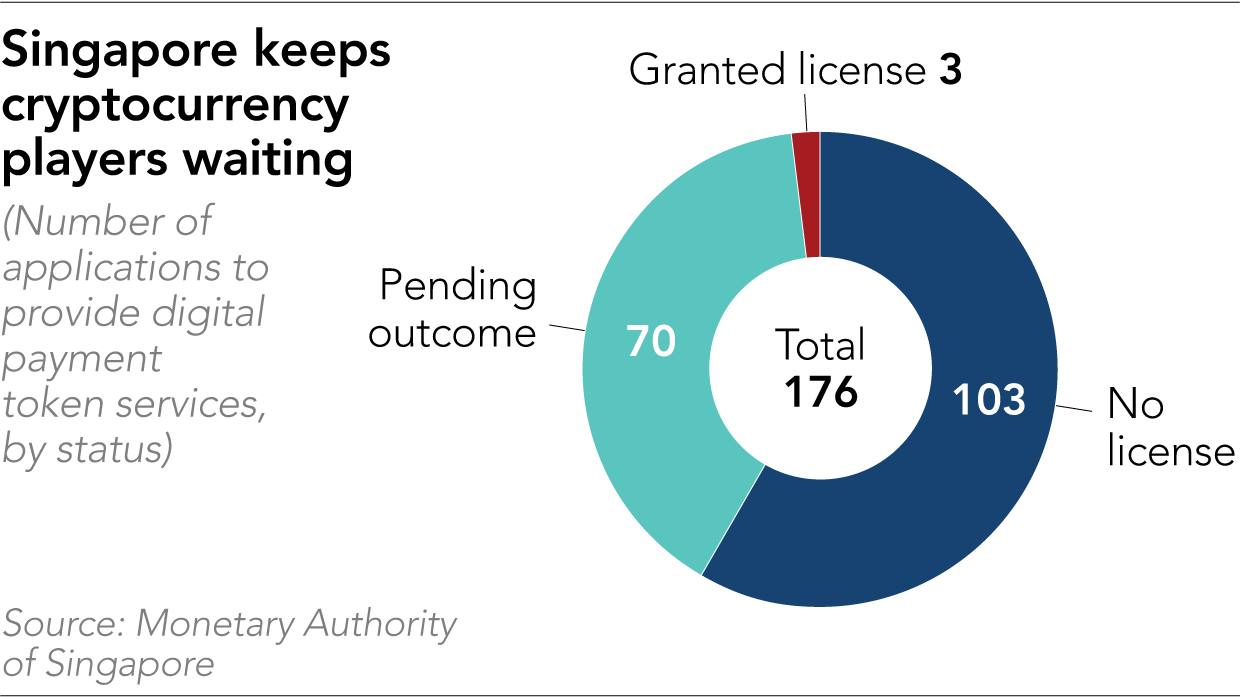
More than 100 of the around 170 businesses that applied for licenses to offer “digital payment token services” have now been turned down or withdrawn their applications, according to the latest figures from regulators.

And scores more face an uncertain future, operating under exemptions but amid a darkening mood over the approval process.

In early September, the Monetary Authority of Singapore (MAS) ordered Binance, one of the world’s largest crypto exchanges, to stop providing services to residents in the city-state, and last week Binance’s Singapore-only affiliate announced it also was shutting down its trading platform for the city-state. Dozens are confronting a similar fate.

Dubai-based crypto exchange Bitxmi is one of 103 companies that appear on the latest MAS list of entities whose exemptions allowing them to operate have been removed. Having set up in Singapore in late 2018, it was unsuccessful in securing a license, chief executive officer Sanjay Jain told Nikkei Asia.

“We can’t operate in Singapore,” he said. “We have an office there, but it’s just more or less—there’s one person for our accounting and legal issues.”

Jain declined to speak about why his outfit did not manage to secure a license from regulators. “That, you need to ask them,” he said.

The introduction of the licensing regime in January was cast as the next step in building a thriving crypto sector and set up a contrast with Singapore’s rival Asian financial hub, Hong Kong, which had taken a more skeptical approach to crypto businesses.

Graph by Nikkei Asia.

A spokesperson for MAS told Nikkei that it is supportive of innovation in the use of blockchain technology, which underpins cryptocurrencies, while also recognizing the risks.

“Cryptocurrencies could be abused for money laundering, terrorism financing, or proliferation financing due to the speed and cross-border nature of the transactions,” the spokesperson said. “Digital payment token service providers in Singapore … have to comply with requirements to mitigate such risks, including the need to carry out proper customer due diligence, conduct regular account reviews, and monitor and report suspicious transactions.”

Rahul Advani, Asia-Pacific policy director at blockchain company Ripple, said Singapore’s stance on digital assets has resulted in the city-state being one of the most advanced and mature nations in the field, helping foster development and innovation in the emerging industry.

“It’s very clear where digital assets and related activities lie on the risk spectrum, so you mitigate the potential of developing and investing in technology that is unregulated,” he told Nikkei.

Crypto players that raced to set up in Singapore run the spectrum from exchange platforms for trading bitcoin, Ethereum, and other tokens, through investment managers and financial advisers looking after digital asset portfolios for the wealthy, to business-to-business outfits helping corporate clients accept cryptocurrency payments.

Outfits that were operating in the country prior to the introduction of the licensing regime were granted exemptions until the outcome of their license application is known. Senior Minister Tharman Shanmugaratnam told parliament in July that there were 90 companies operating under such exemptions.

The MAS website showed that the group had shrunk to about 70 as of December 14.

So far, only three players—DBS Vickers Securities, a unit of Singapore and Southeast Asia’s largest bank, DBS Group Holdings; digital payments startup FOMO Pay; and Australia’s Independent Reserve, which offers crypto exchange services—have been listed on the MAS website as licensed entities.

Two others—Coinhako, which operates a crypto exchange platform, and TripleA, a payments company—have put out announcements themselves saying they have acquired the necessary approvals to operate.

Anndy Lian, chairman of Netherlands-registered crypto trading platform BigONE Exchange, told Nikkei that his outfit does not intend to apply for a license in Singapore presently.

“The whole process of selecting who to give the license to is not very transparent,” he said. “It gives the impression that the government is favoring big players and foreign exchanges.”

MAS has not publicly disclosed why specific crypto players were unable to obtain a permit.

But Nikkei understands that some of them did not have the capacity or infrastructure to meet the high compliance standards set out by the financial regulator to deter money laundering and financing of terrorism.

“Cryptocurrencies are currently being used to channel the earnings of everything from ransomware proceeds, the sale of narcotics to some of the most horrific crimes, including human trafficking,” said Rachel Woolley, head of financial crime at client management solutions provider Fenergo.

“Regulators have now entered this space in an effort to protect the financial services industry from illicit activity in much the same way that activity involving fiat currency must be monitored.”

MAS pointed to comments from its managing director, Ravi Menon, who has said that Singapore does not need 160 players in the crypto sector and it may be better to have “half of them” operating at very high standards.

TripleA told Nikkei that in securing its permit, it had to ensure that its operating procedures for risk assessment, customer due diligence, record-keeping, suspicious transaction reporting, auditing, and training were up to snuff.

But its CEO, Eric Barbier, said TripleA gained little insight into what exactly made the difference between success and failure.

“MAS never talks. MAS asks questions and questions and questions,” he said. “You can ask questions but they will not answer, and most regulators are like this.”

Barbier reckoned that being a business serving other businesses may have helped secure a license. “Especially for consumer-to-consumer, like consumer exchanges and so on, the risk of money laundering is very high, so they need to demonstrate to MAS that they are able to mitigate all those risks accordingly,” he said.

Peiying Chua, financial regulation partner for Singapore at the law firm Linklaters, said it is unlikely MAS is specifically favoring big, incumbent financial players: “Likely reasons for unsuccessful applicants may include a lack of track record or key personnel without adequate experience, a lack of a sustainable business model or serious adverse records relating to directors and key individuals.”

“The regulatory approach by MAS may to some degree stifle innovation in smaller entrepreneurs and sift out smaller virtual asset service providers that may not be able to comply with the regulations,” said Quek Li Fei, partner at law firm CNPLaw.

But he added it “provides a more forward-thinking approach toward encouraging legitimate innovation and entrepreneurship in cryptocurrency and digital asset businesses, with a reasonable level of protection to investors.”


Source: https://www.dealstreetasia.com/stories/crypto-entrepreneurs-singapore-274592/


Anndy Lian is an early blockchain adopter and experienced serial entrepreneur who is known for his work in the government sector. He is a best selling book author- “NFT: From Zero to Hero” and “Blockchain Revolution 2030”.

Currently, he is appointed as the Chief Digital Advisor at Mongolia Productivity Organization, championing national digitization. Prior to his current appointments, he was the Chairman of BigONE Exchange, a global top 30 ranked crypto spot exchange and was also the Advisory Board Member for Hyundai DAC, the blockchain arm of South Korea’s largest car manufacturer Hyundai Motor Group. Lian played a pivotal role as the Blockchain Advisor for Asian Productivity Organisation (APO), an intergovernmental organization committed to improving productivity in the Asia-Pacific region.

An avid supporter of incubating start-ups, Anndy has also been a private investor for the past eight years. With a growth investment mindset, Anndy strategically demonstrates this in the companies he chooses to be involved with. He believes that what he is doing through blockchain technology currently will revolutionise and redefine traditional businesses. He also believes that the blockchain industry has to be “redecentralised”.
j j j