Analyzing the Role of Celebrities in NFTs Adoption and Popularization

Analyzing the Role of Celebrities in NFTs Adoption and Popularization

Amidst all events that happened this year in the cryptocurrency industry, without a doubt, the list would not be complete without making mention of Non-Fungible Tokens (NFTs). Asides from the Bull Run, Decentralized Finance (DeFi) frenzy on the Binance Smart Chain among others which was witnessed, NFTs rave was and is still very relevant.

However, celebrities had a role to play in the popularization and adoption of the technology. Just the way institutional investors that came into the Bitcoin and cryptocurrency markets played a huge role in wide adoption and likewise increase in the price of Bitcoin. Institutional investors popularized Bitcoin such that banks and individuals that once spoke against the technology have now embraced it with open arms. Celebrities have played a similar role in the adoption of NFTs by the creation and auction sales of NFTs.

What are NFTs?

NFT is an acronym for Non-Fungible Tokens which means the token is interchangeable with an equivalent. In other words, an NFT is a unique unit of data stored in a digital format with Blockchain technology and can therefore not be replicated or replaced. The irreplaceable nature of NFTs is what distinguishes them from the normal cryptos. NFTs are exclusive to an individual, unlike Bitcoin and Ethereum that can be held by a lot of people. They’re fungible tokens because 1 BTC is equivalent to 1 BTC and can be exchanged for each other.

An NFT may represent real-world objects like art, music, in-game items, and videos. They are bought and sold online, frequently with cryptocurrency, and they are generally encoded with the same underlying software as many cryptos.

Use-case of NFTs

The basic and most important use of non-fungible tokens is the storage of unique data on the blockchain. The process of storing a real asset on the Blockchain is called tokenization. Different categories of real assets can be tokenized; songs, albums, publication records, artworks, photos, and lots more.

These NFTs are tokenized with the aim of either keeping the digital format on the Blockchain or ultimately putting them up for sale. 2021 has seen the sale of different NFTs at whopping prices on NFT marketplaces such as OpenSea, Rarible, Influxo among others.

So why would anyone want to buy these NFTs?

Anyone can view the individual images—or even the entire collage of images online for free. So why are people willing to spend millions on something they could easily screenshot or download?

Because an NFT allows the buyer to own the original item. Not only that, it contains built-in authentication, which serves as proof of ownership. Much like the priceless nature of a Matisse or a Van Gogh, the original creation is worth more than the postcard you bought from the museum, and the same follows for NFTs and their copyrights.

Collectors value those “digital bragging rights” almost more than the item itself.

What Role Have Celebrities Played in NFTs?

NFTs have become a force to reckon with in the year 2021. The market capitalization of NFTs has exploded and witnessed parabolic growth in 2021 and celebrities have played a very important role in making that a reality. Several celebrities have tokenized their musical albums, artworks among others and auctioned them for sale, and have made good returns on these NFTs. This has in turn popularized NFTs and brought them mainstream.

Nevertheless, celebrities have also prompted other reputable companies to adopt the idea of NFTs and have set plans in motion to launch theirs. Fashion companies, media houses, and beverage drink companies among others have shown intention of creating NFTs this year. Apart from the fact that celebrities are making money from the NFTs rave, the adoption of unique digital storage is being popularized and widely adopted.

Ultimately, the popularization of NFTs by celebrities is in a way fostering the growth of blockchain technology and the cryptocurrency industry at large. An instance whereby a celebrity makes a sale on an NFT created, the news will spread far and wide and inquisitive people begin to ask questions. This could go a long way in bringing those individuals into the crypto industry.

There is a massive value and monetary potential in owning these ‘one of a kind’ NFTs, as with all art, inflation and rarity will drive its intrinsic value. Experts say that this phenomenon is ‘history in the making’ for the industry that only has one value at the point of sale when it comes to paying royalty to these masterpieces, only made possible by NFTs.

Legendary footballer, Ronaldinho who won the FIFA Player of the year award twice is said to have launched an NFT collection recently in July 2021 on NFT platform INFLUXO, which was developed by BigONE. The collection of NFTs will feature about seven NFTs and will be auctioned to fans of the legendary footballer. Taking a look at this scenario, football is one of the most popular games with a large fan base, and with the move of Ronaldinho, his fans will be interested in the auction as well as the technology behind the NFT idea which is, in turn, encouraging the growth of the industry.

What determines if a celebrity NFT is rare and significant?

The NFT has to tell a story that depicts the significance of the moment or the poetry of its being, just like Ronaldho’s Legendary footwork on the field, “Gathering everyone on the field to stop the genius, but they still can’t do it”. Owning the feeling or the genius-ness of Ronaldho is something that only a true fan can resonate with its intrinsic value. To many, this digital marketplace INFLUXO could be a way to communicate this specific feeling that couldn’t’ exist differently.

Celebrities and NFTs; making Our World a Metaverse

At the end of the NFTs wave with celebrities,  is the evolution of our world into a metaverse where the internet will become a virtual world. We’ve witnessed albums, artworks, songs, photos, and even real estate being tokenized and sold as NFTs. The NFTs auctioned and sold by celebrities are a way of connecting with their fans digitally with the sale of tokenized assets thereby making the world a metaverse.

In conclusion, the NFTs industry is still in its early stages and many innovations lie ahead for the industry. It is a very secure way of storage on the Blockchain that cannot be tampered with. The technology will soon be widely adopted and celebrities have taken the lead already.

Author:
Anndy Lian is an early blockchain adopter and experienced serial blockchain entrepreneur who is known for his work in the government sector. He is a best-selling book author “Blockchain Revolution 2030”. Anndy is the Chairman for BigONE in Asia and concurrently appointed as the Chief Digital Advisor for Mongolia.

Original Source:

https://www.securities.io/analyzing-the-role-of-celebrities-in-nfts-adoption-and-popularization/

Anndy Lian is an early blockchain adopter and experienced serial entrepreneur who is known for his work in the government sector. He is a best selling book author- “NFT: From Zero to Hero” and “Blockchain Revolution 2030”.

Currently, he is appointed as the Chief Digital Advisor at Mongolia Productivity Organization, championing national digitization. Prior to his current appointments, he was the Chairman of BigONE Exchange, a global top 30 ranked crypto spot exchange and was also the Advisory Board Member for Hyundai DAC, the blockchain arm of South Korea’s largest car manufacturer Hyundai Motor Group. Lian played a pivotal role as the Blockchain Advisor for Asian Productivity Organisation (APO), an intergovernmental organization committed to improving productivity in the Asia-Pacific region.

An avid supporter of incubating start-ups, Anndy has also been a private investor for the past eight years. With a growth investment mindset, Anndy strategically demonstrates this in the companies he chooses to be involved with. He believes that what he is doing through blockchain technology currently will revolutionise and redefine traditional businesses. He also believes that the blockchain industry has to be “redecentralised”.
j j j

Anndy Lian: COVID-19 has accelerated blockchain adoption by corporates

Anndy Lian: COVID-19 has accelerated blockchain adoption by corporates

Thanks Platform Africa for taking the time to speak to me. I spoke about my journey in the blockchain space and also how I see blockchain adoption evolute. I must emphasize again, we are at the early stages of blockchain and crypto. Let your imaginations run wild, you may be the next Elon Musk in the crypto industry.


Anndy Lian: COVID-19 has accelerated blockchain adoption by corporates

We speak to Anndy Lian, a blockchain expert who has played a pivotal role in bringing greater acceptance to blockchain in the public sector as the Blockchain Advisor for the Asian Productivity Organisation (APO), an intergovernmental organisation committed to improving productivity in the Asia-Pacific region.

Anndy is currently serving as an Advisory Board Member for Hyundai DAC, the blockchain arm of the South Korean car manufacturing major.

He has also written a book titled “Blockchain Revolution 2030”, where, together with co-authors Park Young Sook and Shawn Hamnison, he shares his expert insights on how blockchain technology plays an important role in the Fourth Industrial Revolution.

Read our edited excerpts from an exclusive interview in which Anndy advises African governments to put away their old thinking and embrace the future with blockchain technology, while cautioning them to tread carefully in the digital currency space:


  • How did your journey in the blockchain space begin?

My blockchain journey began around 2013, with bitcoin. Back then, we used bitcoin to purchase items online from gaming assets to accounts. I began to see it as a form of future currency.

Then, in 2016, I got interested in blockchain technology after a closed door session organised by a pharmaceutical company. In that session, the power of blockchain – tracing, tracking and anti-counterfeiting properties – opened my mind to the endless possibilities offered by blockchain technology.


  • As an Intergovernmental Blockchain Advisor, what role do you envisage for blockchain in the public sector? Has COVID-19 accelerated the adoption of blockchain by governments? 

In the beginning, many of my friends thought that I was crazy and was wasting my time convincing governments of the benefits of blockchain. But time has proved me right. Governments were indeed very reluctant to listen at first. Some of them were worried about the change and uncertainty that blockchain would bring in its wake, while others were firm in their stand that blockchain was all hype and nothing else. As I brought in proper companies to showcase its capabilities, some of them eventually changed their perspectives. Now they want to know more about cryptocurrencies. This is how much change there is between now and then.

COVID-19 did accelerate technology adoption as a whole. This includes blockchain too. In many ways, this pandemic is a blessing in disguise for the technology industry. We can see that tech stocks are valued higher, digital payments have become more popular, and e-commerce has fully integrated into many lives.


  • In particular, could you take us through the latest trends, concepts and applications of blockchain technologies? 

Trends and concepts move very fast in the crypto space. The buzzwords right now are DeFi and NFT.

DeFi is decentralised finance, a blockchain-backed finance system that has no central authority.

While NFT stands for non-fungible tokens that act as a non-duplicable digital certificate of ownership for any assigned digital asset.


  • What advice would you like to give to governments in Africa on adopting blockchain in the public sector, given its ability to infuse transparency and increase productivity? 

My advice is to put away the old thinking and embrace the future. Many times governments are trapped in their traditional thinking and legacy issues. I often tell them to put all these doubts aside and ask them the one question that dares to get at the truth: What would they do if they could reset their country?

Most of the time, the obvious reasons are right in front of them. Being open and addressing the pain points makes them understand the situation they are currently in, and where they want to be.

Don’t get me wrong, I am not trying to get governments to completely change their current system and forget about their past. That cannot be done. I just want them to realise what can be done better if they have a chance.


  • As an Advisory Board Member for Hyundai DAC, could you take us through the possibilities offered by blockchain in the corporate space? Has COVID-19 accelerated the adoption of blockchain by the private sector?

From a private sector standpoint, COVID-19 has accelerated the case of blockchain for corporates who were earlier in their comfort zones. Many of them who were still in the proof of concept (POC) stages have really stepped up during this period, for instance, healthcare start-ups. Such projects tend to be the cleanest and leanest, resulting in a number of them passing their POC stage quickly and getting deployed in merely a quarter, now that there is greater will to see them through.

Indeed, blockchain technology has matured a lot during this period of time. Take elections, for instance. Blockchain technology was used in the US elections during the pandemic.


  • Do you believe that the growth of blockchain and cryptocurrencies is inherently complementary – or can blockchain reach its true potential even in the absence of mainstreaming of cryptocurrencies?

Indeed, blockchain and cryptocurrencies are definitely complementary. Blockchain works hand in hand with other technologies such as the Internet of Things (IoT), Artificial Intelligence (AI) and Machine Learning, among others. Cryptocurrency is one of its products.

In the future, I am sure that blockchain technology will be widely used and we won’t even know that we are using it. So my advice is to bear with the current times and keep in mind that we are at the very beginning of an exciting journey.


  • With Elon Musk having embraced cryptocurrencies as a payment mode for Tesla, do you see this as a major move in the mainstreaming of digital currencies, or is there still a long way to go? 

Elon is certainly a visionary. He did help to market crypto to another level. However, is this enough? The unfortunate but true answer is, it is not. For crypto to truly take off, corporates must continue to be open, adapt to the changes, and adopt new technology.

Back to Elon and Tesla accepting bitcoin. If you read the news he will accept and keep bitcoin, and not convert it to fiat. So far, so good. However, for cryptocurrency to be a currency, it needs to be used and circulated – keeping it as a store of value alone won’t help. Hope I am not being controversial here!


  • With African economies Tunisia and Senegal being first movers in launching their digital currencies, both based on the blockchain, what role do you think Africa can play in adoption of, and advocacy for, digital currencies worldwide, much as M-Pesa had paved the way for mobile payments across the globe?

While I can’t speak specifically for African economies, I can share my view generally. Digital currencies are not crypto in that, unlike cryptocurrencies, they depend on a central authority.

If the fiat currency and economy are not doing well, it will make no difference whether they are available in a digital form or not. Hence, I would advise that countries must think twice before adopting a digital regime.


  • Finally, could you tell us more about your book ‘Blockchain Revolution 2030’? What insights would you like to share with those who are seeking to learn more about this exciting technology? 

Blockchain Revolution 2030 highlighted how blockchain technology plays an important role in transforming and creating a new model for the digital economy. It has chapters on how the supply chain and finance sectors can be enhanced. It also has chapters talking about how NFT will change the art scene. Take note that this book is drafted in 2018, and many of our “predictions” have since come true.

For those who are thinking of joining us in this blockchain journey, I highly encourage them to take a longer term perceptive. Experience comes with time. Always learn from the right source and do not take short cuts. My door is always open.


Original Source: https://www.platformafrica.com/2021/03/30/anndy-lian-covid-19-has-accelerated-blockchain-adoption-by-corporates/

Anndy Lian is an early blockchain adopter and experienced serial entrepreneur who is known for his work in the government sector. He is a best selling book author- “NFT: From Zero to Hero” and “Blockchain Revolution 2030”.

Currently, he is appointed as the Chief Digital Advisor at Mongolia Productivity Organization, championing national digitization. Prior to his current appointments, he was the Chairman of BigONE Exchange, a global top 30 ranked crypto spot exchange and was also the Advisory Board Member for Hyundai DAC, the blockchain arm of South Korea’s largest car manufacturer Hyundai Motor Group. Lian played a pivotal role as the Blockchain Advisor for Asian Productivity Organisation (APO), an intergovernmental organization committed to improving productivity in the Asia-Pacific region.

An avid supporter of incubating start-ups, Anndy has also been a private investor for the past eight years. With a growth investment mindset, Anndy strategically demonstrates this in the companies he chooses to be involved with. He believes that what he is doing through blockchain technology currently will revolutionise and redefine traditional businesses. He also believes that the blockchain industry has to be “redecentralised”.

j j j

Anndy Lian To Moderate at the CABA ASEAN Summit 2020 on Technology Adoption & Investment Trends

Anndy Lian To Moderate at the CABA ASEAN Summit 2020 on Technology Adoption & Investment Trends

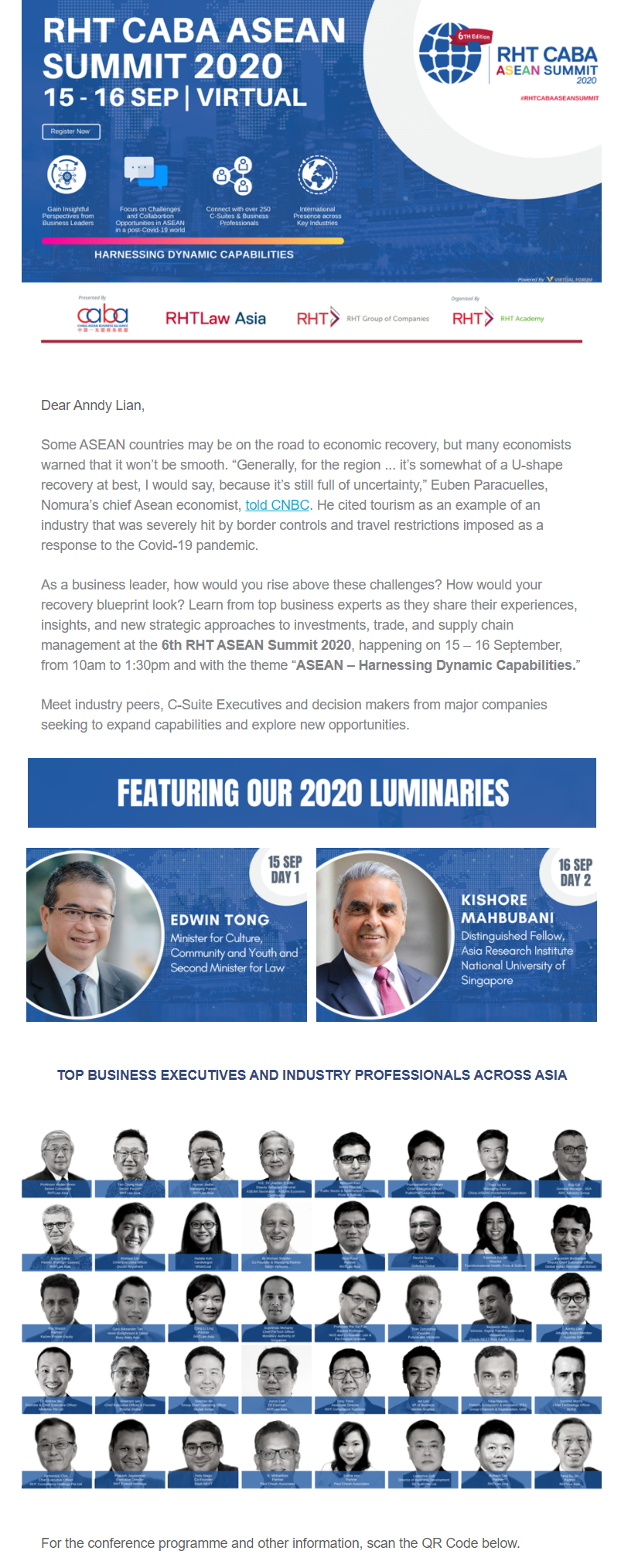
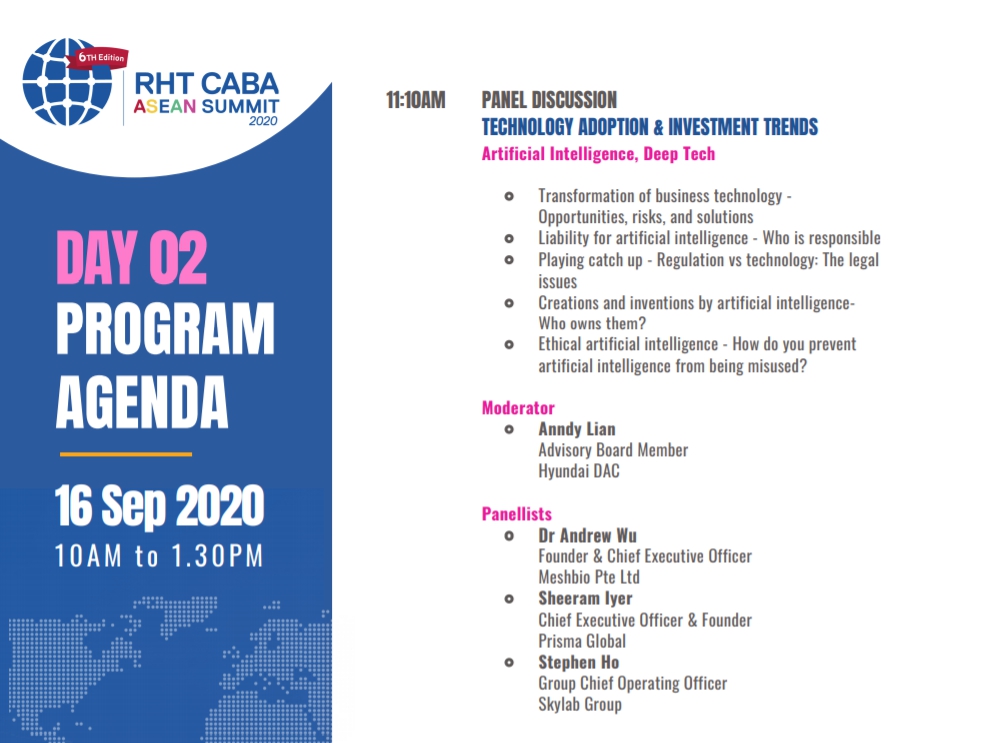
Anndy Lian, Advisory Board Member of Hyundai DAC will moderate a Panel Discussion at the CABA ASEAN Summit 2020 on 16 September 2020. Together with the panellists, they will be talking about technology adoption & investment trends and in particular on artificial intelligence and deep tech.

We will cover the following topics:

> Transformation of business technology – Opportunities, risks, and solutions
> Liability for artificial intelligence – Who is responsible
> Playing catch up – Regulation vs technology: The legal issues
> Creations and inventions by artificial intelligenceWho owns them?
> Ethical artificial intelligence – How do you prevent artificial intelligence from being misused?

You will also be hearing from:
> Dr Andrew Wu, Founder & Chief Executive Officer, Meshbio Pte Ltd
> Sheeram Iyer, Chief Executive Officer & Founder, Prisma Global
> Stephen Ho, Group Chief Operating Officer, Skylab Group

6th RHT CABA ASEAN Summit, with the overarching theme of “ASEAN – Dynamic Capabilities” delivered on a hybrid format on 15-16
September 2020, from 10am to 1:30pm.

This year, we are introducing a new component to the Summit centred on the China-ASEAN Business Alliance (CABA), a platform to promote business ties and collaboration for the China and ASEAN region. A series of insightful CABA forums will be held in the lead up to the Summit.

In 2020, Covid-19 wreaks havoc in all aspects of our lives globally. The health of the world’s population, economy and environment takes centre stage as organisations grapple with an increasingly volatile, uncertain, complex and ambiguous environment. The Summit’s focus on harnessing dynamic capabilities aims to deliver insights that will help businesses and organisations thrive during challenging times. The specially curated programme will dive into sustainability and the environment, healthcare, technology and intelligence. Up to 250 C-Suite Executives, ASEAN business leaders and industry professionals from various economic sectors are expected to attend. Past summits have also attracted the attendance of the diplomatic community and numerous Ministers as the guest-of-honour.

Join them on this 2 days conference,  Minister Edwin Tong, Minister for Culture, Community and Youth and Second Minister for Law will also deliver his keynote speech.

Anndy Lian is an early blockchain adopter and experienced serial entrepreneur who is known for his work in the government sector. He is a best selling book author- “NFT: From Zero to Hero” and “Blockchain Revolution 2030”.

Currently, he is appointed as the Chief Digital Advisor at Mongolia Productivity Organization, championing national digitization. Prior to his current appointments, he was the Chairman of BigONE Exchange, a global top 30 ranked crypto spot exchange and was also the Advisory Board Member for Hyundai DAC, the blockchain arm of South Korea’s largest car manufacturer Hyundai Motor Group. Lian played a pivotal role as the Blockchain Advisor for Asian Productivity Organisation (APO), an intergovernmental organization committed to improving productivity in the Asia-Pacific region.

An avid supporter of incubating start-ups, Anndy has also been a private investor for the past eight years. With a growth investment mindset, Anndy strategically demonstrates this in the companies he chooses to be involved with. He believes that what he is doing through blockchain technology currently will revolutionise and redefine traditional businesses. He also believes that the blockchain industry has to be “redecentralised”.
j j j