Soft landing or FOMO return? Markets rally on Fed cut amidst inflation caution

Soft landing or FOMO return? Markets rally on Fed cut amidst inflation caution

Global risk sentiment has improved markedly in recent days, driven by the Federal Reserve’s decision to lower interest rates, which has injected fresh optimism into financial markets worldwide. Investors appear to view this move as a signal that policymakers are prioritising economic growth amid signs of a cooling labour market, even as inflation remains somewhat elevated. The cut has ripple effects across asset classes, from equities to commodities and cryptocurrencies, fostering an environment where risk-taking feels more rewarded. In this context, Wall Street has pushed to new heights, while emerging trends in digital assets suggest a sector on the cusp of broader institutional acceptance.

The Federal Reserve announced a 25 basis point reduction in its benchmark rate on September 17, bringing it down from previous levels and marking the first easing since late last year. This adjustment aims to support hiring and prevent a sharper slowdown in employment, as recent data showed initial jobless claims dropping significantly to 231,000 for the week ending September 13, the largest decline in nearly four years. Officials emphasised that the move addresses risks to the job market while keeping an eye on inflation, which ticked up slightly to 2.9 per cent in August but remains within a manageable range. Markets had largely anticipated this step, with probabilities exceeding 75 per cent leading up to the announcement, though some volatility ensued as traders digested the forward guidance indicating potential for two more cuts by year-end.

In contrast, the Bank of England opted to hold its key rate steady at four per cent on September 18, citing persistent inflationary pressures alongside uncertainties in growth and the jobs landscape. The Monetary Policy Committee voted 7-2 to maintain the status quo, with members expressing caution that the UK economy is not yet out of the woods on price stability. Looking ahead, the Bank of Japan is set to reveal its policy stance today, with expectations leaning toward no change from the current 0.5 per cent short-term rate, as officials navigate tariff risks and a potential US slowdown. These divergent approaches among major central banks highlight a global economy at a crossroads, where easing in one region could spill over to influence others.

Equity markets have responded positively overall, with US indices scaling fresh peaks on September 18. The Dow Jones Industrial Average climbed 0.27 per cent to close above 46,000, the S&P 500 advanced 0.48 per cent to around 6,600, and the Nasdaq Composite surged 0.94 per cent to over 22,200, buoyed by strength in technology shares. This rally reflects investor confidence that lower borrowing costs will sustain corporate earnings and consumer spending. Yields on US Treasuries moved higher in response to the robust jobless claims figure, which eased fears of a rapid labour market deterioration. The 10-year Treasury note rose three basis points to above 4.11 per cent, while the 2-year yield increased two basis points to 3.56 per cent. Such movements suggest markets are pricing in a soft landing rather than a recession, though the bond market’s reaction also underscores ongoing sensitivity to economic data.

Currency and commodity dynamics have shifted as well. The US dollar index strengthened by 0.49 per cent to 97.35, benefiting from the perception of relative US economic resilience amid global uncertainties. Gold prices dipped 0.4 per cent to US$3,643.40 per ounce, as profit-taking followed a recent record high, with the metal’s appeal dimming slightly in a risk-on environment. Brent crude oil fell 0.9 per cent to US$67.32 per barrel, pressured by concerns over US demand despite the rate cut’s potential to stimulate activity. These declines illustrate how commodities are caught between supportive monetary policy and lingering worries about global growth, particularly with trade tensions simmering.

Asian equities displayed a mixed performance, trimming some gains post the Fed’s meeting but still showing resilience in key benchmarks. Japan’s Nikkei 225 crossed the 45,000 threshold for the first time, closing higher amid a tech-led advance, reflecting spillover optimism from US markets. Early trading today saw varied movements across the region, with US futures pointing to a positive open, suggesting the upbeat sentiment may persist. This regional response highlights the increasing interconnectedness of global markets, with policy shifts in the US often setting the tone for Asia’s trading sessions.

Cryptocurrencies, on the other hand, have shown remarkable vigour, with Bitcoin maintaining momentum around US$117,000 despite initial sluggishness following the rate cut. Technical indicators point to a bullish setup, with a trend line support at US$115,800 and recent breaks above resistances at US$116,200 and US$116,500. The price peaked at US$117,920 before a minor retracement to the 50 per cent Fibonacci level near US$116,750. Analysts anticipate resistance at US$117,500 and US$117,850, with a clear breach of US$118,000 potentially propelling it toward US$118,500 or even US$118,800. On-chain data reveals strong institutional accumulation, with ETF flows and whale activity supporting the floor. Social media discussions on platforms such as X highlight this breakout potential, with traders noting that a close above US$117,000 on high volume could ignite further upside. However, overbought signals from the RSI above 88 suggest a possible short-term pullback, with supports at US$116,550 and US$115,800 if resistance holds firm.

Solana has emerged as a standout performer, rallying beyond US$250, its highest in nearly eight months, and outperforming the altcoin market by 25 per cent over the past month. Institutional adoption drives this surge, with corporations holding over 17 million SOL tokens valued at US$4.3 billion. Notable players include Forward Industries with 6.82 million SOL, Sharps Technology at 2.14 million, and others like Defi Development Corp and Upexi Inc., nearing 2 million each. Helius Medical Technologies’ $500 million SOL treasury program echoes strategies like MicroStrategy’s Bitcoin reserves, bolstering SOL’s case as a reserve asset. The blockchain’s total value locked stands at US$14.6 billion, making it the second-largest DeFi ecosystem, while a 6.8 per cent staking yield surpasses Ethereum’s 2.9 per cent. Options data shows higher call premiums, indicating bullish trader sentiment, with predictions eyeing US$300 as the next target amid ETF approval hopes. X conversations amplify this enthusiasm, with users pointing to treasury strategies and network upgrades as catalysts.

Regulatory developments have further catalysed crypto’s ascent. The US and UK signed a memorandum to collaborate on quantum computing and AI, impacting blockchain security. Coinbase CEO Brian Armstrong expressed confidence in the Digital Asset Market Clarity Act passing through Congress, clarifying the roles of the SEC and CFTC. Australia’s ASIC eased stablecoin licensing, while the SEC approved Grayscale’s Digital Large Cap Fund—the first multi-asset crypto ETF and proposed rule changes to expedite ETF listings. These steps signal a maturing framework, reducing uncertainty and attracting institutional capital.

From my perspective, this moment feels pivotal for cryptocurrencies. The convergence of monetary easing, regulatory clarity, and institutional inflows positions digital assets for sustained growth, potentially eclipsing traditional markets in volatility but also in returns. Bitcoin’s resilience above US$117,000 amid broader economic shifts suggests it’s evolving from a speculative play to a legitimate hedge, much like gold in past cycles. I remain cautious. Rate cuts don’t erase risks like stagflation or geopolitical tensions, and crypto’s history of sharp corrections warrants prudence. Investors should diversify their portfolios and closely monitor macroeconomic indicators.


Source: https://e27.co/soft-landing-or-fomo-return-markets-rally-on-fed-cut-amidst-inflation-caution-20250919/

Anndy Lian is an early blockchain adopter and experienced serial entrepreneur who is known for his work in the government sector. He is a best selling book author- “NFT: From Zero to Hero” and “Blockchain Revolution 2030”.

Currently, he is appointed as the Chief Digital Advisor at Mongolia Productivity Organization, championing national digitization. Prior to his current appointments, he was the Chairman of BigONE Exchange, a global top 30 ranked crypto spot exchange and was also the Advisory Board Member for Hyundai DAC, the blockchain arm of South Korea’s largest car manufacturer Hyundai Motor Group. Lian played a pivotal role as the Blockchain Advisor for Asian Productivity Organisation (APO), an intergovernmental organization committed to improving productivity in the Asia-Pacific region.

An avid supporter of incubating start-ups, Anndy has also been a private investor for the past eight years. With a growth investment mindset, Anndy strategically demonstrates this in the companies he chooses to be involved with. He believes that what he is doing through blockchain technology currently will revolutionise and redefine traditional businesses. He also believes that the blockchain industry has to be “redecentralised”.

j j j

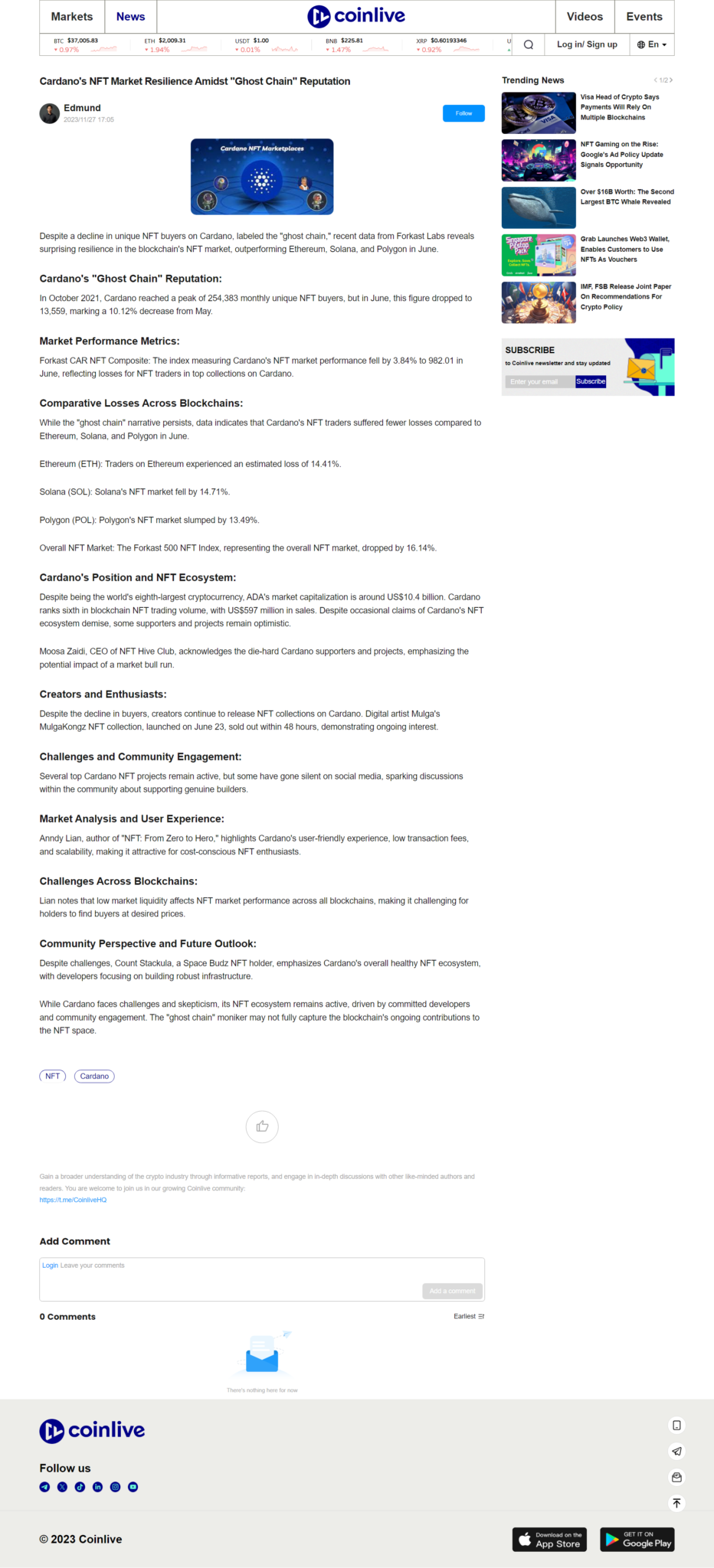
Cardano’s NFT Market Resilience Amidst “Ghost Chain” Reputation

Cardano’s NFT Market Resilience Amidst “Ghost Chain” Reputation

Despite a decline in unique NFT buyers on Cardano, labeled the “ghost chain,” recent data from Forkast Labs reveals surprising resilience in the blockchain’s NFT market, outperforming Ethereum, Solana, and Polygon in June.


Cardano’s “Ghost Chain” Reputation:

In October 2021, Cardano reached a peak of 254,383 monthly unique NFT buyers, but in June, this figure dropped to 13,559, marking a 10.12% decrease from May.


Market Performance Metrics:

Forkast CAR NFT Composite: The index measuring Cardano’s NFT market performance fell by 3.84% to 982.01 in June, reflecting losses for NFT traders in top collections on Cardano.


Comparative Losses Across Blockchains:

While the “ghost chain” narrative persists, data indicates that Cardano’s NFT traders suffered fewer losses compared to Ethereum, Solana, and Polygon in June.


Ethereum (ETH): Traders on Ethereum experienced an estimated loss of 14.41%.

Solana (SOL): Solana’s NFT market fell by 14.71%.

Polygon (POL): Polygon’s NFT market slumped by 13.49%.

Overall NFT Market: The Forkast 500 NFT Index, representing the overall NFT market, dropped by 16.14%.


Cardano’s Position and NFT Ecosystem:

Despite being the world’s eighth-largest cryptocurrency, ADA’s market capitalization is around US$10.4 billion. Cardano ranks sixth in blockchain NFT trading volume, with US$597 million in sales. Despite occasional claims of Cardano’s NFT ecosystem demise, some supporters and projects remain optimistic.


Moosa Zaidi, CEO of NFT Hive Club, acknowledges the die-hard Cardano supporters and projects, emphasizing the potential impact of a market bull run.


Creators and Enthusiasts:

Despite the decline in buyers, creators continue to release NFT collections on Cardano. Digital artist Mulga’s MulgaKongz NFT collection, launched on June 23, sold out within 48 hours, demonstrating ongoing interest.


Challenges and Community Engagement:

Several top Cardano NFT projects remain active, but some have gone silent on social media, sparking discussions within the community about supporting genuine builders.


Market Analysis and User Experience:

Anndy Lian, author of “NFT: From Zero to Hero,” highlights Cardano’s user-friendly experience, low transaction fees, and scalability, making it attractive for cost-conscious NFT enthusiasts.


Challenges Across Blockchains:

Lian notes that low market liquidity affects NFT market performance across all blockchains, making it challenging for holders to find buyers at desired prices.


Community Perspective and Future Outlook:

Despite challenges, Count Stackula, a Space Budz NFT holder, emphasizes Cardano’s overall healthy NFT ecosystem, with developers focusing on building robust infrastructure.


While Cardano faces challenges and skepticism, its NFT ecosystem remains active, driven by committed developers and community engagement. The “ghost chain” moniker may not fully capture the blockchain’s ongoing contributions to the NFT space.


Source: https://www.coinlive.com/news/cardano-s-nft-market-resilience-amidst-ghost-chain-reputation

Anndy Lian is an early blockchain adopter and experienced serial entrepreneur who is known for his work in the government sector. He is a best selling book author- “NFT: From Zero to Hero” and “Blockchain Revolution 2030”.

Currently, he is appointed as the Chief Digital Advisor at Mongolia Productivity Organization, championing national digitization. Prior to his current appointments, he was the Chairman of BigONE Exchange, a global top 30 ranked crypto spot exchange and was also the Advisory Board Member for Hyundai DAC, the blockchain arm of South Korea’s largest car manufacturer Hyundai Motor Group. Lian played a pivotal role as the Blockchain Advisor for Asian Productivity Organisation (APO), an intergovernmental organization committed to improving productivity in the Asia-Pacific region.

An avid supporter of incubating start-ups, Anndy has also been a private investor for the past eight years. With a growth investment mindset, Anndy strategically demonstrates this in the companies he chooses to be involved with. He believes that what he is doing through blockchain technology currently will revolutionise and redefine traditional businesses. He also believes that the blockchain industry has to be “redecentralised”.

j j j

Worldcoin is amidst a World War. Here’s How it Can Fight Back

Worldcoin is amidst a World War. Here’s How it Can Fight Back
  • The project that scans the users’ iris to validate their identity is facing significant regulatory battles in many countries.
  • Worldcoin must provide concise information outlining how data will be collected, used, and stored.

Worldcoin, an innovative project with a vision of establishing a global identity and financial network, aims to revolutionize the way we perceive digital identity and currency. Founded on the ambitious goal of granting majority ownership of this network to humanity, Worldcoin endeavors to unleash economic potential, ensure online privacy, enable democratic processes, and even lay the foundation for a Universal Basic Income funded by AI.

At its core, Worldcoin comprises two crucial elements: World ID, a privacy-focused digital identity network utilizing ‘proof of personhood’, and WLD, its digital currency. The World App serves as the main interface to World ID and the Worldcoin Protocol, developed by Tools for Humanity (TFH).

‘Proof of personhood’ forms the heart of Worldcoin’s concept, verifying individual human status and uniqueness. Successful implementation of World ID could set a global standard for validating personhood and overcome challenges in online voting as well as value distribution.

Worldcoin’s foundational principles include emphasizing ‘proof of personhood’ in the AI era, aligning network incentives for genuine human involvement, and drawing parallels with Bitcoin and Ethereum’s security models. However, challenges arise, particularly regarding the collection, handling, and privacy of biometric data.

World ID, backed by the Orb biometric device, offers a privacy-focused way to verify individual identity. While it promises enhanced security through unique biometric markers, it raises concerns about data storage and ethical usage. The diversity of data privacy regulations worldwide adds complexity, prompting concerns and regulatory scrutiny in countries like Kenya, the United Kingdom, India, and the United States.

Kenya suspended Worldcoin’s activities due to security, privacy, and financial issues, raising questions about data handling, ownership, and legality.

Additionally, The Information Commissioner’s Office, the U.K.’s data protection regulator, has said that it is “examining” the project and “making further inquiries” about its data collection practices. While India’s central bank, The Reserve Bank of India, has warned that Worldcoin is not legal tender and that using it as a payment instrument is illegal. Also, The U.S. Securities and Exchange Commission has not yet commented on Worldcoin, but some experts believe it could be classified as a security, subjecting it to stricter regulations.

In a world embracing digital transformation, Worldcoin’s proposal signifies a paradigm shift in identity and finance. However, the controversial aspects surrounding biometric data and regulatory challenges highlight the need for transparency, robust safeguards, and respectful adherence to privacy laws.

As Worldcoin strives to redefine the digital landscape, its journey underscores the intricate balance between innovation and ethical responsibility. The project’s success hinges on its ability to address concerns, collaborate with regulators, and ensure data security, providing a future where digital identity and financial networks coexist harmoniously on a global scale.

Vigilant in Avoiding Exploitation

To address privacy and data collection challenges, the project should prioritize enhanced transparency regarding its data collection and usage practices. Worldcoin must provide clear and concise information that outlines how data will be collected, used, and stored. It should obtain informed consent from individuals prior to collecting their biometric data is essential. Ensuring that individuals fully comprehend the implications of data sharing and voluntarily provide consent is paramount.

Worldcoin must be vigilant in avoiding any exploitation of vulnerable populations. The project’s marketing and recruitment strategies should adhere to ethical principles and avoid targeting those who may be more susceptible.

Also, collaboration with regulatory bodies is imperative. By engaging with regulators transparently and cooperatively, the project can effectively address any concerns raised and ensure compliance with relevant regulations.

Apart from tackling privacy concerns, Worldcoin can also strengthen its industry footprint to boost legitimacy. It can collaborate with organizations specializing in privacy and data protection that could aid in developing and implementing robust best practices for data collection and utilization.

Additionally, it should create a framework for data governance that would reinforce responsible and ethical data use, further safeguarding individuals’ information. Another step could be prioritizing investments in robust security measures is essential to prevent unauthorized access and misuse of sensitive data. And educating the public about the project’s objectives, practices, and safeguards is crucial for building trust and fostering understanding among potential users.

Casting a Shadow

The emergence of Worldcoin presents a captivating vision of a globally connected identity and financial network underpinned by innovative concepts like ‘proof of personhood’ and biometric authentication. The potential benefits encompass economic opportunities, enhanced online security, and even transformative social initiatives like a Universal Basic Income funded by AI.

Nevertheless, the project has encountered its share of controversy, primarily revolving around collecting and managing sensitive biometric data. While using biometric markers for identity verification holds promise, concerns about data privacy, security, and ethical considerations have cast a shadow over Worldcoin’s ambitious goals.

Source: https://www.financemagnates.com/cryptocurrency/worldcoin-is-amidst-a-world-war-heres-how-it-can-fight-back/

Anndy Lian is an early blockchain adopter and experienced serial entrepreneur who is known for his work in the government sector. He is a best selling book author- “NFT: From Zero to Hero” and “Blockchain Revolution 2030”.

Currently, he is appointed as the Chief Digital Advisor at Mongolia Productivity Organization, championing national digitization. Prior to his current appointments, he was the Chairman of BigONE Exchange, a global top 30 ranked crypto spot exchange and was also the Advisory Board Member for Hyundai DAC, the blockchain arm of South Korea’s largest car manufacturer Hyundai Motor Group. Lian played a pivotal role as the Blockchain Advisor for Asian Productivity Organisation (APO), an intergovernmental organization committed to improving productivity in the Asia-Pacific region.

An avid supporter of incubating start-ups, Anndy has also been a private investor for the past eight years. With a growth investment mindset, Anndy strategically demonstrates this in the companies he chooses to be involved with. He believes that what he is doing through blockchain technology currently will revolutionise and redefine traditional businesses. He also believes that the blockchain industry has to be “redecentralised”.

j j j