
Anndy Lian: SEC政策收紧对数字资产将产生什么影响?

Anndy Lian: SEC政策收紧对数字资产将产生什么影响?

2023年5月10日,Anndy Lian在金融期刊Financial Express上发表了一篇引人深思的文章《SEC撤销在对冲基金规定中的数字资产部分,将对数字资产未来产生什么影响?》(SEC removes digital assets from hedge fund rule: What does it mean for the future of digital asset regulation)。

Anndy Lians是畅销书《Blockchain Revolution 2030》和 《NFT: from Zero to Hero》的作者,对区块链和数字化领域有着广泛的研究和见解。目前,Anndy Lian担任蒙古生产力组织的首席数字顾问,致力于推动国家数字化的发展。

作为一位新加坡知名科普作家和新科技投资者,Anndy Lian以增长型投资的思维方式在业界有着广泛影响力。他坚信区块链技术将彻底改变和重新定义传统企业,并且主张实现区块链行业的“再去中心化”(Re-decentralized)。

在他最新的文章中,Anndy Lian探讨了美国证券交易委员会(SEC)最近关于数字资产的决定。SEC是负责监管证券行业的机构,过去将数字资产定义为证券,并在对冲基金规则中对其进行了额外监管。然而,SEC最近删除了这一定义,这意味着他们仍在评估这一术语,并尚未决定是否将数字资产归类为证券。这一决定引发了人们对SEC监管数字资产方式的质疑和讨论。

在这篇文章中,Anndy Lian将带领我们深入探讨SEC对数字资产的监管态度转变,以及这对数字资产监管未来的意义。他的专业知识和对区块链技术的了解将为我们提供深入的洞察力,并帮助我们更好地理解数字资产市场的发展趋势。

对冲基金规则

对冲基金规则,正式称为1940年投资顾问法案下的206(4)-8号规则,是美国证券交易委员会(SEC)制定的一项规则,旨在防止投资顾问向对冲基金等集合投资工具的投资者提供虚假或误导性陈述。

该规则对对冲基金和其他私募基金的顾问施加了额外的报告和披露要求,并要求他们实施具体的合规程序和风险管理措施。该规则旨在通过确保投资顾问在客户的最佳利益下行事,并提供关于投资策略和风险的准确完整信息,保护投资者并维护金融市场的完整性。

在数字资产的背景下,SEC在其对冲基金规则中将“数字资产”定义为证券,从而使其受到额外的监管。然而,SEC最近取消了这个定义,表明他们仍在评估这个术语,并尚未决定是否应将数字资产归类为证券。

“数字资产”作为新的资产类别

许多人对此举感到惊讶,并质疑SEC在数字资产监管方面的方法。值得注意的是,SEC主席加里·根斯勒(Gary Gensler)在2023年4月18日出席美国众议院金融服务委员会的听证会上就该机构对数字资产的立场发表了讲话。这次听证会并不专门针对SEC的加密策略,但监管机构的主席在被批评存在过度监管和缺乏明确的加密分类的问题上受到了批评。在听证会上,根斯勒拒绝对以太币(ETH)是证券还是商品发表评论,称这取决于事实和法律,尽管他被告知他清楚。值得注意的是,美国众议院金融服务委员会和农业委员会计划制定监管加密领域的立法。该法案将在未来两个月内提交。

话虽如此,我认为这是积极的一面。这表明SEC正在制定数字资产的监管框架,并且这个决定可能是整体战略的一部分。SEC可能从对冲基金规则中删除了“数字资产”的定义,以便进一步考虑和评估对这个新资产类别适当的监管方法。SEC可能采取谨慎的态度,以确保其制定的任何监管框架适用于数字资产的独特特征,并解决潜在风险,同时不妨碍创新。

对数字资产的监管是复杂而有争议的

专家对SEC取消将数字资产定义为证券的决定发表了评论,这将使它们受到额外的监管。加密货币行业的主要参与者Coinbase公开反对SEC对数字资产的监管立场。一些专家认为,数字资产领域需要更加注重风险管理和运营尽职调查,并结合思考周全的监管,以修复其声誉。

需要认识到SEC对数字资产的态度一直在变化,这次的决定并不是他们第一次对其分类立场。此前,SEC确认401(k)计划可以被视为根据第3(c)(1)条和第3(c)(7)条的单一投资者和合格买方,如果计划参与者具有分配他们账户的投资自由裁量权。

关于如何监管数字资产的问题是复杂而有争议的。除了上述观点外,一些人认为数字资产与传统证券有根本的不同,应被视为一种独立的资产类别。由于它们在分散网络上运作,数字资产不受传统证券的同样监管和监督。这种缺乏监管导致了对市场操纵、欺诈和其他非法活动的担忧。

此外,数字资产没有实物资产或政府担保支持,这使其具有固有的风险。然而,它们也有潜在的高回报,这可能吸引愿意在投资中承担更多风险的投资者。由于这些独特的特征,一些专家建议在风险管理、估值和投资策略方面,数字资产需要与传统证券有所不同的方法。

数字资产市场的发展可能需要更清晰的监管框架和标准。然而,对这些资产的分类和监管以及其对整体市场的影响仍存在不确定性。数字资产具有与传统资产不同的独特特征,包括分散化和区块链技术的应用。这种技术实现了无边界交易、智能合约和去中心化应用,为零售和机构投资者提供了新的投资机会。

结束语

数字资产市场的增长吸引了监管机构和投资者的广泛关注,有人主张将数字资产视为证券以保护投资者免受欺诈行为。SEC从对冲基金规则中删除数字资产作为证券的定义,引发了关于这个资产类别适当的监管框架的持续辩论。随着数字资产的使用不断扩大,SEC很可能会继续制定其监管方法。

总之,SEC最近的决定对于监管数字资产是一个重大发展,并引发了关于如何对这些资产进行分类和监管的问题。随着数字资产市场的成熟,可能需要更清晰的监管框架和标准,以保护投资者、防止欺诈,同时允许创新和增长的发生。


Anndy Lian is an early blockchain adopter and experienced serial entrepreneur who is known for his work in the government sector. He is a best selling book author- “NFT: From Zero to Hero” and “Blockchain Revolution 2030”.

Currently, he is appointed as the Chief Digital Advisor at Mongolia Productivity Organization, championing national digitization. Prior to his current appointments, he was the Chairman of BigONE Exchange, a global top 30 ranked crypto spot exchange and was also the Advisory Board Member for Hyundai DAC, the blockchain arm of South Korea’s largest car manufacturer Hyundai Motor Group. Lian played a pivotal role as the Blockchain Advisor for Asian Productivity Organisation (APO), an intergovernmental organization committed to improving productivity in the Asia-Pacific region.

An avid supporter of incubating start-ups, Anndy has also been a private investor for the past eight years. With a growth investment mindset, Anndy strategically demonstrates this in the companies he chooses to be involved with. He believes that what he is doing through blockchain technology currently will revolutionise and redefine traditional businesses. He also believes that the blockchain industry has to be “redecentralised”.
j j j

Anndy Lian’s NFT NYC Speech: Think Bigger in the Next NFT Summer

Anndy Lian’s NFT NYC Speech: Think Bigger in the Next NFT Summer

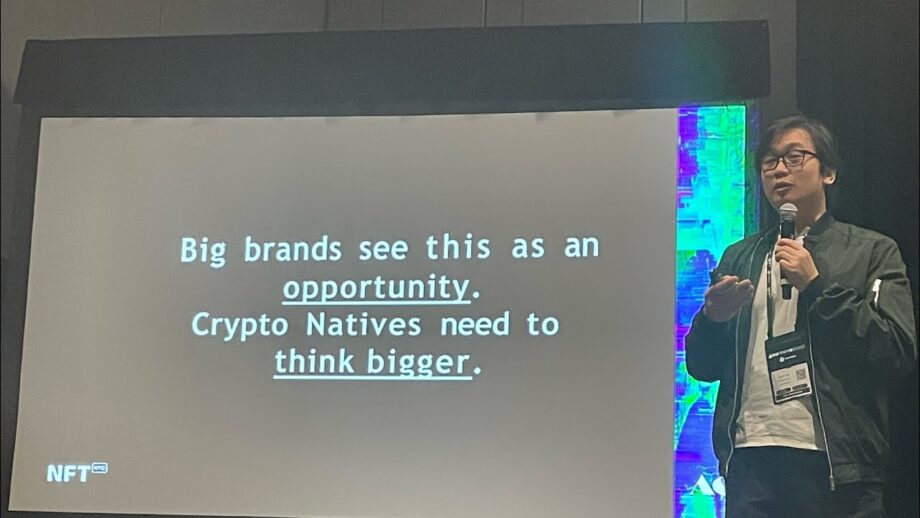
Best selling book author, Anndy Lian gave his speech titled “Think Bigger In the next NFT Summer” at NFT.NYC 2023.

The concept of NFTs (Non-Fungible Tokens) has been in existence for some time now. However, while it has gained considerable popularity, it has also raised concerns amongst some people. Many individuals have developed a negative perception of NFTs due to the hype surrounding them. There have also been instances of NFT wash trades, which are used to inflate NFT prices artificially. Additionally, some NFTs have no practical use, and some are regarded as securities, which is a regulatory issue.

Despite this, the NFT craze is far from over, and it could be just the beginning of a new era. Big names like Gucci, Porsche, Starbucks, Amazon, and Red Bull Racing have started investing in NFTs, which suggests that the market is gaining traction and legitimacy. This year could be the last NFT summer where people only see NFTs as a speculative asset.

In 1999, Bill Gates predicted that everything would be on the internet. Jack Ma did the same in China, but people thought it was impossible. Now, we are living in a world where the internet is an integral part of our daily lives. If we continue to use our current mindset to envision the future, we risk being left behind, just like those who laughed at the internet in its early days.

We need to broaden our minds and start thinking beyond the current limitations of NFTs. NFTs can be used for anything, from digital art and music to virtual real estate and gaming items. The possibilities are endless, and the new assets are in the digital world. Crypto natives need to think bigger and explore the true potential of NFTs.

Although we currently view NFTs as speculative, we must start using them in the future we create. Big brands have recognized this and are willing to invest in the technology. It is time for us to move past the current hype and start creating and exploring the digital world that awaits us.

In conclusion, the next NFT summer will not be about speculating on assets but rather about creating and using them. NFTs represent the future, and it is time for us to start thinking beyond our current limitations and explore their full potential. The possibilities are endless, and anything can be an NFT. Let us embrace this technology and start creating a better digital world.

NFT NYC is a yearly event dedicated to NFTs and blockchain technology, which has quickly become a major focus of the art and collectibles world. This immersive conference and festival attracts a wide variety of participants, including industry leaders, artists, collectors, and enthusiasts, who come together to explore the possibilities of NFTs. Attendees can learn about the latest trends, technologies, and best practices related to NFTs.

Timeline:

00:00 Introduction of Anndy Lian’s vlog at New York
00:19 Anndy Lian gets his VIP Speaker badge to NFT.NYC Conference
00:30 Walking into NFT.NYC Conference area
00:59 Visting the art gallery at NFT.NYC
01:13 Introduction of the First Speaker, Anndy Lian
01:47 Anndy Lian’s Introduction
02:05 Anndy Lian’s Talk on “Thinking Bigger in the Next NFT Summer”
04:01 Anndy Lian’s Discussion on NFTs and their Current State
04:52 Anndy Lian’s Thoughts on NFTs in the Upcoming Summer and the Participation of Big Brands
08:57 Anndy urges all to think bigger in the next NFT Summer
10:19 Conclusion to Anndy Lian’s speech is “Anything can be NFT. Your new assets is in the digital world.”
11:50 End of Anndy’s speech
11:55 Continue to look at the exhibitions and network
12:42 End of video

Tags:

#NFTs, #ThinkBigger, #AnndyLian, #NFTNYC, #DigitalAssets, #BlockchainTechnology, #CryptoNatives, #VirtualRealEstate, #GamingItems, #ArtandMusic, #EndlessPossibilities
#CreateTheFuture, #BeyondLimitations, #InvestInTechnology, #BetterDigitalWorld, #NFT, #newyork

Anndy Lian is an early blockchain adopter and experienced serial entrepreneur who is known for his work in the government sector. He is a best selling book author- “NFT: From Zero to Hero” and “Blockchain Revolution 2030”.

Currently, he is appointed as the Chief Digital Advisor at Mongolia Productivity Organization, championing national digitization. Prior to his current appointments, he was the Chairman of BigONE Exchange, a global top 30 ranked crypto spot exchange and was also the Advisory Board Member for Hyundai DAC, the blockchain arm of South Korea’s largest car manufacturer Hyundai Motor Group. Lian played a pivotal role as the Blockchain Advisor for Asian Productivity Organisation (APO), an intergovernmental organization committed to improving productivity in the Asia-Pacific region.

An avid supporter of incubating start-ups, Anndy has also been a private investor for the past eight years. With a growth investment mindset, Anndy strategically demonstrates this in the companies he chooses to be involved with. He believes that what he is doing through blockchain technology currently will revolutionise and redefine traditional businesses. He also believes that the blockchain industry has to be “redecentralised”.
j j j

Anndy Lian on decentralization and the potential impact of Web4

Anndy Lian on decentralization and the potential impact of Web4

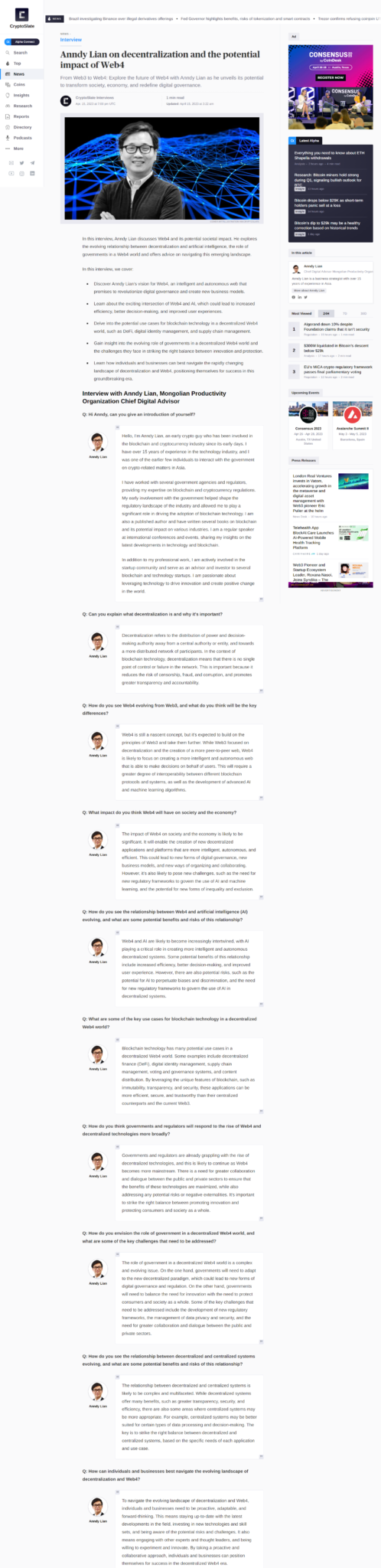
In this interview, Anndy Lian discusses Web4 and its potential societal impact. He explores the evolving relationship between decentralization and artificial intelligence, the role of governments in a Web4 world and offers advice on navigating this emerging landscape.

In this interview, we cover:

  • Discover Anndy Lian’s vision for Web4, an intelligent and autonomous web that promises to revolutionize digital governance and create new business models.
  • Learn about the exciting intersection of Web4 and AI, which could lead to increased efficiency, better decision-making, and improved user experiences.
  • Delve into the potential use cases for blockchain technology in a decentralized Web4 world, such as DeFi, digital identity management, and supply chain management.
  • Gain insight into the evolving role of governments in a decentralized Web4 world and the challenges they face in striking the right balance between innovation and protection.
  • Learn how individuals and businesses can best navigate the rapidly changing landscape of decentralization and Web4, positioning themselves for success in this groundbreaking era.

Interview with Anndy Lian, Mongolian Productivity Organization Chief Digital Advisor

Q: Hi Anndy, can you give an introduction of yourself?

Hello, I’m Anndy Lian, an early crypto guy who has been involved in the blockchain and cryptocurrency industry since its early days. I have over 15 years of experience in the technology industry, and I was one of the earlier few individuals to interact with the government on crypto-related matters in Asia.

I have worked with several government agencies and regulators, providing my expertise on blockchain and cryptocurrency regulations. My early involvement with the government helped shape the regulatory landscape of the industry and allowed me to play a significant role in driving the adoption of blockchain technology. I am also a published author and have written several books on blockchain and its potential impact on various industries. I am a regular speaker at international conferences and events, sharing my insights on the latest developments in technology and blockchain.

In addition to my professional work, I am actively involved in the startup community and serve as an advisor and investor to several blockchain and technology startups. I am passionate about leveraging technology to drive innovation and create positive change in the world.

Q: Can you explain what decentralization is and why it’s important?

Decentralization refers to the distribution of power and decision-making authority away from a central authority or entity, and towards a more distributed network of participants. In the context of blockchain technology, decentralization means that there is no single point of control or failure in the network. This is important because it reduces the risk of censorship, fraud, and corruption, and promotes greater transparency and accountability.

Q: How do you see Web4 evolving from Web3, and what do you think will be the key differences?

Web4 is still a nascent concept, but it’s expected to build on the principles of Web3 and take them further. While Web3 focused on decentralization and the creation of a more peer-to-peer web, Web4 is likely to focus on creating a more intelligent and autonomous web that is able to make decisions on behalf of users. This will require a greater degree of interoperability between different blockchain protocols and systems, as well as the development of advanced AI and machine learning algorithms.

Q: What impact do you think Web4 will have on society and the economy?

The impact of Web4 on society and the economy is likely to be significant. It will enable the creation of new decentralized applications and platforms that are more intelligent, autonomous, and efficient. This could lead to new forms of digital governance, new business models, and new ways of organizing and collaborating. However, it’s also likely to pose new challenges, such as the need for new regulatory frameworks to govern the use of AI and machine learning, and the potential for new forms of inequality and exclusion.

Q: How do you see the relationship between Web4 and artificial intelligence (AI) evolving, and what are some potential benefits and risks of this relationship?

Web4 and AI are likely to become increasingly intertwined, with AI playing a critical role in creating more intelligent and autonomous decentralized systems. Some potential benefits of this relationship include increased efficiency, better decision-making, and improved user experience. However, there are also potential risks, such as the potential for AI to perpetuate biases and discrimination, and the need for new regulatory frameworks to govern the use of AI in decentralized systems.

Q: What are some of the key use cases for blockchain technology in a decentralized Web4 world?

Blockchain technology has many potential use cases in a decentralized Web4 world. Some examples include decentralized finance (DeFi), digital identity management, supply chain management, voting and governance systems, and content distribution. By leveraging the unique features of blockchain, such as immutability, transparency, and security, these applications can be more efficient, secure, and trustworthy than their centralized counterparts and the current Web3.

Q: How do you think governments and regulators will respond to the rise of Web4 and decentralized technologies more broadly?

Governments and regulators are already grappling with the rise of decentralized technologies, and this is likely to continue as Web4 becomes more mainstream. There is a need for greater collaboration and dialogue between the public and private sectors to ensure that the benefits of these technologies are maximized, while also addressing any potential risks or negative externalities. It’s important to strike the right balance between promoting innovation and protecting consumers and society as a whole.

Q: How do you envision the role of government in a decentralized Web4 world, and what are some of the key challenges that need to be addressed?

The role of government in a decentralized Web4 world is a complex and evolving issue. On the one hand, governments will need to adapt to the new decentralized paradigm, which could lead to new forms of digital governance and regulation. On the other hand, governments will need to balance the need for innovation with the need to protect consumers and society as a whole. Some of the key challenges that need to be addressed include the development of new regulatory frameworks, the management of data privacy and security, and the need for greater collaboration and dialogue between the public and private sectors.

Q: How do you see the relationship between decentralized and centralized systems evolving, and what are some potential benefits and risks of this relationship?

The relationship between decentralized and centralized systems is likely to be complex and multifaceted. While decentralized systems offer many benefits, such as greater transparency, security, and efficiency, there are also some areas where centralized systems may be more appropriate. For example, centralized systems may be better suited for certain types of data processing and decision-making. The key is to strike the right balance between decentralized and centralized systems, based on the specific needs of each application and use case.

Q: How can individuals and businesses best navigate the evolving landscape of decentralization and Web4?

To navigate the evolving landscape of decentralization and Web4, individuals and businesses need to be proactive, adaptable, and forward-thinking. This means staying up-to-date with the latest developments in the field, investing in new technologies and skill sets, and being aware of the potential risks and challenges. It also means engaging with other experts and thought leaders, and being willing to experiment and innovate. By taking a proactive and collaborative approach, individuals and businesses can position themselves for success in the decentralized Web4 era.


Source: https://cryptoslate.com/anndy-lian-on-decentralization-and-the-potential-impact-of-web4/

Anndy Lian is an early blockchain adopter and experienced serial entrepreneur who is known for his work in the government sector. He is a best selling book author- “NFT: From Zero to Hero” and “Blockchain Revolution 2030”.

Currently, he is appointed as the Chief Digital Advisor at Mongolia Productivity Organization, championing national digitization. Prior to his current appointments, he was the Chairman of BigONE Exchange, a global top 30 ranked crypto spot exchange and was also the Advisory Board Member for Hyundai DAC, the blockchain arm of South Korea’s largest car manufacturer Hyundai Motor Group. Lian played a pivotal role as the Blockchain Advisor for Asian Productivity Organisation (APO), an intergovernmental organization committed to improving productivity in the Asia-Pacific region.

An avid supporter of incubating start-ups, Anndy has also been a private investor for the past eight years. With a growth investment mindset, Anndy strategically demonstrates this in the companies he chooses to be involved with. He believes that what he is doing through blockchain technology currently will revolutionise and redefine traditional businesses. He also believes that the blockchain industry has to be “redecentralised”.

j j j