STRONG coin price prediction: Can token regain growth?

STRONG coin price prediction: Can token regain growth?

StrongBlock is the first of its kind decentralised platform attempting to make launching nodes, necessary for the smooth running of blockchains, cheaper and easier.

Its native cryptocurrency, STRONG token, has had quite the journey since launching in 2020, enjoying a rather fruitful 2021. Yet since then, the coin started to dramatically fall in the second half of January 2021, unable to reach past heights.

Can STRONG rise back to its October 2021 value and which factors are driving the STRONG/USD forecast?

What is the STRONG coin?

StrongBlock was founded in 2018 by ‘blockchain pioneers’ David Moss, Brian Abramson and Corey Lederer with the goal  to easily add secure, decentralised blockchains to any application.

It had taken the company, however, two years to launch its Blockchain-as-a-Service (BaaS) platform.

By tackling one of the biggest problems new blockchains face, StrongBlock managed to become the first and only blockchain-agnostic protocol that rewards its users for running nodes.

Nodes, which are vital for the existence of any blockchain, keep full copies of blockchain transactions but are hard to create and pricey to operate. This leads many nodes to run outdated software, store incomplete blockchain histories and be intermittently offline.

StrongBlock’s Nodes-as-a-Service (NaaS) function lets cryptocurrency miners create nodes in seconds. In turn, miners are rewarded in the form of the blockchain’s native cryptocurrency, STRONG, for maintaining the node without having to run their device 24/7.

Rewards can be boosted with StrongBlock non-fungible tokens (NFTs) that are available in four categories: bronze, silver, gold and platinum.

Once a node is launched, it can be used by anyone to access the blockchain the node was built for. So far, StrongBlock supports hundreds of nodes built for Polygon, Ethereum and Sentinel. The approximate amount to set up and run a full Ethereum node is $113.11 per month.

Being listed as an eligible node on StrongBlock is free, however, users should expect a mining deposit to amount to 10 STRONG tokens.

STRONG is an ERC-20 cryptocurrency built on the Ethereum network. Its original supply amounted to 10 million, however, after launching the second version of its Decentralised Finance (DeFi) protocol, StrongBlock ended up burning 94% of the original tokens limiting the supply to around 535,000 STRONG coins.

In the second version of its tokenomics paper, StrongBlock noted that the token:

  • Is primarily used for rewards.
  • Supports a low-inflation model with rewards mostly generated through node participation that may adjust in accordance to token valuation over time. In addition, deflationary measures will also be used including the burning of STRONG tokens in some transactions.
  • Establishes governance, which will eventually determine how StrongBlock works as a decentralised network.
  • Is helping the project reach a model of long-term, self-sustaining growth.

As of the time of writing (1 April), StrongBlock is rewarding 444,676 nodes.

Over 138,000 coins are currently in circulation, according to data provided by CoinMarketCap at the time of writing. STRONG currently has a market capitalisation surpassing $16m (£12.2m) and is ranked as the 828th largest cryptocurrency.

STRONG price analysis: Bear trend

The STRONG cryptocurrency embarked on quite the journey during its two years in circulation. After reaching a record high of $1,193.31 on 28 October 2021, the StrongBlock coin failed to regain those levels, slumping to the $116 mark, as of 1 April 2022.

After a mini peak of $708.97 on 14 January 2022 the STRONG token started to drastically drop, losing 35.48% of its value in 10 days. Throughout February 2022, the STRONG coin value lost 47% amid broad negative market sentiment as tensions rose on the Russia-Ukraine border.
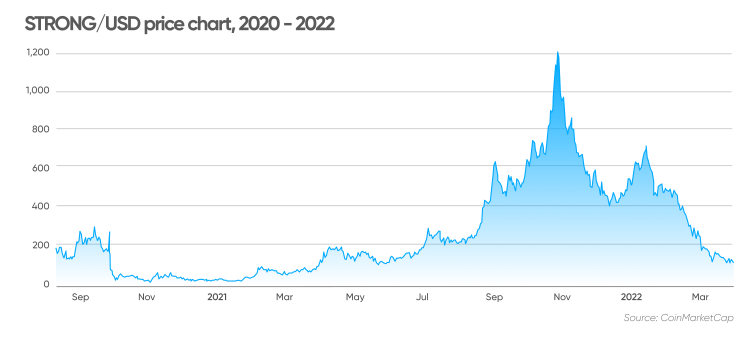
STRONG/USD price chart, 2020 – 2022

In the most recent STRONG coin news, the project announced that the StrongBlock had reached 270,000 nodes on 27 January 2022.

The number of nodes being activated on StrongBlock drastically increased in February 2022 from 285,000 on 3 February to 350,000 on 27 February. In addition, the token celebrated great success as it debuted third on the top 10 US trending coins for the week chart on CoinGecko on 18 February. This gave investors hope that the token’s price could still resurface.

STRONG’s price continued to decrease in the next couple of weeks, falling to $113.62 on 26 March 2022, its lowest value that month.

Last year STRONG’s price action seemed hopeful as it surged to a record high of $1,193.31 on 28 October 2021 as the blockchain announced the start of its metal NFT lottery where miners would be eligible to qualify to purchase one StrongBlock metal NFT for its original price in STRONG.

In terms of STRONG technical analysis, the short-term sentiment for the token was largely bearish as at the time of writing (1 April).

Relative Strength Index (RSI) reading of 31 was extremely close to the oversold territory. A reading of 30 or below would indicate that the asset has become undervalued and a trend reversal is likely. Meanwhile, the token was trading below its three, five and 10-day moving averages, indicating a bearish trend.

STRONG token price prediction: Key drivers

On 28 February 2022, StrongBlock published its roadmap for 2022 underlining some key goals including:

  • The launch of its new token, STRONGER, which plans to solve a number of problems that followed the success of the NaaS DApp.
  • The release of several new features including two new, different types of nodes, a node marketplace and node transfer.
  • The platform’s intention to build a Layer 1, EVM-compatible blockchain protocol that will be known as StrongChain with the bigger goal in mind of moving its NaaS platform to StrongChain and creating a community-oriented model that will unlock new economic layers, increase sustainability, make STRONG more resilient, and lay a new foundation for growth.

BigONE Exchange chair in Asia, Anndy Lian, told Capital.com that the token’s price could be struggling due to the platform being unable to gain retail investor understanding.

“STRONG brings more decentralisation to the current decentralised space by offering multi chain third party external nodes and other data oracles to build robustness and efficiency,” Lian exclusively told Capital.com.

“They believe the best way to adopt blockchain is through DAO governance and reward the community sufficiently. This idea works well on the paper but may not be well understood by the retail investors as a whole. Things might change when they list in the more major exchanges,” he added.

Thus far, the STRONG token has been listed on ChainSwap and Poloniex Exchange.

In the recent announcement by the project, StrongBlock warned investors to beware of scams, suggesting it has been prone to attacks in the past.

StrongBlock (STRONG) price prediction 2022 – 2025

Despite the latest downward price action, algorithm-based forecasting service WalletInvestor gave a bullish STRONG crypto price prediction at the time of writing (1 April). The site noted that STRONG is “an awesome long-term investment”, adding that it has a long-term earning potential amounting to 1,343.3%.

Based on its analysis of past price performance, Wallet Investor predicted that STRONG could cost $460.507 in 2023 and reach $1,751.200 by 2027.

DigitalCoinPrice supported the positive STRONG/USD forecast but saw a much slower pace of growth in the following years, expecting the token to grow to $167.83 by the end of 2022 and reach $248.68 by the end of 2025.

By the end of 2027, the site predicted that the price of STRONG coin could reach $376.08. Its long-term STRONG token forecast showed the cryptocurrency reaching $553.34 by 2030.

Note that predictions about the future of STRONG can be wrong. Forecasts and analyst expectations shouldn’t be used as a substitute for your own research. Always conduct your own due diligence and rely on your own projections, and never invest or trade money you cannot afford to lose.


Original Source: https://capital.com/strongblock-strong-coin-price-prediction

Anndy Lian is an early blockchain adopter and experienced serial entrepreneur who is known for his work in the government sector. He is a best selling book author- “NFT: From Zero to Hero” and “Blockchain Revolution 2030”.

Currently, he is appointed as the Chief Digital Advisor at Mongolia Productivity Organization, championing national digitization. Prior to his current appointments, he was the Chairman of BigONE Exchange, a global top 30 ranked crypto spot exchange and was also the Advisory Board Member for Hyundai DAC, the blockchain arm of South Korea’s largest car manufacturer Hyundai Motor Group. Lian played a pivotal role as the Blockchain Advisor for Asian Productivity Organisation (APO), an intergovernmental organization committed to improving productivity in the Asia-Pacific region.

An avid supporter of incubating start-ups, Anndy has also been a private investor for the past eight years. With a growth investment mindset, Anndy strategically demonstrates this in the companies he chooses to be involved with. He believes that what he is doing through blockchain technology currently will revolutionise and redefine traditional businesses. He also believes that the blockchain industry has to be “redecentralised”.

j j j

Anndy Lian spoke at launch of Alawad Fund “Dubai’s Drive To Be a Global Hub for Crypto Innovation Show Results”

Anndy Lian spoke at launch of Alawad Fund “Dubai’s Drive To Be a Global Hub for Crypto Innovation Show Results”

As regulation hots up in the US following the Executive Order, and with the prospect of new UK government plans to regulate the cryptocurrency market in the coming weeks, it’s clear that countries can no longer sit on the sidelines of the crypto industry. The potential shift in power spurred on by innovation in blockchain and related technologies means playing safe for jurisdictions is no longer an option. The UAE is well positioned to be a regional hub for the crypto industry, with a regulatory structure in place and with more than 350 blockchain companies operating there. UAE also took advantage of the pandemic to attract business with aggressive vaccination while largely keeping its borders open, while retaining business through low taxes and a light touch regulatory mindset – a perfect environment for attracting crypto entrepreneurs in the last two years.

Indeed, some call Dubai the fastest growing hub in the world right now for crypto technology, reflected in the fact that Binance has now set up offices in Dubai. It’s also benefiting from business relationships with the booming Israeli crypto sector based in Tel Aviv, according to a report in the Wall Street Journal following recent peace accords. In addition, it’s reported that the Abu Dhabi-headquartered fund Mubadala, one of the largest sovereign wealth funds with over $243bn AUM, is investing in the blockchain sector. Mubadala’s CEO Khaldoon Al Mubarak told CNBC in December that he was not a skeptic but saw it as real. But he did admit the regulatory format was not there totally, but it needed to be in place in order for the asset class to transition into something new. “We are looking at the ecosystem around crypto and we are investing in that system.”

This global momentum to embrace crypto and blockchain was addressed by the Chairman of BigONE Anndy Lian recently, in a speech to His Highness Awadh Mohamed Al Sh Mogrin Sultan, a top-ranking diplomat, and Honourable Chairman of the Alawad Fund. Lian said he saw similarities with the innovative and supportive crypto environment in Singapore: “I’ve actually seen the same trend in Dubai, I’ve met some good projects that are very serious about what they do, whether it’s looking at web3 or decentralized storage, or DeFi.”

Elaborating on two key trends starting with DeFi Lian said the integration of traditional finance products into DeFi such as bonds meant this was a sustainable sector for a country such as Dubai. He said the second significant trend was the crypto mining business with a very good uptake of new miners. “There are many new investors going into crypto mining, and when I say big investors, we’re talking about at the very least tens of billions of dollars going into the mining space. If you look at the longer term, it is a very lucrative investment.”

Lian remarked that as a partner & LP to several funds, with an AUM (assets under management) of around $500 million and having invested in crypto startups since 2018, he was looking forward to talking to people and brands about working together on the investment front in Dubai. “I want everybody to work together. You know, we should work together, be open, and welcome, good partners; this is the same philosophy that you do as well; this is the place where we will start to build a new story,” added Lian.

Earlier in March His Highness Sheikh Mohammed bin Rashid Al Maktoum, Vice-President and Prime Minister of the UAE and Ruler of Dubai, approved the first ever law on regulating virtual assets. “Today we are participating in designing the future of virtual assets globally.” Sheikh Mohammed stressed that Dubai possesses all the capabilities to be a key global center in the field of virtual assets, supported with the new legislative environment. “Dubai will provide the most advanced virtual asset ecosystem in terms of organization, governance and security. Approving the virtual asset law and establishing the Dubai Virtual Asset Regulatory Authority is a vital step that establishes the UAE’s position in this sector… a step that aims to help the sector to grow and protect investors,” he confirmed.

The Chainalysis ‘2021 Geography of Cryptocurrency Report’ published in October 2021, found plenty of potential for growth in the Middle East in general and specifically the UAE. The Middle East as a whole is the second-smallest cryptocurrency economy studied by Chainalysis, having received $271.7 billion worth of cryptocurrency between July 2020 and June 2021 (6.6% of global activity). “While that total is low compared to other regions, it represents nearly a 1500% increase over the Middle East’s total activity the previous year, making it one of the fastest-growing markets in the world,” the report’s authors said.

Reflecting the success in promoting crypto businesses in Dubai, it was reported on March 28 that cryptocurrency exchange business Bybit has received in-principle approval to conduct a full spectrum of virtual assets business in Dubai, the firm announced with the UAE Ministry of Economy at the World Government Summit 2022. Bybit also confirmed that it plans to set up its global HQ in Dubai, under the Emirate’s “test-adapt-scale” virtual assets market model.

Anndy Lian is an early blockchain adopter and experienced serial entrepreneur who is known for his work in the government sector. He is a best selling book author- “NFT: From Zero to Hero” and “Blockchain Revolution 2030”.

Currently, he is appointed as the Chief Digital Advisor at Mongolia Productivity Organization, championing national digitization. Prior to his current appointments, he was the Chairman of BigONE Exchange, a global top 30 ranked crypto spot exchange and was also the Advisory Board Member for Hyundai DAC, the blockchain arm of South Korea’s largest car manufacturer Hyundai Motor Group. Lian played a pivotal role as the Blockchain Advisor for Asian Productivity Organisation (APO), an intergovernmental organization committed to improving productivity in the Asia-Pacific region.

An avid supporter of incubating start-ups, Anndy has also been a private investor for the past eight years. With a growth investment mindset, Anndy strategically demonstrates this in the companies he chooses to be involved with. He believes that what he is doing through blockchain technology currently will revolutionise and redefine traditional businesses. He also believes that the blockchain industry has to be “redecentralised”.

j j j

OVR coin price prediction: Does AR have a future

OVR coin price prediction: Does AR have a future

Augmented and virtual reality metaverse platform OVR started December 2021 with a blast.

However, amid broad negative market sentiment due to an escalation of geopolitical tensions between Russia and Ukraine, its native token, OVR, saw a 50.52% decline since its all time high of $3.3213 on 2 December to $1.6431 at the time of writing (25 February 2022).

Following recent news that the platform decided to move to the Polygon network from Ethereum in an attempt to tackle scalability, what is the outlook for the OVR coin price prediction for 2022, 2025 and 2030?

What is OVR coin?

OVR is a decentralised augmented reality (AR) and virtual reality (VR) metaverse project which merges the physical and virtual worlds.

AR allows users to add different types of content to their surroundings, including audio, video two-dimensional (2D) and three-dimensional (3D) animation.

The metaverse can be accessed via a mobile device or smart glasses, through which users will be able to experience interactive augmented reality experiences.

According to the platform’s whitepaper, OVR aims to become the reference decentralised platform for AR content.

The metaverse is built on the Ethereum network and is powered by the OVR token, an ERC-20-based cryptocurrency.

The platform is made up of the OVR ecosystem, a digital layer that covers the entirety of the Earth’s surface with 1.6t hexagons. Each of these hexagons is known as an OVRLand and have specific geographical position points on the Earth’s surface and a standard 300 square metre dimension.

OVRLands can be further divided into seven hexagons, allowing players to have more precise localisation.

They act as non-fungible tokens (NFTs) and can be sold, auctioned and rented via the platform’s native marketplace.

The game starts when users purchase an OVRLand and become an OVROwner.

OVROwners can adjust and enhance their lands with a number of AR experiences known as OVRExperiences which can also be purchased through the OVR marketplace. The experiences are related to specific geographic locations and, according to the game’s developers, everything is possible when creating them from static 3D content.

Users can also create personalised avatars and join a number of live events, where they can meet fellow metaverse players and make friends or enter relationships.

The OVR token acts as an exchange medium within the entirety of the OVR ecosystem and can be used in the following ways:

  • Purchase OVRLand and other products on the OVR marketplace
  • Create OVRExperiences
  • Pay OVRCreators to build OVRExperience for users
  • Pay for the rent of virtual space
  • Grant users governance that can exercise voting rights on key features within the project’s roadmap

OVR tokens can be earned by selling or renting OVRLand, staking, building and publishing AR experiences. In addition, the platform implemented a decentralised advertising system based on a publisher/advertiser principle where users can earn coins by adding sponsored content on the owned lands.

The token did not have an initial coin offering (ICO). Instead, it introduced an initial bonding curve offering (IBCO), which determined the coin’s price via demand following its bonding curve. If the coin was in demand, its price would grow and more tokens would be minted.

The total supply of OVR tokens stands at 110m, with 27.9m in circulation. The coin’s market capitalization surpassed $46m. OVR was ranked 2973 by CoinMarketCap as of the time of writing (25 February 2022).

As of 25 February 2022, the platform had sold 90,766 OVRLands. All OVRLands are sold via auctions, which extend for 24 hours. The minimum value for a land is $10. OVRLand sales will run until all hexagons are minted.

OVR coin news and analysis: Key drivers

The OVR token had quite the journey before it managed to hit its all-time high of $3.3213 on 2 December 2021 – a 4,555.59% surge since its launch on 31 December 2020 at $0.07134.

The coin’s price started to grow in February 2021, when the metaverse published its development milestones for the month on 1 February. Ten days later it released an updated version of its minting function, known as Light Minting 2.0, which used the Merkle tree storage on the Ethereum blockchain and brought minting fees to 0.

The token surpassed the $1 value for the first time on 8 March 2021, the day the platform released its OVR SDK Alpha version, a function that started to allow users to build experiences on their OVRLand.

The token surged by 169.45% to $2.8562 on 24 March from $1.06 on 8 March.

The OVR token fell to $2.1801 four days later. It regained momentum, surging by 29.77% to $2.8292 two days later as the platform announced the launch of Rollups, a key scalability solution for Ethereum.

The coin’s success was not long-lived. The price started to dramatically drop between March and June, OVR tokens losing 73.47% of their value to $0.7504 on 21 June, despite the platform launching the second version of its Treasure Hunt, a function that allowed users to search for treasures in a manner similar to the Pokémon Go game.

The token’s price continued to move sideways for the next few months. It began to rise once again at the end of October.

At the start of November, the platform introduced OVRLand Mapping, which led to a 70.46% surge from $1.4694 on 31 October to $2.5048 on 7 November.

The introduction of payments via the Binance Smart Chain (BSC) on 18 November saw the token rise by 45.81% to $2.6215 on 25 November after dropping to $1.7978 one day earlier.

The token reached its all time high of $3.3213 on 2 December as the metaverse announced further updates, including the introduction of BSC Swapper and the launch of their updated website.

Despite that, the OVR token started to rapidly decline falling to $2.417 by the end of December and failing to gain momentum since.

What’s next for the OVR token?

Amid wider negative market sentiment, the OVR token price declined by 50.52% to $1.6431, as of the time of writing (25 February 2022) since its all time high in December.

Major OVR coin news followed on 28 January, when the platform announced that it would be moving to the Polygon network from Ethereum in an attempt to tackle scalability.

OVR announced that it was the biggest gas burner  on the Polygon network, having minted over 776,500 OVRLand NFTs between 17th and 23rd February to over 26,800 owners.

Moreover, the metaverse announced on 23 February that ownership of OVR platform assets becoming fully decentralised and independent from the OVR company, however, all the positive news failed to hike the coin’s price.

The platform is planning many more upgrades in the first and second quarters of 2022, including the decentralisation of its OVRLand secondary market, avatar AI integration and the launch of a new marketplace.

The OVR token could be affected by a recent rise in investor uncertainty amid geopolitical tensions and the Russian invasion of Ukraine.

OVR price prediction 2022-2030:

Algorithm-based forecasting service Wallet Investor gave a bullish OVR crypto price prediction at the time of writing (25 February), calling it an “awesome long-term investment”.

Based on its analysis of the cryptocurrency’s past performance, the forecasting service predicted that OVR could trade at $3.228 in 2023 and reach $9.242 by 2027.

DigitalCoinPrice supported the bullish OVR token forecast, seeing the coin reach $2.34 by the end of 2022 and $3.07 by December 2025.

The site predicted that the OVR token could reach $6.15 by the end of 2028 and rise to $7.51 by the end of 2030.

BigOne Exchange Chair Anndy Lian supported a bullish OVR price prediction.

“OVR is surely growing. Their ability to map the metaverses with precision is important,” he told Capital.com.

“And now that they have migrated from Ethereum to Polygon network, it will greatly decrease transactional and mining costs, while increasing its scalability for metaverses. I believe the roadmap we see now for OVR is just a small portion of it. I hope to see new developments from them soon.”

Please note that price and analyst predictions can be wrong. Forecasts shouldn’t be used as a substitute for your own research. Always conduct your own due diligence before investing. And never invest or trade money you cannot afford to lose.


Original Source: https://capital.com/ovr-coin-price-prediction

Anndy Lian is an early blockchain adopter and experienced serial entrepreneur who is known for his work in the government sector. He is a best selling book author- “NFT: From Zero to Hero” and “Blockchain Revolution 2030”.

Currently, he is appointed as the Chief Digital Advisor at Mongolia Productivity Organization, championing national digitization. Prior to his current appointments, he was the Chairman of BigONE Exchange, a global top 30 ranked crypto spot exchange and was also the Advisory Board Member for Hyundai DAC, the blockchain arm of South Korea’s largest car manufacturer Hyundai Motor Group. Lian played a pivotal role as the Blockchain Advisor for Asian Productivity Organisation (APO), an intergovernmental organization committed to improving productivity in the Asia-Pacific region.

An avid supporter of incubating start-ups, Anndy has also been a private investor for the past eight years. With a growth investment mindset, Anndy strategically demonstrates this in the companies he chooses to be involved with. He believes that what he is doing through blockchain technology currently will revolutionise and redefine traditional businesses. He also believes that the blockchain industry has to be “redecentralised”.

j j j