Thai Police Raid Five Crypto Firms, Arrest 11 in Crackdown

Thai Police Raid Five Crypto Firms, Arrest 11 in Crackdown

Thai police have raided the offices of five unlicensed cryptocurrency firms, arresting 11 employees as part of a wider crackdown on illicit crypto-related activities within Thailand.

Officers from the Economic Crime Suppression Division (ECD) had received warrants to search the premises of five companies operating in the provinces of Nakhon Pathom, Samut Sakhon and Bangkok.

ECD commander Thatphum Jaruprat said that the 11 arrested individuals included a mix of executives and less senior employees, with police also seizing six computers and other evidence.

An investigation by the ECD had determined that the arrested individuals had been illegally operating e-money firms with a combined annual turnover of approximately one billion baht, or $29.3 million.

The raided firms had allegedly acted as intermediaries for local investors wishing to buy investment products sold overseas, requiring customers to transfer money into e-wallets in order to complete the cross-border purchases.

Thailand strictly regulates forex-based e-money businesses, with its 2017 Payment System Act requiring all such enterprises to register and secure licensing.

Yet according to the ECD, the firms’ failure to register created a money laundering risk, while it also damaged the economy by enabling capital flight.

The police have charged the 11 suspects with providing unlicensed electronic money services, and it’s not the first time this year that authorities have cracked down on illegal crypto activity.

Thailand’s crypto crackdown

January saw Thailand’s Cyber Crime Investigation Bureau propose a ban on Polymarket, arguing that the crypto-based prediction marketplace creates “economic and social risks.”

Last month, Thai and Chinese police froze cryptocurrencies worth around $2.5 million after arresting two Chinese individuals later charged with fraud and human trafficking.

And only today, Binance TH reported that Thailand has seen one of the biggest increases worldwide in investment complaints and damage, with the exchange receiving over 1,000 data requests from police over the past three years.

Such actions may invite the suspicion that Thailand is cracking down on crypto, yet Singapore-based intergovernmental blockchain advisor Anndy Lian argues that Thai authorities are focused mostly on bad actors.

“You’ve got the Cyber Crime Investigation Bureau (CCIB) working with folks like Binance to bust pig butchering scams—those nasty romance-investment hybrids that have ripped off millions,” he told Decrypt.

Lian noted that one particular operation, named Trust No One, resulted in numerous high-profile arrests and the seizure of substantial sums, while subsequent operation The Purge did something similar last year.

“Then there’s the raids on illegal mining ops in places like Chachoengsao and Surat Thani, where they caught people stealing electricity to power their rigs,” Lian added. “That’s another sign they’re keeping an eye on shady crypto activities.”

Lian reiterated that Thai police are zeroing in on fraudsters, extortionists and thieves much more than the crypto space more generally, although it also has a zero-tolerance policy for platforms that do not register with the Thai Securities and Exchange Commission.

“The SEC’s been pushing to block unlicensed exchanges too, like they did with Bybit and others last year, but that’s more about regulating the space than shutting it down,” he explained.

Thailand and crypto

But in general, the cryptocurrency industry in Thailand is growing healthily: the Southeast Asian nation ranked 16th in Chainalysis’ 2024 Global Crypto Adoption Index, while it saw just over $50 billion in cryptocurrency value received between July 2023 and July 2024.

Thailand’s SEC has also been busy updating its rules surrounding cryptocurrency investment for mutual and private funds, in a bid to attract more legitimate investment in the space.

“Plus, with the SEC now eyeballing spot Bitcoin ETFs and stablecoins, it seems like they’re trying to figure out how to manage it, not kill it,” says Lian, referring to the SEC’s January announcement that it may begin permitting local Bitcoin exchange-traded funds.

Such moves mean that Thailand sits somewhere in the middle of Southeast Asian jurisdictions when it comes to crypto regulations, not quite as liberal as Singapore but “not a total lockdown like China,” according to Lian.

Source: https://decrypt.co/308623/thai-police-raid-five-crypto-firms-arrest-11-in-crackdown

Anndy Lian is an early blockchain adopter and experienced serial entrepreneur who is known for his work in the government sector. He is a best selling book author- “NFT: From Zero to Hero” and “Blockchain Revolution 2030”.

Currently, he is appointed as the Chief Digital Advisor at Mongolia Productivity Organization, championing national digitization. Prior to his current appointments, he was the Chairman of BigONE Exchange, a global top 30 ranked crypto spot exchange and was also the Advisory Board Member for Hyundai DAC, the blockchain arm of South Korea’s largest car manufacturer Hyundai Motor Group. Lian played a pivotal role as the Blockchain Advisor for Asian Productivity Organisation (APO), an intergovernmental organization committed to improving productivity in the Asia-Pacific region.

An avid supporter of incubating start-ups, Anndy has also been a private investor for the past eight years. With a growth investment mindset, Anndy strategically demonstrates this in the companies he chooses to be involved with. He believes that what he is doing through blockchain technology currently will revolutionise and redefine traditional businesses. He also believes that the blockchain industry has to be “redecentralised”.

j j j

SOL /BTC prediction: Can Solana arrest year-long decline, return to growth?

SOL /BTC prediction: Can Solana arrest year-long decline, return to growth?

Solana’s SOL has been seeing a surge in investor interest as it continues to expand its network with more exciting projects coming up. Despite dipping by 87.8% since its all-time high in November 2021, experts are saying that a rebound is near while bitcoin (BTC) is down by around 70% since November 2021 gains.

How do the two coins trade against each other and what does the SOL to BTC forecast suggest amid a bear market? Let’s take a look at the SOL/BTC pair and some of the factors that may shape its exchange rate.

What is SOL/BTC?

SOL/BTC is the exchange rate between SOL, the native cryptocurrency of the Solana blockchain platform, and BTC, the native token of the Bitcoin Network.

Bitcoin was first mined in 2009 by its creator or group of creators who prefer to keep their identity a secret using the pseudonym Satoshi Nakamoto. It is also the first ever platform to use a blockchain to build, exchange, store and distribute the digital coin.

The cryptocurrency is used as a peer-to-peer payments method, and over the last 10 years it has also become an investment vehicle.

Bitcoin uses a Proof-of-Work (PoW) consensus mechanism. The cryptocurrency is given as a reward to miners who solve mathematical equations to prove the legitimacy of BTC transactions.

The maximum number of newly mined bitcoins is limited at 21 million. After every 210,000 mined BTC blocks (this takes around four years), the blockchain experiences a halving event, which cuts the number of BTC coins in circulation by half.

Solana is a public, open-source blockchain that hosts a number of projects in the likes of decentralised finance (DeFi) applications, non-fungible tokens (NFTs) and Web3.

It prides itself in its low transaction costs (at less than $0.01), fast speed (at 400 milliseconds per block) and security (it is censorship resistant). The blockchain was nicknamed the ‘Ethereum killer’, as it aims to improve what the Ethereum blockchain is lacking.

It was founded in 2017 by a former Qualcomm (QCOM) employee and Dropbox software engineer Anatoly Yakovenko and his colleague Greg Fitzgerald. In contrast to BTC, Solana uses a Proof of History (PoH) consensus mechanism for verifying transactions on the blockchain, which uses an alternative method for calculating time.

Some of the network’s key functions allow users to mint, sell and trade NFTs, create their own DeFi projects, write smart contracts, build Web3 games and accept payments in crypto form.

SOL coins are ERC-20 standard, meaning that they were developed on the Ethereum (ETH) network and are primarily used for interacting on the blockchain.

SOL to BTC price history

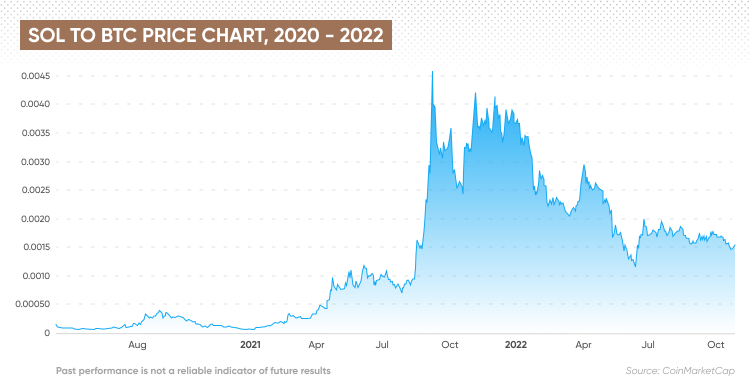
Since SOL’s launch in 2020, the SOL to BTC rate struggled to pick up momentum, moving sideways for around 10 months before starting to gain speed at the end of February 2021.

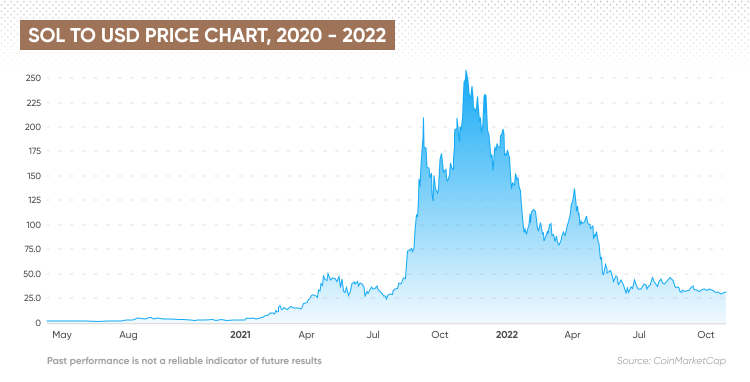
Between late February 2021 and mid-August 2021 the pairing fluctuated between values as low as 0.0001781BTC and as high as 0.001179BTC. The SOL to USD price chart followed a similar trend, fluctuating between $13 and $49.

SOL to BTC price chart, 2020 - 2022

Between 15 August 2021 and 9 September 2021, however, the SOL/BTC pair surged, rising by more than 385%, up from 0.0009374BTC to 0.004576BTC as Solana was being discovered by a number of celebrities, such as Mike Tyson and Jason Derulo. This was also the time when the SOL to BTC reached its all-time high, as seen on the price chart above.

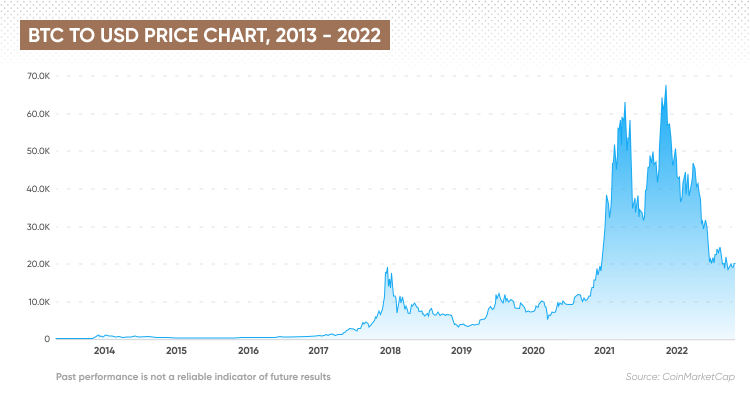
Between 9 September 2021 and 20 October 2021 the SOL/BTC price lost nearly 50% of its gains, dropping to 0.002425BTC as the BTC price in US dollars started to see major gains, surging by around 39% within the period from $46,000 to $64,000.

BTC to USD price chart, 2013 - 2022

In line with other major cryptocurrencies, the SOL/BTC rate regained a big portion of its losses as it rose to 0.004202BTC by 7 November 2021, at the time when the SOL value in USD reached its all-time high of $258.78.

SOL to USD price chart, 2020 - 2022

Up until the start of January 2022, the SOL to BTC exchange rate was fluctuating between 0.004000BTC and 0.003000BTC before falling more than 60% to 0.001149BTC on 13 June 2022, amid overall broad negative investor sentiment.

In terms of technical analysis, the chief digital advisor at the Mongolian Productivity Organisation and author of NFT: From Zero to Hero, Anndy Lian, told Capital.com that the SOL price could be headed towards a trend reversal, as of 28 October.

“The Relative Strength Index (RSI) indicates that the token is in the overbought zone, signalling a reversal could be on the way,” he said.

The pairing’s current exchange rate (28 October) is 0.00151BTC, up by 31.4% since its 13 June 2022 dip.

What is driving SOL/BTC?

On 30 September 2022, the Solana Mainnet Beta cluster experienced an outage, which led to a temporary collapse in the blockchain. This saw the SOL to BTC exchange rate drop by 3.1% within a week, down to 0.001682BTC by 7 October 2022, from 0.001735BTC on the day of the outage.

Dr. Pooja Lekhi, professor of global financial institutions, risk management approach and financial management at University Canada West, told Capital.com:

“Solana has experienced several recent network outages and failures. In the beginning of June, validators in the network stopped processing new blocks for several hours and apps built on Solana’s blockchain were taken offline, which sent its price down more than 12%.”

Projects built on Solana have potential to affect the token’s future price. On 27 October, the Web3 platforms built on Solana Decentralised Engineering Corporation (DEC) and Teleport announced that they have raised funding to bring a Web3 Uber rival (TRIP) to the Solana blockchain, something Ethereum co-creator Vitalik Buterin theorised a while back.

Lian noted that bringing the ridesharing industry to the Solana ecosystem “would surely put SOL into a high utility mode”.

In addition, Solana had partnered with artist Nancy Baker Cahill. She launched her first NFT collection on the blockchain that was shown across 90 billboards on Times Square. Metaplex, an NFT ecosystem built on Solana, also announced it was bringing a new asset class that will allow “creators to enforce royalties at the protocol level by extending the Token Metadata program, which powers 99%+ of all NFTs on Solana.”

Dr. Lekhi noted that until Solana network’s upgrade, “stability will remain a major concern for the SOL, adding:

“It is expected that the Mainnet version will stop the power outage issue. The SOL market had set higher benchmarks for its prices, along with developments in decentralised exchanges, Solana NFT marketplace, Yield aggregators and online games.”

The date for the upgrade launch is yet to be announced.

The enthusiasm surrounding Solana also comes following the news about Saga, its flagship Android phone, which will start shipping in 2023, Lian noted. Solana announced that Saga will have its first mint event on 28 October, which will only be available to those who pre-ordered the phone.

SOL/BTC price prediction

Based on the analysis of past performance, as of 28 October, algorithm-based forecasting service Wallet Investor predicted that SOL/USD could fall to $2.947 in 2023. The platform did not provide a price prediction for 2027.

In terms of its BTC value forecast, the site saw BTC/USD trade at $23,107.27 in 2023 and reach $36,574.97 by 2027.

While Wallet Investor did not provide a direct SOL to BTC forecast, data suggested that the exchange rate could be 0.00012754BTC in 2023.

DigitalCoinPrice predicted that SOL/USD could rise to $36.55 by the end of 2022. The site’s data, as of 28 October, showed that the coin was expected to trade at $49.68 in 2023 and $80.94 in 2025. Its long-term prediction saw the coin reaching $169.10 in 2030.

The site also gave an upbeat BTC/USD forecast, as of 28 October, expecting the coin to grow to $25,646.42 by the end of 2022, reach $33,474.34 in 2023, $53,010.14 in 2025 and surpass $112,000 in 2030.

DigitalCoinPrice’s SOL to BTC forecast for 2022 expected the pair to reach 0.0014252BTC and 0.0014841BTC in 2023. The site’s SOL/BTC forecast for 2025 stood at 0.0015269BTC. Its long-term SOL/BTC forecast for 2030 was 0.0015098BTC.

Dr. Lekhi noted that 2022 was not a good year for SOL, however, the coin may observe a steady growth in the coming months as a rebound in SOL’s price is anticipated.

Lian added that interest in SOL is “extremely high” which could mean that its future movement could be “overall positive”, adding that “with the strong ecosystem backing its value, the rebound can be promising.”

Remember that analysts’ and algorithm-based predictions can be wrong and shouldn’t be used as a substitute for your own research.

Always conduct your own due diligence on a cryptocurrency project before trading, looking at the latest news, a wide range of analyst commentary and technical analysis. Note that past performance does not guarantee future returns. And never trade money you cannot afford to lose.


Source: https://capital.com/sol-btc-prediction-solana-bitcoin-exchange

Anndy Lian is an early blockchain adopter and experienced serial entrepreneur who is known for his work in the government sector. He is a best selling book author- “NFT: From Zero to Hero” and “Blockchain Revolution 2030”.

Currently, he is appointed as the Chief Digital Advisor at Mongolia Productivity Organization, championing national digitization. Prior to his current appointments, he was the Chairman of BigONE Exchange, a global top 30 ranked crypto spot exchange and was also the Advisory Board Member for Hyundai DAC, the blockchain arm of South Korea’s largest car manufacturer Hyundai Motor Group. Lian played a pivotal role as the Blockchain Advisor for Asian Productivity Organisation (APO), an intergovernmental organization committed to improving productivity in the Asia-Pacific region.

An avid supporter of incubating start-ups, Anndy has also been a private investor for the past eight years. With a growth investment mindset, Anndy strategically demonstrates this in the companies he chooses to be involved with. He believes that what he is doing through blockchain technology currently will revolutionise and redefine traditional businesses. He also believes that the blockchain industry has to be “redecentralised”.

j j j