Crypto Expo Asia 2022 Singapore: The Role of Crypto Exchanges in Today’s Landscape

Crypto Expo Asia 2022 Singapore: The Role of Crypto Exchanges in Today’s Landscape

Crypto Expo Asia is the largest event in Asia for Investors and Crypto industry leaders to network and explore more business opportunities in the crypto space. They provide the market’s leading content & updates on the Crypto and Blockchain industry that will help you explore the investment opportunities available as smartly and securely.

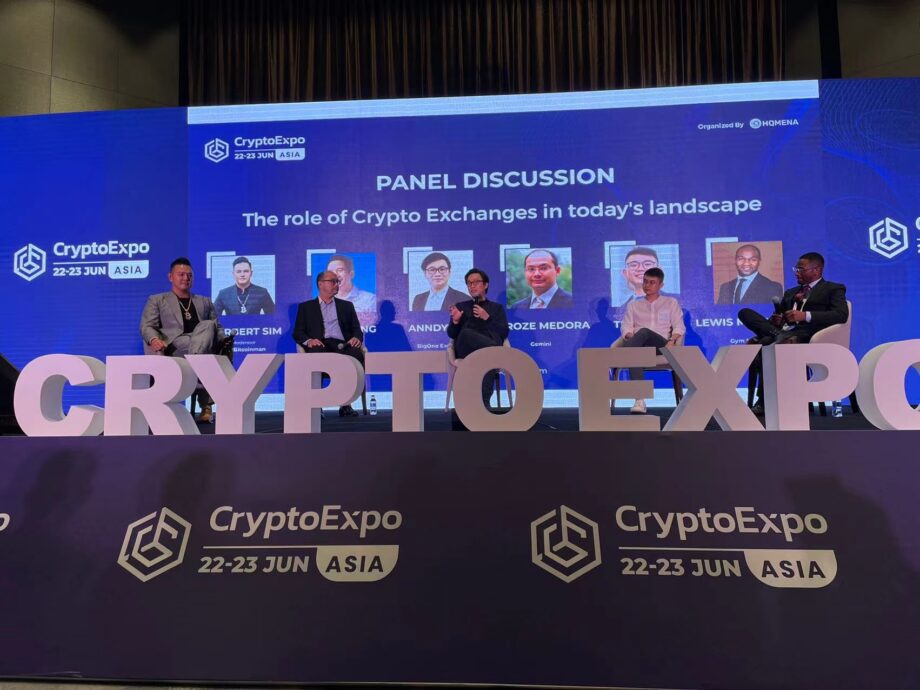
A crypto exchange is a platform on which you can buy and sell cryptocurrency. You can use exchanges to trade one crypto for another — converting Bitcoin to Binance Coin, for example — or to buy crypto using regular currency, like the U.S. Dollar. Cryptocurrencies make it easier for people in different countries to pay each other, negating financial borders currently controlled by banks and governments. The panel comprises experts and practitioners from centralized exchanges. They will share insights on the role of Crypto Exchanges in today’s landscape.

The session is moderated by Herbert Sim, Bitcoin Man and with panelists Feroze Medora, Gemini; Anndy Lian, BigONE; Travis Teo, Tokenize and Lewis Mahlanga, Gym Network.

The following questions were addressed:

#1 The explosion of thus many crypto exchanges is the white-labelling phenomena, which allows for almost instant creation of an exchange. With all this proliferation, the nature of platforms continues to diversify. What is the current role of exchanges today, besides crypto trading?

Lewis Mahlanga: “We need to educate the market about cryptocurrencies.”

#2 Centralized Exchanges versus Decentralized Exchanges. What are your thoughts? Pros and cons?

Travis Teo: “As a new user, you might not know how the wallets work. You are also may not know where to obtain ETH or SOL. CEX will act as a bridge for these new users to guide them through the process.”

#3 To list out some more roles that a crypto exchange could play – Payment services (Remittance, Escrow Service, Micropayments, Merchant Services – Gateway processor, Mobile PoS card reader, Debit card; and more); Mobile wallet, ATM. What are the differentiating factors which sets apart each of the exchanges?

Herbert Sim: “Security of the exchange, how credible it is.”

#4 A big challenge for centralized crypto exchanges over the years is custodial. Users are required to perform mandatory tasks to sign up and verify their identity. Fees can be expensive because platform takes a percentage of initial investment, and off every trade. While there is high level of trust in the CEX from the users, the CEX actually holds the private keys to the tokens and the funds, which makes it subject to hacking. And we have all seen massive multi-million, even close to billion dollar hacks taken place, even in the present day. What are your thoughts about CEX’s custodial today?

#5 Possibly the toughest, most controversial question for crypto exchanges. What are your thoughts on wash-trading? And rankings on CoinMarketCap?

Feroze Medora: “Even though we are in a very new industry, I like the expression ‘Nothing is new under the sun’. Wash trading falls under the border category of market manipulation. Which are features of regular financial market for very time.”

#6 The question that is probably the biggest challenge for crypto exchanges. What are your thoughts on regulations by regulators across the world – from US SEC, to China’s PBoC, and here in Singapore Monetary Authority of Singapore (MAS)?

#7 Let’s talk about crypto trading specifically. Mobile Financial Trading, Derivatives Trading, Future Trading, Financial Trading. What’s next? What do you think is the future of trading?

Anndy Lian: “I think derivatives trading would be the strongest and will be one of the key crypto highlights. NFT trading and NFT marketplace would be the next to look at too. The current NFT market has not reached its fullest potential in terms of trading, because it has not hit a critical volume. We should look at this market seriously, build products on top of NFT, facilitate it with real utility and link back to spot/ derivatives trading to optimize its full potential.”

Crypto Expo Asia 2022 is held on 22 – 23 June 2022, at Raffles City Convention Centre, Singapore. The second day of the event will feature speakers from ConsenSys, UOB, OKX, Bybit, Fireblocks and many more. More information can be obtained at https://cryptoexpoasia.com/.

This article is produced by BLOCKCAST.CC.

Anndy Lian is an early blockchain adopter and experienced serial entrepreneur who is known for his work in the government sector. He is a best selling book author- “NFT: From Zero to Hero” and “Blockchain Revolution 2030”.

Currently, he is appointed as the Chief Digital Advisor at Mongolia Productivity Organization, championing national digitization. Prior to his current appointments, he was the Chairman of BigONE Exchange, a global top 30 ranked crypto spot exchange and was also the Advisory Board Member for Hyundai DAC, the blockchain arm of South Korea’s largest car manufacturer Hyundai Motor Group. Lian played a pivotal role as the Blockchain Advisor for Asian Productivity Organisation (APO), an intergovernmental organization committed to improving productivity in the Asia-Pacific region.

An avid supporter of incubating start-ups, Anndy has also been a private investor for the past eight years. With a growth investment mindset, Anndy strategically demonstrates this in the companies he chooses to be involved with. He believes that what he is doing through blockchain technology currently will revolutionise and redefine traditional businesses. He also believes that the blockchain industry has to be “redecentralised”.
j j j

Cloud Executive Summit Asia: Architecting a Future Cloud Ready Strategy for Metaverse

Cloud Executive Summit Asia: Architecting a Future Cloud Ready Strategy for Metaverse

Metaverse is a much talked about topic nowadays. Technology has a symbiotic relationship with the world, and humans’ interaction with technology constantly gets disrupted with new innovations. The future of the Internet and the vision of it being the Metaverse has definitely a potential for disruptive change to the way we live, work and play. The race is on for businesses looking to have a stake in building and positioning themselves for the arrival of the future. As this will be the next battleground for cloud computing, evolving your cloud strategy and tools will be the first step to lead you to this new frontier. This panel will discuss:

– Defining the metaverse and reasons why we are pursuing it
– Importance of cloud infrastructure in the concept
– How should technologies evolve to support the realisation of this concept

The speakers’ lineup includes:

– Lim May-Ann, Executive Director, Asia Cloud Computing Association (moderator)
– Anndy Lian, Chairman, BigONE Exchange; Chief Digital Advisor, Mongolian Productivity Organization
– Lionel Chok, Chief Metaverse Officer, Hatten Edge Pte Ltd (Subsidiary of Hatten Land Ltd)
– Dr. Khoo Eng Tat, Principal Investigator, Immersive Reality Lab, National University of Singapore

May-Ann Lim, Emeritus Director – Asia Cloud Computing Association: “Foundational technology and the stabilisation of all of the important bits and pieces usually not as sexy as the things that you build on top of it. So it’s important to integrate for all that we have been really exciting things on the internet. I think foundationally it’s still a wire in the ground that’s bringing us a lot of things. So that I think that stability and environmental systems are important.” (10:17)
Anndy Lian, Chairman; Chief Digital Advisor – BigONE Exchange: “In a very, in a very simple manner I will say that the metaverse is giving the decentralised network a very good use case. You know, apart from that metaverse can actually exist in both and in some ways or another is still centralized; you know whether the metaverse is being controlled by the DAO or it’s being controlled by the centralised party, in some ways, they’re still a form of decentralisation. So the simplest version that I have in mind, is an environment, a place where people can live a second life, a virtual environment apart from the life we are experiencing right now.” (6:27)
Lionel Chok, Chief Metaverse Officer – Hatten Edge Pte Ltd (Subsidiary of Hatten Land Ltd): “You don’t know if it will take 10 or 15 years, you don’t know. But what we do know is that because so many of the tech giants missed the boat or didn’t totally respond to web 1.0 or 2.0, you can be sure that nobody is going to miss the boat this time.”
Eng Tat Khoo, Principal Investigator, Immersive Reality Lab – National University of Singapore: “Moving forward, I think that what the real world is, and what the virtual world is going to merge at some point, right? And that will be truly better is truly multidimensional and truly parallel. And for that to happen, I think there need to be breakthroughs happening in the space, one is on understanding the space and objects, so we do object tracking, localization, and I think you also need to develop some intelligence for normal voice interaction and natural language processing.” (26:47)
Cloud Executive Summit Asia, powered by Cloud Expo Asia, launches on 13th April 2022 at Marina Bay Sands. It is a one-day face-to-face event that will bring together CTOs, CIOs, Heads of IT, Infrastructure, Digital Transformation, AI, Cloud Security, Architecture, IT Operations, etc. from all industry verticals. The exhibition and conference promises challenging content and the opportunity to network with your industry peers.

The theme of the event is Accelerate Business Agility Through Cloud and some of the topics that form the 2022 programme include:

Digital Infrastructure: Fast, Agile, Resilient, Sustainable
– AI in Cloud Computing
– Hybrid Cloud Strategy
– Imagine the Future (Metaverse)
– The Rise of Serverless: IT-as-a-Service
– Work Productivity
– Sustainability
– Data Management

Anndy Lian is an early blockchain adopter and experienced serial entrepreneur who is known for his work in the government sector. He is a best selling book author- “NFT: From Zero to Hero” and “Blockchain Revolution 2030”.

Currently, he is appointed as the Chief Digital Advisor at Mongolia Productivity Organization, championing national digitization. Prior to his current appointments, he was the Chairman of BigONE Exchange, a global top 30 ranked crypto spot exchange and was also the Advisory Board Member for Hyundai DAC, the blockchain arm of South Korea’s largest car manufacturer Hyundai Motor Group. Lian played a pivotal role as the Blockchain Advisor for Asian Productivity Organisation (APO), an intergovernmental organization committed to improving productivity in the Asia-Pacific region.

An avid supporter of incubating start-ups, Anndy has also been a private investor for the past eight years. With a growth investment mindset, Anndy strategically demonstrates this in the companies he chooses to be involved with. He believes that what he is doing through blockchain technology currently will revolutionise and redefine traditional businesses. He also believes that the blockchain industry has to be “redecentralised”.

j j j

Nikkei Asia: South Korea’s incoming president vows big cryptocurrency push

Nikkei Asia: South Korea’s incoming president vows big cryptocurrency push

SEOUL/SINGAPORE — South Korean President-elect Yoon Suk-yeol will take office in May with no business experience but strong ideas on one of the most contentious subjects in finance, cryptocurrencies.

Yoon, a former top prosecutor who emerged victorious last week in the closest vote for the top office in the country’s history, has promised to allow initial coin offerings, or ICOs, as part of his broader cryptocurrency pledges.

A member of the conservative People Power Party, he has also vowed not to impose taxes on cryptocurrency trading gains of up to 50 million won ($40,000), treating them the same as stock winnings.

Yoon’s proposals were welcomed by cryptocurrency advocates who expect obstacles to be removed and the door opened to increased opportunities in blockchain technology-based assets.

“We definitely welcome his stance as he is confident about boosting the industry,” said Yoon Seong-han, secretary-general at Korea Blockchain Association, a lobby group for cryptocurrency exchanges and other market participants. “As ICOs are banned now, we have no choice but to issue coins in Singapore and other countries. Ventures and startups will be able to raise money easily from investors [if the ban is lifted].”

Yoon the lobbyist is not related to the president-elect.

Singapore-based Anndy Lian, chairman of Netherlands-registered crypto trading platform BigONE Exchange, also welcomed Yoon’s stance. “He understands the importance of crypto,” Lian told Nikkei Asia. “He understands the future, and it is unstoppable.”

Stocks related to coins have rallied on Yoon’s victory over Lee Jae-myung of the center-left Democratic Party. Lee took a cautious stance toward cryptocurrencies. Lee agreed with Yoon on allowing coin issuances but was negative on treating cryptocurrencies the same as stocks.

Cryptocurrencies, which can and do go on huge price swings, have prompted concerns over how they can be effectively regulated.

Shares of Vidente, a telecom facility maker that owns a 34.2% stake in South Korea’s biggest cryptocurrency exchange Bithumb Holdings, jumped 11.3% over two days last week after Yoon was elected, before falling 5.37% on Monday and 2.39% on Tuesday.

According to South Korea’s financial regulator, the country’s cryptocurrency market reached 55.2 trillion won as of December, with average daily trading of 11.3 trillion won. More than 15.2 million people in the country have accounts with 24 cryptocurrency brokers. Of those registered, 5.6 million actually trade.

Traders in their 30s appear to be most enthusiastic, accounting for 31% of all buyers; followed by those in their 40s, at 27%; and those in their 20s, at 23%; according to a Financial Services Commission report released last month. By gender, two-thirds of users are men. More than half of users had cryptocurrencies valued at 1 million won or less, while 15% held 10 million won worth or more.

Stocks have traditionally been South Koreans’ favored investment vehicle. The country’s benchmark Kospi index in 2021 experienced a record year for initial public offerings, which totaled 17.2 trillion won. The index rose 3.63% last year and had a market capitalization of 2.2 quadrillion won.

Yoon’s electoral victory of less than a percentage point was largely propelled by support from socially and economically disaffected younger men, analysts say. This disaffection has been increasing due to high inflation, low growth and more recently soaring home prices.

The victor’s embrace of cryptocurrencies also comes as U.S. President Joe Biden last week signed an executive order ensuring responsible development of cryptocurrencies and other digital assets.

“We must reinforce United States leadership in the global financial system and in technological and economic competitiveness, including through the responsible development of payment innovations and digital assets,” the White House said in a statement, describing one of the order’s objectives.

Yoon can implement part of his cryptocurrency policy through presidential orders, but his no-tax vow will need the National Assembly to revise a tax law. The legislature will also need to pass a bill to set up an agency to regulate digital assets.

This will require cooperation from incumbent President Moon Jae-in’s dominant Democratic Party, which has a majority of 300 seats in the legislature.

At least some of what Yoon proposes is likely to be achieved, according to Han Dae-hoon, an analyst at SK Securities.

“I expect Yoon’s policy to nurture cryptocurrencies is likely to be realized with the new government,” Han wrote in a note on Monday. “But we will not know until we see it.”

In Singapore, Yoon’s openness to crypto has been met with some skepticism. Although the city-state has positioned itself as an Asian hub for digital assets, its financial regulator has been selective in offering operating licenses to crypto players; only a handful of companies have been allowed to do business in the country.

Anson Zeall — emeritus-chair of the Association of Cryptocurrency and Blockchain Enterprises and startups Singapore, a lobby outfit for over 400 businesses — said it remains to be seen how many of Yoon’s promises will be fulfilled.

“Action speaks louder than words,” he told Nikkei Asia. “We need to see what they [South Korea] come up with.”

Lian of BigONE Exchange voiced a similar sentiment.

“Singapore’s menu still has its advantages,” he told Nikkei. “[South] Korea’s money control[s] needs to be relooked [at] in order for crypto to move up another level, so Singapore is still in an advantageous position.”


Original Source: https://asia.nikkei.com/Spotlight/Cryptocurrencies/South-Korea-s-incoming-president-vows-big-cryptocurrency-push

Anndy Lian is an early blockchain adopter and experienced serial entrepreneur who is known for his work in the government sector. He is a best selling book author- “NFT: From Zero to Hero” and “Blockchain Revolution 2030”.

Currently, he is appointed as the Chief Digital Advisor at Mongolia Productivity Organization, championing national digitization. Prior to his current appointments, he was the Chairman of BigONE Exchange, a global top 30 ranked crypto spot exchange and was also the Advisory Board Member for Hyundai DAC, the blockchain arm of South Korea’s largest car manufacturer Hyundai Motor Group. Lian played a pivotal role as the Blockchain Advisor for Asian Productivity Organisation (APO), an intergovernmental organization committed to improving productivity in the Asia-Pacific region.

An avid supporter of incubating start-ups, Anndy has also been a private investor for the past eight years. With a growth investment mindset, Anndy strategically demonstrates this in the companies he chooses to be involved with. He believes that what he is doing through blockchain technology currently will revolutionise and redefine traditional businesses. He also believes that the blockchain industry has to be “redecentralised”.

j j j