Bitcoin’s big moment: Can crypto shine as stocks stumble before Jackson Hole?

Bitcoin’s big moment: Can crypto shine as stocks stumble before Jackson Hole?

Investors face a muted global risk sentiment, with attention firmly fixed on the Jackson Hole symposium starting today and culminating in Federal Reserve Chair Jerome Powell’s speech tomorrow.

This annual gathering in Wyoming often sets the tone for monetary policy, and with recent data showing a cooling US labour market and persistent inflation concerns, markets anticipate signals on potential rate cuts. President Donald Trump added fuel to the fire by demanding Federal Reserve Governor Lisa Cook resign over mortgage fraud allegations, a move that underscores ongoing tensions between the administration and the central bank.

Such political pressure could amplify volatility, especially as the Fed navigates a delicate balance between supporting growth and taming prices. In my view, this environment highlights the fragility of investor confidence, where policy missteps could trigger sharper corrections, but also opens opportunities for resilient assets like cryptocurrencies to shine amid traditional market wobbles.

US stock markets extended their downward trajectory yesterday, reflecting waning enthusiasm for technology stocks, particularly in artificial intelligence sectors that drove much of the earlier rally. The S&P 500 dipped 0.24 per cent, the Nasdaq fell 0.67 per cent, and the Dow Jones eked out a modest 0.04 per cent gain.

Consumer discretionary stocks lagged significantly, dropping 1.2 per cent, as the administration broadened tariffs on steel and aluminum to include various consumer goods. This expansion aligns with Trump’s protectionist agenda, which he has touted as a way to bolster domestic manufacturing, but it risks escalating trade tensions and inflating costs for businesses and consumers alike.

These tariffs represent a double edged sword: they protect certain industries in the short term but could stifle broader economic momentum, especially if retaliatory measures from trading partners emerge. Recent data from Schwab’s market update shows major indexes sputtering after a featureless session, with tech arresting its slide but only inching up, underscoring limited buying interest amid elevated price-to-earnings ratios. Investors appear cautious, weighing the potential for a soft landing against the reality of slowing growth.

Bond markets offered a slight reprieve, with US Treasury yields inching lower. The 10-year yield slipped one basis point to 4.28 per cent, while the two-year yield also declined one basis point to 3.74 per cent. This modest dip reflects expectations of easing monetary policy, as traders bet on rate cuts to support the economy. The spread between the 10-year and two-year yields remains a focal point, with the Federal Reserve Bank of St. Louis data indicating positive values that could imply future growth, though negative spreads have historically signalled downturns.

In my opinion, these yield movements suggest markets price in a dovish Fed pivot at Jackson Hole, where Powell’s speech could confirm or dash hopes for a September rate cut. Previews from Investing.com highlight all eyes on Powell as the Fed navigates a policy tightrope amid stagflation fears. If history serves as a guide, insurance cuts like those in 2019 have boosted equities, but reactive cuts during recessions often coincide with weaker returns.

Currencies and commodities presented a mixed picture. The US Dollar Index closed largely unchanged at 98.22, providing little directional cue. Gold climbed 0.9 per cent to US$3,345 per ounce, benefiting from a softer dollar and safe-haven demand ahead of Jackson Hole. Brent crude advanced 1.6 per cent to US$67 per barrel, spurred by reports of a six-million-barrel drop in US crude inventories.

Oil prices gained slightly in Asian trading, with larger-than-expected declines in crude and fuel supporting the uptick, as noted by Reuters. I see gold’s resilience as a hedge against uncertainty, particularly with geopolitical risks like the ongoing Russia-Ukraine talks between Trump and Putin potentially easing sanctions on Russian oil. Commodities like these often thrive when traditional assets falter, and the current setup reinforces their role in diversified portfolios.

Asian markets mirrored the global unease, closing mixed yesterday with sharp losses in export-reliant economies. Japan’s Nikkei fell 1.51 per cent, and Taiwan’s index dropped 2.99 per cent, driven by a weak July export report from Japan. Early trading today showed most indices opening higher, but caution prevails.

Bloomberg reports updated stock indexes in Asia-Pacific, with China e-commerce stocks’ 230 per cent rally at risk amid concerns. These declines stem from tariff fears and slowing global demand, yet the rebound in early sessions indicates bargain hunting. US equity futures point to a lower open, aligning with the broader wait-and-see approach before Jackson Hole.

Shifting to cryptocurrencies, recent insights from Glassnode illuminate intriguing divisions among Bitcoin investors. The “First Buyers” group increased their stakes by 10 per cent, seizing opportunities during market dips, while “Conviction Buyers” also bolstered holdings by 10 per cent, adopting a cautious yet hopeful stance.

Profit-Takers offloaded 5.4 per cent more assets to capitalise on gains, and Loss Sellers emerged, shedding positions amid creeping losses. Glassnode’s on-chain analysis reveals short-term holders selling at a loss for the first time in seven months, a trend that rings alarm bells but could signal a necessary market reset.

X posts from Glassnode highlight limited realised losses, suggesting newer Bitcoin investors defend their cost basis near US$112,000.

From my standpoint, these shifts underscore Bitcoin’s maturing ecosystem, where long-term holders exhibit resilience, but short-term volatility tests newcomers. The STH-SOPR dipping below 1 mirrors past corrections, yet the average unrealised loss of 10.6 per cent among short-term holders indicates panic selling that might create buying opportunities for institutions.

Institutional interest remains a cornerstone of Bitcoin’s stability, with anticipated ETF inflows amplifying demand despite macroeconomic headwinds. US spot Bitcoin ETFs recorded US$3.37 billion in net inflows last week, pushing Bitcoin from US$116,000 to US$124,000 before a pullback.

Cumulative inflows stand at US$54.85 billion, with assets under management at US$150.9 billion, even as recent outflows hit US$643 million. Trump’s executive order allowing cryptocurrency in 401(k) plans opens the door for broader adoption, potentially injecting billions from retirement savings.

The Department of Labor rescinded 2022 guidance discouraging crypto in plans, democratising access to alternative assets. I believe this policy shift marks a pivotal moment, bridging traditional finance and crypto, though risks like volatility persist for retirement investors.

Bitcoin’s consolidation ripples through altcoins like Ethereum and Solana, with Bitcoin’s market dominance at approximately 58.89 per cent. CoinMarketCap charts show Bitcoin dominance at 59.62 per cent, a slight uptick reflecting its safe-haven status. Ethereum ETFs outpaced Bitcoin inflows for five straight days, with corporate treasuries accumulating ETH amid falling exchange supply. This interdependence means Bitcoin’s stability bolsters altcoins, but a breakout above key resistance could trigger broader rallies. Solana, in particular, benefits from its speed and low fees, positioning it for growth if institutional flows diversify.

Hong Kong’s foray into spot Bitcoin and Ether ETFs adds an international dimension, with recent debuts showing cautious investor appetite. MicroBit Capital Management launched ETFs tracking US dollar prices of Bitcoin and Ether, with the Bitcoin ETF (stock code 3430) rising 0.1 per cent to HK$7.82 (US$1.00) and the Ether ETF (3425) up 2.8 per cent to HK$8.03 (US$1.03).

Trading volumes reached about HK$29.68 million (US$3.80 million), per SoSoValue, contrasting with US euphoria but aligning with new stablecoin rules. Pando Finance teamed with OSL Exchange for its Bitcoin ETF launch on July 18, powered by CME CF benchmarks. Hong Kong’s stablecoin regime, effective August 1, requires licenses for issuers, with the first batch expected early next year. The HKMA’s public registry for licensed issuers enhances transparency. I regard this as a strategic move to position Hong Kong as a crypto hub, potentially attracting Asian capital and fostering innovation in fiat-backed stablecoins for trade and payments.

Overall, these developments paint a picture of interconnected markets navigating uncertainty. Traditional assets grapple with tariffs and policy risks, while cryptocurrencies demonstrate resilience through institutional backing and regulatory progress. Jackson Hole could catalyse shifts: a dovish Powell might ignite risk appetite, lifting stocks and crypto, whereas hawkish tones could strengthen the dollar and pressure yields. X discussions emphasise the symposium’s importance, with investors parsing every nuance.

In my experience, such events often precede turning points, and with Bitcoin’s on-chain metrics showing conviction among long-term holders despite short-term pain, I remain optimistic on its trajectory. The US allowing crypto in 401(k)s could unleash trillions in fresh capital, bridging generations of investors. Yet, caution prevails—volatility remains high, and diversified approaches win in the long run. As we await Powell’s words, markets hold their breath, but history favours those who adapt swiftly to emerging trends.


Source: https://e27.co/bitcoins-big-moment-can-crypto-shine-as-stocks-stumble-before-jackson-hole-20250821/


Anndy Lian is an early blockchain adopter and experienced serial entrepreneur who is known for his work in the government sector. He is a best selling book author- “NFT: From Zero to Hero” and “Blockchain Revolution 2030”.

Currently, he is appointed as the Chief Digital Advisor at Mongolia Productivity Organization, championing national digitization. Prior to his current appointments, he was the Chairman of BigONE Exchange, a global top 30 ranked crypto spot exchange and was also the Advisory Board Member for Hyundai DAC, the blockchain arm of South Korea’s largest car manufacturer Hyundai Motor Group. Lian played a pivotal role as the Blockchain Advisor for Asian Productivity Organisation (APO), an intergovernmental organization committed to improving productivity in the Asia-Pacific region.

An avid supporter of incubating start-ups, Anndy has also been a private investor for the past eight years. With a growth investment mindset, Anndy strategically demonstrates this in the companies he chooses to be involved with. He believes that what he is doing through blockchain technology currently will revolutionise and redefine traditional businesses. He also believes that the blockchain industry has to be “redecentralised”.

j j j

New Crypto Trend: Trading Tokens Before Release

New Crypto Trend: Trading Tokens Before Release

A new trend is taking off in the cryptocurrency community — as investors start to purchase tokens before waiting for them to hit the markets.

In a fast-paced industry, being an early investor is a crucial step as it allows individuals to potentially capitalize on significant price appreciation as innovative projects gain traction and adoption.

And now, investors are finding ways to start buying before the firing pistol has signaled the start of the race.

Here’s everything you need to know.

Key Takeaways

  • Investing in tokens before their release allows investors to potentially benefit from significant price increases as projects gain traction.
  • Platforms like AEVO and Hyperliquid have introduced new opportunities to speculate or hedge against future token prices, marking a shift from traditional ICOs to more dynamic pre-token trading environments.
  • Pre-token and point market sales have seen $50 million in trades despite low liquidity.
  • The pre-token and point markets are heavily dominated by buyers, a sign of potential investor confidence.
  • Despite the enthusiasm and high trading volumes, these markets face challenges such as lower liquidity and higher volatility compared to post-TGE markets.

Pre-Token & Point Markets Take Off

Until recently, investors could purchase cryptocurrencies prior to their official launch through their initial coin offering (ICO), a fundraising mechanism used by new decentralized finance (DeFi) projects to raise capital by selling tokens to investors prior to a project’s full development.

This allows anyone to speculate on or hedge against the price of a token before its launch, creating a new era of crypto investing.

In short, pre-token and point markets are platforms that allow people to buy or sell the promise of receiving tokens or points at a future date, often before the official release of the token.

Such markets are divided into two main types: one where trades are settled with cash and another where the actual tokens or points are exchanged. Such a setup lets investors speculate on the future value of tokens or points, potentially profiting from changes in their price before they become available.

According to Anndy Lian, an inter-governmental blockchain adviser, by participating in pre-sales, investors get the opportunity to directly support the development and growth of new projects, as well as create a sense of community and alignment with the project’s goals.

He said:

“This community effect can drive demand as more people become involved and invested in the token’s success. Effective marketing campaigns can generate significant hype around a token before its release, leading to increased demand as investors don’t want to miss out on what is being promoted as a promising opportunity.”

A Keyrock report released on April 30 uncovered that the crypto community has seen a notable surge in interest and participation in these pre-tokens and point markets with $50 million already being traded.

This high level of activity reflects a growing enthusiasm among investors to engage with new crypto projects at an early stage.

The markets predominantly cater to buyers, with the majority of orders coming from users eager to purchase tokens or points ahead of their public release. This eagerness is driven by the potential for high returns on investments as token values can increase significantly upon official launch.

Pre-token & Point Markets See Higher Buyer Dominance

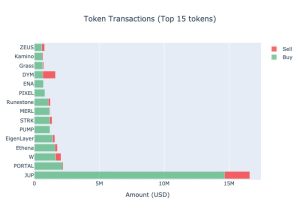
According to the Keyrock report, the markets showed a pronounced buyer dominance, with most tokens analysed displaying a higher buying than selling volume.

This trend suggested that investors were more interested in acquiring tokens rather than selling them, believing in the potential for token value appreciation after their Token Generation Event (TGE).

The report highlighted:

“Most tokens exhibit a buying volume significantly higher than the sell volume. Only 5 out of 57 tokens that have been traded on Whales Market show a selling volume that exceeds the buy volume. Participants in Whale Markets demonstrate a strong preference for buying tokens, points, and runes.”

Data on buying vs selling tokens from Whales Market. Source: Keyrock Data Intelligence

Data on buying vs selling tokens from Whales Market. Source: Keyrock Data Intelligence

Liquidity Remains Low

Despite optimistic trading volumes, pre-token and point markets still face challenges related to liquidity.

The Keyrock report highlighted that compared to traditional post-TGE markets, pre-token and point markets are relatively less liquid, meaning they have relatively fewer buyers and sellers, which could lead to price volatility and make it harder to execute larger orders without affecting the market price.

Additionally, sometimes the demand for a pre-release token is driven more by hype and marketing than by the project’s fundamentals, which could lead to an inflated valuation that does not reflect the token’s true worth, Lian explained.

“Projects that prioritize transparency, communication, and community trust are more likely to succeed in pre-release trading. Investors will gravitate toward projects they believe in.”

Technical issues could also serve as a major potential risk in purchasing cryptocurrencies before they fully launch since the technology behind the asset is only just being developed.

The Bottom Line

As the landscape of pre-token and point markets continues to evolve, strategic considerations and forward-thinking approaches are essential for both investors and project developers.

The surge in trading volumes and the enthusiasm observed in these markets suggest a robust interest in early-stage investment opportunities.

According to Lian, this has been an ongoing trend since the beginning of the crypto ICO period, and the act of trading tokens before their official release is likely to continue into the future as well. However, investors should exercise caution when investing in new projects and never invest money they cannot afford to lose.


Source: https://www.techopedia.com/news/exploring-crypto-pre-token-and-point-markets

Anndy Lian is an early blockchain adopter and experienced serial entrepreneur who is known for his work in the government sector. He is a best selling book author- “NFT: From Zero to Hero” and “Blockchain Revolution 2030”.

Currently, he is appointed as the Chief Digital Advisor at Mongolia Productivity Organization, championing national digitization. Prior to his current appointments, he was the Chairman of BigONE Exchange, a global top 30 ranked crypto spot exchange and was also the Advisory Board Member for Hyundai DAC, the blockchain arm of South Korea’s largest car manufacturer Hyundai Motor Group. Lian played a pivotal role as the Blockchain Advisor for Asian Productivity Organisation (APO), an intergovernmental organization committed to improving productivity in the Asia-Pacific region.

An avid supporter of incubating start-ups, Anndy has also been a private investor for the past eight years. With a growth investment mindset, Anndy strategically demonstrates this in the companies he chooses to be involved with. He believes that what he is doing through blockchain technology currently will revolutionise and redefine traditional businesses. He also believes that the blockchain industry has to be “redecentralised”.

j j j

Bullish investment strategies before spot ETH ETF approval

Bullish investment strategies before spot ETH ETF approval

There are several reasons to be optimistic about the approval of spot Ether exchange-traded funds (ETFs) in the near future. First, the United States Securities and Exchange Commission has already shown a more favorable attitude toward cryptocurrencies in general, as evidenced by its approval of 11 spot Bitcoin ETFs in January 2024. This was a historic milestone for the crypto industry, as it marked the first time the SEC allowed investors to access the largest cryptocurrency through a regulated and mainstream investment vehicle.

Second, Ether has a strong case for being classified as a commodity rather than a security by the SEC. This is a crucial distinction, as commodities are subject to less stringent regulations than securities and are, therefore, more likely to be approved for ETFs.

Ether is widely regarded as a commodity by many experts and authorities, including the U.S. Commodity Futures Trading Commission, the Financial Conduct Authority in the United Kingdom, and Bloomberg’s ETF analysts. The Ethereum blockchain is also the backbone of the decentralized finance and nonfungible token sectors, which are booming with innovation and adoption, and demonstrate the utility and value of the network.

Third, there is a strong demand and interest for spot ETH ETFs from both retail and institutional investors. According to a recent survey by Bitwise Asset Management, 98% of financial advisers who currently have an allocation to crypto in clients’ accounts intend to maintain or increase their exposure in 2024, which also favors ETH.

Chris Kuiper, director of research at Fidelity, recently shared his insights on why Ether could be a more appealing investment option for institutional investors than Bitcoin. He highlighted that comprehending Bitcoin as an investment requires delving into intricate topics such as politics, philosophy, game theory and economics. In contrast, Ether provides a more straightforward perspective, emphasizing basic metrics and cash flow data. Kuiper believes presenting these metrics to institutional investors would make ETH appear more like a conventional financial instrument, making it easier for them to relate to the asset.

In addition, there are several applications for spot ETH ETFs pending with the SEC, such as the Fidelity Ethereum Fund, the WisdomTree Ethereum Trust and BlackRock’s iShares Ethereum Trust. These are some of the world’s most reputable and influential asset managers, and their involvement could sway the SEC’s decision in favor of spot ETH ETFs.

Given the positive outlook for spot ETH ETFs, how should investors prepare for the potential approval? There is no definitive answer, as different investors have different risk appetites, time horizons and market outlooks. However, here are some possible strategies to consider, depending on whether one is bullish or bearish on Ether.

For investors who are bullish and optimistic about the approval of spot ETH ETFs, there are several ways to benefit from the anticipation and speculation of an approval, such as:

  • Buying spot ETH: The simplest, most direct way to gain exposure to the price appreciation of Ether is to buy and hold the spot ETH, either through a crypto exchange or a wallet. However, this also involves the highest risk and cost, as the investor has to deal with the volatility, security, and custody issues of holding and storing Ether directly.
  • Buying futures ETH ETFs: Another way to gain exposure to the price appreciation of Ether is to buy and hold futures-based ETH ETFs, such as the VanEck Ethereum Strategy ETF or the ProShares Ether Strategy ETF. These ETFs track the price of Ether by holding futures contracts that promise to deliver ETH at a future date and price. However, this also involves some risk and cost, as the investor has to deal with the contango, rollover, and tracking error issues of holding and trading futures contracts.
  • Buying call options on ETH or ETH ETFs: A more sophisticated, leveraged way to gain exposure to the price appreciation of Ether is to buy call options on ETH or ETH ETFs, such as CME ETH options. These options give the investor the right, but not the obligation, to buy ETH or ETH ETFs at a predetermined price and date. However, this also involves the most risk and cost, as the investor has to pay a premium for the options, and the options could expire worthless if the price of Ether or the ETH ETF does not exceed the strike price by the expiration date.
  • Arbitraging between different ETH products: A more complex, arbitrage-based way to gain exposure to the price appreciation of Ether is to exploit the price differences between different ETH products, such as spot ETH, futures-based ETH ETFs, spot ETH ETFs (if available in other jurisdictions), and ETH derivatives. However, this also involves the most skill and capital, as the investor has to identify and execute the arbitrage opportunities, and hedge against the market and operational risks.

Ethereum is one of the most innovative, influential platforms in the crypto space, and the approval of spot ETH ETFs could be a game-changer for the industry. However, an approval is not guaranteed, and the timing is uncertain. Therefore, investors should be prepared for various scenarios and adopt the appropriate strategies according to their risk appetite, time horizon and market outlook. To aid in their strategies, investors may consider using a powerful trading dashboard such as Cointelegraph Markets Pro.

Whether one is bullish or bearish on Ether, there are multiple ways to invest in the cryptocurrency before a potential spot ETH ETF approval, and potentially profit from the anticipation and speculation of such an approval. But remember, this is not financial advice.


Source: https://cointelegraph.com/news/bullish-investment-strategies-before-spot-eth-etf-approval

FAQ

[sc_fs_multi_faq headline-0=”h2″ question-0=”What factors make the approval of spot Ether exchange-traded funds (ETFs) more likely in the near future?” answer-0=”According to Anndy Lian, the approval of spot Ether ETFs is increasingly probable due to the SEC’s favorable stance on cryptocurrencies, demonstrated by the approval of 11 spot Bitcoin ETFs in January 2024. Additionally, Ether’s potential classification as a commodity, rather than a security, aligns with less stringent regulations, making it more suitable for ETF approval. The strong demand from both retail and institutional investors further supports this optimistic outlook.” image-0=”” headline-1=”h2″ question-1=”How can investors prepare for the potential approval of spot Ether ETFs?” answer-1=”In the article, Anndy Lian mentioned that investors with varying risk appetites, time horizons, and market outlooks have different strategies to consider. For those bullish on Ether, direct purchase of spot ETH, investment in futures-based ETH ETFs, buying call options, and arbitraging between different ETH products are potential approaches. Each strategy comes with its own set of risks and costs, necessitating careful consideration based on individual preferences and market expectations.” image-1=”” headline-2=”h2″ question-2=”What makes Ethereum an appealing investment option for institutional investors, according to Chris Kuiper of Fidelity?” answer-2=”Chris Kuiper highlights Ethereum’s appeal to institutional investors, emphasizing its straightforward perspective compared to Bitcoin. While understanding Bitcoin requires delving into intricate topics such as politics, philosophy, game theory, and economics, Ethereum provides a more conventional financial instrument view. Kuiper suggests that presenting Ethereum’s basic metrics and cash flow data makes it more relatable to institutional investors, potentially positioning it as a more attractive investment option than Bitcoin.” image-2=”” count=”3″ html=”true” css_class=””]

Anndy Lian is an early blockchain adopter and experienced serial entrepreneur who is known for his work in the government sector. He is a best selling book author- “NFT: From Zero to Hero” and “Blockchain Revolution 2030”.

Currently, he is appointed as the Chief Digital Advisor at Mongolia Productivity Organization, championing national digitization. Prior to his current appointments, he was the Chairman of BigONE Exchange, a global top 30 ranked crypto spot exchange and was also the Advisory Board Member for Hyundai DAC, the blockchain arm of South Korea’s largest car manufacturer Hyundai Motor Group. Lian played a pivotal role as the Blockchain Advisor for Asian Productivity Organisation (APO), an intergovernmental organization committed to improving productivity in the Asia-Pacific region.

An avid supporter of incubating start-ups, Anndy has also been a private investor for the past eight years. With a growth investment mindset, Anndy strategically demonstrates this in the companies he chooses to be involved with. He believes that what he is doing through blockchain technology currently will revolutionise and redefine traditional businesses. He also believes that the blockchain industry has to be “redecentralised”.

j j j