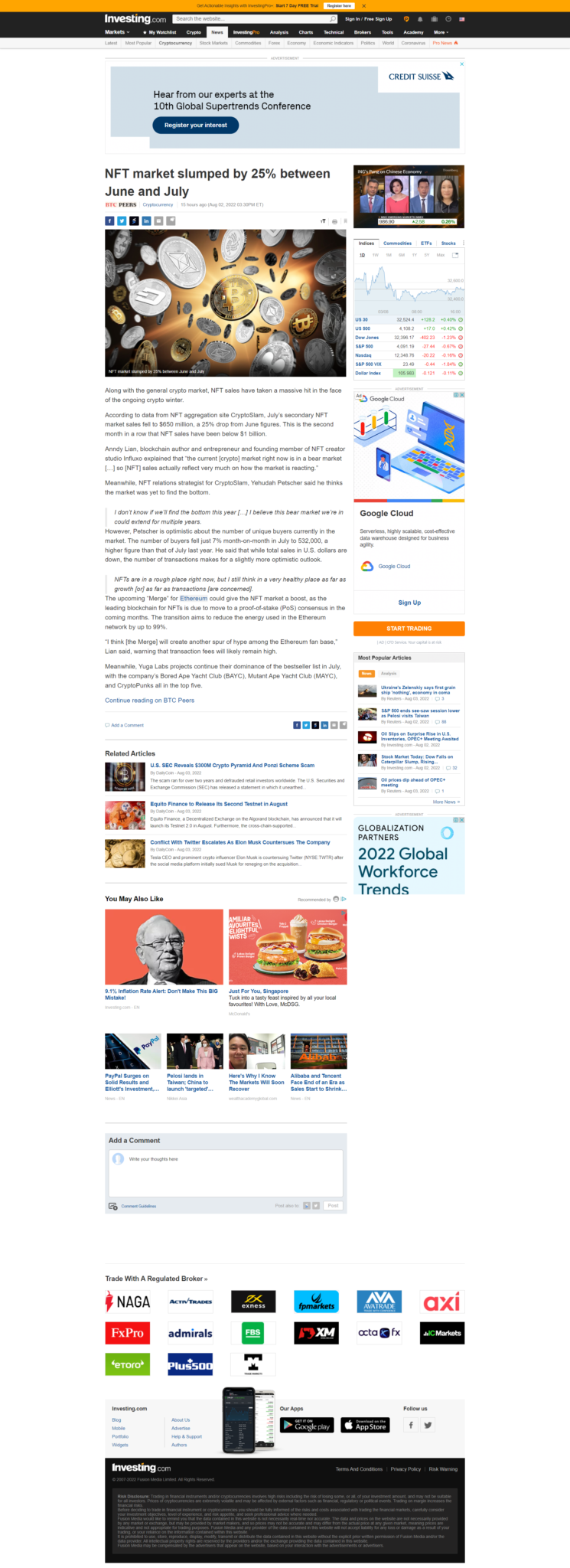
Along with the general crypto market, NFT sales have taken a massive hit in the face of the ongoing crypto winter.
According to data from NFT aggregation site CryptoSlam, July’s secondary NFT market sales fell to $650 million, a 25% drop from June figures. This is the second month in a row that NFT sales have been below $1 billion.
Anndy Lian, blockchain author and entrepreneur and founding member of NFT creator studio Influxo explained that “the current [crypto] market right now is in a bear market […] so [NFT] sales actually reflect very much on how the market is reacting.”
Meanwhile, NFT relations strategist for CryptoSlam, Yehudah Petscher said he thinks the market was yet to find the bottom.
I don’t know if we’ll find the bottom this year […] I believe this bear market we’re in could extend for multiple years.
However, Petscher is optimistic about the number of unique buyers currently in the market. The number of buyers fell just 7% month-on-month in July to 532,000, a higher figure than that of July last year. He said that while total sales in U.S. dollars are down, the number of transactions makes for a slightly more optimistic outlook.
NFTs are in a rough place right now, but I still think in a very healthy place as far as growth [or] as far as transactions [are concerned].
The upcoming “Merge” for Ethereum could give the NFT market a boost, as the leading blockchain for NFTs is due to move to a proof-of-stake (PoS) consensus in the coming months. The transition aims to reduce the energy used in the Ethereum network by up to 99%.
“I think [the Merge] will create another spur of hype among the Ethereum fan base,” Lian said, warning that transaction fees will likely remain high.
Meanwhile, Yuga Labs projects continue their dominance of the bestseller list in July, with the company’s Bored Ape Yacht Club (BAYC), Mutant Ape Yacht Club (MAYC), and CryptoPunks all in the top five.
Anndy Lian is an early blockchain adopter and experienced serial entrepreneur who is known for his work in the government sector. He is a best selling book author- “NFT: From Zero to Hero” and “Blockchain Revolution 2030”.
Currently, he is appointed as the Chief Digital Advisor at Mongolia Productivity Organization, championing national digitization. Prior to his current appointments, he was the Chairman of BigONE Exchange, a global top 30 ranked crypto spot exchange and was also the Advisory Board Member for Hyundai DAC, the blockchain arm of South Korea’s largest car manufacturer Hyundai Motor Group. Lian played a pivotal role as the Blockchain Advisor for Asian Productivity Organisation (APO), an intergovernmental organization committed to improving productivity in the Asia-Pacific region.
An avid supporter of incubating start-ups, Anndy has also been a private investor for the past eight years. With a growth investment mindset, Anndy strategically demonstrates this in the companies he chooses to be involved with. He believes that what he is doing through blockchain technology currently will revolutionise and redefine traditional businesses. He also believes that the blockchain industry has to be “redecentralised”.
According to market observers and its volatile conditions, cryptocurrency trading has maintained the range between $18000 and $22000 for a month. Additional thoughts were shared.
Bitcoin price has a lot to do with the supply and holders too. If you have looked at Glassnode’s data, over 80% of the total USD-denominated wealth invested in bitcoin has been moved for at least three months. When supply is dormant, the price is dormant, and this means that holders are unwilling to spend at a lower price.
Over 80% of the total USD denominated wealth invested in #Bitcoin has been HODLed for at least 3-months.
This signifies that the majority of the $BTC coin supply is dormant, and HODLers are increasingly unwilling to spend at lower prices.
Another possible reason is that SEC chair Gary Gensler said in an interview with Yahoo Finance on 15 July 2022 that they will continue to speak to the crypto industry, saying that they may suggest rules that apply to traditional brokerage to protect investors in the event of crypto failure. This piece of news in a timely manner, and gives more confidence to the investors at large.
The news of South Africa will go all in to regulate crypto as a financial asset is another plus point for this week. With all the news today alone, many people on Twitter turned bullish upon seeing the crypto market cap was traded closer back to the $1 trillion mark. Investors have to look at the following dates:
1) 27 July- Federal Reserve Interest Rates;
2) 28 July- US GDP Figures.
These are important dates to note as they can drive the crypto prices up or down.
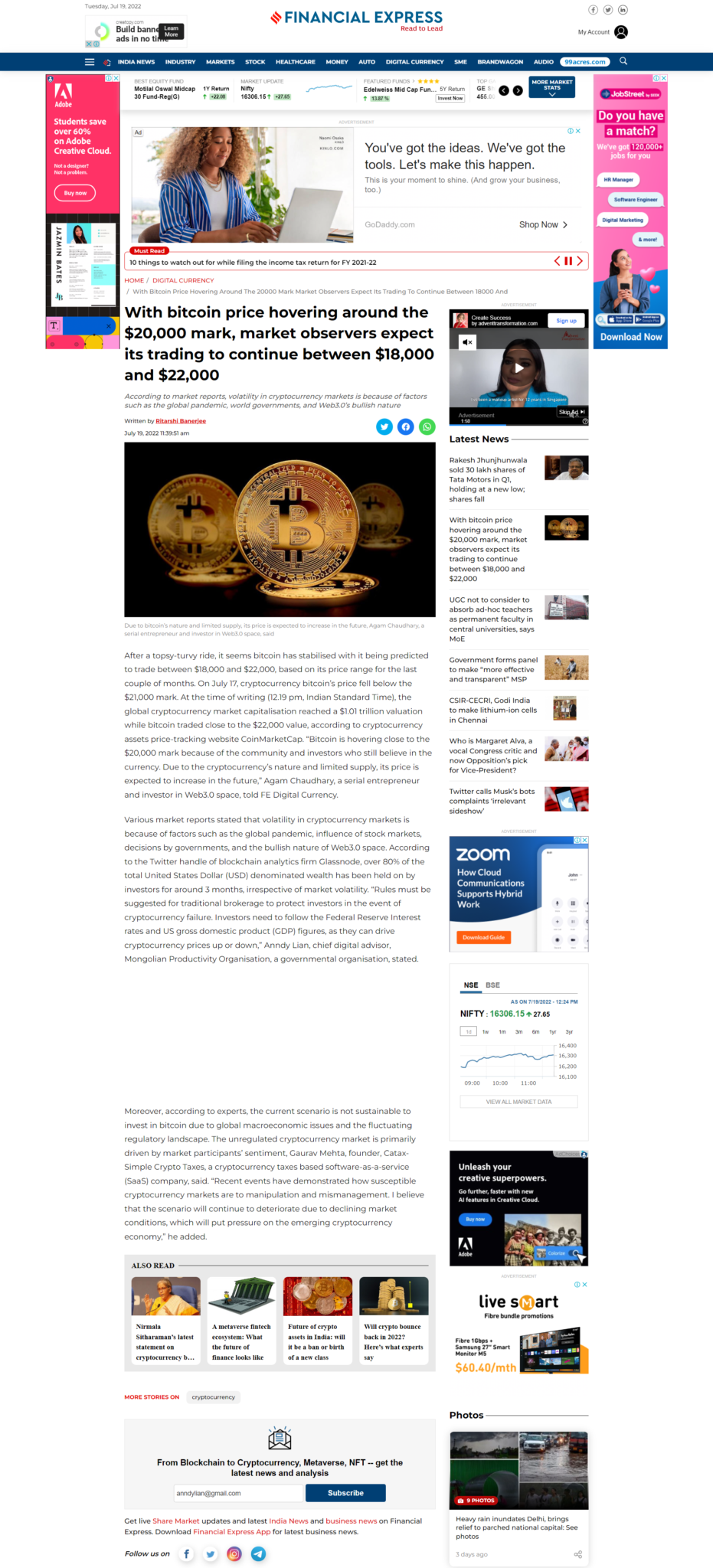
With bitcoin price hovering around the $20,000 mark, market observers expect its trading to continue between $18,000 and $22,000
According to market reports, volatility in cryptocurrency markets is because of factors such as the global pandemic, world governments, and Web3.0’s bullish nature.
After a topsy-turvy ride, it seems bitcoin has stabilised with it being predicted to trade between $18,000 and $22,000, based on its price range for the last couple of months. On July 17, cryptocurrency bitcoin’s price fell below the $21,000 mark. At the time of writing (12.19 pm, Indian Standard Time), the global cryptocurrency market capitalisation reached a $1.01 trillion valuation while bitcoin traded close to the $22,000 value, according to cryptocurrency assets price-tracking website CoinMarketCap. “Bitcoin is hovering close to the $20,000 mark because of the community and investors who still believe in the currency. Due to the cryptocurrency’s nature and limited supply, its price is expected to increase in the future,” Agam Chaudhary, a serial entrepreneur and investor in Web3.0 space, told FE Digital Currency.
Various market reports stated that volatility in cryptocurrency markets is because of factors such as the global pandemic, influence of stock markets, decisions by governments, and the bullish nature of Web3.0 space. According to the Twitter handle of blockchain analytics firm Glassnode, over 80% of the total United States Dollar (USD) denominated wealth has been held on by investors for around 3 months, irrespective of market volatility. “Rules must be suggested for traditional brokerage to protect investors in the event of cryptocurrency failure. Investors need to follow the Federal Reserve Interest rates and US gross domestic product (GDP) figures, as they can drive cryptocurrency prices up or down,” Anndy Lian, chief digital advisor, Mongolian Productivity Organisation, a governmental organisation, stated.
Moreover, according to experts, the current scenario is not sustainable to invest in bitcoin due to global macroeconomic issues and the fluctuating regulatory landscape. The unregulated cryptocurrency market is primarily driven by market participants’ sentiment, Gaurav Mehta, founder, Catax- Simple Crypto Taxes, a cryptocurrency taxes based software-as-a-service (SaaS) company, said. “Recent events have demonstrated how susceptible cryptocurrency markets are to manipulation and mismanagement. I believe that the scenario will continue to deteriorate due to declining market conditions, which will put pressure on the emerging cryptocurrency economy,” he added.
Anndy Lian is an early blockchain adopter and experienced serial entrepreneur who is known for his work in the government sector. He is a best selling book author- “NFT: From Zero to Hero” and “Blockchain Revolution 2030”.
Currently, he is appointed as the Chief Digital Advisor at Mongolia Productivity Organization, championing national digitization. Prior to his current appointments, he was the Chairman of BigONE Exchange, a global top 30 ranked crypto spot exchange and was also the Advisory Board Member for Hyundai DAC, the blockchain arm of South Korea’s largest car manufacturer Hyundai Motor Group. Lian played a pivotal role as the Blockchain Advisor for Asian Productivity Organisation (APO), an intergovernmental organization committed to improving productivity in the Asia-Pacific region.
An avid supporter of incubating start-ups, Anndy has also been a private investor for the past eight years. With a growth investment mindset, Anndy strategically demonstrates this in the companies he chooses to be involved with. He believes that what he is doing through blockchain technology currently will revolutionise and redefine traditional businesses. He also believes that the blockchain industry has to be “redecentralised”.
Anndy Lian is an Inter-Governmental Blockchain Adviser, Book Author, Investor and Board Member.
Anndy Lian is a global thought leader and an all-rounded business strategist with more than 15 years of experience in Asia. He has provided advisory across a variety of industries for local, international & public listed companies. Anndy played a pivotal role in not-for-profit and quasi-government linked organizations. An avid supporter for incubating start-ups, Anndy has investments in a few health-related companies. He believes that what he is doing through Linfinity and blockchain technology currently will revolutionise and redefine traditional businesses.
Anndy Lian Interview focus
1. An introduction from you: education, professional background
2. Asia is one of the most dynamic regions in the world. You have been working in Singapore and South Korea, which are at the forefront of technological development. How do you see this dynamic in the region and especially in these two countries?
3. There is no doubt that governments and organizations need to better understand blockchain and your company is keen to make that vision a reality. Can you tell us more about Linfinity and its mission?
4. Blockchain is one of the fundamental technologies of the 4IR with a lot of potential but we are still in the theoretical stage. Many countries are lagging behind in R&D and there is a lack of awareness about blockchain. Working with governments and businesses, can you share with us your thoughts on what is the general approach to blockchain?
5. You have written ‘Blockchain Revolution 2030’ and very active as a blockchain writer. Can you tell us about your work as an author and how you see blockchain intertwined with traditional industries?
6. Blockchain technology combined with AI is a powerful setup that can create really innovative and interesting solutions for many of our current challenges, such as leveraging trust in technology, digital identity, etc. At the same time, it also raises some concerns in some sectors. including governments and users. How do you see this?
7. Cryptocurrencies are becoming more and more mainstream. Countries are developing CBDCs, there are thousands of different digital currencies, companies use them to raise money through ICOs and, more recently, STOs… How do you see the cryptocurrency industry right now, especially the evolution from ICOs to STOs?
8. From your experience working with governments, advising companies and your knowledge about blockchain and emerging technologies, what would be your advise to governments and companies and what do you expect about the future of blockchain?
Anndy Lian Key Takeaways
· About Anndy Lian’s background and education. I am originally from Singapore but I have spent a great part of my life in working and living in various cities across Asia, including Hong Kong, Taiwan and, especially, Seoul in South Korea. I started my journey in blockchain a few years ago. I joined the government area of blockchain research because of the rising scams and frauds that there were in the blockchain space so I became an advisor to the government. This role and expertise provided me an invaluable insight into the blockchain technology and in management. I was appointed recently to the Hyundai DAC blockchain research branch as an advisor. I am also an investor in different startups and companies building solutions through blockchain technology.
· About working in Asia and the economic development in Singapore, South Korea regarding blockchain. I always wanted to learn more and become an expert in something that would harness the power to change the future and blockchain came about just in the right time so I made myself go out of my comfort zone in Singapore and travel to places where blockchain was trending. When I started in blockchain, I saw a lot of fraud and scams in the blockchain space and I thought it was damaging the technology and its future. I first started as an advisor in the private sector but I soon saw that the only way blockchain can really become widespread is if governments accept it. So that is what drove me to work hand-in-hand with and to advise governments.
· On the governments’ stance on blockchain and Linfinity’s role. Linfinity started in 2017. One thing to note is that even though we are a blockchain-focused company, we never did an ICO or anything like that, not even in the hectic 2018 ICO year where it seemed like it would be the easiest option to get funding. We struggled a bit in the beginning but we didn’t want to do anything that would eventually harm the company.
We have worked with different countries advising them about how to implement functional blockchain platforms and, especially, blockchain technology in supply chain systems. What I learned during that time is that working for governments is much more important than working for the private sector as we can really help a whole country to step up and improve their systems. It is very satisfying to do it. That is ultimately our goal with Linfinity, we want to help the adoption and widespread literacy about blockchain and cryptocurrencies.
· About blockchain adoption and government approach. From a country standpoint, they are talking about the implementation of blockchain solutions in the near future. COVID-19 is actually speeding up research and accelerating the implementation of blockchain-based solutions and that’s really good news, there are positive vibes around the possibilities. I feel like one of my responsibilities is to push the agenda of these countries further and help other countries that are not as receptive to blockchain and change my mind regarding this technology. Fortunately, most of the countries are starting to understand blockchain without cryptocurrencies, as a standalone technology. In fact, if you talk about cryptocurrencies, governments are reluctant to discuss them further due to regulatory hurdles and legacy systems that dominate the financial industry.
Not all countries have the same approach to blockchain and cryptocurrencies. Singapore and South Asia countries, for example, are really keen to research and are more open to implementing blockchain and cryptocurrencies solutions.
· About ‘Blockchain Revolution 2030’ book and your work as an author. Governments, companies and organizations want to be more efficient and there are politicians, which are important for blockchain, that believes that blockchain can do a lot to make legacy systems more efficient, transparent and secured.
Typically, whenever a technology comes up, governments eventually pick up and explore how that technology works and what that technology can do for them and its potentiality. And they have taken that approach with blockchain. I have been approached by governments with these very questions about blockchain. Normally, governments try to see these solutions in place and invite businesses to try them out. The Filipinas example is quite interesting. We were asked by the Filipino government how to implement a blockchain solution to make the export supply chain more efficient as they were losing revenue. We proposed a solution and many businesses from Filipinas step up, attracted by the idea. And I think this is a success story.
· Blockchain technology and AI: Challenges and opportunities. Based on what I see, AI is really going to help our daily lives. There is an ongoing smart city project in which they use AI to improve their citizens’ lives greatly. In fact, AI is the core technology behind the project. I had the chance to talk to the people in charge of the project and I was asking questions about cybersecurity and the right way to implement AI. I was also dropping the benefits of using blockchain in that project because it can actually boost AI with an extra layer of cybersecurity and trust.
One thing I have learned is that blockchain can only do so much, it is the collaboration and combination of different technologies that will change the world.
· How do you see the cryptocurrency industry right now, especially the evolution from ICOs to STOs? I believe that South Korea is a strategic country between Japan, China and the gateway to South Asia. That’s why I think cryptocurrencies took hold there. Today, the main use of cryptocurrencies is trading. There are hundreds of crypto exchanges and there are many traders who make money from cryptocurrencies, speculate on its price and use it as a trading product and I think this will stick with us for the long term. However, I don’t see cryptocurrencies just for their trading capabilities. The regulations will have a major impact on cryptocurrencies, making them a more mature market and helping the industry attract investors and more users. Tokenization is, in fact, much more than trading cryptocurrencies. Companies are already exploring the idea of tokenizing their assets and using tokens to reward employees, investors, and consumers. In short, the cryptocurrency industry will look like a commercial product for a while, but as governments start to take a closer look at it and pass regulations, it will help make the market more mature.
Anndy Lian Biography
Anndy Lian is an Inter-Governmental Blockchain Adviser, Book Author, Investor, Board Member
Anndy Lian is a global thought leader and an all-rounded business strategist with more than 15 years of experience in Asia. He has provided advisory across a variety of industries for local, international & public listed companies. Anndy played a pivotal role in not-for-profit and quasi-government linked organizations. An avid supporter for incubating start-ups, Anndy has investments in a few health-related companies. He believes that what he is doing through Linfinity and blockchain technology currently will revolutionise and redefine traditional businesses.
Anndy Lian is currently the founder and CEO of Linfinity, a company that manages the total supply chain using Blockchain Technology. We establish such a platform with reliable data, transparent information, efficient cooperation and interconnected network to cope with the practical business pain points and development demand of corporate users.
In parallel, Anndy Lian currently serves as the Advisory Board Member for Hdac (Hyundai DAC) Technology, the blockchain arm of South Korea’s largest car manufacturer Hyundai Motor Group. Lian advises the company on the token economy and governance matters.
He is also the author, together with co-authors, Park Young Sook and Shawn Hamnison and published by Kyobo Book Centre, the largest bookstore chain in South Korea, of Blockchain Revolution 2030. Blockchain Revolution 2030 is a comprehensive review of the birth, principles, industrial and institutional issues, status and future of the “blockchain” that will become the foundation technology of the 4th industrial revolution.
Anndy Lian has also been advisory to China-ASEAN Business Alliance (CABA), engaging with government leaders and policymakers of various countries through roundtables and policy briefings and offer views and recommendations on behalf of its members on trade and economic issues/policies affecting them especially on the ASEAN–China Free Trade Area as well as other schemes under the ASEAN-China dialogue relations and ASEAN Economic Community.
Prior to that, he was the Council Head, South East Asia at Korea Horse Industry Council, a subsidiary of the Ministry of Agriculture, Forestry and Fisheries of the Republic of Korea. This department’s aim was to presentee the right policy directions and alternatives for nurturing and supporting the horse industry. It was established on November 28, 2011, to promote the balanced development of the economy and enhance the quality of life of the people by establishing the development base of the horse industry and strengthening its competitiveness.
Anndy Lian is an early blockchain adopter and experienced serial entrepreneur who is known for his work in the government sector. He is a best selling book author- “NFT: From Zero to Hero” and “Blockchain Revolution 2030”.
Currently, he is appointed as the Chief Digital Advisor at Mongolia Productivity Organization, championing national digitization. Prior to his current appointments, he was the Chairman of BigONE Exchange, a global top 30 ranked crypto spot exchange and was also the Advisory Board Member for Hyundai DAC, the blockchain arm of South Korea’s largest car manufacturer Hyundai Motor Group. Lian played a pivotal role as the Blockchain Advisor for Asian Productivity Organisation (APO), an intergovernmental organization committed to improving productivity in the Asia-Pacific region.
An avid supporter of incubating start-ups, Anndy has also been a private investor for the past eight years. With a growth investment mindset, Anndy strategically demonstrates this in the companies he chooses to be involved with. He believes that what he is doing through blockchain technology currently will revolutionise and redefine traditional businesses. He also believes that the blockchain industry has to be “redecentralised”.