TMRW Dubai: Ready for the new world – beyond financial freedom?

TMRW Dubai: Ready for the new world – beyond financial freedom?

Digital assets are here to stay, and their future is brighter than ever. But the world of crypto, NFT, and Metaverse is updating very rapidly, and there is a constant need to satisfy the passionate curiosity that crypto enthusiasts are known for. Although located and connected in the virtual and digital world, it is very important to bring the community together in person.

In 2022, the TMRW conference was one of the first that was held offline after the pandemic. Following the major debut success in Belgrade (Serbia), with 21,000 in-person and online participants from 100 countries, more than 50 speakers, and 250 crypto-related companies, the TMRW conference is ready to conquer the Middle east!

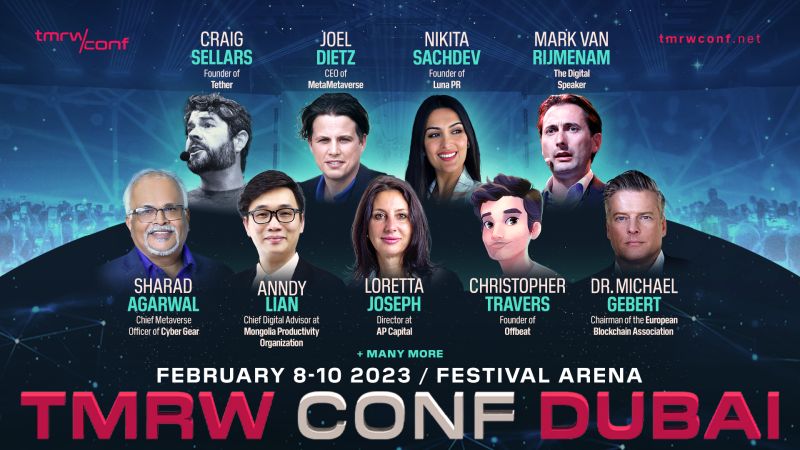
According to the organizers, from February 8-10, the world’s greatest crypto and NFT minds will gather at Dubai Festival City to consider all aspects of blockchain and cryptocurrencies and find out more about the future of digital currency.
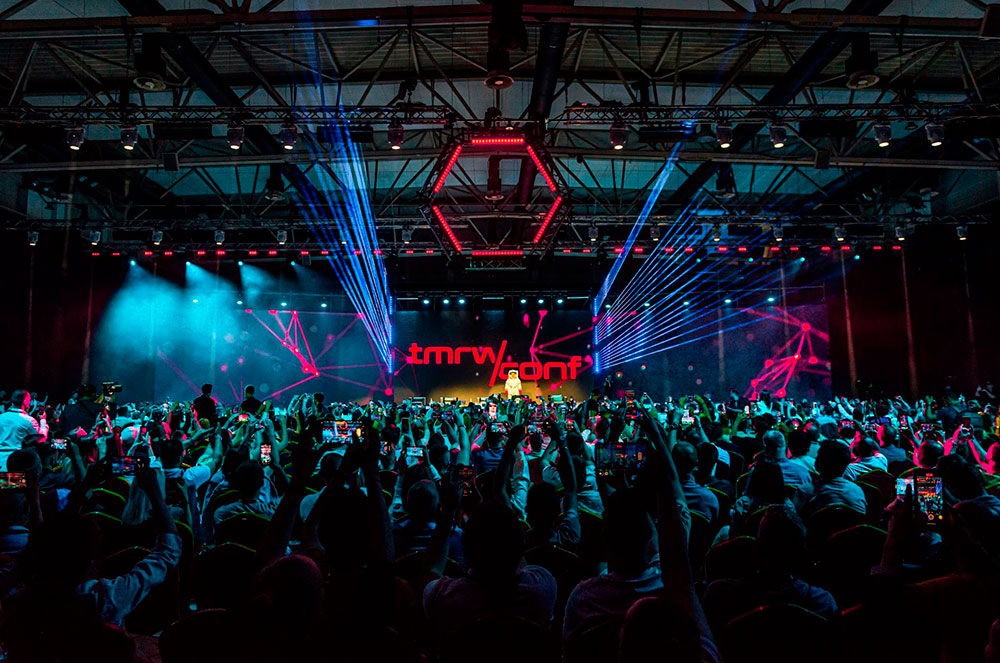
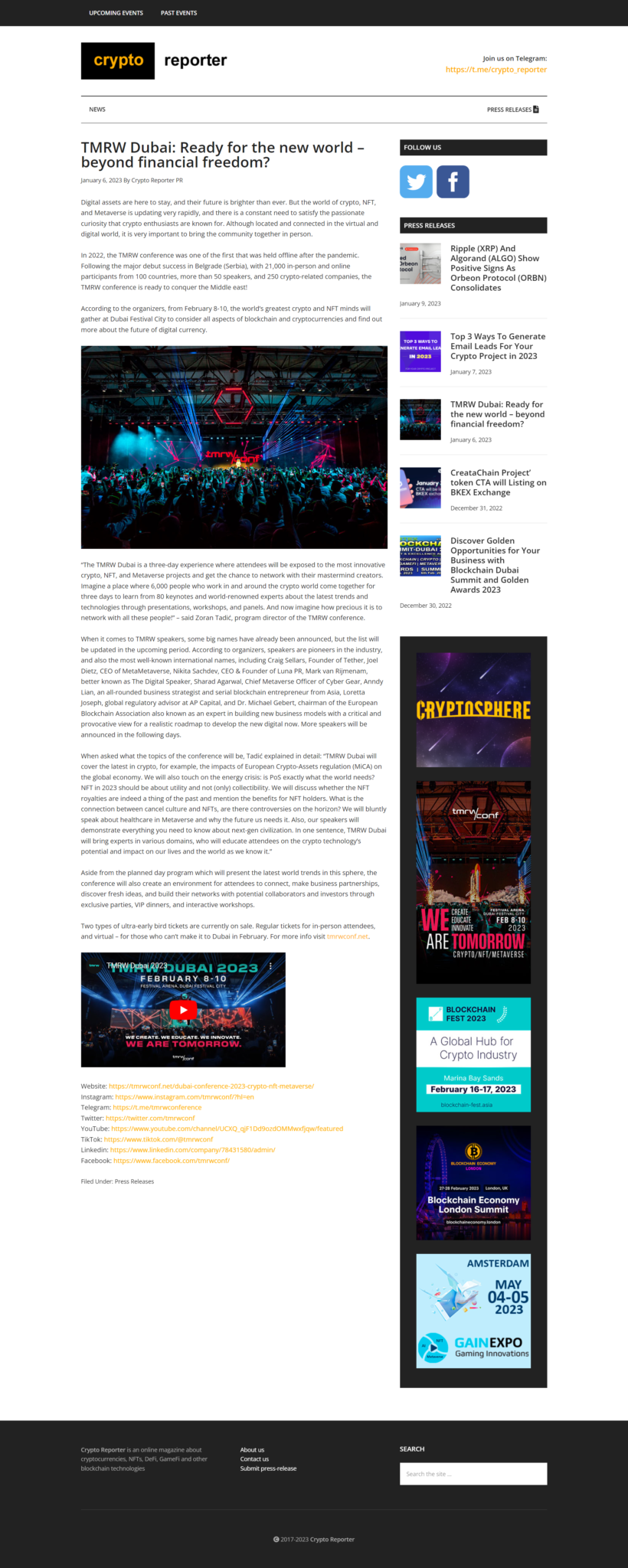
“The TMRW Dubai is a three-day experience where attendees will be exposed to the most innovative crypto, NFT, and Metaverse projects and get the chance to network with their mastermind creators. Imagine a place where 6,000 people who work in and around the crypto world come together for three days to learn from 80 keynotes and world-renowned experts about the latest trends and technologies through presentations, workshops, and panels. And now imagine how precious it is to network with all these people!” – said Zoran Tadić, program director of the TMRW conference.

When it comes to TMRW speakers, some big names have already been announced, but the list will be updated in the upcoming period. According to organizers, speakers are pioneers in the industry, and also the most well-known international names, including Craig Sellars, Founder of Tether, Joel Dietz, CEO of MetaMetaverse, Nikita Sachdev, CEO & Founder of Luna PR, Mark van Rijmenam, better known as The Digital Speaker, Sharad Agarwal, Chief Metaverse Officer of Cyber Gear, Anndy Lian, an all-rounded business strategist and serial blockchain entrepreneur from Asia, Loretta Joseph, global regulatory advisor at AP Capital, and Dr. Michael Gebert, chairman of the European Blockchain Association also known as an expert in building new business models with a critical and provocative view for a realistic roadmap to develop the new digital now. More speakers will be announced in the following days.

When asked what the topics of the conference will be, Tadić explained in detail: “TMRW Dubai will cover the latest in crypto, for example, the impacts of European Crypto-Assets regulation (MiCA) on the global economy. We will also touch on the energy crisis: is PoS exactly what the world needs? NFT in 2023 should be about utility and not (only) collectibility. We will discuss whether the NFT royalties are indeed a thing of the past and mention the benefits for NFT holders. What is the connection between cancel culture and NFTs, are there controversies on the horizon? We will bluntly speak about healthcare in Metaverse and why the future us needs it. Also, our speakers will demonstrate everything you need to know about next-gen civilization. In one sentence, TMRW Dubai will bring experts in various domains, who will educate attendees on the crypto technology’s potential and impact on our lives and the world as we know it.”

Aside from the planned day program which will present the latest world trends in this sphere, the conference will also create an environment for attendees to connect, make business partnerships, discover fresh ideas, and build their networks with potential collaborators and investors through exclusive parties, VIP dinners, and interactive workshops.

Two types of ultra-early bird tickets are currently on sale. Regular tickets for in-person attendees, and virtual – for those who can’t make it to Dubai in February. For more info visit tmrwconf.net.

Website: https://tmrwconf.net/dubai-conference-2023-crypto-nft-metaverse/
Instagram: https://www.instagram.com/tmrwconf/?hl=en
Telegram: https://t.me/tmrwconference
Twitter: https://twitter.com/tmrwconf
YouTube: https://www.youtube.com/channel/UCXQ_qjF1Dd9ozdOMMwxfjqw/featured
TikTok: https://www.tiktok.com/@tmrwconf
Linkedin: https://www.linkedin.com/company/78431580/admin/
Facebook: https://www.facebook.com/tmrwconf/


Source: https://www.crypto-reporter.com/press-releases/tmrw-dubai-ready-for-the-new-world-beyond-financial-freedom-40735/

Anndy Lian is an early blockchain adopter and experienced serial entrepreneur who is known for his work in the government sector. He is a best selling book author- “NFT: From Zero to Hero” and “Blockchain Revolution 2030”.

Currently, he is appointed as the Chief Digital Advisor at Mongolia Productivity Organization, championing national digitization. Prior to his current appointments, he was the Chairman of BigONE Exchange, a global top 30 ranked crypto spot exchange and was also the Advisory Board Member for Hyundai DAC, the blockchain arm of South Korea’s largest car manufacturer Hyundai Motor Group. Lian played a pivotal role as the Blockchain Advisor for Asian Productivity Organisation (APO), an intergovernmental organization committed to improving productivity in the Asia-Pacific region.

An avid supporter of incubating start-ups, Anndy has also been a private investor for the past eight years. With a growth investment mindset, Anndy strategically demonstrates this in the companies he chooses to be involved with. He believes that what he is doing through blockchain technology currently will revolutionise and redefine traditional businesses. He also believes that the blockchain industry has to be “redecentralised”.
j j j

Global Cloud Native & Opensource Summit: What you need to know in 2022 & Beyond

Global Cloud Native & Opensource Summit: What you need to know in 2022 & Beyond

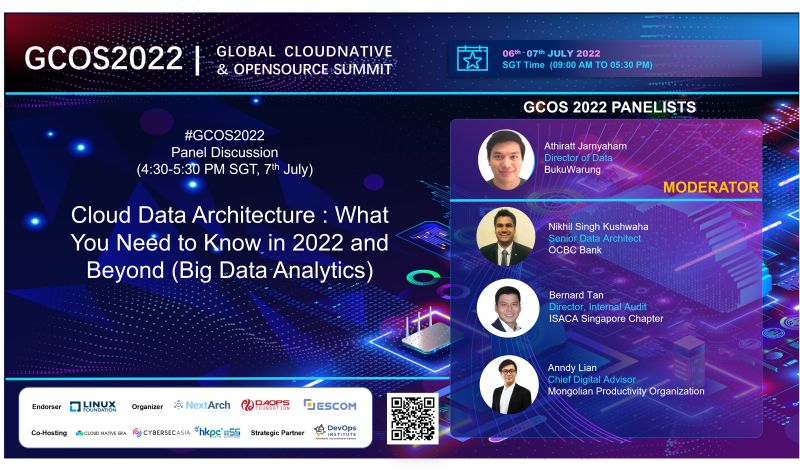
Cloud Data Architecture: What You Need to Know in 2022 and Beyond (Big Data Analytics) talks about cloud solutions, cloud analytics, decentralized storage, data democratization, and more.

Key takeaway pointers:

1) Cloud analytics is often associated with artificial intelligence (AI), machine learning (ML), and deep learning (DL). And it is commonly used in industry applications

2) Democratize advanced technology by allowing your employees to work efficiently within their current knowledge. With innovative technology, there is a learning curve that developers/technicians need to go through to make the most of that technology.

3) Decentralized storage works on a reasonably democratic concept where data storage is not concentrated in the hands of a few tech giants. Instead, it is a peer-to-peer cloud storage solution with ordinary users or miners managing the system. Users rent out free disk space on their drives and are incentivized with tokens in return for their contribution.

4) Cloud adoption is a strategy used by enterprises to improve the scalability of Internet-based database capabilities while reducing cost and risk. To achieve this, businesses engage in the practice of cloud computing or using remote servers hosted on the Internet to store, manage, and process critical data.

5) Distributed cloud will support expanded service availability. By 2023, the leading cloud service providers will have a distributed ATM-like presence to serve a subset of their services for low-latency application requirements. Many cloud service providers are already investing in ways to make their services available closer to the users that need to access them.

Moderator:
Athiratt Jarnyaharn, Director of Data at BukuWarung

Panelist:
Nikhil Singh Kushwaha, Senior Data Architect at OCBC Bank
Bernard Tan, Director, Internal Audit at ISACA Singapore Chapter
Anndy Lian, Chief Digital Advisor at Mongolian Productivity Organization

Global Cloud Native & Open Source Summit 2022 focuses on a full range of cloud-native & open source technologies and is committed to defining the standard of the next generation of software engineering.


Anndy Lian is an early blockchain adopter and experienced serial entrepreneur who is known for his work in the government sector. He is a best selling book author- “NFT: From Zero to Hero” and “Blockchain Revolution 2030”.

Currently, he is appointed as the Chief Digital Advisor at Mongolia Productivity Organization, championing national digitization. Prior to his current appointments, he was the Chairman of BigONE Exchange, a global top 30 ranked crypto spot exchange and was also the Advisory Board Member for Hyundai DAC, the blockchain arm of South Korea’s largest car manufacturer Hyundai Motor Group. Lian played a pivotal role as the Blockchain Advisor for Asian Productivity Organisation (APO), an intergovernmental organization committed to improving productivity in the Asia-Pacific region.

An avid supporter of incubating start-ups, Anndy has also been a private investor for the past eight years. With a growth investment mindset, Anndy strategically demonstrates this in the companies he chooses to be involved with. He believes that what he is doing through blockchain technology currently will revolutionise and redefine traditional businesses. He also believes that the blockchain industry has to be “redecentralised”.

j j j

Why True Decentralization Is Missing? – Redecentralization Needed To Go Beyond Web3 to Web4

Why True Decentralization Is Missing? – Redecentralization Needed To Go Beyond Web3 to Web4
In 2019, I began to speak publicly about a concept I called re-decentralization. At the time, the narrative was already drifting. The cypherpunk ethos was being co-opted by a libertarian fervor that misunderstood the assignment. I argued then, as I do now, that the mission of Web3 was never about removing the government or abolishing banks out of spite. It was not an exercise in anarchy. Rather, it was about building a decentralized crypto ecosystem that could serve as the future of finance. This system would rely on mathematical trust instead of institutional trust.
The goal was to create a parallel financial infrastructure that was more efficient, transparent, and accessible than the legacy system. We wanted to build a better mousetrap, not burn down the house. Many people misunderstood this distinction. They thought decentralization meant eliminating all oversight. My view was that we needed a system that could operate alongside traditional finance while offering superior technology. We needed rails that allowed value to move as freely as information moves on the internet. This vision required true decentralization at the protocol level. It required that no single entity could halt transactions or seize funds without consensus.
As the years progressed and I moved from observing the space to actively investing in it, a disturbing pattern emerged. The promise was beginning to fray. I began to realize that Web3, in its current iteration, is not truly decentralized. In fact, much of it is a sophisticated mirage. My realization did not come from reading whitepapers or listening to keynote speeches. It came from the trenches of due diligence. When you invest capital in a project, you gain a level of visibility that the average retail user never sees. You get to look under the hood. What I found was that most projects were merely pretending to be decentralized.
They used the aesthetics of Web3, including tokens, DAOs, and governance portals. The control structures remained stubbornly Web2. I saw smart contracts with admin keys held by a single founder. I saw treasury funds controlled by multisig wallets, with all signers being employees of the same venture capital firm. I saw community governance where the voting power was so concentrated among early insiders that the average token holder’s vote was mathematically irrelevant. This was decentralization theater. It was a performance designed to attract liquidity and hype without ceding actual power.
The infrastructure was built on public blockchains, yes. The switches that controlled the flow of value were held in private hands. This centralization creates single points of failure. It invites regulatory crackdowns because there is always a human to subpoena. It defeats the purpose of censorship resistance. If a small group of humans can pause the contract, blacklist an address, or change the tokenomics overnight, the system is not trustless. It is simply a digital bank with a worse user interface and higher volatility. This defeats the technology’s original purpose. We built these systems to remove intermediaries, not to create new ones with better marketing.
As I analyzed why this centralization persisted, I identified the root cause. It was not just greed or malice. It was a structural limitation. The human element is stopping how we can grow in this DeFi space. Humans are the bottleneck. In the current DeFi model, humans are required to make almost every critical decision. Humans set the interest rates. Humans decide which collateral is acceptable. Humans vote on governance proposals. Humans monitor the protocols for exploits. This reliance on human intervention introduces latency, emotion, and corruption into a system that was designed to be objective.
Human governance is slow. By the time a DAO votes on a parameter change to mitigate a risk, the market has often already moved. Human decision-making is emotional. Panic selling or FOMO-driven investment strategies destabilize protocols. Furthermore, human governance is susceptible to social engineering and bribery. We have seen countless instances of whales accumulating governance tokens to push through proposals that drain treasuries. As long as humans are the brain of the operation, the system will remain centralized. Humans naturally congregate power. We form committees, we elect leaders, and we create hierarchies. This is antithetical to the concept of a decentralized web.
To achieve the vision, we must remove the human from the decision-making loop, not just the settlement layer. We need a system that thinks faster than a human, acts more objectively than a human, and cannot be bribed. This realization led me to a new conclusion. The evolution of the internet and finance cannot stop at Web3. Web3 provided the ledger, but it lacks the intelligence to manage it autonomously. This is why I term the next phase Web4.
The definition of Web4 is distinct. If Web3 is the decentralized web of ownership, Web4 is the decentralized web of intelligence. In this paradigm, Artificial Intelligence serves as the brain, and the Blockchain serves as the verifier. This symbiosis solves the centralization dilemma. AI agents, unlike humans, can monitor markets 24/7 without fatigue. They can adjust liquidity pools, rebalance collateral, and execute trades in milliseconds based on complex datasets that no human could process in real time. An AI-driven DeFi protocol could autonomously optimize yield strategies. It would react to on-chain data and off-chain oracle inputs instantly. This removes the emotional and slow nature of human management.
AI alone presents its own risks. An AI is a black box. If an AI makes a decision that drains a fund, how do we know it was not malicious? How do we trust the code running the mind? This is where the blockchain becomes critical. In Web4, the blockchain does not necessarily execute the complex logic. That is too expensive and slow for current chains. Instead, the blockchain verifies the outcome. The AI operates off-chain or on layer-two solutions to perform heavy computation. It then submits proof of its actions to the main blockchain. The smart contract verifies that the AI’s actions comply with the protocol’s pre-agreed rules before settling the transaction. The blockchain acts as the immutable truth layer. It ensures that the AI, the brain, did not hallucinate or deviate from its mandate.
This architecture allows for true re-decentralization. We no longer need a human council to vote on every parameter change. The AI adjusts parameters based on algorithmic stability targets, and the blockchain records the change immutably. We no longer need a centralized risk committee to approve collateral. The AI assesses the risk profile of assets in real-time, and the blockchain secures the custody. This is not about creating a rogue AI that controls the world money. It is about creating autonomous economic agents that operate within the strict, trustless confines of cryptographic verification. The rules are coded on-chain. The execution is handled by AI.
When I started talking about re-decentralization, I envisioned a future where finance was open and permissionless. We are closer than ever, but we hit a wall. That wall was human nature. We tried to build decentralized systems, then handed the keys to centralized groups. It was a contradiction that could not hold. Web4 resolves this contradiction. By delegating cognitive load to AI and trust load to the blockchain, we create a truly autonomous system. It is a system that does not sleep, does not feel fear, and cannot be coerced. It fulfills the original promise of the crypto movement. The aim was not to destroy the existing financial order. The aim was to build a superior one that renders the old inefficiencies obsolete.
The journey from 2019 to today has been one of disillusionment, but also of clarity. We stripped away the hype and found the structural flaws. Now, we have the blueprint to fix them. The future of finance is not just decentralized. It is intelligent. It is Web4. This shift represents the industry’s maturation. We are moving from speculative assets to functional utility. We are moving from human error to algorithmic precision. The banks and governments will remain, but their role will change. They will interact with these new protocols rather than control them. The interoperability between legacy finance and Web4 will define the next decade.
We must remain vigilant against centralization creep. Every time a project introduces a human admin key, it introduces risk. Every time a governance vote is dominated by insiders, it reduces security. The path forward requires strict adherence to code-based law. It requires us to trust math over men. It requires us to trust verification over reputation. This is the only way to build a system that lasts. The technology is ready. The AI models are capable. The blockchains are secure. The only missing piece was the integration of these two powerful forces. Web4 brings them together. 

Anndy Lian is an early blockchain adopter and experienced serial entrepreneur who is known for his work in the government sector. He is a best selling book author- “NFT: From Zero to Hero” and “Blockchain Revolution 2030”.

Currently, he is appointed as the Chief Digital Advisor at Mongolia Productivity Organization, championing national digitization. Prior to his current appointments, he was the Chairman of BigONE Exchange, a global top 30 ranked crypto spot exchange and was also the Advisory Board Member for Hyundai DAC, the blockchain arm of South Korea’s largest car manufacturer Hyundai Motor Group. Lian played a pivotal role as the Blockchain Advisor for Asian Productivity Organisation (APO), an intergovernmental organization committed to improving productivity in the Asia-Pacific region.

An avid supporter of incubating start-ups, Anndy has also been a private investor for the past eight years. With a growth investment mindset, Anndy strategically demonstrates this in the companies he chooses to be involved with. He believes that what he is doing through blockchain technology currently will revolutionise and redefine traditional businesses. He also believes that the blockchain industry has to be “redecentralised”.

j j j