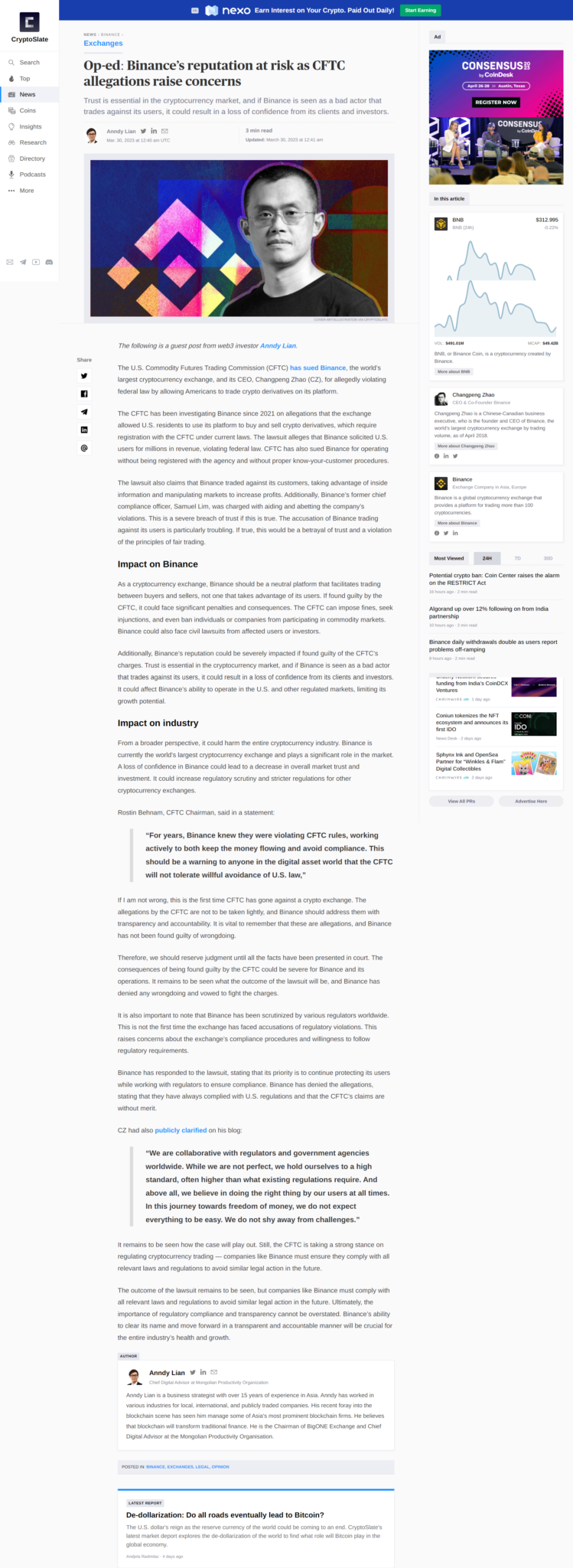
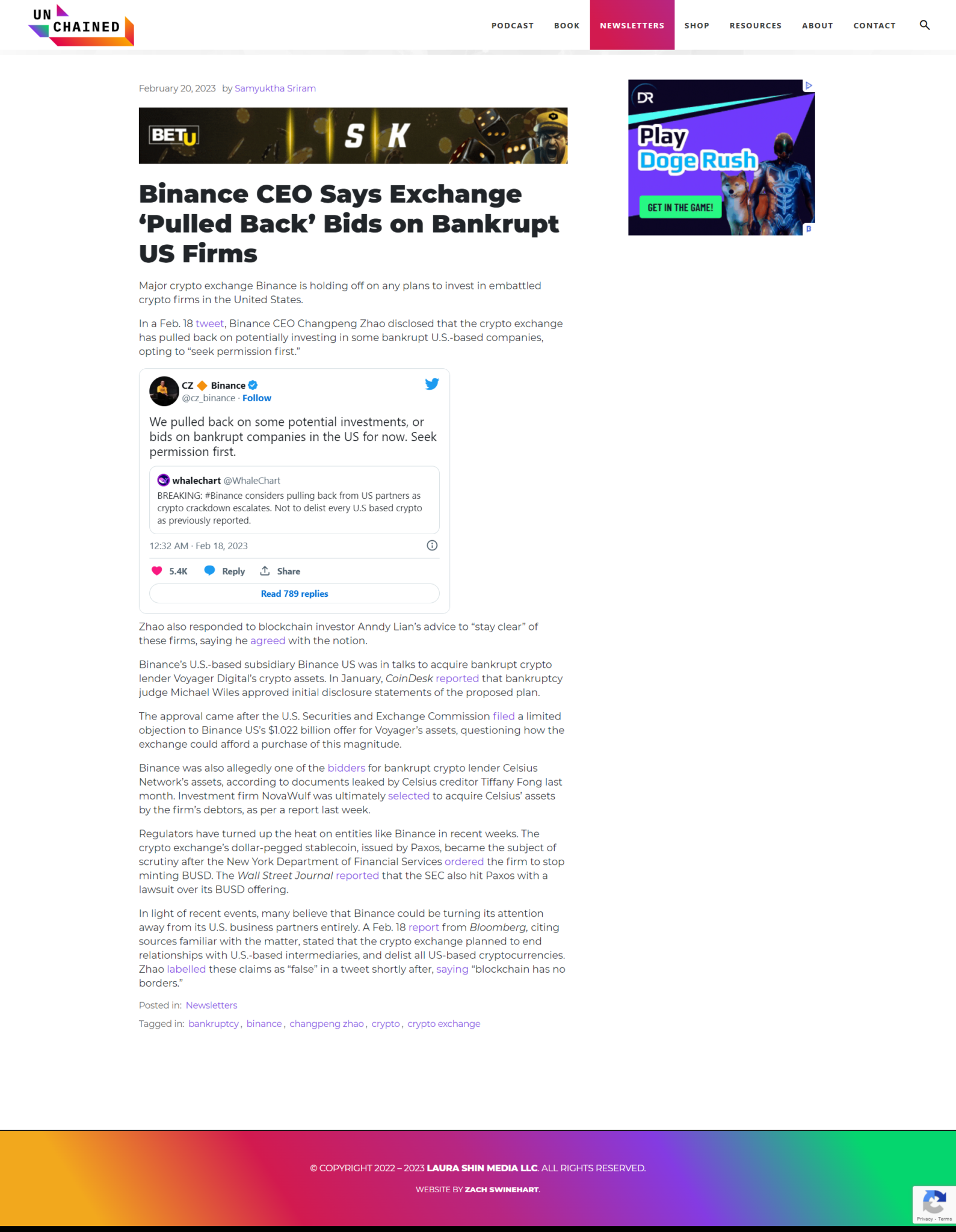
The lawsuit against Binance and its CEO yesterday (Monday) has brought havoc to the cryptocurrency industry. The market prices of Bitcoin and also the publicly listed shares of crypto companies plummeted significantly. The civil changes brought by the SEC are very serious, but the exchange might face further action.
SEC’s Lawsuit against Binance
The SEC brought a total of 13 charges against Binance, its two affiliates, and Founder CEO, Changping Zhao, which includes operating illegal trading platforms, offering unregistered crypto asset securities, and commingling customers’ funds.
However, a part of the industry is not surprised by the actions of the US regulator against the largest global crypto exchange, a title that Binance has been holding for a while now.
“I think this was to be expected, and anyone that has been in the financial industry for years should have seen this coming,” Ilies Larbi, the Co-Founder and CEO at Ouinex, told Finance Magnates.
In an official response, Binance complained that the SEC abandoned negotiations with the exchange to reach a “settlement to resolve their investigations.” Earlier, the SEC settled with companies like BlockFi and Poloniex for hefty fines.
However, according to Anndy Lian, an expert and advisor on blockchain, Binance still has some options.
“In general, companies facing lawsuits from regulatory agencies such as the SEC have several options. They can choose to fight the lawsuit in court, which can be a lengthy and costly process. Alternatively, they can try to negotiate a settlement with the SEC, which may involve paying a fine and agreeing to certain conditions. Binance may also choose to cooperate with the SEC and provide information to help resolve the matter,” he told Finance Magnates.
“Zhao’s stand has always been cooperative. Being the leading crypto exchange, their next step means a lot to the whole industry.”
Are Criminal Charges on the Way?
“The charges are extremely serious, and the mere fact that the settlement route has been ignored by the SEC (despite Binance’s efforts) while requesting from the Department of Justice that Binance’s asset be frozen and repatriated is a testament to how serious the situation is,” Larbi added.
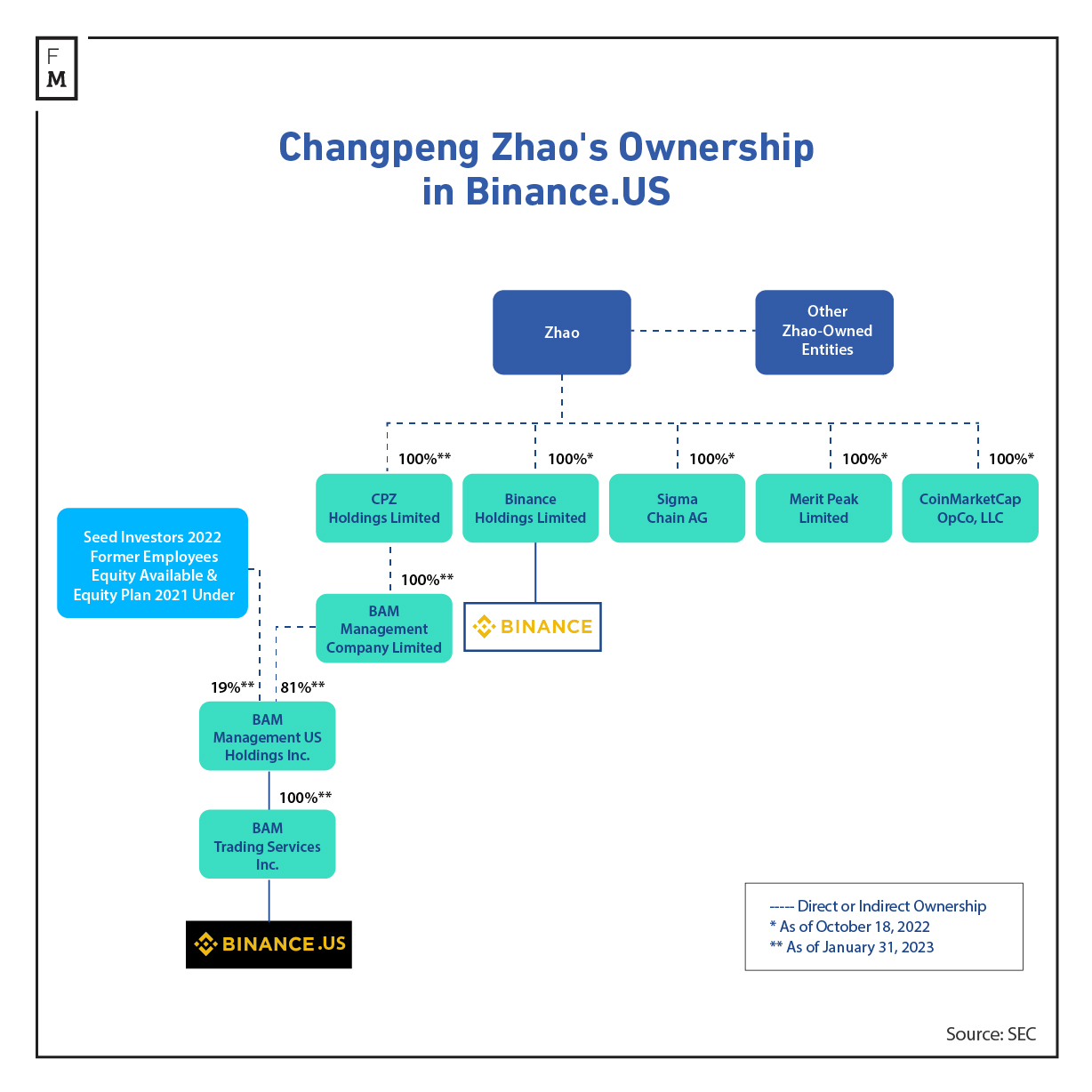
Like FTX, Zhao and Binance’s access to Binance.com and Binance.US gave them the opportunity to commingle customer assets or divert them to Sigma Chain, the market maker and trading firm said to be owned and controlled by Zhao. In addition, they allegedly merged ‘billions of dollars of investor assets’ and sent them to Merit Peak Limited, which is also owned by the Binance Founder. These funds were later subsequently transferred to a third party “apparently in connection with the purchase and sale of crypto assets,” the SEC added.
“The Commission respectfully requests that the Court order temporary and preliminary injunctive relief, including, but not limited to, asset freezes, a verified accounting, repatriation of assets, expedited discovery, preservation of documents and information, prohibition on the destruction of evidence, the appointment of a receiver, alternative service, and/or any other necessary equitable relief,” the lawsuit stated.
Earlier media reports revealed that the Department of Justice was investigating Binance’s failure to implement an anti-money laundering program. Moreover, the exchange faces US investigations for allowing services to Russians, thus breaching sanctions.
“While the SEC has filed a civil action, it is likely that criminal violations have been referred to the Department of Justice as it pertains to matters such as RICO violations, Russian Sanctions violations, fraud, etc,” said Larbi.
In a separate civil lawsuit against Binance, the US derivatives market regulator called the compliance measures of Binance a “sham.” The CFTC’s lawsuit against Binance is along the same lines as its securities market counterpart.
“US regulators are taking a more firm stance towards Binance and are working to enforce compliance with US securities laws,” Lian added. “On the other hand, when I spoke to my counterparts in US who are mainly professional investors, they are supportive of Binance and see them as a force that could challenge SEC and give people more choices to take control of their own money.”
More Incoming Regulatory Actions?
Binance operates on a global scale. While the exchange has obtained several regulatory licenses over the past couple of years, it has operated in many jurisdictions without permission for years.
Now, the SEC’s action might encourage other global regulators to take action against the exchange.
“Many regulators across the globe will look to the US for direction on this, and we are slowly seeing many regulators across the globe following this trend,” said Remonda Kirketerp-Møller, the Founder and CEO at Muinmos. “At the end of the day, it’s about investor protection, and the US does this very well.”
Recently, the Australian financial market regulator revoked the license of Binance Derivatives.
The Goal of Binance
Zhao, a Canadian national of Chinese origin, established Binance in 2017. In its early days, the exchange operated without a license, and Zhao publicly boasted that it had no headquarters.
On top of that, the lawsuit mentioned earlier internal statements from top Binance executives, including Zhao, indicating the goal of the exchange is to avoid regulations.
Zhao allegedly designed and implemented a multi-step plan to surreptitiously evade US laws. A Binance Chief Compliance Officer even admitted that: “we do not want [Binance].com to be regulated ever.”
In the early days of Binance, Zhao publicly boasted his ambitions to facilitate crypto trading with every fiat available globally. However, the US market has always been tricky with its stringent regulatory oversight, which led to the launch of its separate US affiliate.
The Binance CCO explained: “[o]n the surface we cannot be seen to have US users[,] but in reality, we should get them through other creative means.” Moreover, Zhao stated that the “goal” was “to reduce the losses to ourselves, and at the same time to make the US regulatory authorities not trouble us.”
BAM Trading officially operates Binance.US without Zhao in any of its executive roles. It is touted to be operationally independent of the global exchange, Binance.com. However, the reality is different.
The SEC found that Zhao and Binance were intimately involved in directing BAM Trading’s US business operations and providing and maintaining the crypto asset services of the US affiliate.
BAM Trading employees referred to the controls of Zhao and Binance on the company as “shackles” that prevented them from understanding and freely operating the US platform. A former CEO of BAM Trading even told Binance’s CFO that her “entire team feels like [it had] been duped into being a puppet.”
Indirectly, Zhao holds majority ownership of Binance.US, which operates in the US with money-transmitting licenses.
“Whether Binance fights this in court or not is irrelevant at this stage,” Larbi added. “The consequences are going to be, at best, being banned from the USA with fines that mirror Binance’s size.”
“We are only starting to see the tip of the iceberg, and mid-term consequences could go as far as the closure of the Binance operations globally. At the very least extreme consolidation of their operations and reduction in size.”
Gold-i’s Tom Higgins believes the lawsuit will “end Binance US eventually but will not have as much impact on Binance globally.”
The Fall of a Mammoth?
Binance’s strategy worked for years as the exchange became the largest globally in terms of crypto trading volume. The peak of its dominance hit last February when it controlled 57.5 percent of the average monthly volume on the world’s crypto exchanges, according to CCData. However, by the end of April, it dropped to 43 percent.

“Crypto, in general, started as a completely unregulated activity which led first movers such as Binance to onboard clients initially with barely a name and an email. That already set the scene for extreme risk exposure once regulations kicked in. Now the reality is that Binance has not been getting away with these violations. Investigations take time, and this one has been going on for over four years now,” Larbi said.
The Crypto Industry Is Taking the Heat
Though on the surface, the lawsuit is only against Binance, it directly or indirectly hinted at actions against other crypto projects.
One of the major allegations of the SEC against Binance and its US affiliate is for offering and selling unregistered tokens and stablecoin, BNB and BUSD, respectively, to US customers. However, the lawsuit categorized ten other cryptocurrencies as unregistered securities – Solana’s SOL, Cardano’s ADA, Polygon’s MATIC, Filecoin’s FIL, Cosmos’ ATOM, Sandbox’s SAND, Decentraland’s MANA, Algorand’s ALGO, Axie Infinity’s AXS and Coti’s COTI tokens.
With these new additions, the SEC is now categorizing 61 cryptocurrencies in total as unregistered securities. The regulator is already fighting a long-running legal battle with Ripple on the status of XRP.
The SEC’s lawsuit against Binance came after the exchange was hit with a Wells Notice seeking clarification for its alleged lapses. Another crypto exchange that was served with the Wells Notice is Coinbase.
“We observe that several of the details of the lawsuit that the commission filed against Binance echo those it previously filed against crypto exchanges Bittrex and Kraken, and we believe these cases, in aggregate, represent a preview of the action that is likely to be filed against COIN,” Berenberg’s analyst, Mark Palmer wrote in a note.
Furthermore, Coinbase admitted that it is expecting enforcement action following the Wells Notice. The American exchange is fighting a legal battle with the SEC over its regulatory decision-making processes.
The share price of Coinbase dropped 10 percent following the announcement of the lawsuit against Binance.
“Any large exchange that performs all of the trading functions in one place is in danger,” Higgins added. “The traditional finance world separates responsibilities like execution, prime broking, and custody for good reasons. Big crypto exchanges want to own it all, and this will not fly in the long term.”
The Market Reaction
The SEC’s formal allegations against Binance triggered its users to withdraw funds. According to Data from Nansen.ai, Binance and its US affiliate endured about $790 million in net outflows in the past 24 hours, which is the highest since mid-March.
However, Seoul-based crypto analytics firm CryptoQuant pointed out that the outflows remain within historical norms.
“The Crypto market is only now entering its regulated era,” Kirketerp-Møller added. “Crypto firms will have to adjust and “change their mindset,” if you like, from an industry operating at the peripherals of the financial sector to now occupying its main avenue, and as such also very much in the “regulators’ eye.” A similar process happened in recent years in CFDs; for example – we see a lot of online investment firms adopting our mPASS™ solution, which automatically classifies investors and performs cross-border suitability and appropriateness checks. In the past, only a handful of firms applied mPASS™, seeing it as a “luxury”; now it’s the standard and the only way to protect both investors and secure compliance of the institution.”
Itai Sadeh, the CEO of iFOR Fintech the technology arm of the iFOREX Group, said: “The complaint brought by the SEC against Binance, its controlling shareholder Changpeng Zhao and other companies under Zhao’s control, proves the importance of having well structured and strong compliance procedures and functions, which includes robust KYC procedures. US regulations are very strict on the ability of offshore brokers to accept US clients and regulators in the US are swift in enforcing such restrictions. Companies who are not licensed in the US should implement both technological and human measures in order to verify that US clients cannot access overseas trading platforms and that KYC processes are in place to detect and block any US client who manages to circumvent such restrictions.”
“If the SEC allegations that Binance has intentionally allowed US clients to onboard onto Binance’s unregulated platform are proven to be true, Binance and Zhao may face severe consequences.”


Anndy Lian is an early blockchain adopter and experienced serial entrepreneur who is known for his work in the government sector. He is a best selling book author- “NFT: From Zero to Hero” and “Blockchain Revolution 2030”.
Currently, he is appointed as the Chief Digital Advisor at Mongolia Productivity Organization, championing national digitization. Prior to his current appointments, he was the Chairman of BigONE Exchange, a global top 30 ranked crypto spot exchange and was also the Advisory Board Member for Hyundai DAC, the blockchain arm of South Korea’s largest car manufacturer Hyundai Motor Group. Lian played a pivotal role as the Blockchain Advisor for Asian Productivity Organisation (APO), an intergovernmental organization committed to improving productivity in the Asia-Pacific region.
An avid supporter of incubating start-ups, Anndy has also been a private investor for the past eight years. With a growth investment mindset, Anndy strategically demonstrates this in the companies he chooses to be involved with. He believes that what he is doing through blockchain technology currently will revolutionise and redefine traditional businesses. He also believes that the blockchain industry has to be “redecentralised”.