Bitget Restarts Bitcoin Withdrawals After Hacker Uses Thorchain

Bitget Restarts Bitcoin Withdrawals After Hacker Uses Thorchain

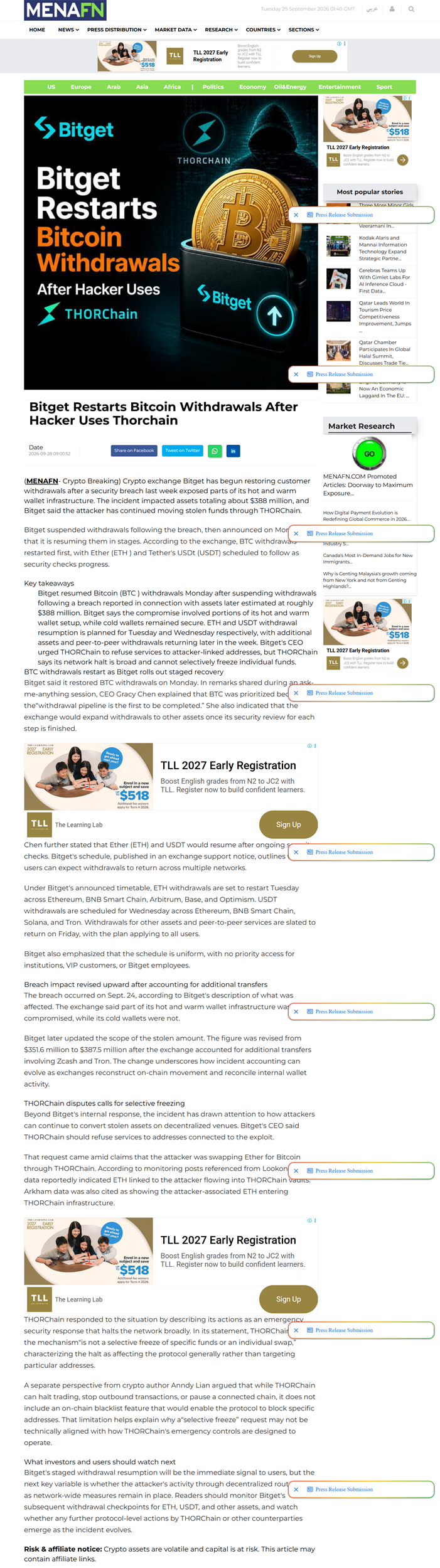
(MENAFN– Crypto Breaking) Crypto exchange Bitget has begun restoring customer withdrawals after a security breach last week exposed parts of its hot and warm wallet infrastructure. The incident impacted assets totaling about $388 million, and Bitget said the attacker has continued moving stolen funds through THORChain.

Bitget suspended withdrawals following the breach, then announced on Monday that it is resuming them in stages. According to the exchange, BTC withdrawals restarted first, with Ether (ETH ) and Tether’s USDt (USDT) scheduled to follow as security checks progress.

Key takeaways

    Bitget resumed Bitcoin (BTC ) withdrawals Monday after suspending withdrawals following a breach reported in connection with assets later estimated at roughly $388 million. Bitget says the compromise involved portions of its hot and warm wallet setup, while cold wallets remained secure. ETH and USDT withdrawal resumption is planned for Tuesday and Wednesday respectively, with additional assets and peer-to-peer withdrawals returning later in the week. Bitget’s CEO urged THORChain to refuse services to attacker-linked addresses, but THORChain says its network halt is broad and cannot selectively freeze individual funds.

BTC withdrawals restart as Bitget rolls out staged recovery

Bitget said it restored BTC withdrawals on Monday. In remarks shared during an ask-me-anything session, CEO Gracy Chen explained that BTC was prioritized because the“withdrawal pipeline is the first to be completed.” She also indicated that the exchange would expand withdrawals to other assets once its security review for each step is finished.

Chen further stated that Ether (ETH) and USDT would resume after ongoing security checks. Bitget’s schedule, published in an exchange support notice, outlines when users can expect withdrawals to return across multiple networks.

Under Bitget’s announced timetable, ETH withdrawals are set to restart Tuesday across Ethereum, BNB Smart Chain, Arbitrum, Base, and Optimism. USDT withdrawals are scheduled for Wednesday across Ethereum, BNB Smart Chain, Solana, and Tron. Withdrawals for other assets and peer-to-peer services are slated to return on Friday, with the plan applying to all users.

Bitget also emphasized that the schedule is uniform, with no priority access for institutions, VIP customers, or Bitget employees.

Breach impact revised upward after accounting for additional transfers

The breach occurred on Sept. 24, according to Bitget’s description of what was affected. The exchange said part of its hot and warm wallet infrastructure was compromised, while its cold wallets were not.

Bitget later updated the scope of the stolen amount. The figure was revised from $351.6 million to $387.5 million after the exchange accounted for additional transfers involving Zcash and Tron. The change underscores how incident accounting can evolve as exchanges reconstruct on-chain movement and reconcile internal wallet activity.

THORChain disputes calls for selective freezing

Beyond Bitget’s internal response, the incident has drawn attention to how attackers can continue to convert stolen assets on decentralized venues. Bitget’s CEO said THORChain should refuse services to addresses connected to the exploit.

That request came amid claims that the attacker was swapping Ether for Bitcoin through THORChain. According to monitoring posts referenced from Lookonchain, data reportedly indicated ETH linked to the attacker flowing into THORChain vaults. Arkham data was also cited as showing the attacker-associated ETH entering THORChain infrastructure.

THORChain responded to the situation by describing its actions as an emergency security response that halts the network broadly. In its statement, THORChain said the mechanism“is not a selective freeze of specific funds or an individual swap,” characterizing the halt as affecting the protocol generally rather than targeting particular addresses.

A separate perspective from crypto author Anndy Lian argued that while THORChain can halt trading, stop outbound transactions, or pause a connected chain, it does not include an on-chain blacklist feature that would enable the protocol to block specific addresses. That limitation helps explain why a“selective freeze” request may not be technically aligned with how THORChain’s emergency controls are designed to operate.

What investors and users should watch next

Bitget’s staged withdrawal resumption will be the immediate signal to users, but the next key variable is whether the attacker’s activity through decentralized routes slows as network-wide measures remain in place. Readers should monitor Bitget’s subsequent withdrawal checkpoints for ETH, USDT, and other assets, and watch whether any further protocol-level actions by THORChain or other counterparties emerge as the incident evolves.


Source: https://menafn.com/1111726293/Bitget-Restarts-Bitcoin-Withdrawals-After-Hacker-Uses-Thorchain

Anndy Lian is an early blockchain adopter and experienced serial entrepreneur who is known for his work in the government sector. He is a best selling book author. The latest book is Web4: The Age of Autonomous Intelligence.


j j j

Bitget resumes Bitcoin withdrawals as hacker swaps ETH via THORChain

Bitget resumes Bitcoin withdrawals as hacker swaps ETH via THORChain

Crypto exchange Bitget is resuming withdrawals after a security breach affecting nearly $388 million in assets, as the attacker continues moving stolen crypto through THORChain.

Bitget said it resumed Bitcoin (BTC) withdrawals Monday after suspending them following last week’s security incident, with additional assets and networks set to follow over the coming days.

The Sept. 24 breach compromised part of Bitget’s hot and warm wallet infrastructure, while its cold wallets remained secure, according to the exchange.

Bitget later revised the stolen amount from $351.6 million to $387.5 million after accounting for additional transfers on Zcash and Tron.

Ether and USDT withdrawals next as security checks progress

BTC withdrawals on the Bitcoin network and the BNB Smart Chain resumed first, Bitget CEO Gracy Chen said during a Monday ask-me-anything session.

“We restored BTC first because the withdrawal pipeline is the first to be completed,” Chen said, adding that Ether (ETH) and Tether’s USDt (USDT) would follow as security checks progress.

Under Bitget’s announced schedule, ETH withdrawals are set to resume Tuesday across Ethereum, BNB Smart Chain, Arbitrum, Base and Optimism, followed by USDT on Wednesday across Ethereum, BNB Smart Chain, Solana and Tron. Withdrawals for other assets and peer-to-peer services are scheduled to return Friday.

The schedule applies to all users, with no priority access for institutions, VIP customers or Bitget employees, Chen said.

THORChain says network halt cannot selectively freeze funds

Bitget CEO Gracy Chen has called on THORChain, a decentralized protocol for swapping assets between blockchains, to refuse services to addresses linked to the attack.

Lookonchain reported Monday that the attacker was swapping Ether for Bitcoin through THORChain, as Arkham data showed ETH linked to the attacker flowing into THORChain vaults.

THORChain said Monday that its network halt is an emergency security mechanism that affects the protocol broadly and “is not a selective freeze of specific funds or an individual swap.”

Crypto author Anndy Lian said THORChain can halt trading, stop outbound transactions or pause a connected chain, but those measures affect users broadly. The protocol has no built-in address blacklist, he said, limiting its ability to block specific addresses.


Source: https://ct.com/news/bitget-btc-withdrawal-hacker-eth-swap-thorchain


Anndy Lian is an early blockchain adopter and experienced serial entrepreneur who is known for his work in the government sector. He is a best selling book author. The latest book is Web4: The Age of Autonomous Intelligence.

j j j

Can Bitcoin Hold $82,000? Inside the Security Fear and Macro Storm

Can Bitcoin Hold $82,000? Inside the Security Fear and Macro Storm

Bitcoin is down 1.05% to $83,491.07 in 24 hours. The total crypto market has fallen 1.49% to $2.86 trillion. My view is that this decline is not 1 single story. It is a 2-part selloff in which a major security breach and a broader macroeconomic risk-off shift have collided. The Bitget exchange hack serves as the primary catalyst for the sector-wide drop. Macroeconomic anxiety over rising yields and geopolitical tension serves as the primary catalyst for Bitcoin’s decline. A leverage flush connects both events and magnifies the damage. The correlation with Gold, at 48% for Bitcoin and 55% for the total market, confirms that investors are moving away from risk assets and seeking safer ground.

The security shock began with news that a hacker stole about $387.5 million from Bitget on September 24. By September 28, about $83 million in XRP had moved beyond freeze controls. Reports potentially link this breach to the North Korean Lazarus Group. This event struck at the heart of trust in centralized exchanges. When a large exchange suffers a breach of this size, users and investors begin to reassess the risks of leaving assets on any trading platform. That reassessment leads to selling across the sector, not just in the directly affected asset. The stolen XRP moving beyond freeze controls made the situation worse because it suggested that containment efforts had failed. My point of view is that this security fear is the most immediate problem for the total market. It creates a confidence crisis that no technical support level can fully answer on its own. Traders now wait for updates from Bitget’s investigation and watch for signs that other exchanges might face similar threats.

The 2nd layer of pressure came from a leverage flush. Bitcoin long liquidations surged 374.62% to $120.21 million over 24 hours. This forced selling turned a modest pullback into a sharper decline. During recent gains, traders had built up significant leverage. That leverage made the trading environment fragile. When the Bitget news hit, prices dipped, and those dips triggered automatic liquidations. Those liquidations added more selling pressure, which triggered more liquidations in a mechanical feedback loop. This is why the drop felt so violent even though the initial catalyst touched only 1 exchange. The derivatives market amplified the move. I will watch funding rates and open interest to see whether leverage is rebuilding or continuing to unwind. If leverage keeps unwinding, prices remain vulnerable to further drops.

Macroeconomic anxiety gave the selloff a wider foundation. The US 10-year Treasury yield rose above 5% for the 1st time since 2007. That move makes non-yielding assets like Bitcoin less attractive. At the same time, geopolitical uncertainty increased after President Trump rejected Iran’s proposal regarding the Strait of Hormuz. That rejection raised oil prices and inflation fears. These forces pushed investors away from risk assets and toward Gold, which explains the 48% correlation with Bitcoin and the 55% correlation with the total crypto market. The macro backdrop was already fragile before the Bitget breach. The breach then gave investors a reason to act on that fragility. 2 key events will test investor confidence soon. The core PCE price index data releases on September 30. The FOMC interest rate decision arrives on October 1. A hotter-than-expected PCE reading could reinforce hawkish Fed expectations. A hawkish FOMC signal could do the same. Either outcome would add pressure to an already strained backdrop.

Technically, Bitcoin has broken below its recent $83,000 to $85,000 range. The immediate battleground is the $82,000 support level. If Bitcoin holds above $82,000, a rebound toward $84,800 is possible. A daily close below $82,000 would confirm bearish momentum and could open a test of $77,000, especially if the PCE data exceeds expectations. For the broader sector, the $2.85 trillion level is the key support. That level matches the 23.6% Fibonacci retracement. If overall capitalization holds above $2.85 trillion, consolidation is likely. A break below that level could extend losses toward $2.8 trillion. If the Fed signals a pause and support holds, a rebound toward the $2.88 trillion 7-day moving average is possible. Institutional demand from ETFs provides an underlying bid, but macro headwinds currently dominate. That tension between ETF inflows and security-driven outflows will shape the next move.

My point of view is cautious with downside risk. The sector faces a confidence problem and a leverage problem at the same time. The Bitget breach damages trust. The macro backdrop damages valuation. The leverage flush accelerates both. Bitcoin’s $82,000 support and the broader sector’s $2.85 trillion support are the 2 lines that matter most. If both hold, prices can stabilize and wait for clearer signals from the PCE report and the FOMC decision. If either breaks, the next targets are $77,000 for Bitcoin and $2.8 trillion for the total market. I do not think this is a moment for blind optimism. I also do not think it is a moment for panic. The key question is whether institutional demand can offset the security-driven outflows and retail fear. That answer will decide whether this is a short-term reset or the start of a deeper correction. For now, the bears have the upper hand, but the supports have not yet failed. The upcoming data releases will tell us much more.


Source: https://e27.co/can-bitcoin-hold-us82000-inside-the-security-fear-and-macro-storm-20260929/

Anndy Lian is an early blockchain adopter and experienced serial entrepreneur who is known for his work in the government sector. He is a best selling book author. The latest book is Web4: The Age of Autonomous Intelligence.
j j j