
The strategic imperative of AI and Blockchain in IT budgeting

The strategic imperative of AI and Blockchain in IT budgeting

As we embark on the journey through 2024, the corporate world stands at the precipice of a technological renaissance, one that is fundamentally altering the way IT budgets are allocated. The catalysts of this change are two disruptive technologies: artificial intelligence (AI) and blockchain. These innovations are not merely tools but strategic imperatives that are reshaping the competitive landscape.

The unanimous march towards AI

The march towards AI is not just a trend but a strategic imperative. A recent Gartner survey indicates that an overwhelming majority of CFOs are increasing their AI budgets, with none considering a reduction. This shift is a clear indication of the confidence that business leaders have in AI’s potential to drive operational efficiency and redefine customer interactions. The survey also highlights that a significant portion of CFOs are boosting their AI spending by at least ten percent over the previous year, signifying the critical role AI plays in modern business strategies.

As the budget for AI increases, the budget for cultivating the team is essential. The successful deployment of AI technologies within an organisation is contingent upon the eradication of bias and the cultivation of team alignment. Without a shared vision, substantial investments in AI can fall short. To combat this, companies are embracing collaborative methodologies akin to design sprints, where stakeholders come together to identify challenges and co-create AI-driven solutions. This inclusive approach democratises the innovation process and aligns team members with the overarching goals and applications of AI.

Scaling the unscalable through AI

AI’s impact on cost reduction is most pronounced in areas where human resource scalability is a challenge.

Traditional customer education and support often rely on human labor, which can be a bottleneck when dealing with large volumes of inquiries. Scaling up human resources to handle increasing customer interactions can be costly and logistically challenging. AI technologies, including chatbots and virtual assistants, offer a solution. These systems can handle routine inquiries, provide instant responses, and even guide users through troubleshooting steps. By automating repetitive tasks, companies can free up human agents to focus on more complex issues.

The benefits are obvious too. Deploying AI-driven chatbots significantly reduces the need for a large customer support team. Companies can achieve cost savings by automating routine tasks. AI systems can operate round the clock, providing consistent support to customers regardless of time zones. As customer inquiries increase, AI systems can seamlessly handle the load without requiring additional hiring or training.

The convergence of AI and Blockchain: Challenges and Opportunities

The fusion of AI and blockchain is poised to unlock new levels of operational efficiency, data integrity, and security. In healthcare, for instance, AI’s analytical capabilities, when applied to patient data secured on a blockchain, can yield more accurate and personalised recommendations. Pioneers like Ethereum and BNBChain are leading the charge in this integration, demonstrating the tangible benefits of marrying these two technologies. I continue to see AI based projects being developed on these chains.

As we continue our exploration into the strategic realignment of IT budgets towards AI and blockchain, it becomes imperative to understand the challenges and opportunities these technologies present. I will dive into the intricacies of implementing these technologies, the impact they have across various industries, and how businesses can navigate the associated challenges.

  • Challenges in AI and Blockchain Implementation: The integration of AI and blockchain into business operations is not without its challenges. One of the primary hurdles is the complexity of these technologies, which often requires specialised knowledge and skills. Companies must invest in training and development to ensure their teams are equipped to handle AI and blockchain applications. Additionally, there are concerns about data privacy and security, particularly when it comes to AI’s data-hungry algorithms and blockchain’s immutable records. Businesses must navigate these concerns with a balanced approach, ensuring compliance with regulations while leveraging the full potential of these technologies.
  • Opportunities for Innovation and Growth: Despite the challenges, the opportunities presented by AI and blockchain are vast. These technologies can streamline supply chains, enhance customer service, and provide new insights through data analysis. In the financial sector, blockchain can revolutionise transactions by increasing transparency and reducing fraud. AI, on the other hand, can transform customer service through personalised interactions and predictive analytics. The healthcare industry also stands to benefit significantly, with AI enabling more accurate diagnoses and blockchain ensuring secure patient data management.

Real-world applications and actionable insights for AI and Blockchain integration

In this final installment of our comprehensive look at the strategic realignment of IT budgets towards AI and blockchain, we turn our attention to real-world applications and the actionable insights that can guide businesses in their integration efforts. This section will present case studies of successful implementations and offer practical advice for companies looking to harness these technologies for innovation and growth.

The real-world applications of AI and blockchain are as varied as they are impactful. Let’s consider a few case studies:

  1. AI-driven predictive maintenance in manufacturing: An automotive manufacturer implemented AI algorithms to predict equipment failures before they occur. By analysing historical data and real-time inputs from machinery, the AI system identifies patterns that precede breakdowns, allowing for proactive maintenance. This shift has led to a significant reduction in downtime and maintenance costs, showcasing AI’s potential to enhance operational efficiency.
  2. Blockchain for supply chain transparency: A multinational retail corporation adopted blockchain technology to track the provenance of products from source to store. This initiative provided customers with verifiable information about the origin and journey of their purchases, fostering trust and transparency. Moreover, the blockchain system streamlined the supply chain process, reducing waste and inefficiencies.
  3. AI in financial services for fraud detection: A regional bank leveraged AI to improve its fraud detection capabilities. The AI system analyses transaction patterns and flags anomalies that may indicate fraudulent activity. This proactive approach has not only protected customers’ assets but also saved the bank millions of dollars in potential losses.

Actionable insights for businesses

Drawing from these case studies, here are some actionable insights for businesses looking to integrate AI and blockchain into their operations:

  • Start Small and Scale Up: Begin with pilot projects that address specific pain points within your business. This allows you to measure the impact of AI and blockchain and make informed decisions about scaling up.
  • Focus on Data Quality: AI’s effectiveness is directly tied to the quality of data it processes. Ensure that your data is accurate, comprehensive, and clean before feeding it into AI systems.
  • Build a Skilled Team: Invest in training and hiring talent with expertise in AI and blockchain. A knowledgeable team is essential for successful implementation and ongoing innovation.
  • Stay Compliant: Keep abreast of regulations governing data privacy and blockchain transactions. Compliance is critical to avoid legal pitfalls and maintain customer trust.
  • Foster a Culture of Innovation: Encourage experimentation and learning within your organisation. A culture that embraces innovation is more likely to find creative ways to apply AI and blockchain technologies.

In Conclusion

The strategic realignment of IT budgets towards AI and blockchain is more than a trend; it is a necessary evolution for businesses in the digital age. Companies that successfully integrate these technologies stand to gain a competitive advantage through enhanced efficiency, cost savings, and innovation. By drawing on the lessons from successful case studies and adhering to actionable insights, businesses can navigate the complexities of this transformation and emerge as leaders in their respective industries.

As we conclude this article, the strategic realignment of IT budgets towards AI and blockchain is a clear indicator of the direction in which the corporate world is heading. As we navigate the intricacies of implementation and leverage the opportunities for innovation, it is crucial to start with focused pilot projects, prioritise data quality, build a skilled team, and ensure compliance with regulations. The journey through 2024 and beyond will be marked by the companies that harness the synergistic power of AI and blockchain, propelling them to new heights of efficiency and innovation. The future is here.

Anndy Lian is an Intergovernmental Blockchain Expert and Best Selling Book Author “NFT: From Zero to Hero”. The views in this article are personal and do not represent the organisation’s views.



Source: https://ciosea.economictimes.indiatimes.com/blog/the-strategic-imperative-of-ai-and-blockchain-in-it-budgeting/110323869

Anndy Lian is an early blockchain adopter and experienced serial entrepreneur who is known for his work in the government sector. He is a best selling book author- “NFT: From Zero to Hero” and “Blockchain Revolution 2030”.

Currently, he is appointed as the Chief Digital Advisor at Mongolia Productivity Organization, championing national digitization. Prior to his current appointments, he was the Chairman of BigONE Exchange, a global top 30 ranked crypto spot exchange and was also the Advisory Board Member for Hyundai DAC, the blockchain arm of South Korea’s largest car manufacturer Hyundai Motor Group. Lian played a pivotal role as the Blockchain Advisor for Asian Productivity Organisation (APO), an intergovernmental organization committed to improving productivity in the Asia-Pacific region.

An avid supporter of incubating start-ups, Anndy has also been a private investor for the past eight years. With a growth investment mindset, Anndy strategically demonstrates this in the companies he chooses to be involved with. He believes that what he is doing through blockchain technology currently will revolutionise and redefine traditional businesses. He also believes that the blockchain industry has to be “redecentralised”.


j j j

AI: The invisible hand steering Blockchain’s evolution

AI: The invisible hand steering Blockchain’s evolution

Imagine stepping into a world where every transaction you make, every contract you sign, isn’t just a simple exchange, but part of a vast, interconnected web of data. This is the world of blockchain, a place where every piece of information is locked in a digital chain, visible for all to see, yet secure and unchangeable. It’s like a digital time capsule, preserving the history of our digital interactions with absolute fidelity.

Now, enter AI, the brilliant, ever-learning brain that’s starting to dip its toes into this digital stream. It’s not just dipping, though; it’s diving deep, swimming through the currents of data with the grace of a dolphin. AI is the new guardian of this realm, a sentinel that never sleeps, always watching, learning, and adapting to keep the blockchain universe safe and sound.

Think of AI as the Sherlock Holmes of the digital world. It looks at the blockchain with a magnifying glass, picking up on the subtlest clues that hint at something amiss. It’s on the lookout for the digital equivalent of Moriarty, ready to pounce on any fraudulent transaction that tries to slip through the cracks. And it’s not just good at catching the bad guys; it’s also a master of efficiency, optimising the way smart contracts work, making them smarter, faster, and more reliable.


Role of AI within in blockchain

The role of artificial intelligence (AI) within the blockchain environment is a multifaceted one, intersecting with issues of security, efficiency, and innovation. As blockchain technology underpins a growing number of systems, from cryptocurrencies to supply chain management, the need for advanced oversight and maintenance becomes increasingly critical. AI, with its expansive capabilities, stands as a pivotal tool in ensuring the robustness of blockchain applications.

At the core of blockchain technology is the concept of a distributed ledger—a database that is consensually shared and synchronised across multiple sites, institutions, or geographies, accessible by multiple people. It allows transactions to have public “witnesses,” thereby creating a level of accountability for all parties involved in the transaction. Each transaction is recorded as a “block” and contains a timestamp and a link to the previous block, forming a chronological chain.

One of the primary roles of AI in this environment is to enhance the security of these blockchains. Given the immutable nature, once data is entered, it is exceedingly difficult to alter. This is a fundamental feature that ensures the integrity of the ledger’s history. However, before this data is entered, there is a critical need to verify its accuracy and legitimacy. AI algorithms are increasingly sophisticated in detecting patterns and anomalies that could indicate fraudulent activity. By analysing vast quantities of transaction data, AI can identify irregularities that may elude human oversight, acting as an early detector for possible fraud and scams.

Moreover, AI systems can be trained to understand the typical behavior of a blockchain network, which means they can also detect deviations that could signify a security breach. This is particularly relevant in the realm of cryptocurrencies, where large-scale fraud and theft have resulted in significant financial losses. AI-driven security systems can work continuously, scanning for suspicious activities across multiple chains and alerting human operators to potential threats in real-time.

Another essential application of AI in blockchain is the optimisation of smart contracts. Smart contracts are self-executing contracts with the terms of the agreement directly written into lines of code. They are designed to automatically enforce and verify contract terms, reducing the need for intermediaries and thereby lowering transaction costs. However, smart contracts are only as effective as the code they are written in, and bugs or flaws in this code can lead to significant vulnerabilities. Utilising AI to check and validate smart contracts before they are launched can greatly reduce the risk of errors that could be exploited by malicious actors.

AI can also assist in the development of smart contracts by providing predictive models based on historical data, which can guide the creation of more robust and resilient contracts. The use of machine learning algorithms can enable a dynamic approach to smart contract management, where contracts can evolve in response to changing conditions without human intervention.

The integration of AI also extends to its operational efficiency. The processing power required to validate transactions on a blockchain, particularly for proof-of-work systems like Bitcoin, is substantial. AI can streamline the validation process by intelligently predicting which transactions are most likely to be legitimate and prioritising them for confirmation. This not only accelerates transaction processing times but can also reduce the energy consumption associated with mining activities—a critical concern given the environmental impact of large-scale cryptocurrency mining operations.

On the matter of data integrity, AI systems can help maintain the accuracy and consistency of data on the blockchain. By using AI algorithms to cross-reference and corroborate information from multiple sources, it’s possible to ensure that the data being added on chain is both accurate and complete. This is particularly vital in supply chain applications where provenance and authenticity are paramount.

My perspectives on the current state

To provide a personal perspective on the current state, the integration of AI in blockchain is still in its early stages. However, the potential implications are immense. Blockchain technology promises a level of transparency and security that was previously unattainable in many digital transactions. When combined with the predictive power of AI, blockchain’s capabilities are significantly enhanced.

Statistics and data support the optimistic view of AI and blockchain integration. According to a report by MarketsandMarkets, the global AI in the blockchain market size is expected to grow from USD 228 million in 2020 to USD 703 million by 2025, at a Compound Annual Growth Rate (CAGR) of 25.3% during the forecast period. This growth is indicative of the increasing recognition of the value that AI brings to blockchain-based applications.

Citing from the National Library of Medicine, AI and blockchain stand out as the twin pillars of innovation birthed by the Fourth Industrial Revolution, heralding profound transformations across industries. The fusion of these technologies promises to unlock unprecedented opportunities, paving the way for novel business paradigms empowered by digitalisation. Despite existing research on their individual applications and collective convergence, a comprehensive grasp of how their integration can benefit businesses is still developing. This study is designed to bridge this knowledge gap by delineating the diverse applications and advantages of the combination, showcasing their potential across various business sectors. I would like to add on to say that it led to the development of more efficient and trustworthy digital platforms. AI could significantly enhance the decision-making processes inherent in blockchain networks, leading to more intelligent and adaptive digital ecosystems.

Conclusion

In conclusion, the role of AI in the blockchain environment is both transformative and essential. AI’s ability to analyse large datasets, detect patterns, and predict outcomes makes it an invaluable asset in managing and securing the blockchain. From optimising smart contracts to enhancing security and operational efficiency, AI provides the tools necessary to address the inherent challenges of blockchain technology.

Bearing in mind, AI’s role isn’t just about playing defense; it’s also about building a better future. It’s like a skilled architect, using historical data as its blueprint to design smart contracts that are not just smart by name but truly intelligent. These contracts can adapt, evolve, and respond to the world around them without any human needing to lift a finger.

And let’s not forget the sheer muscle power AI brings to the table. Validating transactions in the blockchain world, especially in the energy-hungry proof-of-work systems, is like a never-ending marathon. AI is like a world-class coach, ensuring that every step, every breath, every beat of the heart is optimised for peak performance, cutting down on the energy bill and keeping the digital world green.

In the grand scheme of things, the marriage of AI and blockchain is still fresh, the ink on the wedding certificate barely dry. But oh, the potential it holds! It’s like we’ve been given a glimpse of a utopian digital society, where transparency and security are the norm, not the exception. The stats and studies are painting a rosy picture, with growth charts and forecasts all pointing skywards, telling us that this is just the beginning of a beautiful partnership.

So, as we stand on the brink of this new digital dawn, let’s not just watch; let’s dive in and swim with the current. The fusion of AI and blockchain isn’t just a technological revolution; it’s a promise of a more secure, efficient, and sustainable future. And as we continue to explore and innovate, who knows what wonders we’ll uncover in this brave new world of bits and bytes. The continued research and development in this field will undoubtedly unlock new possibilities and reinforce the foundational role these technologies will play in the evolution of digital infrastructure.

Anndy Lian is an Intergovernmental Blockchain Expert and Best Selling Book Author “NFT: From Zero to Hero”. The views in this article are personal and do not represent the organisation’s views.

Source: https://ciosea.economictimes.indiatimes.com/blog/ai-the-invisible-hand-steering-blockchains-evolution/109388874

Anndy Lian is an early blockchain adopter and experienced serial entrepreneur who is known for his work in the government sector. He is a best selling book author- “NFT: From Zero to Hero” and “Blockchain Revolution 2030”.

Currently, he is appointed as the Chief Digital Advisor at Mongolia Productivity Organization, championing national digitization. Prior to his current appointments, he was the Chairman of BigONE Exchange, a global top 30 ranked crypto spot exchange and was also the Advisory Board Member for Hyundai DAC, the blockchain arm of South Korea’s largest car manufacturer Hyundai Motor Group. Lian played a pivotal role as the Blockchain Advisor for Asian Productivity Organisation (APO), an intergovernmental organization committed to improving productivity in the Asia-Pacific region.

An avid supporter of incubating start-ups, Anndy has also been a private investor for the past eight years. With a growth investment mindset, Anndy strategically demonstrates this in the companies he chooses to be involved with. He believes that what he is doing through blockchain technology currently will revolutionise and redefine traditional businesses. He also believes that the blockchain industry has to be “redecentralised”.
j j j

Blockchain for Business: Top Use Cases, Benefits & Pitfalls in 2024

Blockchain for Business: Top Use Cases, Benefits & Pitfalls in 2024

blockchain is a shared and immutable data storage technology that is used for payments, supply chain management, trade operations, tokenization, and privacy solutions.

The technology is finding its way into the corporate world because of its unique properties that allow the creation of programmable, transparent, accessible, secure, and trustless systems.

Anndy Lian, an intergovernmental blockchain experttold Techopedia:

“It is not just financial systems; blockchain can empower individuals to take control of their personal data and privacy, mitigating risks associated with centralized data storage. We’re at the early stages of understanding how blockchain and crypto can revolutionize various industries. From supply chain management to healthcare, the potential applications are vast.”

What are the benefits of blockchain applications? What are the challenges that companies may face when adopting blockchain tech? We explore these and highlight some of the most popular use cases of blockchain for businesses in various sectors.

Key Takeaways

  • Blockchain tech has unique properties that allow the creation of programmable, transparent, accessible, secure, and trustless systems.
  • Blockchains are used for payroll, supply chain management, trade operations, tokenization, privacy, and retail operations.
  • Businesses can use public blockchains like Ethereum or create their custom private blockchains.
  • Businesses can use blockchain to build trust, improve privacy, reduce costs, facilitate cross-border payments, and more.
  • Uncertainty around crypto regulation is a key hindrance in adopting blockchain technology.

What Are the Major Blockchain Applications Across Industries?

Here are some of the most popular blockchain use cases and examples of using blockchain for small businesses and large corporations.

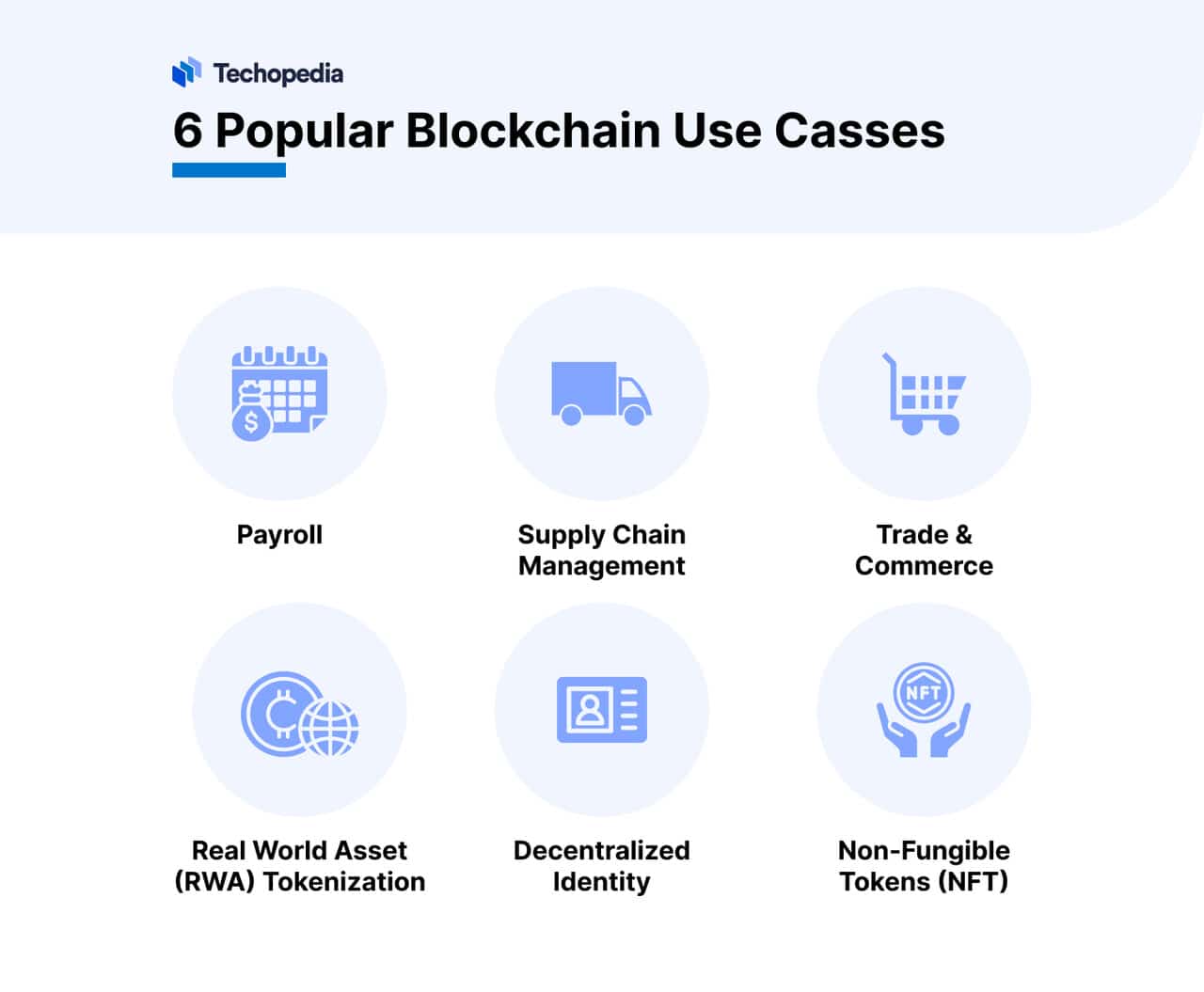
Six Popular Blockchain Use Cases

Payroll

Payments are an obvious use case of blockchain technology. The cryptocurrency industry has used blockchain technology as a bedrock to build peer-to-peer payment systems, while governments are leveraging blockchain technology to create central bank digital currencies (CBDCs).

The growth of remote work has also helped this trend grow as crypto payments facilitate easy, quick, and cheap cross-border payments.

For example, the human resources (HR) management platform Deel allows companies to pay and contractors to receive their salaries in BTCETHUSDC, Dash (DASH), Solana (SOL), and BUSD.

Supply Chain Management

Blockchain supply chain management solutions modernize complex chains that have numerous intermediary parties, processes and endpoints.

The transparent and immutable nature of a blockchain ledger ensures that all concerned parties have a single trusted source of information while providing information in real time to all concerned parties.

Blockchain supply chain solutions also reduce paper-based processes and email exchanges and allow automation, thereby increasing transaction speeds.

Trade management company Covantis created a network to process the execution of bulk agricultural trade operations from the appointment of third-party providers to sharing of documentary instructions and generating drafts and final documents.

Trade & Commerce

Blockchain solutions for trade and commerce created a reliable platform to help buyers find sellers, negotiate with each other, and complete the trade without having to meet each other.

These trading platforms store agreed-upon contracts on the blockchain, while smart contracts custody funds and automate payments when real-world conditions are met. All the information remains visible to all parties on the blockchain.

IBM created a blockchain-based trade management platform we.trade that solves the issue of lack of trust. Importers and exporters that don’t know each other can securely connect with each other on we.trade.

Real World Asset (RWA) Tokenization

Tokenization of real world assets is a promising blockchain use case for businesses that want to increase market liquidity for illiquid assets like real estate. Tokenization can also be used to safeguard intellectual property like copyrights and patents by storing them on an immutable blockchain network.

RWA tokenization is among the top five crypto market trends and technologies in 2024. Traditional finance companies are tokenizing illiquid real estate and fine art into thousands of digital tokens, bringing down the entry barrier for small investors. At the same time, the global nature of public blockchains like Ethereum (ETH) has allowed RWA tokens to reach investors from across the world.

Lian said:

“I believe that tokenization has the potential to democratize access to investment opportunities, allowing individuals from diverse backgrounds to participate in previously inaccessible markets.”

The world saw the first tokenization of real estate in June 2019 when a luxury property called ​​AnnA Villa in France was divided into thousands of digital tokens on the Ethereum blockchain with a minimum entry ticket of investment of €6.5. The tokens came with ownership rights, voting rights, and a one-year vesting period for initial token holders.

Decentralized Identity

Data privacy and security are key issues that businesses have to deal with every day. Using blockchain technology, corporations can leverage a privacy-preserving identity management system called decentralized identity.

Decentralized identities are stored on the blockchain and are not controlled, managed, and stored by centralized third parties. The use of zero-knowledge proof technology, which is gaining popularity on public blockchains, allows organizations to create identifications and certificates that can be verified without revealing any information. Decentralized identification prevents certificate fraud, fake credentials, slow verification processes, and data leaks.

Health-focused enterprise enablement company BurstIQ provides a blockchain-powered platform called LifeGraph that manages sensitive health data. Healthcare and life sciences companies can secure customer data to a single source where participants can control others’ access to their data. Permissioned data can be analyzed, without violating data privacy norms, for improved efficiency, better decision-making, and increased effectiveness in medical processes.

Non-Fungible Tokens (NFT)

Although crypto NFTs are typically associated with absurd market prices, their broad use cases are often misunderstood. Consumer brands like Nike, Puma, and Louis Vuitton have used NFTs as a marketing tool and as a way to digitize and enhance shopping experience.

Since acquiring digital art studio RTFKT in 2021, Nike has occasionally released exclusive NFTs that can be redeemed for physicals. Similarly, in 2023, French luxury fashion house Louis Vuitton sold “phygital” NFTs called Treasure Trunks – worth €39,000 a piece, as reported by Vogue – that granted owners access to goods and experiences.

In September 2022, Starbucks piloted a customer rewards program powered by NFTs called Starbucks Odyssey. However, the company later shut the program in March 2024.

Benefits & Pitfalls of Blockchain for Business

Benefits

  • Trust
  • Improved Privacy & Security
  • Reduced Costs
  • Faster Settlements
  • Programmability & Customizability
  • Tokenization

Challenges

  • Technical Expertise & Investment
  • Regulation Uncertainty
  • Risk of Hacks
  • Limited User Adoption
  • Energy Consumption
  • Scalability & Interoperability

Benefits of Blockchain for Business

Here are the key benefits of using blockchain tech for business operations:

1. Building Trust

Blockchains when paired with smart contract technology can create trustless systems that are immutable, transparent and objective in nature. In a world where there is growing distrust over corporate practices, the use of blockchain technology can help generate trust.

2. Improved Privacy & Security

Although blockchains are not immune to hacks, the development of cryptographic technologies such as zk-proof can ensure data privacy and safety. ZK-proof technology is especially useful in protecting private data as it allows data verification without revealing any information.

Businesses can also leverage public blockchains such as Ethereum to store data and transact upon. The decentralized nature of public blockchains ensures that no centralized party has the power to modify or delete stored data.

3. Reduced Costs


Blockchain technology can help organizations reduce costs by making supply chain and trade management systems efficient, transparent, and accountable. This is especially useful for corporations that have to conduct business operations on the assumption of trust.

4. Faster Settlements

The use of blockchain technology shines when it comes to payments. Cryptocurrency blockchains are global in nature and operate 24/7 making them perfect channels for cheap and immediate cross-border payments.

Unlike the traditional banking sector, businesses will not have to wait for banking hours for settlement and will not incur multiple fees applicable in international money routing.

5. Programmability & Customizability

Businesses have the choice to use different types of blockchains depending on their needs. For example, public crypto blockchains are suitable for handling payrolls, while private blockchains can be developed to allow access to only concerned parties within a supply chain or trade operation.

Furthermore, the use of programmable smart contracts allows the development of applications that use the underlying blockchain networks for data storage and transaction settlement. Smart contracts also allow automation where transactions self-execute when specific conditions are met.

6. Tokenization

Tokenization fits financial use cases. The borderless nature of public blockchains like Ethereum and Solana allows tokenized financial assets to attract a wider pool of investors from across the globe.

Potential Challenges & Pitfalls

Here are the biggest barriers to blockchain adoption in business:

1. Requirement of Technical Expertise & Investment

Businesses will incur costs when recruiting blockchain experts and implementing blockchain technology. The use of public blockchains will require businesses to pay gas fees and auditing fees when setting up applications and smart contracts. Meanwhile, the development of private blockchains from scratch may be expensive and time-consuming due to its complexity.

2. Regulation

The uncertainty around cryptocurrency regulations is one of the biggest challenges in implementing blockchain technology for businesses. Cryptocurrency and blockchain applications often face difficulty finding banking partners in regions with unfriendly and unclear crypto regulations.

The uncertain crypto rules and regulations can hamper business progress and discourage customers from using blockchain-based applications.

3. Hacks

Blockchains are not immune to hacks. 51% attacksdouble-spending, and sybil attacks are key risks to public blockchains. Furthermore, businesses must conduct thorough audits of their smart contracts before deployment or risk being compromised.

4. Limited User Adoption

Blockchain technology is relatively nascent, and therefore, businesses may encounter resistance from trade partners, supply chain management parties and consumers when they introduce blockchain-based solutions. Low awareness about blockchain and cryptocurrency technology among concerned parties is a major hurdle in this area.

5. High Energy Consumption of Proof-of-Work Blockchains

Proof-of-work (PoW) blockchains like Bitcoin are criticized for their high energy consumption rates and carbon footprint. Businesses looking to use these blockchains may attract criticism from customers and investors.

6. Scalability

Public blockchains like Bitcoin and Ethereum often face scalability issues that have resulted in limited network throughput. High transaction volumes on these networks can result in transaction execution failure, exorbitant transaction fees, and delayed transaction processing.

7. Interoperability

Blockchains are often referred to as “data silos” as they tend to exist in isolation from other blockchain networks.

The lack of interoperability between blockchains leads to inefficiencies as businesses will have to rely on third-party solutions to retrieve data from a foreign blockchain.

Fragmentation of data can also hinder collaboration and stifle innovation between businesses or departments within a corporation.

The Bottom Line

Blockchain is a revolutionary technology that offers unique value propositions like trustlessness, transparency, immutability and decentralization.

When duly implemented, blockchain can help corporations make their business operations more efficient and bring about a social and cultural change where trustless and transparent systems become the norm.


Source: https://www.techopedia.com/blockchain-for-business-your-enterprise-guide

Anndy Lian is an early blockchain adopter and experienced serial entrepreneur who is known for his work in the government sector. He is a best selling book author- “NFT: From Zero to Hero” and “Blockchain Revolution 2030”.

Currently, he is appointed as the Chief Digital Advisor at Mongolia Productivity Organization, championing national digitization. Prior to his current appointments, he was the Chairman of BigONE Exchange, a global top 30 ranked crypto spot exchange and was also the Advisory Board Member for Hyundai DAC, the blockchain arm of South Korea’s largest car manufacturer Hyundai Motor Group. Lian played a pivotal role as the Blockchain Advisor for Asian Productivity Organisation (APO), an intergovernmental organization committed to improving productivity in the Asia-Pacific region.

An avid supporter of incubating start-ups, Anndy has also been a private investor for the past eight years. With a growth investment mindset, Anndy strategically demonstrates this in the companies he chooses to be involved with. He believes that what he is doing through blockchain technology currently will revolutionise and redefine traditional businesses. He also believes that the blockchain industry has to be “redecentralised”.

j j j