Busan Blockchain Week 2022: Trends shaping the future of NFT

Busan Blockchain Week 2022: Trends shaping the future of NFT

Busan Blockchain Week (BWB) 2022, hosted by Busan Metropolitan City held at BEXCO for three days from October 27 to October 29th. With the theme of “Blockchain, City and Life”, as an extension of last year’s NFT Busan 2021, BWB 2022 will feature conferences for the advancement of the blockchain industry and provide a space to obtain insight as well as to share information.

Anndy Lian’s speech is on “Trends Shaping the Future of NFT”.

Lian is an all-rounded business strategist in Asia. He has provided advisory across a variety of industries for local, international, public listed companies and governments. He is an early blockchain adopter and experienced serial entrepreneur, book author, investor, board member and keynote speaker.

NFT: From Zero to Hero is his latest book. The book is a call to anyone and everyone excited about the prospect of the world of NFT. Bound by imagination only, the NFT space is still in its early days, and early adopters can be a “hero” in their search for new possibilities. The book is available on Amazon and Bybit. More than 8,000 copies were sold.

NFTs took 2021 by storm. With billions traded over NFTs and a strong community behind the technology, we’re seeing NFTs being adopted by industries as diverse as gaming, finance, art, and medicine.

NFT gaming and game-fi

This trend is obvious. At present, many successful game manufacturers in the traditional game industry want to get involved in NFTs.

NFT ticketing

NFT ticketing goes beyond this. The future of NFTs in ticketing offers opportunities for lifetime value, exclusive access, and extra incentives for buyers.

NFT fragments

Fractionalisation essentially breaks up an NFT into smaller pieces so people can purchase small parts of an expensive NFT.

Digital twin NFTs

Imagine this same type of record existing for physical items. It would completely change resale markets.

AI NFTs

Alongside blockchain, Artificial Intelligence (AI) is the next major disruptor in tech. So it should be no surprise the two are being combined.

NFTs and health

With issues surrounding counterfeit vaccination passports and concerns about the vulnerabilities of centralised data storage of sensitive medical information, NFTs and the blockchain may well be integrated more and more into medicine and health in the years to come.

Growth amidst doubt

Although the popularity of NFTs is indeed declining, all walks of life are still accelerating their integration with NFTs.

Starting in the second half of 2021, many well-known brands have also begun to try NFTs, matching them with real objects and even designing their own metaverse. Obviously, the utility has become the first test for big brands in the metaverse field through NFTs.

NFT essentially provides brands with a new way to launch limited-edition products, and the resulting community and word-of-mouth communication will raise their share of voice compared to rival brands.

The future of NFTs

A number of countries are now actively working on regulatory frameworks for NFT assets, strengthening anti-fraud and anti-manipulation audits of projects, determining the business core of each platform, and solving financial security issues such as illegal fundraising and false fraud.

At the same time, major public chains are actively upgrading, expanding, and building their own ecological frameworks to provide underlying support for the production, confirmation, pricing, circulation, and traceability of NFT assets.

Nowadays, NFT financial tools are becoming more and more abundant, and the scale of financial derivatives is steadily increasing. The NFT industry is gradually exploring a development path suitable for blockchain assets.

“The future these NFT trends depict is an interesting one. While many people are concerned about the implications of the metaverse and the rise of AI, it’s a future full of possibilities. We are still early. Let’s build the ecosystem together.” Lian added.


Source: https://e27.co/busan-blockchain-week-2022-trends-shaping-the-future-of-nft-metaverse-20221102/
Anndy Lian is an early blockchain adopter and experienced serial entrepreneur who is known for his work in the government sector. He is a best selling book author- “NFT: From Zero to Hero” and “Blockchain Revolution 2030”.

Currently, he is appointed as the Chief Digital Advisor at Mongolia Productivity Organization, championing national digitization. Prior to his current appointments, he was the Chairman of BigONE Exchange, a global top 30 ranked crypto spot exchange and was also the Advisory Board Member for Hyundai DAC, the blockchain arm of South Korea’s largest car manufacturer Hyundai Motor Group. Lian played a pivotal role as the Blockchain Advisor for Asian Productivity Organisation (APO), an intergovernmental organization committed to improving productivity in the Asia-Pacific region.

An avid supporter of incubating start-ups, Anndy has also been a private investor for the past eight years. With a growth investment mindset, Anndy strategically demonstrates this in the companies he chooses to be involved with. He believes that what he is doing through blockchain technology currently will revolutionise and redefine traditional businesses. He also believes that the blockchain industry has to be “redecentralised”.

j j j

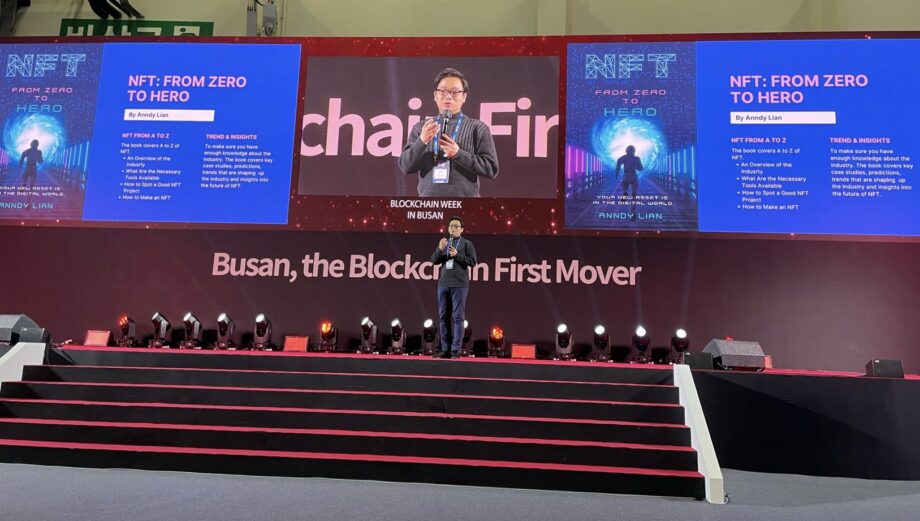
Anndy Lian Talks about “Trends Shaping the Future of NFT” at Busan Blockchain Week

Anndy Lian Talks about “Trends Shaping the Future of NFT” at Busan Blockchain Week

Busan Blockchain Week (BWB) 2022, hosted by Busan Metropolitan City held at BEXCO for 3 days from Oct. 27th (Thu.) to the 29th (Sat).

With the theme of “Blockchain, City and Life”, as an extension of last year’s NFT Busan 2021, BWB 2022 will feature conferences for the advancement of the blockchain industry and provide a space to obtain insight as well as to share information.

Anndy Lian’s speech is on “Trends Shaping the Future of NFT”.

Anndy Lian is an all-rounded business strategist in Asia. He has provided advisory across a variety of industries for local, international, public listed companies and governments. He is an early blockchain adopter and experienced serial entrepreneur, book author, investor, board member and keynote speaker.

NFT: From Zero to Hero is his latest book. Zero to Hero is a call to anyone and everyone excited about the prospect of the world of NFT. Bound by imagination only, the NFT space is still in its early days and early adopters can be a “hero” in their search for new possibilities. The book is available on Amazon and Bybit. More than 8,000 copies were sold.

NFTs took 2021 by storm. With billions traded over NFTs and a strong community behind the technology, we’re seeing NFTs being adopted by industries as diverse as gaming, finance, art, and medicine.

NFT Gaming and GameFi: This trend is obvious. At present, many successful game manufacturers in the traditional game industry want to get involved in NFTs.

NFT Ticketing: NFT ticketing goes beyond this. The future of NFTs in ticketing offers opportunities for lifetime value, exclusive access, and extra incentives for buyers.

NFT Fragments: Fractionalization essentially breaks up an NFT into smaller pieces, so people can purchase small parts of an expensive NFT.

Digital Twin NFTs: Imagine this same type of record existing for physical items. It would completely change resale markets.

AI NFTs: Alongside blockchain, artificial intelligence (AI) is the next major disruptor in tech. So it should be no surprise the two are being combined.

NFTs and Health: With issues surrounding counterfeit vaccination passports and concerns about the vulnerabilities of centralized data storage of sensitive medical information, NFTs and the blockchain may well be integrated more and more into medicine and health in the years to come.

Growth Amidst Doubt

Although the popularity of NFTs is indeed declining, all walks of life are still accelerating their integration with NFTs.

Starting in the second half of 2021, many well-known brands have also begun to try NFTs, matching them with real objects and even designing their own metaverse. Obviously, the utility has become the first test for big brands in the metaverse field through NFTs.

NFT essentially provides brands with a new way to launch limited-edition products, and the resulting community and word-of-mouth communication will raise their share of voice compared to rival brands.

The Future of NFTs

A number of countries are now actively working on regulatory frameworks for NFT assets, strengthening anti-fraud and anti-manipulation audits of projects, determining the business core of each platform, and solving financial security issues such as illegal fundraising and false fraud.

At the same time, major public chains are actively upgrading, expanding, and building their own ecological frameworks to provide underlying support for the production, confirmation, pricing, circulation, and traceability of NFT assets. Nowadays, NFT financial tools are becoming more and more abundant, and the scale of financial derivatives is steadily increasing. The NFT industry is gradually exploring a development path suitable for blockchain assets.

“The future these NFT trends depict is an interesting one. While many people are concerned about the implications of the metaverse and the rise of AI, it’s a future full of possibilities. We are still early. Let’s build the ecosystem together.” Anndy Lian added.

Anndy Lian is an early blockchain adopter and experienced serial entrepreneur who is known for his work in the government sector. He is a best selling book author- “NFT: From Zero to Hero” and “Blockchain Revolution 2030”.

Currently, he is appointed as the Chief Digital Advisor at Mongolia Productivity Organization, championing national digitization. Prior to his current appointments, he was the Chairman of BigONE Exchange, a global top 30 ranked crypto spot exchange and was also the Advisory Board Member for Hyundai DAC, the blockchain arm of South Korea’s largest car manufacturer Hyundai Motor Group. Lian played a pivotal role as the Blockchain Advisor for Asian Productivity Organisation (APO), an intergovernmental organization committed to improving productivity in the Asia-Pacific region.

An avid supporter of incubating start-ups, Anndy has also been a private investor for the past eight years. With a growth investment mindset, Anndy strategically demonstrates this in the companies he chooses to be involved with. He believes that what he is doing through blockchain technology currently will revolutionise and redefine traditional businesses. He also believes that the blockchain industry has to be “redecentralised”.
j j j

From centralisation to decentralisation; how blockchain-oriented fintech can benefit the financial sector

From centralisation to decentralisation; how blockchain-oriented fintech can benefit the financial sector

Additional comments.

Blockchain has the potential to digitize the entire trade finance lifecycle while increasing security and efficiency, lower fraud, human error, and overall counterparty risk.

From a productivity stand point, blockchain intervention allows the whole banking process to be automated within a given set of variables and guidelines and certain banking functions can work 24/7 instead of 9 to 5. In the example of payment, the current system for cross border transactions can take up to a week to clear, with the help of blockchain the amount can be cleared instantly.

On top of everything, it can enable more transparent governance as all the transactions are trackable and traceable on the blockchain.


Anndy Lian

—-

From centralisation to decentralisation; how blockchain-oriented fintech can benefit the financial sector

As stated by experts, blockchain has the capability to digitise the trade finance ecosystem with increment in security and efficiency, reduction in fraudulent practices and human errors, and overall fall in counterparty risks

From what it seems one of the burgeoning technology blockchain is expected to have an impact across sectors including finance. Insights from a study conducted by Market Research Future, a market analysis company, have shown that blockchain within the fintech market will be valued at $31.4 billion by 2030, thereby clocking a 47.90% compound annual growth rate (CAGR). “Blockchain’s influence on the fintech sector can play a key role in boosting privacy and reduction of risks, while transactions are conducted. With no intermediaries involved, customers can conduct transactions at a reduced cost. As the financial industry starts to use blockchain, the potential to provide reliable and transparent transactions will become prevalent,” Prashant Kumar, founder, and CEO, weTrade, a cryptocurrency startup, told FE Digital Currency.

As stated by experts, blockchain has the capability to digitise the trade ecosystem with increment in security and efficiency, reduction in fraudulent practices and human errors, and overall fall in counterparty risks. A blog by International Business Machines (IBM) Corporation, a technology corporation, mentioned that 54% of banks surveyed said that transformative technologies such as blockchain, digital trade, and online trade platforms are priority areas of development with regard to future growth. “From a productivity standpoint, blockchain’s intervention will allow the banking system to be automated within a given set of variables, to allow them to function 24×7. Moreover, it can enable transparent governance, as transactions will become traceable on blockchain,” Anndy Lian, chief digital advisor, Mongolian Productivity Organisation, a governmental organisation, said.

Anndy Lian is an early blockchain adopter and experienced serial entrepreneur who is known for his work in the government sector. He is a best selling book author- “NFT: From Zero to Hero” and “Blockchain Revolution 2030”.

Currently, he is appointed as the Chief Digital Advisor at Mongolia Productivity Organization, championing national digitization. Prior to his current appointments, he was the Chairman of BigONE Exchange, a global top 30 ranked crypto spot exchange and was also the Advisory Board Member for Hyundai DAC, the blockchain arm of South Korea’s largest car manufacturer Hyundai Motor Group. Lian played a pivotal role as the Blockchain Advisor for Asian Productivity Organisation (APO), an intergovernmental organization committed to improving productivity in the Asia-Pacific region.

An avid supporter of incubating start-ups, Anndy has also been a private investor for the past eight years. With a growth investment mindset, Anndy strategically demonstrates this in the companies he chooses to be involved with. He believes that what he is doing through blockchain technology currently will revolutionise and redefine traditional businesses. He also believes that the blockchain industry has to be “redecentralised”.

j j j