
Anndy Lian: Blockchain và tiền điện tử tăng nhiệt ở Đông Nam Á

Anndy Lian: Blockchain và tiền điện tử tăng nhiệt ở Đông Nam Á

TheLEADERSự gia tăng vượt bậc trong việc áp dụng tiền điện tử đã khiến khu vực Trung Á và Đông Nam Á trở thành thị trường tiền điện tử lớn thứ tư thế giới.

Cũng không có gì phải ngạc nhiên với sự bùng nổ này. Theo phân tích của Chainalysis, thị phần tiền điện tử của khu vực Trung Á và Đông Nam Á (CSAO) trên toàn cầu đã tăng từ 2% trong tháng 7/2020 lên mức 14% vào tháng 6/2021. Với giá trị giao dịch hơn 572,5 tỷ USD trong giai đoạn này, thị trường CSAO ghi nhận mức tăng trưởng 706% chỉ sau một năm.

Đáng chú ý, Ngân hàng Nhân dân Trung Quốc vào ngày 24/9/2021 đã tuyên bố, tất cả giao dịch tài chính liên quan đến tiền điện tử ở nước này đều bất hợp pháp. Cơ quan này cảnh báo tiền điện tử đe doạ nghiêm trọng đến an toàn tài sản của người dân. Liệu đây có phải là dấu hiệu cho một sự ngưng trệ trong quá trình phát triển tiền điện tử ở Đông Nam Á, hay là lý do chính đáng để lạc quan trước lệnh cấm của Trung Quốc?

“Chúng ta sẽ thấy làn sóng di cư ngày càng rõ nét của giới kinh doanh tiền điện tử Trung Quốc. Tôi tin rằng điều đó sẽ khiến tiền điện tử trở nên phổ biến ở Đông Nam Á và nhanh chóng khiến thị trường này trở thành một điểm nóng”, bà Lily Z. King, Giám đốc vận hành một nền tảng quản lý tài sản và lưu ký tiền điện tử có trụ sở tại Singapore chia sẻ trên Forkast.

Lily Z. King nhận định, lệnh cấm của Trung Quốc sẽ khiến giới đầu tư nước này ngày càng e dè, dẫn đến sự chuyển hoá sức mạnh tiền điện tử từ Trung Quốc sang các thị trường khác, đặc biệt là Đông Nam Á.

“Trước những ảnh hưởng nặng nề của khủng hoảng Covid-19, dòng chảy mới về vốn và công nghệ có thể mang lại một lực đẩy quan trọng cho nền kinh tế số của Đông Nam Á. Về dài hạn, điều này sẽ mang lại lợi ích cho các nhà phát triển tiền điện tử Trung Quốc nói riêng cũng như phong trào tiền điện tử trên toàn cầu nói chung”, bà Lily S. King nhận định.

Nếu luận điểm đó chính xác thì những xu hướng tiền điện tử/blockchain nào hiện nay có khả năng tăng tốc luôn thay vì phải đổi mới để trở lại đường đua?

Báo cáo của Chainalysis chỉ ra sự tăng trưởng rõ rệt trong hoạt động tài chính phi tập trung (DeFi) không chỉ ở Đông Nam Á mà cả Trung Á và Châu Đại Dương.

Từ tháng 5/2020, hoạt động tài chính phi tập trung đã tăng vọt, đạt trên 50% trong tất cả khối lượng giao dịch vào tháng 2/2021. Hoạt động này chủ yếu được thực hiện trên các nền tảng như Uniswap, Instadapp và dydx thông qua các giao thức như Compound, Curve, AAVE và 1inch.

Nhưng đằng sau những phân tích này, điều gì sẽ giúp giải thích về các tác động có thể có từ lệnh cấm của Trung Quốc?

Singapore được biết đến như một quốc gia tiên phong trong việc áp dụng tiền điện tử và blockchain. Dẫn số liệu từ CoinMarketCap năm 2019, một bài báo trên Hacker Noon chỉ ra, có 634 công ty được thành lập tại Singapore liên quan đến tiền điện tử, tổng giá trị đạt 8,3 tỷ USD.

Chưa dừng lại ở đó, vào cuối năm 2020, một chương trình có giá trị hàng triệu đô la đã được Singapore khởi động, góp phần tăng thêm sức mạnh cho hệ sinh thái blockchain của nước này.

Cơ quan Phát triển truyền thông thông tin Singapore (IMDA) cho biết, sự hỗ trợ này rất cần thiết trong bối cảnh sự thiếu hụt những hình mẫu thành công quy mô lớn ngoài lĩnh vực công nghệ tài chính (fintech) đang cản trở tiến trình đưa blockchain vào ứng dụng một cách chính thống.

“Sự non trẻ của nó đồng nghĩa với việc thiếu hụt các mô hình kinh doanh được mã hóa trên môi trường đáng tin cậy của blockchain. Ngành công nghiệp này sẽ mang lại những giải pháp blockchain độc lập và chuyên biệt hơn là các chuỗi khối tương thích”, IMDA nói.

Cơ quan này cũng lưu ý rằng, hiện vẫn thiếu hụt sự hỗ trợ dành cho các startup đang tìm kiếm những đối tác có cùng chí hướng. Trong khi đó, báo cáo Hệ sinh thái blockchain Singapore 2020 được công bố vào cuối năm ngoái chỉ ra, đại dịch Covid-19 đã đẩy nhanh việc ứng dụng công nghệ blockchain trong quản lý danh tính để đảm bảo kiểm soát dịch bệnh.

Đáng chú ý, các quy định rất rõ ràng của Cơ quan Quản lý tiền tệ Singapore (MAS) đã trở thành động lực thúc đẩy các doanh nghiệp tiền điện tử bỏ qua lệnh cấm của Trung Quốc để đẩy mạnh triển khai hoạt động ở Singapore. Trên thực tế, đảo quốc này đã trở thành nơi đặt trụ sở của nhiều công ty tiền điện tử của Trung Quốc, bao gồm sàn giao dịch tiền điện tử lớn nhất thế giới – Binance.

“Singapore có các quy định rất rõ ràng cho hoạt động của các loại tiền điện tử khác nhau như token thanh toán, chứng khoán, lưu ký, quản lý quỹ tiền điện tử… Điều này đương nhiên hấp dẫn bất kỳ công ty tiền điện tử nào, cho dù từ Trung Quốc hay quốc gia khác, trong việc xem xét việc thiết lập văn phòng ở đây”, Chia Hock Lai, đồng Chủ tịch Hiệp hội Blockchain Singapore cho biết.

Xét về yếu tố nhân khẩu của sáu nền kinh tế hàng đầu khu vực bao gồm Singapore, Indonesia, Malaysia, Philippines, Thái Lan và Việt Nam có thể thấy, một nửa trong tổng số khoảng 580 triệu người dân đang ở độ tuổi dưới 35.

Về tỷ lệ người dân sử dụng tiền điện tử, trái ngược với việc ứng dụng trong kinh doanh ở Đông Nam Á, thì Việt Nam không chỉ đứng đầu bảng xếp hạng khu vực mà còn trên thế giới khi xét về khối lượng giao dịch trên các nền tảng ngang hàng (P2P).

Báo cáo toàn cầu 2021 của Chainalysis đã chỉ ra: “Nhiều người sử dụng các sàn giao dịch tiền điện tử P2P làm cơ sở chuyển đổi chính của họ sang tiền điện tử, thường là vì họ không có quyền truy cập vào các sàn giao dịch tập trung”.

Bên cạnh đó, việc cờ bạc bị coi là hoạt động bất hợp pháp ở Việt Nam cũng đã thúc đẩy nhu cầu đối với các hoạt động tương tự thông qua tài sản tiền điện tử.

Đông Nam Á có khoảng 290 triệu người chưa có tài khoản ngân hàng, chủ yếu ở Indonesia, Philippines và Việt Nam. Đây là một yếu tố góp phần thúc đẩy hình thức P2P mà trong đó, ví tiền điện tử Novi của Facebook (nay đã đổi tên thành Meta) được dự đoán sẽ phát triển rất mạnh trong khu vực.

Lấy ví dụ, số liệu năm 2019 của Ngân hàng Trung ương Philippines cho thấy, 71% người trưởng thành ở nước này không có tài khoản ngân hàng. Trong khi đó, trái ngược với giới trẻ Mỹ đang rời xa Facebook thì số lượng người dùng Facebook có tuổi đời từ 18-24 ở Philippines chiếm tới 33%. Hồ sơ người dùng được Metamask hỗ trợ. Metamask là ví tiền điện tử được sử dụng như tiện ích mở rộng trên các trình duyệt Chrome, Firefox và Brave.

Đến đầu tháng 9/2021, Metamask đã cán mốc 10 triệu người dùng tích cực hàng tháng, trong đó, Philippines chiếm 1/5, nhờ vào sự thành công của Axie Infinity – một trò chơi trực tuyến từ thế giới DeFi dựa trên NFT cho phép người chơi kiếm tiền. Tựa game này do một startup Việt mang tên Sky Mavis phát triển.

Dẫn thông tin từ cha đẻ của Axie Infinity, Business Insider cho biết, Philippines là quốc gia có lượng người chơi đông đảo nhất, chiếm tới 40%.

“Động lực lớn nhất cho tiền điện tử trong vài năm tới sẽ không phải là DeFi, cũng sẽ không mở rộng ra các sàn giao dịch tập trung, mà sẽ là GameFi (các trò chơi trên blockchain kết hợp yếu tố tài chính)”, Brian Lu, đối tác tại Headline Asia và Infinity Ventures Crypto, nhận định trên Forkast. Headline Asia và Infinity Ventures Crypto là những công ty đã đầu tư vào các dự án tiền điện tử ở Đông Nam Á.

Theo chuyên gia này, “GameFi sẽ thúc đẩy việc áp dụng tiền điện tử ở Đông Nam Á và Nam Á. Blockchain và lĩnh vực chơi để kiếm tiền sẽ thu hút người chơi hiện không dùng tiền điện tử và [biến] họ thành người dùng tiền điện tử một khi họ nhận ra rằng họ có thể kiếm được nhiều tiền hơn hoặc bổ sung vào nguồn thu nhập của mình chỉ bằng việc ngồi chơi game vài tiếng đồng hồ mỗi ngày”.

Sự đa dạng trong việc áp dụng tiền điện tử, cho dù là các doanh nghiệp thành công dựa trên tiền điện tử hay các game thủ chơi để kiếm tiền, đã chứng minh được tiềm năng lớn của lĩnh vực này ở Đông Nam Á.

Dù là một quốc gia đang dẫn đầu về ứng dụng blockchain thì các chương trình được Singapore đẩy mạnh triển khai trong thời gian qua cũng cho thấy sự cấp thiết của việc phối hợp hành động giữa các bên liên quan để vươn mình thành quốc gia hàng đầu thế giới về ứng dụng công nghệ phi tập trung trong bối cảnh chính quyền Trung Quốc cũng đang nỗ lực trở thành nước dẫn đầu về chuỗi khối (dù không ngừng đàn áp các loại tiền điện tử).

Cho dù được ứng dụng để phục vụ nhu cầu của những người dân không có tài khoản ngân hàng hay hỗ trợ trong lĩnh vực y tế thì cơ hội trong lĩnh vực tiền điện tử và blockchain vẫn đang chờ đón những “người chơi” sẵn sàng nắm bắt.

(Bạn đọc có thể xem bài viết tiếng Anh của tác giả tại đây: https://e.theleader.vn/the-rise-of-the-use-of-blockchain-and-crypto-in-southeast-asia-1635393795663.htm).

(*) Anndy Lian (Singapore) là một nhà chiến lược kinh doanh ở châu Á. Ông đã cung cấp dịch vụ tư vấn trong nhiều lĩnh vực khác nhau cho các chính phủ và công ty niêm yết trong và ngoài nước. Ông là người có kinh nghiệm với blockchain từ giai đoạn rất sớm và cũng đồng thời là doanh nhân, tác giả sách, nhà đầu tư, thành viên hội đồng quản trị và diễn giả chính của các hội thảo lớn ở trong nước và khu vực.

Ông hiện là Cố vấn trưởng kỹ thuật số tại Cơ quan Năng suất Mông Cổ, một quốc gia đang đi rất nhanh trên hành trình chuyển đổi số quốc gia. Hiện ông còn đảm nhiệm vai trò Chủ tịch BigONE Exchange châu Á.

Source: https://theleader.vn/blockchain-va-tien-dien-tu-tang-nhiet-o-dong-nam-a-1635727844146.htm


Anndy Lian is an early blockchain adopter and experienced serial entrepreneur who is known for his work in the government sector. He is a best selling book author- “NFT: From Zero to Hero” and “Blockchain Revolution 2030”.

Currently, he is appointed as the Chief Digital Advisor at Mongolia Productivity Organization, championing national digitization. Prior to his current appointments, he was the Chairman of BigONE Exchange, a global top 30 ranked crypto spot exchange and was also the Advisory Board Member for Hyundai DAC, the blockchain arm of South Korea’s largest car manufacturer Hyundai Motor Group. Lian played a pivotal role as the Blockchain Advisor for Asian Productivity Organisation (APO), an intergovernmental organization committed to improving productivity in the Asia-Pacific region.

An avid supporter of incubating start-ups, Anndy has also been a private investor for the past eight years. With a growth investment mindset, Anndy strategically demonstrates this in the companies he chooses to be involved with. He believes that what he is doing through blockchain technology currently will revolutionise and redefine traditional businesses. He also believes that the blockchain industry has to be “redecentralised”.

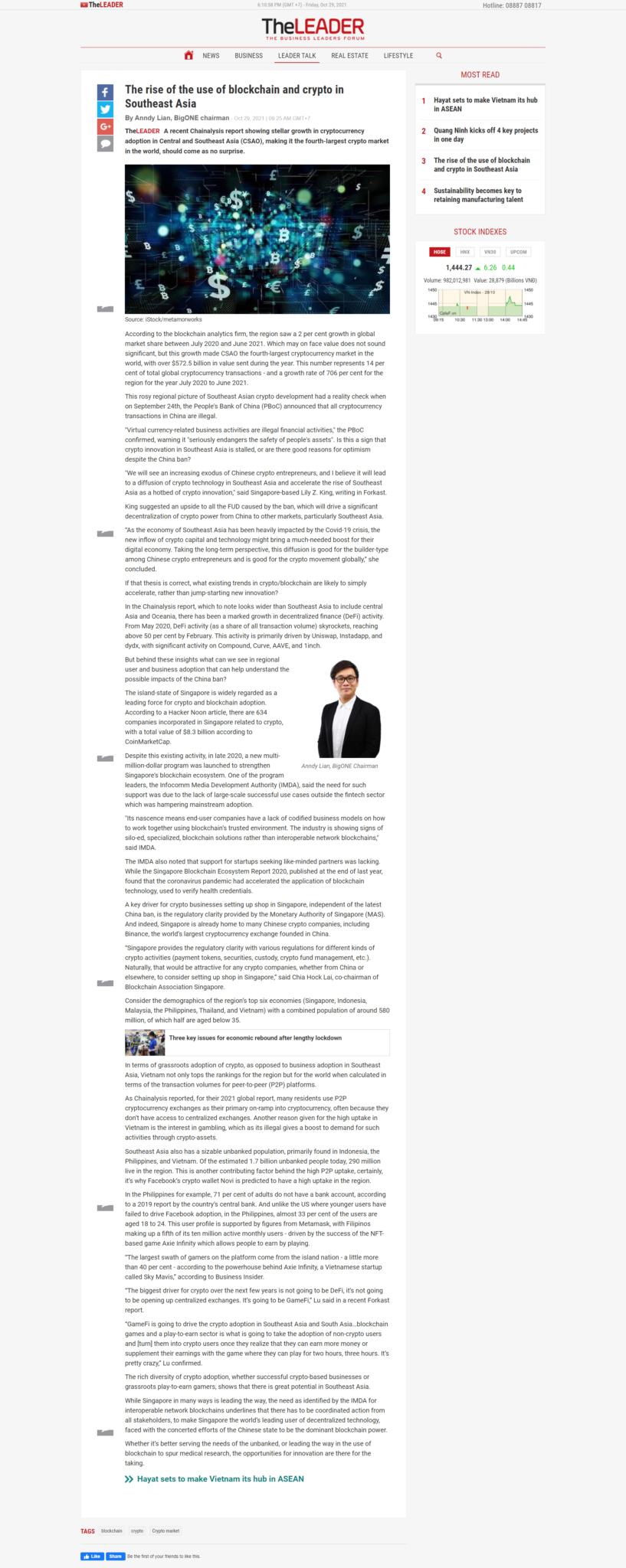
j j j

Op-ed by Anndy Lian: The rise of the use of blockchain and crypto in Southeast Asia

Op-ed by Anndy Lian: The rise of the use of blockchain and crypto in Southeast Asia
By Anndy Lian – Oct 29, 2021 | 09:25 AM GMT+7

TheLEADER A recent Chainalysis report showing stellar growth in cryptocurrency adoption in Central and Southeast Asia (CSAO), making it the fourth-largest crypto market in the world, should come as no surprise.

According to the blockchain analytics firm, the region saw a 2 per cent growth in global market share between July 2020 and June 2021. Which may on face value does not sound significant, but this growth made CSAO the fourth-largest cryptocurrency market in the world, with over $572.5 billion in value sent during the year. This number represents 14 per cent of total global cryptocurrency transactions – and a growth rate of 706 per cent for the region for the year July 2020 to June 2021.

This rosy regional picture of Southeast Asian crypto development had a reality check when on September 24th, the People’s Bank of China (PBoC) announced that all cryptocurrency transactions in China are illegal.

“Virtual currency-related business activities are illegal financial activities,” the PBoC confirmed, warning it “seriously endangers the safety of people’s assets”. Is this a sign that crypto innovation in Southeast Asia is stalled, or are there good reasons for optimism despite the China ban?

“We will see an increasing exodus of Chinese crypto entrepreneurs, and I believe it will lead to a diffusion of crypto technology in Southeast Asia and accelerate the rise of Southeast Asia as a hotbed of crypto innovation,” said Singapore-based Lily Z. King, writing in Forkast.

King suggested an upside to all the FUD caused by the ban, which will drive a significant decentralization of crypto power from China to other markets, particularly Southeast Asia.

“As the economy of Southeast Asia has been heavily impacted by the Covid-19 crisis, the new inflow of crypto capital and technology might bring a much-needed boost for their digital economy. Taking the long-term perspective, this diffusion is good for the builder-type among Chinese crypto entrepreneurs and is good for the crypto movement globally,” she concluded.

If that thesis is correct, what existing trends in crypto/blockchain are likely to simply accelerate, rather than jump-starting new innovation?

In the Chainalysis report, which to note looks wider than Southeast Asia to include central Asia and Oceania, there has been a marked growth in decentralized finance (DeFi) activity. From May 2020, DeFi activity (as a share of all transaction volume) skyrockets, reaching above 50 per cent by February. This activity is primarily driven by Uniswap, Instadapp, and dydx, with significant activity on Compound, Curve, AAVE, and 1inch.

But behind these insights what can we see in regional user and business adoption that can help understand the possible impacts of the China ban?

The island-state of Singapore is widely regarded as a leading force for crypto and blockchain adoption. According to a Hacker Noon article, there are 634 companies incorporated in Singapore related to crypto, with a total value of $8.3 billion according to CoinMarketCap.

Despite this existing activity, in late 2020, a new multi-million-dollar program was launched to strengthen Singapore’s blockchain ecosystem. One of the program leaders, the Infocomm Media Development Authority (IMDA), said the need for such support was due to the lack of large-scale successful use cases outside the fintech sector which was hampering mainstream adoption.

“Its nascence means end-user companies have a lack of codified business models on how to work together using blockchain’s trusted environment. The industry is showing signs of silo-ed, specialized, blockchain solutions rather than interoperable network blockchains,” said IMDA.

The IMDA also noted that support for startups seeking like-minded partners was lacking. While the Singapore Blockchain Ecosystem Report 2020, published at the end of last year, found that the coronavirus pandemic had accelerated the application of blockchain technology, used to verify health credentials.

A key driver for crypto businesses setting up shop in Singapore, independent of the latest China ban, is the regulatory clarity provided by the Monetary Authority of Singapore (MAS). And indeed, Singapore is already home to many Chinese crypto companies, including Binance, the world’s largest cryptocurrency exchange founded in China.

“Singapore provides the regulatory clarity with various regulations for different kinds of crypto activities (payment tokens, securities, custody, crypto fund management, etc.). Naturally, that would be attractive for any crypto companies, whether from China or elsewhere, to consider setting up shop in Singapore,” said Chia Hock Lai, co-chairman of Blockchain Association Singapore.

Consider the demographics of the region’s top six economies (Singapore, Indonesia, Malaysia, the Philippines, Thailand, and Vietnam) with a combined population of around 580 million, of which half are aged below 35.

In terms of grassroots adoption of crypto, as opposed to business adoption in Southeast Asia, Vietnam not only tops the rankings for the region but for the world when calculated in terms of the transaction volumes for peer-to-peer (P2P) platforms.

As Chainalysis reported, for their 2021 global report, many residents use P2P cryptocurrency exchanges as their primary on-ramp into cryptocurrency, often because they don’t have access to centralized exchanges. Another reason given for the high uptake in Vietnam is the interest in gambling, which as its illegal gives a boost to demand for such activities through crypto-assets.

Southeast Asia also has a sizable unbanked population, primarily found in Indonesia, the Philippines, and Vietnam. Of the estimated 1.7 billion unbanked people today, 290 million live in the region. This is another contributing factor behind the high P2P uptake, certainly, it’s why Facebook’s crypto wallet Novi is predicted to have a high uptake in the region.

In the Philippines for example, 71 per cent of adults do not have a bank account, according to a 2019 report by the country’s central bank. And unlike the US where younger users have failed to drive Facebook adoption, in the Philippines, almost 33 per cent of the users are aged 18 to 24. This user profile is supported by figures from Metamask, with Filipinos making up a fifth of its ten million active monthly users – driven by the success of the NFT-based game Axie Infinity which allows people to earn by playing.

“The largest swath of gamers on the platform come from the island nation – a little more than 40 per cent – according to the powerhouse behind Axie Infinity, a Vietnamese startup called Sky Mavis,” according to Business Insider.

“The biggest driver for crypto over the next few years is not going to be DeFi, it’s not going to be opening up centralized exchanges. It’s going to be GameFi,” Lu said in a recent Forkast report.

“GameFi is going to drive the crypto adoption in Southeast Asia and South Asia…blockchain games and a play-to-earn sector is what is going to take the adoption of non-crypto users and [turn] them into crypto users once they realize that they can earn more money or supplement their earnings with the game where they can play for two hours, three hours. It’s pretty crazy,” Lu confirmed.

The rich diversity of crypto adoption, whether successful crypto-based businesses or grassroots play-to-earn gamers, shows that there is great potential in Southeast Asia.

While Singapore in many ways is leading the way, the need as identified by the IMDA for interoperable network blockchains underlines that there has to be coordinated action from all stakeholders, to make Singapore the world’s leading user of decentralized technology, faced with the concerted efforts of the Chinese state to be the dominant blockchain power.

Whether it’s better serving the needs of the unbanked, or leading the way in the use of blockchain to spur medical research, the opportunities for innovation are there for the taking.


Original Source: https://e.theleader.vn/the-rise-of-the-use-of-blockchain-and-crypto-in-southeast-asia-1635393795663.htm


Anndy Lian is an early blockchain adopter and experienced serial entrepreneur who is known for his work in the government sector. He is a best selling book author- “NFT: From Zero to Hero” and “Blockchain Revolution 2030”.

Currently, he is appointed as the Chief Digital Advisor at Mongolia Productivity Organization, championing national digitization. Prior to his current appointments, he was the Chairman of BigONE Exchange, a global top 30 ranked crypto spot exchange and was also the Advisory Board Member for Hyundai DAC, the blockchain arm of South Korea’s largest car manufacturer Hyundai Motor Group. Lian played a pivotal role as the Blockchain Advisor for Asian Productivity Organisation (APO), an intergovernmental organization committed to improving productivity in the Asia-Pacific region.

An avid supporter of incubating start-ups, Anndy has also been a private investor for the past eight years. With a growth investment mindset, Anndy strategically demonstrates this in the companies he chooses to be involved with. He believes that what he is doing through blockchain technology currently will revolutionise and redefine traditional businesses. He also believes that the blockchain industry has to be “redecentralised”.
j j j

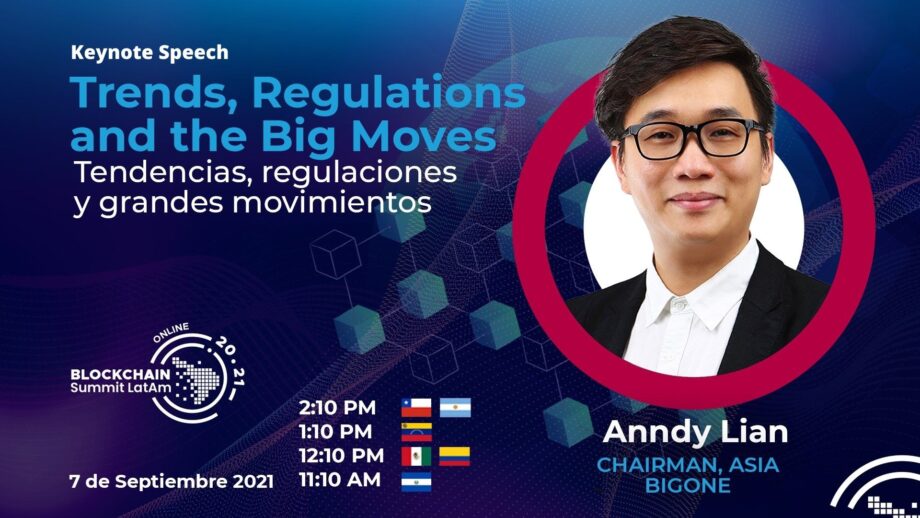
Anndy Lian: Keynote Speech at Blockchain Summit LatAm 2021

Anndy Lian: Keynote Speech at Blockchain Summit LatAm 2021

Decentralized crypto initiatives and government moves to co-opt crypto show that Latin American is at the crossroads of a revolution in crypto adoption, said Anndy Lian, Chairman of BigONE Exchange, following a successful Blockchain Summit LatAm, which ended on September 10.

“The news that El Salvador has launched Bitcoin as legal tender is encouraging news for the whole region, but such a decentralized currency needs to include education and practical tools for everyday use that are built with its users in mind – principles which are at the heart of our own global exchange,” he added.

The trend towards greater use of cryptocurrency in Latin America is not hard to see. Between 2017 and 2020, the bitcoin volume in Latin America has an average of 6% of the volume of BTC globally. In March 2020, Latin America had a 15.8% share, compared to 6% in the US. In April 2021, the Latin American countries with the highest volume of cryptocurrencies are Colombia, with 45% of bitcoin volume in the region; followed by Peru with 13%; Chile with 12%; Mexico with 11%; and Brazil with 11%.

Another trend is the growing commitment from Latin American governments to advance central bank digital currencies (CBDCs), with the Central Bank of Venezuela launching its CBDC in October. The region’s regulators aren’t uniformly in favor of cryptocurrency, however, so progress its likely to be uneven.

While the LatAm conference was taking place Mauricio Moura, a director of the Central Bank of Brazil, stated that anonymity when using crypto won’t be a choice for users in future, an approach likely to be followed by other Latin American governments. Nevertheless, Visa’s vice president of new business in Brazil stated recently that the company will be testing direct bitcoin payments this year.

The potential of decentralized digital assets to disrupt Latin American markets isn’t going away any time soon however, especially with the global boom in the market for NFTs.  In Latin America culture, where art, design, music, and sports are celebrated, the NFT market is starting to grow, such as Influxo’s Ronaldinho NFT supported by BigONE, which will be launched shortly. Although NFTs are still relatively new to Latin America marketplaces, it’s a part of the revolution in crypto adoption that will only increase in popularity.

Anndy Lian is an early blockchain adopter and experienced serial entrepreneur who is known for his work in the government sector. He is a best selling book author- “NFT: From Zero to Hero” and “Blockchain Revolution 2030”.

Currently, he is appointed as the Chief Digital Advisor at Mongolia Productivity Organization, championing national digitization. Prior to his current appointments, he was the Chairman of BigONE Exchange, a global top 30 ranked crypto spot exchange and was also the Advisory Board Member for Hyundai DAC, the blockchain arm of South Korea’s largest car manufacturer Hyundai Motor Group. Lian played a pivotal role as the Blockchain Advisor for Asian Productivity Organisation (APO), an intergovernmental organization committed to improving productivity in the Asia-Pacific region.

An avid supporter of incubating start-ups, Anndy has also been a private investor for the past eight years. With a growth investment mindset, Anndy strategically demonstrates this in the companies he chooses to be involved with. He believes that what he is doing through blockchain technology currently will revolutionise and redefine traditional businesses. He also believes that the blockchain industry has to be “redecentralised”.

j j j