O que explica o sucesso das meme coins: humor, FOMO e comunidade

O que explica o sucesso das meme coins: humor, FOMO e comunidade

A ascensão das moedas meme tem sido uma reviravolta surpreendente para muitos investidores em criptomoedas de longo prazo. Mas o que as torna tão populares?

Conversamos com especialistas em psicologia e criptografia para descobrir os prós e contras do motivo pelo qual as pessoas compram tokens com senso de humor.

Dogecoin – Como tudo começou

De fotos engraçadas de cachorros a celebridades e desenhos animados, os memes se tornaram parte integrante da cultura da internet. E, assim como qualquer outro produto da internet, as criptomoedas também estavam propensas a sucumbir às tendências.

Muitos investidores cripto de longo prazo esperavam que essas tendências desaparecessem com os memes nos quais as moedas foram inspiradas. No entanto, uma década após a criação da primeira moeda meme verdadeira – Dogecoin (DOGE), essa categoria de criptomoedas continua a florescer.

A ascensão das moedas meme

A razão número um pela qual as moedas meme ganharam popularidade é devido ao seu traço humorístico relacionado a um determinado meme da internet. A primeira moeda meme, DOGE, foi criada em 2013 como uma paródia do fenômeno da criptomoeda. E, ironicamente, decolou.

Desde então, elas têm surgido a torto e a direito, sendo que algumas das maiores são DOGE, Pepe (PEPE), uma moeda inspirada no meme Pepe the Frog, e Shiba Inu (SHIB), outra moeda meme inspirada no popular meme do cachorro Shiba Inu.

As moedas de meme são projetadas para se tornarem virais e, muitas vezes, são fortemente promovidas em plataformas de mídia social. Cria-se, então, um hype em torno de um novo projeto. O autor de NFT: From Zero to Hero, Anndy Lian, explicou que as moedas meme geralmente ganham impulso quando os membros da comunidade compram o mais novo token criado “para participar da piada”.

“Uma vez que se torna popular e aumenta de valor, os investidores de varejo às vezes entram a bordo e aumentam ainda mais a moeda. Além disso, as moedas meme são orientadas principalmente pela comunidade e podem ganhar popularidade da noite para o dia devido ao endosso da comunidade on-line e ao FOMO [medo de ficar de fora].”

Os psicólogos concordam, dizendo que um dos maiores motivos pelos quais as pessoas tendem a investir em moedas meme parece ser o FOMO.

“As meme coins frequentemente criam um senso de urgência e empolgação, causando apreensão quanto à perda de possíveis lucros. As pessoas podem ser compelidas a investir porque têm medo de ficar de fora”, disse o Dr. Ketan Parmar, psiquiatra e especialista em saúde mental, ao website Technopedia.

Marissa Moore, conselheira e terapeuta licenciada, acrescentou que a popularidade das moedas meme também pode estar ligada à prova social. Ou seja, as pessoas são influenciadas pelas ações de outras, sua associação com um senso de diversão ou entusiasmo, bem como o senso de comunidade que promove um ambiente de apoio para muitos investidores.

Embora a psicologia por trás das criptomoedas de memes seja fascinante, os investidores devem se lembrar de que esses ativos são altamente voláteis. E nunca investir dinheiro que não possam perder. Entre os novos projetos recém-listados, destacamos Thug Life, que tem todos os atributos para tornar-se um dos grandes destaques de meme coin de 2023.

Thug Life: Projeto promissor com suposto apoio de Snoop Dogg

Após uma pré-venda meteórica e extremamente bem-sucedida, Thug Life está sendo negociado na Uniswap. US$ 2.058 milhões foram arrecadados em poucos dias.

O objetivo do Thug Life é criar um movimento impulsionado pelo humor e pela solidariedade, ajudando os investidores a recuperar suas perdas passadas. Há boatos de que Snoop Dogg pode estar envolvido no projeto, o que poderia aumentar ainda mais seu valor.

Dentre os principais atrativos do $THUG, destacam-se a autodenominação como a “moeda meme dos ballers” e o apelo a “tornar-se gangsta neste mercado e elevar seu jogo de dinheiro”.

Thug Life Token já está construindo uma forte comunidade orgânica nas redes sociais, essencial para o sucesso de qualquer moeda meme.  Finalmente, $THUG é apoiado pela mesma equipe de marketing que impulsionou o token meme SpongeBob em abril, com ganhos de quase 100x.


Source: https://br.beincrypto.com/o-que-explica-o-sucesso-das-meme-coins-humor-fomo-e-comunidade/
be

Anndy Lian is an early blockchain adopter and experienced serial entrepreneur who is known for his work in the government sector. He is a best selling book author- “NFT: From Zero to Hero” and “Blockchain Revolution 2030”.

Currently, he is appointed as the Chief Digital Advisor at Mongolia Productivity Organization, championing national digitization. Prior to his current appointments, he was the Chairman of BigONE Exchange, a global top 30 ranked crypto spot exchange and was also the Advisory Board Member for Hyundai DAC, the blockchain arm of South Korea’s largest car manufacturer Hyundai Motor Group. Lian played a pivotal role as the Blockchain Advisor for Asian Productivity Organisation (APO), an intergovernmental organization committed to improving productivity in the Asia-Pacific region.

An avid supporter of incubating start-ups, Anndy has also been a private investor for the past eight years. With a growth investment mindset, Anndy strategically demonstrates this in the companies he chooses to be involved with. He believes that what he is doing through blockchain technology currently will revolutionise and redefine traditional businesses. He also believes that the blockchain industry has to be “redecentralised”.

j j j

Psychology of Meme Coins Explained: Humor, FOMO, and More

Psychology of Meme Coins Explained: Humor, FOMO, and More

From funny photos of dogs to celebrities and cartoons, memes have become an integral part of internet culture. And just like anything else which predominantly lives on the internet, cryptocurrencies were also prone to succumb to the trends.

The rise of meme coins has been a surprising twist for many long-term crypto investors, with many expecting the trend to die down along with the memes that the coins were inspired by. However, a decade after the first-ever true meme coin – dogecoin (DOGE) – was created, this category of cryptocurrencies continues to flourish.

This article dives into the psychology behind investing in meme coins and why people love them so much.

The Rise of Meme Coins

The number one reason as to why meme coins have gained popularity is due to their humorous streak related to a certain internet meme. The first-ever meme coin, dogecoin (DOGE), was created in 2013 as a parody of the cryptocurrency phenomenon and ironically took off.


Since then, they have been popping up left and right with some of the biggest being DOGE, pepe (PEPE), a coin inspired by the Pepe the Frog meme and shiba inu (SHIB) another meme coin inspired by the popular Shiba Inu dog meme.

Meme coins are designed to go viral and are often heavily promoted on social media platforms, creating hype around a new project. Author of NFT: From Zero to Hero, Anndy Lian, explained that meme coins often gain momentum when members of the community buy into the newest token created “in order to be in on the joke”.

“Once it gets popular and spikes in value, retail investors sometimes jump on board and further boost the coin. Additionally, meme coins are mainly community-driven and can gain popularity overnight due to online community endorsements and FOMO [fear of missing out].”

Psychologists agree, saying that one of the biggest reasons as to why people tend to invest in meme coins seems to be FOMO.

“Memecoins frequently create a sense of urgency and excitement, causing apprehension about missing out on possible profits. People may be compelled to invest because they are afraid of being left out,” Dr Ketan Parmar a psychiatrist and mental health expert told Technopedia.

Licensed counsellor and therapist Marissa Moore added that the popularity of meme coins can also be linked to social proof, or people being influenced by the actions of others, their association with a sense of fun or excitement as well as the sense of community which fosters a supportive environment for many investors.

Meme Coins and Internet Culture

David Kemmerer, the CEO and co-founder of CoinLedger said that one of the key driving points in the success or failure of a meme coin is internet culture. He added that because memes are community-driven and are heavily dependent on market sentiment they continue to drive the hype surrounding meme tokens as well.

Lian added that online platforms in the likes of Discord, Reddit, Twitter, and TikTok serve as catalysts for their viral marketing campaigns and allow meme coins to connect with a diverse range of users. In addition, humor and meme culture, two great catalysts in the success of the said cryptocurrencies, can also have a number of effects on investor behavior.

Dr Parmar noted that humor can foster innovation and novelty in the crypto space, while also reducing risk and seriousness of investing in an asset as volatile and speculative as meme cryptocurrencies.

Moore added that viral marketing and emotional connection associated with meme cryptocurrencies can also influence investor behavior.

Emotional Investing and Meme Coins

Although, with assets that are as dependent on emotions as meme cryptocurrencies, emotional investing could be a key influence in meme cryptocurrency culture.

Emotional investing is the process of making financial decisions based on one’s emotions rather than rational analysis. Dr Parmar explained that emotional investing could include heightened risk-taking, it could affect decision-making as well as amplify or dampen an investor’s confidence and motivation.

Moore noted:

“Emotions can cloud judgment and lead to impulsive decisions, such as buying or selling meme coins without considering the underlying fundamentals or risks. [It] can lead to significant gains but also exposes investors to greater losses when sentiment shifts.”

Bandwagon and Herd Mentality

Investors who tend to invest in more “traditional” cryptocurrencies, like bitcoin (BTC) are doing so to make a profit, however, when a person chooses to invest in a meme token, they could be mostly motivated by jumping on to the “bandwagon” and hype surrounding a certain asset.  This makes meme coin investors higher risk-takers, while traditional crypto investors are a little more risk-averse, Kemmerer explained.

“People may invest in meme coins because they see others doing so, or because they want to fit in or avoid being left behind… Such cognitive biases can affect how people perceive and evaluate meme coins and influence their investment behavior,” Dr Parmar said.

Moore added that when investors see others profiting from meme cryptocurrencies, they may feel compelled to join “the herd, leading to increased demand and potentially inflating prices.”

The Bottom Line

Kemmerer explained that most meme coin investors tend to be very cautious when it comes to investing in the cryptocurrencies. This is due to the tokens being more of an entertainment and depending on the narrative and the community standing behind them.

Lian added:

“Meme coins are heavily community-driven tokens. Since they do not have any fundamental economic or business use case, their prices are usually influenced by social media and online sentiment. This often brings a lot of hype, but also FOMO and financial risk. Memes are a language in themselves, with a capacity to transcend cultures and construct collective identities between people. These sharable visual jokes can also be powerful tools for self-expression, connection, social influence and even political subversion. Due to the hype around meme culture, many investors are turning to digital assets in hopes of striking it rich.”

While the psychology behind why so many people chose to invest in meme cryptocurrencies is fascinating, investors should remember that these assets are highly volatile and never invest money, they can not afford to lose.


Source: https://www.techopedia.com/the-psychology-of-meme-coins-why-people-love-tokens-with-a-sense-of-humour

Anndy Lian is an early blockchain adopter and experienced serial entrepreneur who is known for his work in the government sector. He is a best selling book author- “NFT: From Zero to Hero” and “Blockchain Revolution 2030”.

Currently, he is appointed as the Chief Digital Advisor at Mongolia Productivity Organization, championing national digitization. Prior to his current appointments, he was the Chairman of BigONE Exchange, a global top 30 ranked crypto spot exchange and was also the Advisory Board Member for Hyundai DAC, the blockchain arm of South Korea’s largest car manufacturer Hyundai Motor Group. Lian played a pivotal role as the Blockchain Advisor for Asian Productivity Organisation (APO), an intergovernmental organization committed to improving productivity in the Asia-Pacific region.

An avid supporter of incubating start-ups, Anndy has also been a private investor for the past eight years. With a growth investment mindset, Anndy strategically demonstrates this in the companies he chooses to be involved with. He believes that what he is doing through blockchain technology currently will revolutionise and redefine traditional businesses. He also believes that the blockchain industry has to be “redecentralised”.

j j j

Meme Coins: The Next Jackpot or Just a Gamble?

Meme Coins: The Next Jackpot or Just a Gamble?

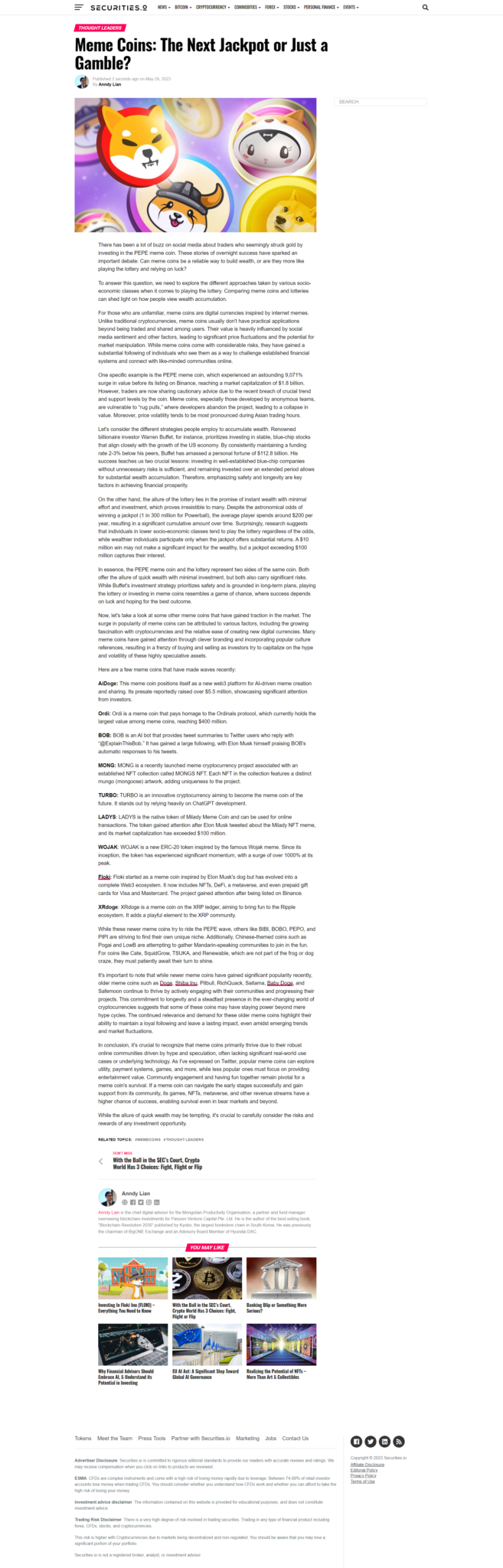
There has been a lot of buzz on social media about traders who seemingly struck gold by investing in the PEPE meme coin. These stories of overnight success have sparked an important debate: Can meme coins be a reliable way to build wealth, or are they more like playing the lottery and relying on luck?

To answer this question, we need to explore the different approaches taken by various socio-economic classes when it comes to playing the lottery. Comparing meme coins and lotteries can shed light on how people view wealth accumulation.

For those who are unfamiliar, meme coins are digital currencies inspired by internet memes. Unlike traditional cryptocurrencies, meme coins usually don’t have practical applications beyond being traded and shared among users. Their value is heavily influenced by social media sentiment and other factors, leading to significant price fluctuations and the potential for market manipulation. While meme coins come with considerable risks, they have gained a substantial following of individuals who see them as a way to challenge established financial systems and connect with like-minded communities online.

One specific example is the PEPE meme coin, which experienced an astounding 9,071% surge in value before its listing on Binance, reaching a market capitalization of $1.8 billion. However, traders are now sharing cautionary advice due to the recent breach of crucial trend and support levels by the coin. Meme coins, especially those developed by anonymous teams, are vulnerable to “rug pulls,” where developers abandon the project, leading to a collapse in value. Moreover, price volatility tends to be most pronounced during Asian trading hours.

Let’s consider the different strategies people employ to accumulate wealth. Renowned billionaire investor Warren Buffet, for instance, prioritizes investing in stable, blue-chip stocks that align closely with the growth of the US economy. By consistently maintaining a funding rate 2-3% below his peers, Buffet has amassed a personal fortune of $112.8 billion. His success teaches us two crucial lessons: investing in well-established blue-chip companies without unnecessary risks is sufficient, and remaining invested over an extended period allows for substantial wealth accumulation. Therefore, emphasizing safety and longevity are key factors in achieving financial prosperity.

On the other hand, the allure of the lottery lies in the promise of instant wealth with minimal effort and investment, which proves irresistible to many. Despite the astronomical odds of winning a jackpot (1 in 300 million for Powerball), the average player spends around $200 per year, resulting in a significant cumulative amount over time. Surprisingly, research suggests that individuals in lower socio-economic classes tend to play the lottery regardless of the odds, while wealthier individuals participate only when the jackpot offers substantial returns. A $10 million win may not make a significant impact for the wealthy, but a jackpot exceeding $100 million captures their interest.

In essence, the PEPE meme coin and the lottery represent two sides of the same coin. Both offer the allure of quick wealth with minimal investment, but both also carry significant risks. While Buffet’s investment strategy prioritizes safety and is grounded in long-term plans, playing the lottery or investing in meme coins resembles a game of chance, where success depends on luck and hoping for the best outcome.

Now, let’s take a look at some other meme coins that have gained traction in the market. The surge in popularity of meme coins can be attributed to various factors, including the growing fascination with cryptocurrencies and the relative ease of creating new digital currencies. Many meme coins have gained attention through clever branding and incorporating popular culture references, resulting in a frenzy of buying and selling as investors try to capitalize on the hype and volatility of these highly speculative assets.

Here are a few meme coins that have made waves recently:

AiDoge: This meme coin positions itself as a new web3 platform for AI-driven meme creation and sharing. Its presale reportedly raised over $5.5 million, showcasing significant attention from investors.

Ordi: Ordi is a meme coin that pays homage to the Ordinals protocol, which currently holds the largest value among meme coins, reaching $400 million.

BOB: BOB is an AI bot that provides tweet summaries to Twitter users who reply with “@ExplainThisBob.” It has gained a large following, with Elon Musk himself praising BOB’s automatic responses to his tweets.

MONG: MONG is a recently launched meme cryptocurrency project associated with an established NFT collection called MONGS NFT. Each NFT in the collection features a distinct mungo (mongoose) artwork, adding uniqueness to the project.

TURBO: TURBO is an innovative cryptocurrency aiming to become the meme coin of the future. It stands out by relying heavily on ChatGPT development.

LADYS: LADYS is the native token of Milady Meme Coin and can be used for online transactions. The token gained attention after Elon Musk tweeted about the Milady NFT meme, and its market capitalization has exceeded $100 million.

WOJAK: WOJAK is a new ERC-20 token inspired by the famous Wojak meme. Since its inception, the token has experienced significant momentum, with a surge of over 1000% at its peak.

Floki: Floki started as a meme coin inspired by Elon Musk’s dog but has evolved into a complete Web3 ecosystem. It now includes NFTs, DeFi, a metaverse, and even prepaid gift cards for Visa and Mastercard. The project gained attention after being listed on Binance.

XRdoge: XRdoge is a meme coin on the XRP ledger, aiming to bring fun to the Ripple ecosystem. It adds a playful element to the XRP community.

While these newer meme coins try to ride the PEPE wave, others like BIBI, BOBO, PEPO, and PIPI are striving to find their own unique niche. Additionally, Chinese-themed coins such as Pogai and LowB are attempting to gather Mandarin-speaking communities to join in the fun. For coins like Cate, SquidGrow, TSUKA, and Renewable, which are not part of the frog or dog craze, they must patiently await their turn to shine.

It’s important to note that while newer meme coins have gained significant popularity recently, older meme coins such as DogeShiba Inu, Pitbull, RichQuack, Saitama, Baby Doge, and Safemoon continue to thrive by actively engaging with their communities and progressing their projects. This commitment to longevity and a steadfast presence in the ever-changing world of cryptocurrencies suggests that some of these coins may have staying power beyond mere hype cycles. The continued relevance and demand for these older meme coins highlight their ability to maintain a loyal following and leave a lasting impact, even amidst emerging trends and market fluctuations.

In conclusion, it’s crucial to recognize that meme coins primarily thrive due to their robust online communities driven by hype and speculation, often lacking significant real-world use cases or underlying technology. As I’ve expressed on Twitter, popular meme coins can explore utility, payment systems, games, and more, while less popular ones must focus on providing entertainment value. Community engagement and having fun together remain pivotal for a meme coin’s survival. If a meme coin can navigate the early stages successfully and gain support from its community, its games, NFTs, metaverse, and other revenue streams have a higher chance of success, enabling survival even in bear markets and beyond.

While the allure of quick wealth may be tempting, it’s crucial to carefully consider the risks and rewards of any investment opportunity.


Source: https://www.securities.io/meme-coins-the-next-jackpot-or-just-a-gamble/

Anndy Lian is an early blockchain adopter and experienced serial entrepreneur who is known for his work in the government sector. He is a best selling book author- “NFT: From Zero to Hero” and “Blockchain Revolution 2030”.

Currently, he is appointed as the Chief Digital Advisor at Mongolia Productivity Organization, championing national digitization. Prior to his current appointments, he was the Chairman of BigONE Exchange, a global top 30 ranked crypto spot exchange and was also the Advisory Board Member for Hyundai DAC, the blockchain arm of South Korea’s largest car manufacturer Hyundai Motor Group. Lian played a pivotal role as the Blockchain Advisor for Asian Productivity Organisation (APO), an intergovernmental organization committed to improving productivity in the Asia-Pacific region.

An avid supporter of incubating start-ups, Anndy has also been a private investor for the past eight years. With a growth investment mindset, Anndy strategically demonstrates this in the companies he chooses to be involved with. He believes that what he is doing through blockchain technology currently will revolutionise and redefine traditional businesses. He also believes that the blockchain industry has to be “redecentralised”.

j j j