Anndy Lian Speaks at Tradeup Conference: Gamefi- The Future of Crypto

Anndy Lian Speaks at Tradeup Conference: Gamefi- The Future of Crypto

As you are new to cryptocurrency trading you will have already come across and invested in the likes of Bitcoin and Ether, and started to research on alternatives such as Litecoin, which is regarded as an improved version of Bitcoin.

You’ve no doubt also decided on a sound crypto investment plan, with sufficient financial reserves to deal with losses, and set up an account with a reputable secure exchange such as BigONE to manage your trading activities.

And now having reviewed all the various options you are keen to find out what the next big thing in crypto is, which is exactly what I’m here to talk about. So, without further introduction, let’s take a deep dive into the world of meme coins, the metaverse, DeFi and an emerging exciting sector in gaming called play-as-you-earn, also known as GameFi.

But to start by setting the context, so you are the most equipped traders coming into this booming sector of crypto investment, let’s look at the rise of meme coins, created originally as a joke about crypto which have taken a life of their own as their popularity has soared and new meme coins have emerged with real world use cases since the launch of DogeCoin in 2013.

Trading tokens in the metaverse?

It’s also not hard to see meme coins use in related sectors such as music and particularly gaming, as a cross-proprietary platform currency to enable the vision of the ‘multiverse’ or more commonly known as the metaverse.

In a recent report UK-based blockchain VC Outlier Ventures sees the need to have a crypto decentralized core, with its own payment system as key to building the metaverse.

But to take a step back and explain the metaverse a little, and why it’s worth understanding from a crypto traders’ perspective. First, a definition of metaverse. In layman’s terms, a metaverse is a virtual world that exists alongside the real world. The popularity of the metaverse concept is taking serious shape in recent years, with tech titans such as Facebook, Google, Microsoft, Samsung, and Sony joining forces to form the XR Association, which is aimed at bringing this concept of an ‘experiential reality to life.

So back to the role of crypto, or the lack of it to date, in the metaverse.
Despite the frictionless use of crypto, with low fees and decentralized P2P structures, the reality is that the commercial first movers in the metaverse space from gaming have their own proprietary currencies.

What makes DeFi so attractive to the metaverse community is that it can be automated, without any centralized intervention. It also means that DeFi has long term attractions, allowing game developers and players to invest time and money knowing the underlying blockchain platform won’t change without crypto community consensus.

Cryptocurrencies have already been successfully integrated recently into virtual worlds created by companies such as Decentraland and Sandbox. For example, users in Decentraland can purchase virtual real estate such as theme parks and monetize them using cryptocurrencies. While drinks giant Coca Cola plans to launch its own NFTs on the platform, including a ‘wearable’ jacket for avatars in the Decentraland metaverse.

NFTs
As newcomers to the world of crypto trading you may not have heard of the metaverse before, but you probably heard of NFTs and the headline grabbing rise in value of these unique digital assets.

Non-fungible tokens are referred to as NFTs. According to my understanding of economics, the term fungible relates to anything that can be exchanged for something of equal value.

Most investors know that the nonfungible token (NFT) sector has been on fire since July, and as the likes of CryptoPunks (which got even more coverage when bought recently by VISA), Mutant Ape Yacht Club and pet EtherRock NFTs fetched six- and seven-figure sums, while top NFT marketplace OpenSea surpassed $4 billion in total sales.

While the frenzy has been impressive, it’s also true that many new projects have launched across a variety of blockchain networks, and the recent decline in transaction volumes could be a signal that investors are looking to move to different pastures.

The DAO, or Decentralized Autonomous Organization, is the final piece of the jigsaw that is key to the creation of a metaverse that is open, rather than one run and controlled by the Facebooks of this world. What’s interesting about this novel form of organisation, without a central leadership or the usual management structure used for companies or other entities, is that it’s giving birth to a new way to make money called play to earn or GameFi.

In a close fit with the vision of an open metaverse, play to earn crypto games are built on the fundamental need for a place that is available to everyone and owned by no one in particular.

An amalgam of gaming and decentralized finance (DeFi), ‘GameFi’ refers to the intersection between blockchain-based gaming and decentralized financial instruments in all their guises: yield farming, lending/borrowing, algorithmic stablecoins, token minting instruments, etc.

GameFi essentially means that people are playing a game to profit with real money with payment in the form of cryptocurrencies. Some players play games and earn crypto simply because they enjoy it, and the monetary rewards simply come as a bonus. While there are other players who play to earn crypto games as their main source of income.

In some play to earn crypto games, players can start playing a game for free without paying for it. While in other cases players will need to pay to play i.e., they will need to pay for the character they want to use in game, or perhaps they may want to pay for specific items they want to use in game.

The key idea is that players play games to earn crypto, and their earning potential will increase or decrease depending on the amount of time a player is willing to spend playing the games. Likewise, as a player’s skill improves so will her/his potential profits increase. With play to earn crypto games the more you play and the better you get at the game the great financial rewards you can earn.

Concluding remarks

The Motley Fool cautious analysis of MOBOX could be seen to apply to the wider set of GameFi tokens that have rocketed in value in the last few months. While there are signs the NFT market may be cooling off, and investor attention turning to DeFi in general and GameFi in particular, it’s also right to be cautious. “With Yield Guild Games (YGG) token sale netting $12.5 million in 30 seconds, [it] shows that market participants will not hesitate to switch from one hot toy to another, no different to yield farming craze earlier in the year,” Denis Vinokourov, head of research at Synergia Capital, told CoinDesk, adding that the market is still too “nascent” to make any conclusions.

A more optimistic take is that the GameFi ecosystem has started to grow and mature thanks to a plethora of unique play-to-earn models that have seen revenue generation incorporated into gameplays. Also impressive is the amount of finance being devoted to developing the infrastructure required to take GameFi to the next level. Taking an ambitious view, with consequences for trading opportunities for the future, and not just in the short term, this arguably means global adoption that rivals traditional gaming economies.

Certainly, as the metaverse becomes more and more a reality GameFi will play an important part, helping users to access a market to trade gaming assets across their favourite platforms, in turn helping grow future inter-connected play-to-earn ecosystems. Understanding this GameFi growth trend early on will enable you to better spot trading opportunities today, as well as see opportunities for the future.

Anndy Lian is an early blockchain adopter and experienced serial entrepreneur who is known for his work in the government sector. He is a best selling book author- “NFT: From Zero to Hero” and “Blockchain Revolution 2030”.

Currently, he is appointed as the Chief Digital Advisor at Mongolia Productivity Organization, championing national digitization. Prior to his current appointments, he was the Chairman of BigONE Exchange, a global top 30 ranked crypto spot exchange and was also the Advisory Board Member for Hyundai DAC, the blockchain arm of South Korea’s largest car manufacturer Hyundai Motor Group. Lian played a pivotal role as the Blockchain Advisor for Asian Productivity Organisation (APO), an intergovernmental organization committed to improving productivity in the Asia-Pacific region.

An avid supporter of incubating start-ups, Anndy has also been a private investor for the past eight years. With a growth investment mindset, Anndy strategically demonstrates this in the companies he chooses to be involved with. He believes that what he is doing through blockchain technology currently will revolutionise and redefine traditional businesses. He also believes that the blockchain industry has to be “redecentralised”.
j j j

Anndy Lian Commented”DeFi has a role in the future financial markets” at Asian Digital Week ” Fintech & Digital Banking Innovation Conference”

Anndy Lian Commented”DeFi has a role in the future financial markets” at Asian Digital Week ” Fintech & Digital Banking Innovation Conference”

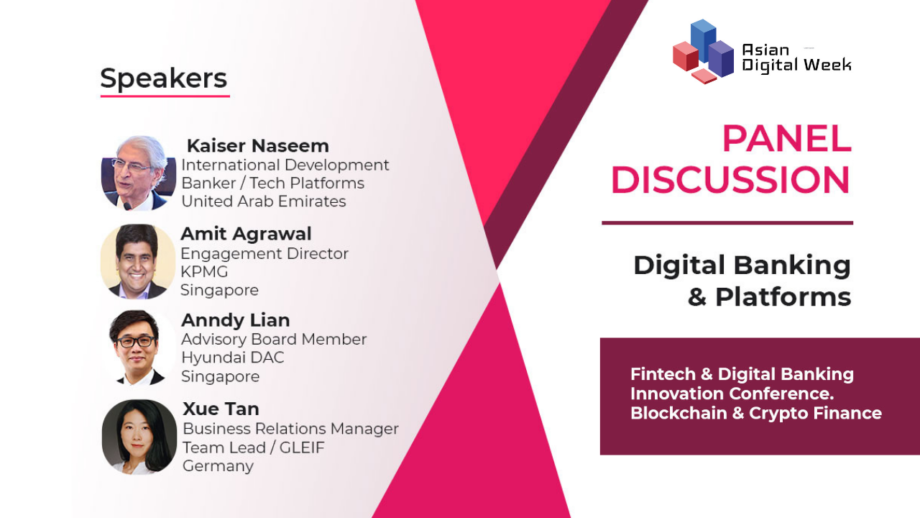
Asian Digital Week ” Fintech & Digital Banking Innovation Conference” brought experts into the event to discuss on “Digital Banking & Platforms”. This is also the second session for the event. The experts talked about the adoption of blockchain for governments, large enterprises & SMEs, decentralised finance, trends ahead on fintech, neo-banks, responsible innovation and evolving regulatory frameworks.

This panel discussion is moderated by Kaiser Naseem – International Development Banker, Tech Platforms, United Arab Emirates and panellists: Anndy Lian – Advisory Board Member, Hyundai DAC, Singapore; Kaiser Naseem – International Development Banker, Tech Platforms, United Arab Emirates; Amit Agrawal – Engagement Director, KPMG, Singapore and Xue Tan – Business Relations Manager Team Lead, GLEIF, Germany.

“Everybody is talking about cryptocurrencies. I won’t be surprised that in the next few years down the line, I don’t need to use physical cash and everything become digital. This will change the entire landscape.” Amit Agrawal – Engagement Director, KPMG, Singapore commented.

“DeFi lending for example. The transactions will take much less time, your collateral can be any digital asset and therefore your physical assets can be safe. There are also no credit checks are necessary, henceforth anybody can apply for a loan.” said Anndy Lian – Advisory Board Member, Hyundai DAC, Singapore

Anndy ended his speech with the question “Is the future of finance decentralised?” He believes that decentralised finance has a role in the future financial markets.

Asian Digital Week is a virtual event, dedicated to the digital transformation of modern society. It includes 7 conferences, giving the viewers useful information about the essential trends related to digital technology. Experts and business leaders from Asia and around the world will come to share personal and professional knowledge, best-case practices and showcase project experiences. The participant will have the chance to learn cutting edge information and view the latest in financial technology.


Anndy Lian is an early blockchain adopter and experienced serial entrepreneur who is known for his work in the government sector. He is a best selling book author- “NFT: From Zero to Hero” and “Blockchain Revolution 2030”.

Currently, he is appointed as the Chief Digital Advisor at Mongolia Productivity Organization, championing national digitization. Prior to his current appointments, he was the Chairman of BigONE Exchange, a global top 30 ranked crypto spot exchange and was also the Advisory Board Member for Hyundai DAC, the blockchain arm of South Korea’s largest car manufacturer Hyundai Motor Group. Lian played a pivotal role as the Blockchain Advisor for Asian Productivity Organisation (APO), an intergovernmental organization committed to improving productivity in the Asia-Pacific region.

An avid supporter of incubating start-ups, Anndy has also been a private investor for the past eight years. With a growth investment mindset, Anndy strategically demonstrates this in the companies he chooses to be involved with. He believes that what he is doing through blockchain technology currently will revolutionise and redefine traditional businesses. He also believes that the blockchain industry has to be “redecentralised”.

j j j

Anndy Lian’s Speech on “Cryptocurrency Regulation & Commercialisation 2021” at Digital Assets Investment Conference

Anndy Lian’s Speech on “Cryptocurrency Regulation & Commercialisation 2021” at Digital Assets Investment Conference

Anndy Lian gave a speech on “Cryptocurrency Regulation & Commercialisation 2021” at the Digital Assets Investment Conference on 13 November 2020. Anndy is an early blockchain adopter and experienced serial blockchain entrepreneur who is known for his work in the government sector. He is a best selling book author “Blockchain Revolution 2030” and currently the Advisory Board Member of Hyundai DAC Technology. In his speech, he gave an overview of regulations for cryptocurrency globally for 2021 & beyond, commercial adoption & implementation, and finally trends to look out for in 2021.

An Overview

He started by sharing some positive headlines:

– Investment banking giant JPMorgan is about to see the first commercial transactions with its own cryptocurrency, JPM Coin.
– PayPal allows Bitcoin and crypto spending. It has gone live today.
– Jack Dorsey’s Square buys $50 million in bitcoin
– Mode allocated up to 10% of cash reserves to purchase #Bitcoin and adopt it as a treasury reserve asset
– DBS Bank Is Planning to Launch a Digital Asset Exchange
– 22 Indian Bank Branches to Begin Offering Crypto Banking Services
– Alibaba Founder Jack Ma: “Digital Currencies” Are the Future
– World’s Second-Biggest Bank, China Construction Bank (CCB) has tapped Labuan-based digital asset exchange Fusang for the issuance of $3 billion worth of debt securities over a blockchain.

Then he also shared the not so positive headlines:

– BitMEX founder arrested for violation of US anti-money laundering laws
– China’s OKEx halts cryptocurrency withdrawals after founder arrested
– $150M Stolen by Hackers from KuCoin Crypto Exchange

Based on the above, Anndy felt that this is a positive sign in his opinion and stated that the blockchain and cryptocurrency space is taking its shape. Regulations are catching up. Investors are more aware of what they are investing in. And it is heading for mainstream.

Government attitude

The surveyed countries have categorized cryptocurrencies differently for tax purposes, as illustrated by the following examples:

Israel→taxed as an asset
Bulgaria→taxed as a financial asset
Switzerland→taxed as foreign currency
Denmark→subject to income tax and losses are deductible
United Kingdom→corporations pay corporate tax, unincorporated businesses pay income tax, individuals pay capital gains tax

In Singapore, the nation has started recognizing cryptocurrencies in 2017. The Payment Services Act (PSA) in Singapore, which came into effect on 28 January 2020, stated that cryptocurrency businesses must obtain a license from MAS to comply with AML/CFT regulations. This expands to companies that both transfer cryptocurrency within Singapore and outside of Singapore.

Similarly, more forward-looking countries have also started their public consultation for specific crypto-related bills to be passed.

To sum up, in this part, Lian emphasizes that we have to follow the rules and be upfront and open when dealing on unclear grounds. Having said so, the crypto space has been shifting and changing very fast. Experts should also find channels to update governments of the latest developments like Defi, AMM, and PMM and keep them informed of the latest scams and Ponzi schemes in the market. Proper education and awareness must be told to their people to avoid any form of fraud. Leading exchanges like Binance are always giving free lessons and updates on the industry. Information from credible sources and channels like them should be a useful reference. A formalized think tank in blockchain and cryptocurrencies accredited by the government must also be set up to be the voice.

Paths to commercialization

There must be clear incentives for the stakeholders and clients to drive proper ROI on the blockchain solutions. It should potentially have the ability to create revenue and cost-saving outcomes by using this new technology.

Blockchain technology implementation is no different from other technology. There must be clear strategic objectives, road maps, and specialized skill sets needed to drive commercialization and deliver business value.

It should also be an integrative approach, able to scale and provide a level of standardization so that existing data management and process standards can be applied to the blockchain solution.

Trends in 2021

Anndy highlighted that prop trading would be introduced, and social trading will gain more popularity in early 2021. On top of this, he also stated that STO would be more mature in 2021, more licenses will be approved, and will be operational in Q4.

Lian also mentioned briefly that DeFI would be more sustainable next year, stating that most of the higher risk companies would be flushed out from the ecosystem because of competition.

He mentioned that there would be more licensed LOTTO businesses getting into the crypto space.

Finally, he is optimistic that 2021 will hit a new milestone for the leading blockchain companies, and governments will be supportive. He also ended with an insightful quote.

“I do think that it is possible that Bitcoin goes to $100,000 but once it starts to affect governmental monetary policy and fiscal policy. You will see a whole different reaction.”- Anndy Lian

About Anndy Lian

Anndy Lian is an early blockchain adopter and experienced serial blockchain entrepreneur who is known for his work in the government sector. He is a best selling book author “Blockchain Revolution 2030” and currently the Advisory Board Member of Hyundai DAC Technology. He plays a pivotal role as the Blockchain Advisor for Asian Productivity Organisation (APO), an intergovernmental organization committed to improving productivity in the Asia-Pacific region. Anndy is also part of the Gyeongsangbuk-do Blockchain Special Committee, Government of Republic Korea, together with industry experts such as Brock Pierce. You can read more about Anndy’s work at www.anndy.com


About STOBOX:

STOBOX gives businesses access to a worldwide community of retail and private accredited investors. They provide a full range of services for issuing next generation digital security on a distributed ledger, including legal structuring, technical setup, preparation of marketing materials and organization of a fundraising campaign. The offering of digital securities is conducted in complete compliance with EU financial regulation.

Anndy Lian is an early blockchain adopter and experienced serial entrepreneur who is known for his work in the government sector. He is a best selling book author- “NFT: From Zero to Hero” and “Blockchain Revolution 2030”.

Currently, he is appointed as the Chief Digital Advisor at Mongolia Productivity Organization, championing national digitization. Prior to his current appointments, he was the Chairman of BigONE Exchange, a global top 30 ranked crypto spot exchange and was also the Advisory Board Member for Hyundai DAC, the blockchain arm of South Korea’s largest car manufacturer Hyundai Motor Group. Lian played a pivotal role as the Blockchain Advisor for Asian Productivity Organisation (APO), an intergovernmental organization committed to improving productivity in the Asia-Pacific region.

An avid supporter of incubating start-ups, Anndy has also been a private investor for the past eight years. With a growth investment mindset, Anndy strategically demonstrates this in the companies he chooses to be involved with. He believes that what he is doing through blockchain technology currently will revolutionise and redefine traditional businesses. He also believes that the blockchain industry has to be “redecentralised”.

j j j