Crypto crashes 13 per cent as Fed rate cut hopes fade, S&P 500 correlation hits 0.95

Crypto crashes 13 per cent as Fed rate cut hopes fade, S&P 500 correlation hits 0.95

Over the past 24 hours, the crypto market shed 3.51 per cent, extending a punishing 13 per cent weekly decline driven by a confluence of macroeconomic headwinds, cascading derivatives liquidations, and a dramatic collapse in trader sentiment. This sell-off exemplifies how tightly interwoven crypto has become with traditional financial systems, particularly as correlations with equities have deepened to levels not seen in months.

Monday’s performance in US equities underscored this linkage, with the Dow Jones falling 1.18 per cent, the S&P 500 down 0.92 per cent, and the Nasdaq slipping 0.84 per cent, as technology stocks led the retreat. These losses emerged alongside diminishing expectations for a Federal Reserve rate cut in December, which had previously provided some support to risk assets. The recalibration of Fed expectations followed strong US economic data, which reinforced concerns about persistent inflation and delayed the anticipated pivot toward monetary easing.

The shifting macroeconomic landscape was further reflected in movements across fixed-income and foreign exchange markets. The 10-year US Treasury yield declined modestly by 1.0 basis point to settle at 4.139 per cent, while the two-year yield edged higher by 0.4 basis points to 3.610 per cent, signalling a slight flattening of the yield curve. Meanwhile, the US Dollar Index gained 0.29 per cent to close at 99.588, adding pressure on non-dollar assets.

Gold, often viewed as a safe haven, dropped 1.0 per cent to US$4044.96 per ounce, weighed down by both the stronger dollar and receding hopes for near-term rate cuts, which typically support precious metals by lowering opportunity costs. In energy markets, Brent crude settled slightly lower at US$64.20 per barrel, recovering marginally as loadings resumed at Russia’s Novorossiysk export terminal following a brief suspension caused by a Ukrainian drone strike. Across Asia, equities finished the session mixed but turned lower in early Tuesday trading, though US index futures pointed to a modest recovery at the open, suggesting some short-term stabilisation may be on the horizon.

The crypto downturn lies a powerful macro risk-off dynamic that has pulled digital assets into the same downdraft affecting equities. Over the past 24 hours, Bitcoin’s price correlation with the S&P 500 surged to 0.95, its highest since June 2025. This near-perfect synchronisation underscores how traders increasingly treat crypto not as an uncorrelated alternative asset but as a high-beta extension of the broader risk spectrum. The catalyst for this shift came from revised market pricing around Federal Reserve policy. Stronger-than-expected economic indicators have tempered expectations for a December rate cut, pushing the implied probability lower and driving the 10-year Treasury yield up by 14 basis points over recent sessions.

This tightening of financial conditions has hit speculative assets especially hard. Bitcoin’s breach below the psychologically critical US$91,500 level triggered a wave of algorithmic stop-loss orders, accelerating the decline and dragging down major altcoins such as Solana and Cardano, which posted weekly losses of 21.7 per cent and 22.4 per cent, respectively. The market now awaits pivotal upcoming events, the release of the November 20 Fed meeting minutes, and Nvidia’s earnings report on November 21, for further directional cues. Any sign of continued economic resilience or hawkish Fed rhetoric could prolong risk aversion.

Compounding the macro pressure, a violent unwind in crypto derivatives markets has magnified losses through forced liquidations. Trading volume in perpetual futures contracts spiked by 45.6 per cent to an astonishing US$423 trillion over 24 hours, reflecting frantic hedging and position adjustments. Simultaneously, total open interest in the derivatives market fell by 7.4 per cent, now standing at US$787 billion, down 8.4 per cent in a single day. This contraction signals a rapid deleveraging as overextended positions were forcibly closed. Options markets mirrored this bearish sentiment, with US$740 million in put options placed targeting a Bitcoin price of US$90,000 and Ethereum at US$2,800.

Funding rates for major altcoins also turned negative, with the average rate dipping to minus 0.0019775, which disincentivises holding long positions and encourages further shorting. This feedback loop of rising volatility, liquidations, and negative funding creates a self-reinforcing cycle that can deepen sell-offs beyond what fundamentals alone would justify. Market participants now watch open interest closely, as a continued decline could signal capitulation, potentially setting the stage for a relief rally once leverage is sufficiently purged.

Perhaps most telling is the collapse in market psychology, captured starkly by the Crypto Fear & Greed Index, which plunged to 15, entering “Extreme Fear” territory. This marks the lowest reading since March 2025, a period that ultimately coincided with a market bottom when Bitcoin found support near US$76,000. Retail investors, overwhelmed by the speed and severity of the decline, have fled to the perceived safety of stablecoins, pushing Tether’s dominance to 7.2 per cent, a 30-day high. Social sentiment has turned sharply negative, with average daily scores falling to 4.29 out of 10, and viral commentary reflecting deep pessimism toward even leading altcoins.

Phrases like “Solana’s fuel is running out” have gained traction, illustrating how quickly narrative momentum can reverse in stressed markets. Historically, sustained readings below 20 on the Fear & Greed Index have often preceded short-term bounces, as excessive fear creates oversold conditions ripe for contrarian positioning. However, such rebounds typically require a catalyst, and in the current environment, that catalyst remains uncertain.

Technically, Bitcoin’s daily RSI has plummeted to 9.05, a level that suggests extreme oversold conditions rarely seen outside major market dislocations. This raises the possibility of a reflexive bounce, particularly if macro conditions stabilise or if institutional buyers step in near key support levels. El Salvador recently deployed over US$100 million in purchases at the US$90,000 level, suggesting strong hands view this zone as a strategic entry point. Whether Bitcoin can hold this critical threshold in the face of ongoing liquidations and macro uncertainty will likely determine near-term market direction.

In summary, the current crypto sell-off is not an isolated event, but rather part of a broader reassessment of risk across global markets. It reflects the convergence of three powerful forces: a macro regime shift driven by sticky inflation and delayed monetary easing, a violent derivatives-driven deleveraging, and a collapse in market sentiment that has pushed fear to multi-month extremes.

While technical indicators hint at potential exhaustion, any sustainable recovery will depend on a stabilisation in equity markets, a reduction in liquidation pressure, and a recalibration of Fed expectations. Until then, the path of least resistance for crypto remains downward, with US$90,000 standing as the last line of defence before deeper levels come into play.


 

Source: https://e27.co/crypto-crashes-13-per-cent-as-fed-rate-cut-hopes-fade-sp-500-correlation-hits-0-95-20251118/

Anndy Lian is an early blockchain adopter and experienced serial entrepreneur who is known for his work in the government sector. He is a best selling book author- “NFT: From Zero to Hero” and “Blockchain Revolution 2030”.

Currently, he is appointed as the Chief Digital Advisor at Mongolia Productivity Organization, championing national digitization. Prior to his current appointments, he was the Chairman of BigONE Exchange, a global top 30 ranked crypto spot exchange and was also the Advisory Board Member for Hyundai DAC, the blockchain arm of South Korea’s largest car manufacturer Hyundai Motor Group. Lian played a pivotal role as the Blockchain Advisor for Asian Productivity Organisation (APO), an intergovernmental organization committed to improving productivity in the Asia-Pacific region.

An avid supporter of incubating start-ups, Anndy has also been a private investor for the past eight years. With a growth investment mindset, Anndy strategically demonstrates this in the companies he chooses to be involved with. He believes that what he is doing through blockchain technology currently will revolutionise and redefine traditional businesses. He also believes that the blockchain industry has to be “redecentralised”.

j j j

Is Bitcoin Setting Up For A Rally Given Its Historical Correlation With Gold?

Is Bitcoin Setting Up For A Rally Given Its Historical Correlation With Gold?

Looking at the past decade and a half, two assets have emerged prominently as bastions against the erosion of fiat currency value: gold and Bitcoin. Both assets share fundamental characteristics that define sound money—scarcity, decentralization, and resistance to manipulation. Investors seeking refuge from inflationary pressures and economic instability have increasingly turned to these two distinct yet philosophically aligned assets. Despite their shared appeal, gold and Bitcoin have recently diverged significantly in their short-term performance, prompting investors and analysts alike to question the underlying reasons behind this unexpected split.

Since January 2025, Bitcoin has experienced a notable decline of roughly 12%, while gold has surged impressively by approximately 20%. This divergence is particularly intriguing given Bitcoin’s historical tendency to outperform gold during periods of economic uncertainty. If both assets theoretically benefit from similar macroeconomic conditions—such as inflation, currency debasement, and geopolitical instability—why have their paths diverged so sharply in recent months?

To unravel this puzzle, we must examine the unique market dynamics, institutional behaviors, and macroeconomic factors influencing each asset.

Gold’s Resurgence: Institutional Confidence and Central Bank Accumulation

Gold’s recent rally can largely be attributed to heightened demand from central banks and institutional investors. According to the an article by JP Morgan, central banks globally have significantly increased their gold reserves, purchasing record amounts in recent years. Especially the People’s Bank of China (PBOC) has aggressively expanded its gold holdings, signaling a strategic shift away from reliance on the US dollar amid escalating geopolitical tensions and economic uncertainties.

Gold’s enduring appeal lies in its historical role as a universally recognized store of value. Its tangible nature provides a sense of security and stability that digital assets cannot yet fully replicate. Institutional investors, particularly those managing large portfolios, find comfort in gold’s established regulatory framework and widespread acceptance. Unlike Bitcoin, gold faces minimal regulatory ambiguity, making it a straightforward choice for conservative investors seeking stability.

Recently, Goldman Sachs revised its gold price forecast upward, projecting prices to reach $3,700 per ounce by year-end. This bullish outlook underscores the growing institutional confidence in gold’s ability to serve as a reliable hedge against inflation and economic volatility.

Bitcoin’s Temporary Setback: Growing Pains and Market Volatility

In contrast, Bitcoin has encountered several headwinds in 2025. Despite its impressive long-term trajectory, Bitcoin remains a relatively young and volatile asset class. Regulatory uncertainty continues to pose significant challenges, deterring many institutional investors from fully embracing cryptocurrency. Additionally, Bitcoin’s price movements are heavily influenced by retail investor sentiment, which can fluctuate dramatically based on short-term market psychology.

The recent decline in Bitcoin’s price can also be attributed to profit-taking following its substantial gains in previous years. After the explosive growth witnessed in 2021 and 2022, a period of consolidation and correction was inevitable. Such volatility is characteristic of emerging asset classes, particularly those undergoing rapid adoption and market maturation.

Nevertheless, Bitcoin’s fundamental attributes remain robust. Its capped supply of 21 million coins ensures scarcity, while its decentralized blockchain structure provides resistance to censorship and manipulation. Historically, Bitcoin has demonstrated resilience, often rebounding strongly after periods of correction and consolidation.

Historical Correlation and Divergence: A Temporary Phenomenon?

Historically, gold and Bitcoin have exhibited a fascinating relationship. Analysts such as David Foley and Lawrence Lepard have observed that gold often initiates rallies, with Bitcoin subsequently following and amplifying these movements. This historical pattern suggests that Bitcoin, as a smaller and more volatile asset, typically lags behind gold initially but eventually surpasses it in magnitude during bullish cycles.

Given this historical context, the current divergence between gold and Bitcoin may be temporary. If past patterns hold true, Bitcoin could soon experience a significant rally, potentially surpassing previous highs. This could mean that Bitcoin reaching upwards of $108,000 within months, aligning with its historical behavior during periods of economic uncertainty and rising gold prices.

The broader macroeconomic landscape remains highly favorable for both gold and Bitcoin. Central banks worldwide continue expansive monetary policies, fueling inflationary pressures and eroding fiat currency purchasing power. The US Federal Reserve, in particular, faces challenges balancing inflation control with economic growth, leading to diminished confidence in the dollar’s long-term stability.

In such an environment, assets embodying sound money principles become increasingly attractive. Both gold and Bitcoin offer investors protection against systemic risks associated with excessive debt, currency debasement, and geopolitical instability. As global financial fragility intensifies, diversification into assets outside traditional financial systems becomes not just prudent but essential.

Bitcoin: Digital Gold for a Digital Era

While gold boasts historical credibility and institutional acceptance, Bitcoin represents the evolution of sound money in a digital age. Its digital nature provides unique advantages: borderless transactions, ease of transfer, and immunity from physical confiscation. These attributes resonate strongly with younger generations and populations in countries experiencing currency instability or authoritarian governance.

Bitcoin adoption continues to accelerate globally. Prominent corporations such as Tesla and MicroStrategy have integrated Bitcoin into their balance sheets, while nations like El Salvador have officially recognized it as legal tender. These developments underscore Bitcoin’s growing legitimacy as a global reserve asset.

Moreover, technological advancements within the Bitcoin ecosystem, such as the Lightning Network, enhance its practicality for everyday transactions. The rise of decentralized finance (DeFi) and non-fungible tokens (NFTs) further expands Bitcoin’s utility, solidifying its role within the broader financial landscape.

Gold: Timeless Stability Amidst Uncertainty

Despite Bitcoin’s compelling narrative, gold remains an indispensable cornerstone of global finance. Its physical presence and millennia-long history as a store of value provide unmatched trust and stability. Gold’s lower volatility compared to Bitcoin makes it particularly appealing to risk-averse investors and institutions seeking predictable returns.

Historically, gold has consistently outperformed other asset classes during periods of economic turmoil, reinforcing its reputation as a reliable safe haven. This proven track record explains why central banks and institutional investors continue to prioritize gold holdings, especially during uncertain economic climates.

Complementary Roles: Diversification in Sound Money

The divergence between gold and Bitcoin in 2025 highlights their distinct yet complementary roles within a diversified investment portfolio. Rather than viewing these assets as competitors, investors should recognize their unique strengths and limitations. Gold offers stability, institutional acceptance, and historical reliability, while Bitcoin provides growth potential, technological innovation, and adaptability to a digital economy.

In an increasingly uncertain global financial environment, the importance of sound money assets cannot be overstated. Both gold and Bitcoin serve as critical hedges against inflation, currency debasement, and systemic financial risks. Investors seeking comprehensive protection and growth potential would be wise to allocate resources to both assets, leveraging their complementary characteristics.

Conclusion: A Unified Vision for Sound Money

Ultimately, the debate between gold and Bitcoin transcends mere competition. Both assets embody the principles of sound money, offering investors refuge from the vulnerabilities inherent in fiat currency systems. Their recent divergence in performance reflects temporary market dynamics rather than fundamental weaknesses.

As the global financial landscape continues to evolve, the combined strengths of gold and Bitcoin will become increasingly apparent. Together, they represent a powerful dual strategy for navigating economic uncertainty, inflationary pressures, and geopolitical instability. Investors who embrace both assets position themselves advantageously for the challenges and opportunities of the 21st century.

In the end, the choice between gold and Bitcoin is not binary but complementary. Each asset offers unique advantages, and together they form a robust foundation for preserving and growing wealth in uncertain times. Whether through the timeless reliability of gold or the transformative potential of Bitcoin, sound money remains an undefeated strategy in an era defined by financial volatility and uncertainty.


Source: https://www.benzinga.com/markets/cryptocurrency/25/04/44955500/is-bitcoin-setting-up-for-a-rally-given-its-historical-correlation-with-gold

Anndy Lian is an early blockchain adopter and experienced serial entrepreneur who is known for his work in the government sector. He is a best selling book author- “NFT: From Zero to Hero” and “Blockchain Revolution 2030”.

Currently, he is appointed as the Chief Digital Advisor at Mongolia Productivity Organization, championing national digitization. Prior to his current appointments, he was the Chairman of BigONE Exchange, a global top 30 ranked crypto spot exchange and was also the Advisory Board Member for Hyundai DAC, the blockchain arm of South Korea’s largest car manufacturer Hyundai Motor Group. Lian played a pivotal role as the Blockchain Advisor for Asian Productivity Organisation (APO), an intergovernmental organization committed to improving productivity in the Asia-Pacific region.

An avid supporter of incubating start-ups, Anndy has also been a private investor for the past eight years. With a growth investment mindset, Anndy strategically demonstrates this in the companies he chooses to be involved with. He believes that what he is doing through blockchain technology currently will revolutionise and redefine traditional businesses. He also believes that the blockchain industry has to be “redecentralised”.

j j j

Bitcoin’s Correlation with Altcoins is Declining Again. Anndy Lian said “Its temporary.”

Bitcoin’s Correlation with Altcoins is Declining Again. Anndy Lian said “Its temporary.”

Data reveals that certain bigger altcoins (e.g. BNB, XRP, ADA, DOGE, and also ETH to a lesser extent) have become markedly less correlated with BTC over recent months.

The bull market changes the correlated relationship between some altcoins and Bitcoin. It has not significantly changed it though. What we are seeing now is an overhyped and oversubscribed market. There is an overflow in liquidity. Community members and supporters are buying some of the altcoins thinking that it will give them 10-20X ROI. They also think that Bitcoin has hit its maximum price level during this period. Therefore moving their investment into altcoins. And that is why we are seemingly seeing less correlation. But if you watch the market closely, whenever Bitcoin is down, they are all down too.

This recent decline in correlations is temporary. Bitcoin is still the big brother with slightly over $1 trillion in market cap. Bitcoin also takes up more than half of the entire crypto-verse. I would expect Bitcoin to continue taking the lead. If big brother is down, all will be down. We can see this more impactfully when we hit bearish like situations.

In the shorter term, especially in this bull market, this divergence is good for traders and investors. Retail investors are gaining more. Social traders are also getting more. Professional investors are getting even more.

In the longer term, if the top few altcoins can continue to generate out good results in their token price and real business value that is generating good revenue and profits, it is still good for everyone.

Personally, I still prefer Bitcoin to be the poster boy. We are still early in this crypto industry. Any failure will be glaring. Altcoins diverging from the Bitcoin trend may not be convincing enough especially so to the whales and institutional investors who still prefer Bitcoin.

Lastly, I would like to thank CryptoNews and Simon Chandler for quoting me in the article.

View the original article at https://cryptonews.com/exclusives/bitcoin-s-correlation-with-altcoins-is-declining-again-what-10131.htm or on Google News.


Bitcoin’s Correlation with Altcoins is Declining Again. What Does it Mean?

Bitcoin (BTC) has long been accustomed to being the dominant cryptoasset, yet recently its share of the overall crypto market capitalization has declined. From standing at around 70% at the start of the year, it has since fallen below 50%, highlighting how other cryptoassets are increasingly starting to take a bigger share of recent gains.

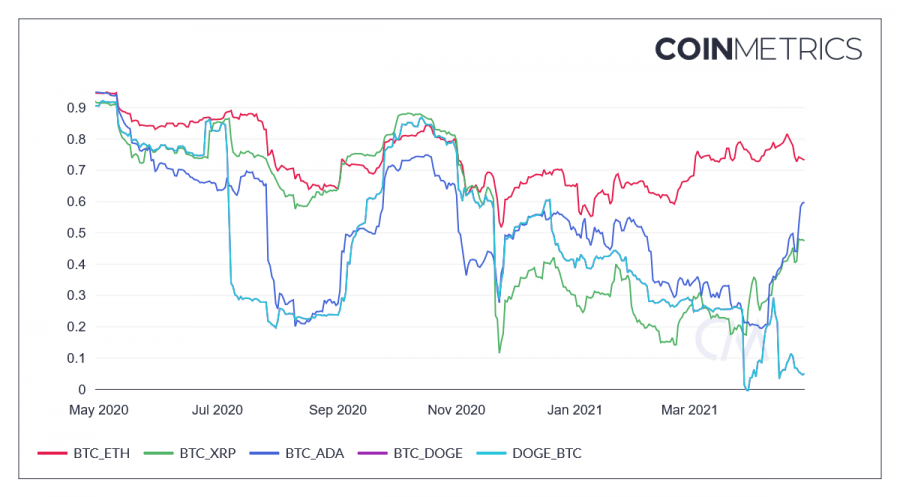
The logical extension of this decline in dominance is that correlations between bitcoin and other coins have also begun to subside. As far back as a year ago, pretty much all the leading cryptoassets had a correlation with BTC of 0.9 and above (1 being the maximum), but in recent weeks this figure has sunk below 0.3 for many of the top-ten cryptos.

Opinion among analysts regarding this decline is mixed. While some claim it’s the temporary result of an expansionary bull market, others say that declining correlations represent a fundamental shift in the industry, as other coins beyond BTC increasingly prove their value propositions to investors.

Been there, done that

If you rewind to the end of April 2020, ethereum (ETH)XRPdogecoin (DOGE), and cardano (ADA) were all heavily correlated with bitcoin, at ratios of 0.95, 0.92, 0.91 and 0.95, respectively. Basically, whenever bitcoin rose or fell in price they all did the same, with their movements arguably little more than an expression of bitcoin’s performance.

As the graph below indicates, things began to change in the second half of the year.

There was a gradual subsidence up until July/August, when bitcoin (and to a lesser extent, ethereum) began rising in price, leaving many altcoins behind. Despite a recovery in correlations in October, things began to drop again from November, when bitcoin’s bull run really began picking up momentum.

Again, there was a partial recovery leading into January of this year, but correlations have been falling quite heavily since February. This is precisely when numerous altcoins began making up for lost time, rising in price as many bullish investors looked for the next big thing (now that BTC may seem a little expensive).

“The weakening correlation between major altcoins and bitcoin in a bull market is not new. As ETH and top altcoins rally during bullish spells, they often post higher returns compared to BTC, which in turn causes the correlation to drop,” said Robbie Liu, a market analyst at OKEx Insights.

Liu noted that pretty much the same phenomenon was observed during the 2017–2018 bull run. “The most notable example was in January 2018, when the correlation coefficient between BTC and ETH fell from above 0.8 to a negative value,” he told Cryptonews.com.

Nearly every analyst agrees that the drop in correlations is largely the product of the current bull market.

“In the 2017 bull market, bitcoin led the pack early on, but as investors gained confidence in the longevity of the boom, they increasingly looked to invest in smaller cryptos, which started to push those prices up faster than bitcoin’s. It’s the same story again in 2021,” said Glen Goodman, a cryptoasset analyst and author of The Crypto Trader.

Is it different this time?

Opinion is split on whether this drop in correlation is permanent or temporary.

“Market participants are learning that many cryptocurrencies offer different value propositions. This is becoming more evident as we begin to see development in the space highlighting these differences,” said Joel Kruger, a trader and strategist at LMAX.

However, for other analysts, ‘value proposition’ refers mostly to the potential for a quick buck.

“What we are seeing now is an overhyped and oversubscribed market. There is an overflow in liquidity. Community members and supporters are buying some of the altcoins thinking that it will give them 10-20x [return on investment],” said crypto advisor and investor Anndy Lian, adding that many investors likely believe that BTC has hit its maximum price level for the current period.

Of course, the truth often lies somewhere in the middle. For Quantum Economics analyst Lou Kerner, the overexuberance of the current bull market is a big factor in rising altcoins, but it certainly isn’t the only one.

“The other factor at work is some projects are scaling rapidly (e.g. UniswapPolkadotBinance) creating significant value, bringing down bitcoin’s dominance,” he told Cryptonews.com.

What this means is that, while certain fundamental shifts have taken place, we may also expect a return to greater bitcoin dominance in the event of a more bearish market.

“The rapid growth of DeFi in the past year gives ETH better fundamentals than before,” said Robbie Liu.

“However, just like what happened after January 2018, after the bull market ends, bitcoin’s dominance is likely to pick up and alts will begin underperforming the market leader.”

Implications for traders and investors

Regardless of how permanent the shift is, analysts agree that it’s good for traders and investors, given that declining correlations provide them with the opportunity to diversify.

“A decline in correlation should be a most welcome development as it opens up more opportunities to trade into different value propositions within the emerging space,” said Joel Kruger.

Robbie Liu takes a very similar position, saying that the decline in correlations provides smaller traders with more of an opportunity for outsized gains.

“For retail investors with small amounts of capital and a higher tolerance for risk, the current decline in correlation is a welcome shift, presenting them with more opportunities to reap higher gains,” he said.

Assuming that the divergence in correlations persists into the future, this would ultimately be a win for traders, investors and the wider industry alike.

As Glen Goodman concluded, declining correlations would be a sign that the market is maturing.


Anndy Lian is an early blockchain adopter and experienced serial entrepreneur who is known for his work in the government sector. He is a best selling book author- “NFT: From Zero to Hero” and “Blockchain Revolution 2030”.

Currently, he is appointed as the Chief Digital Advisor at Mongolia Productivity Organization, championing national digitization. Prior to his current appointments, he was the Chairman of BigONE Exchange, a global top 30 ranked crypto spot exchange and was also the Advisory Board Member for Hyundai DAC, the blockchain arm of South Korea’s largest car manufacturer Hyundai Motor Group. Lian played a pivotal role as the Blockchain Advisor for Asian Productivity Organisation (APO), an intergovernmental organization committed to improving productivity in the Asia-Pacific region.

An avid supporter of incubating start-ups, Anndy has also been a private investor for the past eight years. With a growth investment mindset, Anndy strategically demonstrates this in the companies he chooses to be involved with. He believes that what he is doing through blockchain technology currently will revolutionise and redefine traditional businesses. He also believes that the blockchain industry has to be “redecentralised”.

j j j