Vitalik Buterin Calls for Inclusion of Prediction Markets, DAOs in Creator Coin Ecosystem

Vitalik Buterin Calls for Inclusion of Prediction Markets, DAOs in Creator Coin Ecosystem
A combination of prediction market mechanisms and decentralized autonomous organizations may be key to improving the growth and utility of creator coins, according to Ethereum co-founder Vitalik Buterin.

Tweeting one of his characteristic mini-essays on Sunday, Buterin offered his take on how he “would do creator coins,” which he suggested do not currently match Substack in terms of providing meaningful incentives to creators.

He said that Substack is successful in ensuring that “high quality” creators generally become the most popular on its platform, and that for the most part these creators “are people who would not have been elevated without Substack’s presence.”

By contrast, he suggests that the current crop of creator coin platforms, such as Zora, tend to elevate creators who already “have very high social status” and who are notable primarily for reasons unrelated to their content.

A two-track solution

As a solution to this, Buterin suggested a combination of two mechanisms: creator DAOs dedicated to particular subjects and/or types of content; and prediction markets for creator coins.

According to Buterin, the DAOs would be modestly sized (no greater than 200 members) and would anonymously vote for the inclusion of new members (and the exclusion of old ones).

On the other side of the equation, the prediction markets would place bets on which creators would be admitted to which DAOs, doing so presumably by trading the coins of specific creators.

Such markets effectively become a discovery mechanism for creator DAOs, who can look to prediction markets to see which new creators may be deserving of membership.

Conversely, Buterin says that a “portion of […] proceeds” from a given DAO will be used to burn the coins of a creator who is selected for membership, something which would in theory increase the value of their coin by reducing the supply.

The two elements in this system reinforce and support each other, while ensuring that creator coins do not simply become the objects of pure speculation.

“This way, the token speculators are NOT participating in a recursive-speculation attention game backed only by itself,” Buterin wrote. “Instead, they are specifically being predictors of what new creators the high-value creator DAOs will be willing to accept.”

Concluding the post, Buterin says that the “ultimate decider” of which creators/creator coins become prominent will not be speculators, but rather the creators themselves, who produce good enough content to earn admission into a DAO.

Maximizing accountability

In a follow-up tweet, the Ethereum co-founder goes on to describe the prediction market layer as “maximally open” and one that “maximizes accountability,” while he suggests that the DAO layer “maximizes space for intrinsic motivation” (i.e. motivation to create content).

Buterin then suggests that a prediction market is the correct way to organize a “decentralized executive,” since it would provide the highest degree of accountability in a permissionless context.

While his views did draw some skepticism from certain industry figures, including Dogecoin founder Bill Markus (who described creator coins as an “inherently flawed concept”), others see the logic in his suggestions.

“[Buterin] proposes a two-layer system: an inner, non-tokenized DAO of high-quality creators who curate membership based on taste and alignment (like Protocol Guild), and an outer prediction market where speculators trade creator coins whose value is tied to DAO admission,” said Anndy Lian, an intergovernmental blockchain advisor and author, who also replied to Buterin’s initial post.

Speaking to Decrypt, Lian agreed that within this kind of system, token value would be anchored by real revenue, given that final judgements related to membership would reside with creators.

He said, “I think his model thus leverages decentralization without sacrificing curation, recognizing that surfacing quality requires mission-driven, opinionated communities – not neutral, open markets.”

Lian also agrees that creator coins and creator coin platforms remain flawed as they are, since they generally treat attention as synonymous with value, rewarding celebrity or pure speculation instead of serious work.

“Vitalik’s proposal cuts through that by making token economics dependent on curation, not clicks,” he said. “If a creator gets into a high-trust DAO, their token gets backed by real revenue flows.”

Loxley Fernandes, Co-Founder and CEO of prediction market Myriad, called the evolution of social media economics using prediction market mechanics “compelling.”

Fernandes, whose prediction market Myriad is owned by Decrypt‘s parent company Dastan, noted that the technology enables communities to “define values and standards, while markets forecast outcomes within those constraints.” Together, he added, they are “far more robust than letting speculation or follower counts decide who or what matters.”


Source: https://decrypt.co/356902/vitalik-buterin-calls-for-inclusion-of-prediction-markets-daos-in-creator-coin-ecosystem?amp=1


Anndy Lian is an early blockchain adopter and experienced serial entrepreneur who is known for his work in the government sector. He is a best selling book author- “NFT: From Zero to Hero” and “Blockchain Revolution 2030”.

Currently, he is appointed as the Chief Digital Advisor at Mongolia Productivity Organization, championing national digitization. Prior to his current appointments, he was the Chairman of BigONE Exchange, a global top 30 ranked crypto spot exchange and was also the Advisory Board Member for Hyundai DAC, the blockchain arm of South Korea’s largest car manufacturer Hyundai Motor Group. Lian played a pivotal role as the Blockchain Advisor for Asian Productivity Organisation (APO), an intergovernmental organization committed to improving productivity in the Asia-Pacific region.

An avid supporter of incubating start-ups, Anndy has also been a private investor for the past eight years. With a growth investment mindset, Anndy strategically demonstrates this in the companies he chooses to be involved with. He believes that what he is doing through blockchain technology currently will revolutionise and redefine traditional businesses. He also believes that the blockchain industry has to be “redecentralised”.
j j j

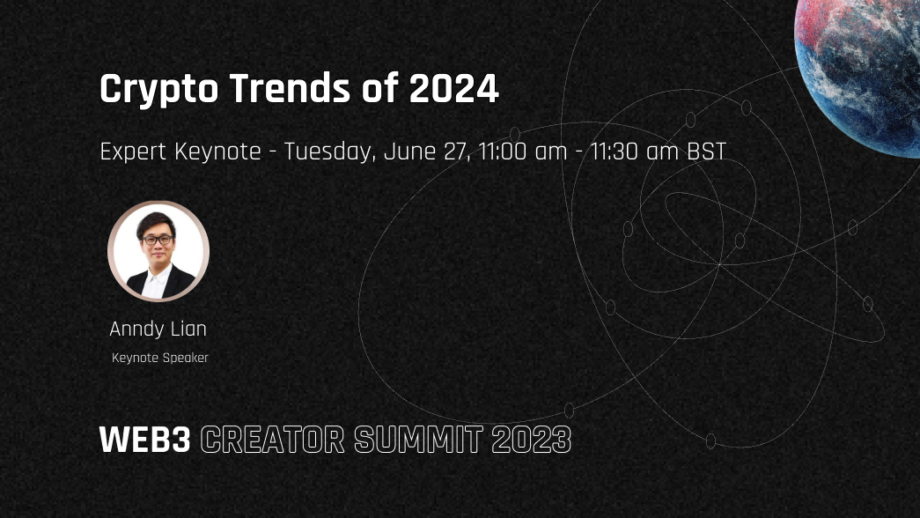
Web3 Creator Summit Expert Keynote: Crypto Trends of 2024 by Anndy Lian

Web3 Creator Summit Expert Keynote: Crypto Trends of 2024 by Anndy Lian

As we look into the future of the crypto industry, it’s essential to anticipate the trends and developments that will shape the landscape in 2024. I discussed the transformative power of artificial intelligence (AI), the significance of Central Bank Digital Currency (CBDC), the advancement of the crypto travel rule, and the shift towards decentralized governance, among other topics. Let’s explore these predictions further:

Artificial Intelligence: Transforming Everyday Life

I believe that AI will continue to disrupt various sectors and seamlessly integrate into our daily lives. Its impact is expected to be profound, reshaping industries and revolutionizing the way we interact and conduct business.

CBDC: A Game-Changer for the Crypto Industry

I place great emphasis on the significance of Central Bank Digital Currency (CBDC) as a pivotal element in tracking, tracing, and taxing financial transactions. The introduction of CBDCs holds the potential to drive the widespread adoption of digital assets and revolutionize the crypto industry as a whole. The enhanced transparency and accountability provided by CBDCs have the capacity to reshape our perception of and engagement with cryptocurrencies.

Crypto Travel Rule: Advancing Traceability and Taxation

The imminent advancement of the crypto travel rule aims to elevate traceability and taxation within the crypto space. By implementing stricter regulations, authorities can ensure that transactions are closely monitored, leading to a more secure and transparent ecosystem for all participants.

Layer 2: The Growing Influence of Bitcoin and Ethereum

I highlight the continued growth of Bitcoin and Ethereum, the two leading cryptocurrencies. Additionally, the rise of BRC20 tokens and the development of zero-knowledge proofs (ZK) are expected to contribute to the expansion of Layer 2 solutions. These advancements promise to enhance scalability, security, and efficiency within blockchain networks, fostering an environment conducive to widespread adoption.

Next Level NFT: Adoption and Brand Recognition

Non-Fungible Tokens (NFTs) have experienced increased adoption, thanks to the support and endorsement of major brands. Although the sales volume of NFTs has not seen significant growth, their relevance and influence continue to expand. NFTs provide unique digital assets that hold intrinsic value and can be securely traded on blockchain platforms, revolutionizing the concept of ownership and collectibles.

Web4: A Decentralized and Autonomous Web

The emergence of Web4 signifies a paradigm shift towards a more decentralized and autonomous web. Internet natives are actively participating in building decentralized narratives and fostering a more inclusive online environment. This transition aims to empower individuals and ensure that digital spaces remain democratic and accessible to all, free from the control of centralized entities.

Security Tokens: Advancing Crypto’s Potential

Security tokens play a vital role in unlocking the full potential of the crypto market. By tokenizing traditional financial assets such as stocks and bonds, the adoption of security tokens has the potential to revolutionize traditional markets and attract a broader investor base to the world of crypto. This democratization of access to financial assets promises to reshape the investment landscape.

Commodity Trading with Crypto: Expanding Possibilities

The integration of cryptocurrencies into commodity trading markets opens up exciting new possibilities for investors. From oil to gold, crypto enables individuals to seamlessly trade popular commodities, providing greater flexibility and choice while reducing traditional barriers to entry.

Mainstream Adoption: Defi and Financial Institutions

Decentralized finance (Defi) is gaining traction among mainstream financial companies. Banks, their clients, and family offices are increasingly allocating a significant portion of their assets to crypto. This mainstream acceptance further solidifies the legitimacy and potential of Defi as an integral part of the financial ecosystem, encouraging wider adoption and collaboration.

In conclusion, these predictions offer valuable insights into the future of various industries. Embracing the disruptions brought about by artificial intelligence, CBDCs, decentralized governance, and other emerging trends will be essential for individuals and businesses to thrive in an ever-changing world. By leveraging these transformative forces, we can unlock new opportunities, reshape traditional models, and shape a future that is both innovative and inclusive.


Anndy Lian is an early blockchain adopter and experienced serial entrepreneur who is known for his work in the government sector. He is a best selling book author- “NFT: From Zero to Hero” and “Blockchain Revolution 2030”.

Currently, he is appointed as the Chief Digital Advisor at Mongolia Productivity Organization, championing national digitization. Prior to his current appointments, he was the Chairman of BigONE Exchange, a global top 30 ranked crypto spot exchange and was also the Advisory Board Member for Hyundai DAC, the blockchain arm of South Korea’s largest car manufacturer Hyundai Motor Group. Lian played a pivotal role as the Blockchain Advisor for Asian Productivity Organisation (APO), an intergovernmental organization committed to improving productivity in the Asia-Pacific region.

An avid supporter of incubating start-ups, Anndy has also been a private investor for the past eight years. With a growth investment mindset, Anndy strategically demonstrates this in the companies he chooses to be involved with. He believes that what he is doing through blockchain technology currently will revolutionise and redefine traditional businesses. He also believes that the blockchain industry has to be “redecentralised”.

j j j

The Future of NFT’s @ Web3 Creator Summit 2023 Wishu

The Future of NFT’s @ Web3 Creator Summit 2023 Wishu

The highly anticipated Web3 Creator Summit 2023 is set to delve into the future of Non-Fungible Tokens (NFTs), showcasing the groundbreaking potential and emerging trends in the NFT space. The summit, which brings together influential voices and key players in the blockchain and digital art industries, will serve as a platform for in-depth discussions, inspiring presentations, and engaging panels on the evolution of NFTs and their impact on the Web3 ecosystem.

With NFTs gaining significant traction in recent years, the Web3 Creator Summit 2023 aims to shed light on their transformative power and explore the possibilities they present for creators, collectors, and enthusiasts alike. The event will feature renowned speakers, including leading artists, technologists, entrepreneurs, and thought leaders, who will share their insights, experiences, and visions for the future of NFTs.

The panel covers the topic – The Future of NFT’s. Jenny Zheng, BD Lead; Bybit NFT; Karen Shidlo, CMO, Fiat24; Hugo Gong, Lecturer, Westminister Business School, and Anndy Lian, Intergovernmental Blockchain Advisor shared their views on the future of NFT. Carmac Rowe, an NFT Enthusiast, is the moderator.

The future of Non-Fungible Tokens (NFTs) holds immense potential and offers numerous intriguing possibilities. NFTs have garnered significant attention in recent years, and their impact on various industries is poised to continue expanding. Let’s explore some key aspects that shape the future of NFTs.

Expanded Adoption: While NFTs have primarily been associated with digital art, their applications are diversifying rapidly. In the future, we can anticipate NFTs being utilized across domains such as music, movies, virtual real estate, fashion, sports, and even physical assets like property deeds or collectibles. This broader adoption will unlock fresh opportunities for creators, artists, and investors, fueling innovation and growth.

Enhanced Interactivity: NFTs possess the potential to revolutionize the way people engage with digital content. By linking additional benefits or experiences to NFT ownership, artists and creators can offer exclusive access to events, virtual meet-and-greets, or personalized content. This heightened interactivity and engagement can elevate the value and desirability of NFTs, fostering deeper connections between creators and their audiences.

Governance and Royalties: Smart contracts associated with NFTs can be programmed to automatically distribute royalties to creators whenever the NFTs are sold or traded. This unique feature ensures that artists receive ongoing compensation for their work, even in secondary market transactions. Moreover, NFTs can incorporate governance features, enabling token holders to actively participate in decision-making processes related to associated projects or communities, fostering transparency and inclusivity.

Sustainability and Environmental Concerns: NFTs have faced criticism regarding their environmental impact, primarily due to the energy consumption of blockchain networks like Ethereum. However, ongoing efforts are underway to address these concerns by adopting more energy-efficient consensus algorithms or exploring alternative blockchain platforms. The future of NFTs will likely witness an increased emphasis on sustainability and the integration of environmentally friendly practices to minimize their ecological footprint.

Evolving Standards and Interoperability: Currently, different blockchain networks have their own NFT standards, such as ERC-721 and ERC-1155 on Ethereum. In the future, we might witness the development of interoperable standards that enable seamless transferability of NFTs across different blockchains. This interoperability can significantly enhance liquidity and extend the reach of NFTs, fostering a more interconnected ecosystem.

It is important to note that the future of NFTs is still evolving, and the technology is subject to rapid changes and advancements. As with any emerging field, there are inherent risks and challenges to navigate. However, the unique properties of NFTs, such as their ability to authenticate and prove ownership, as well as their potential to create new economic models, make them an intriguing concept with significant potential in the years to come. By responsibly harnessing this potential, we can unlock a future where NFTs empower creators, reshape ownership paradigms, and revolutionize industries worldwide.

Anndy Lian is an early blockchain adopter and experienced serial entrepreneur who is known for his work in the government sector. He is a best selling book author- “NFT: From Zero to Hero” and “Blockchain Revolution 2030”.

Currently, he is appointed as the Chief Digital Advisor at Mongolia Productivity Organization, championing national digitization. Prior to his current appointments, he was the Chairman of BigONE Exchange, a global top 30 ranked crypto spot exchange and was also the Advisory Board Member for Hyundai DAC, the blockchain arm of South Korea’s largest car manufacturer Hyundai Motor Group. Lian played a pivotal role as the Blockchain Advisor for Asian Productivity Organisation (APO), an intergovernmental organization committed to improving productivity in the Asia-Pacific region.

An avid supporter of incubating start-ups, Anndy has also been a private investor for the past eight years. With a growth investment mindset, Anndy strategically demonstrates this in the companies he chooses to be involved with. He believes that what he is doing through blockchain technology currently will revolutionise and redefine traditional businesses. He also believes that the blockchain industry has to be “redecentralised”.

j j j