BTC / USD forecast: Can bitcoin reverse downward trend as crypto winter bites?

BTC / USD forecast: Can bitcoin reverse downward trend as crypto winter bites?

Since its November 2021 all-time high, Bitcoin (BTC), the world’s biggest cryptocurrency, has lost over 70% of its value, in line with the broad cryptocurrency markets. The harsh crypto winter was sparked by surging inflation, risk-off sentiment amid recession fears and the crash of the TerraUSD (UST) stablecoin.

Will the cryptocurrency pioneer ever resurface? We take a look at the key factors driving the BTC/USD forecast in 2023 and beyond.

What is BTC/USD?

BTC/USD is the exchange rate of bitcoin against the US currency. BTC to USD measures how many USD are required to purchase one bitcoin.

Created in 2009, Bitcoin, the first ever decentralised digital currency, acts as a peer-to-peer payments system. It uses no central authorities or banks to manage transactions, which are instead organised “collectively by the network”.

The cryptocurrency was invented  by an anonymous person or group of people under the pseudonym Satoshi Nakamoto. It has since established itself as one of the most popular digital assets. The first ever BTC token, the so-called genesis block, was mined in January 2009.

Bitcoin’s blockchain uses a Proof-of-Work (PoW) consensus mechanism, which is secured by miners verifying BTC transactions in exchange for BTC reward. The process is known as crypto mining.

These rewards are cut in half after every 210,000 blocks are mined, or approximately every four years, in halving events, thus reducing the amount of overall BTC coins in circulation and raising the cryptocurrency’s price by cutting supply.

The most recent halving event took place on 11 May 2021, when bitcoin’s block reward was reduced to 6.25BTC. The next halving event is estimated to take place in 2024.

In addition to being a “peer-to-peer version of electronic cash” bitcoin is also now used as a store of value. Bitcoin has a maximum supply of 21 million tokens.

BTC/USD price history

It has taken BTC to USD around eight years to surge past $1,000 since its launch in 2009. In 2017, the cryptocurrency saw a good run, rising by 1,600% within a year from $1,044.4 at the start of January 2017 to $17,760.3 by 20 December 2017 – a then all-time high.

However, a steep sell-off at the start of 2018 interfered, bringing the bitcoin’s price down to $7,637.86 by 8 February 2018. BTC continued to decline falling to $3,000 by 10 December 2018.

The cryptocurrency peaked once again in the beginning of July 2019, surpassing $12,000 for a brief time before losing over 58% of its value and dropping to $5,000 by 13 March 2020.
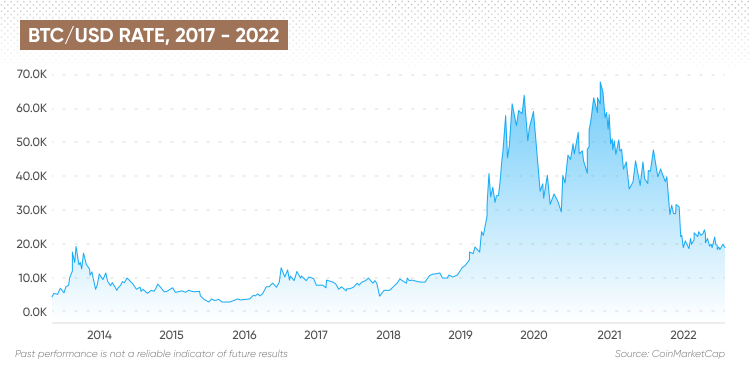
BTC/USD RATE 2017-2022

In 2021, the cryptocurrency enjoyed another bull run, the biggest in its history. By 8 January 2021, the token was valued at around $ 39,000. On 16 April 2021, bitcoin reached its first peak at $63,258.51 – a surge of around 62%. BTC’s price continued to rise, reaching the all-time high of $67,549.74 on 9 November 2021.

In 2022, the coin has been experiencing one of the harshest crypto winters yet, losing nearly 72% since the November 2021 highs, and is currently (12 October) hovering at $19,000.

What’s shaping the BTC/USD forecast?

The cryptocurrency market has been affected by a number of factors in 2022 such as with the war in Ukraine, the collapse of the TerraUSD (UST) stablecoin and rising inflation. Peter Eberle, president and chief investment officer of Castle Funds, told Capital.com:

“The first half of 2022 was horrible for equity, bond and crypto markets. A confluence of macro factors such as Russia’s invasion of Ukraine, US Policy makers’ slow realisation that inflation was real, then the aggressive pivot to higher interest rates, supply chain issues due to China’s Covid polices all led to a steep sell off across markets.”

Eberle added that Terra’s “meltdown”, which led to the subsequent fall of its sister cryptocurrency, LUNA, “created cascading liquidations across multiple platforms”, affecting not only the BTC/USD price but also several hedge funds, including Three Arrow Capital and Celsius Network.

On 9 June, bitcoin briefly traded above $31,000, however, this soon turned into a selloff, which saw the cryptocurrency lose over 90% of its minor gains, falling to $19,000 10 days later. Since then, BTC has been fluctuating, trading between $23,000 and $19,000.

“At the end of the 2nd quarter many in the industry were waiting for the proverbial ‘next shoe to drop’, but fortunately things calmed down,” Eberle noted.

Anndy Lian, chief digital advisor at the Mongolian Productivity Organisation and author of NFT: From Zero to Hero, said that bitcoin’s price depends on the outcomes of the Federal Reserve’s (Fed) meetings and decisions on monetary policy tightening, as well as latest inflation readings such as Producer Price Index (PPI) and the Consumer Price Index (CPI).

“However, I am not pessimistic. The mining companies have endured tough times. Despite the high hash rate, bitcoin’s price has not significantly increased. This signals that the miners are not piling the network to obtain big gains on bitcoin, they are confident that the mining business will do well now that the network has proven staying power.”

Historically, October has been a good month for cryptocurrencies, with bitcoin’s price change averaging at 14.6% gain in October since 2011, Capital.com’s seasonality research showed. Yet this year proves to be different.  Castle Fund’s Eberle noted:

“The third quarter of 2022 showed consolidation in the crypto market while equities and bonds continue to slump. The Dow Jones Industrial Average dropped 6.2%, Bitcoin dropped 2% but saw significantly lower volatility and the broader crypto market capitalization increased by 8.5%.”

Bitcoin to US dollar forecasts are currently focusing on macro events, Eberle added, specifically the Fed’s interest decisions, the future outcomes of the Russia-Ukraine conflict and the US midterm elections that are due to take place on 8 November. In addition, Eberle added some historical outlook concerning bitcoin’s past halving events:

“In 2015 BTC bottomed 547 days before the halving and in 2018 is occurred 517 before. The next halving is estimated to happen in April or May of 2024 so if history repeats we should be nearing the beginning of the next bull market.”

BTC/USD forecast 2022 and beyond

Despite the latest downward price action, algorithm-based forecasting service Wallet Investor gave a bullish BTC/USD forecast at the time of writing (12 October). The site noted that BTC was “a very good long-term investment”.

Based on its analysis of past price performance, WalletInvestor predicted that BTC/USD could trade at $25,373.90 in 2023 and surge to $47,496.74 in 2027.

DigitalCoinPrice supported the positive BTC/USD forecast but saw a speedier pace of growth in the following years, expecting the cryptocurrency to reach $24,206.47 by the end of 2022 and $43,340.43 by the end of 2023.

Its BTC/USD forecast for 2025 showed the cryptocurrency reaching $77,238.07 on average and $94,929.40 in 2027. The platform’s long-term BTC/USD forecast for 2030 expected the cryptocurrency to surge to $266,189.92 on average.

Lian did share the bullish sentiment on BTC to USD forecast:

“Bitcoin price hovers around $19,400, up 1.9% in the last week. Zooming out, it has gained 1% in value for the past 30 days. Unless we see the S&P 500 go down to 3200, bitcoin can go below the $13,000 region, else I think it will continue to trend sideways for the next few weeks.”

However, Lian noted that a positive aspect to highlight would be bitcoin’s hash rate which continues to surge.

Note that BTC/USD predictions can be wrong. Analysts’ and algorithm-based predictions shouldn’t be used as a substitute for your own research.

Always conduct your own due diligence on the stock before trading, looking at the latest news, a wide range of analyst commentary, technical and fundamental analysis. Note that past performance does not guarantee future returns. And never trade money you cannot afford to lose.


Source: https://capital.com/btc-usd-forecast-dollar-bitcoin-price

Anndy Lian is an early blockchain adopter and experienced serial entrepreneur who is known for his work in the government sector. He is a best selling book author- “NFT: From Zero to Hero” and “Blockchain Revolution 2030”.

Currently, he is appointed as the Chief Digital Advisor at Mongolia Productivity Organization, championing national digitization. Prior to his current appointments, he was the Chairman of BigONE Exchange, a global top 30 ranked crypto spot exchange and was also the Advisory Board Member for Hyundai DAC, the blockchain arm of South Korea’s largest car manufacturer Hyundai Motor Group. Lian played a pivotal role as the Blockchain Advisor for Asian Productivity Organisation (APO), an intergovernmental organization committed to improving productivity in the Asia-Pacific region.

An avid supporter of incubating start-ups, Anndy has also been a private investor for the past eight years. With a growth investment mindset, Anndy strategically demonstrates this in the companies he chooses to be involved with. He believes that what he is doing through blockchain technology currently will revolutionise and redefine traditional businesses. He also believes that the blockchain industry has to be “redecentralised”.

j j j

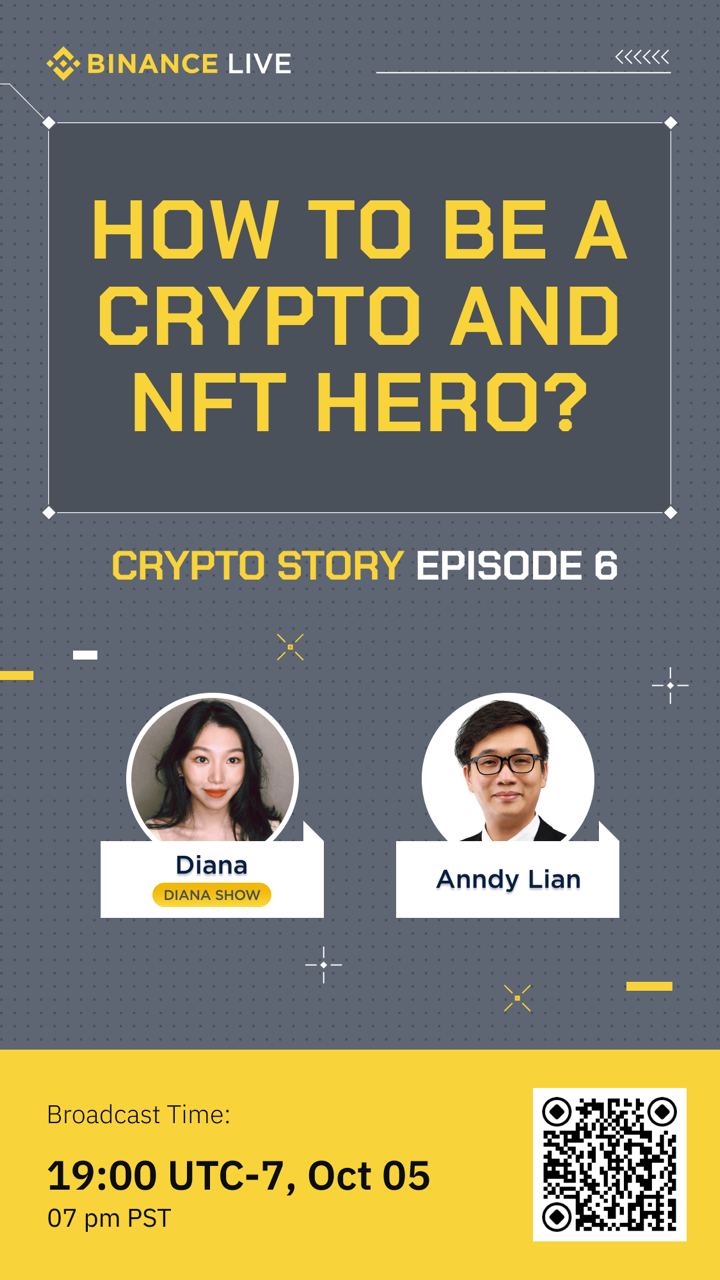
Anndy Lian, Author “NFT: From Zero to Hero” Goes on Binance Live: How to be a Crypto and NFT Hero?

Anndy Lian, Author “NFT: From Zero to Hero” Goes on Binance Live: How to be a Crypto and NFT Hero?

Anndy Lian speaks to Diana on Binance Live, a live stream video hub by Binance about his new book titled “NFT: From Zero to Hero”.

Diana walks through all 9 Chapters of Anndy’s book.

Chapter 1: The Beginning, Web 1, 2, 3
Chapter 2: An Overview of the NFT Industry
Chapter 3: What Are the Necessary Tools Available?
Chapter 4: How To Spot A Good NFT Project?
Chapter 5: How To Make an NFT?
Chapter 6: Case Studies
Chapter 7: Predictions for the Future of Art NFTs
Chapter 8: NFT Trends Shaping the Future of NFTs
Chapter 9: Insights Into the Future

The future of NFT is still very bright. A number of countries are now actively working on regulatory frameworks for NFT assets, strengthening anti-fraud and anti-manipulation audits of projects, determining the business core of each platform, and solving financial security issues such as illegal fundraising and false fraud.

At the same time, major public chains are actively upgrading, expanding, and building their own ecological frameworks to provide underlying support for the production, confirmation, pricing, circulation, and traceability of NFT assets.

Due to the short development history of NFTs, we are still in the infancy of the industry, but we can still see its rapid development and gradual maturity. It is believed that under the transformation of the market, the improvement of supervision, and the gradual improvement of the ecosystem, then the future of NFTs will never be just about hype but will become an indispensable part of future technological life.

The NFT space is fast-changing. While writing this, new NFT projects are popping up every day. From the Busan Metropolitan Government in Korea announcing an NFT conference to the International Cricket Council launching cricket NFTs to CoinRunners crowdfunding a movie by selling NFTs.

“We should embrace technology and build the ecosystem together. Crypto is still young and we are all pioneers in this field. If you want to be an NFT Hero. Join me.” Anndy Lian

Binance is a cryptocurrency exchange which is the largest exchange in the world in terms of daily trading volume of cryptocurrencies. Changpeng Zhao, who goes by CZ, is the founder and CEO.

Find out more about NFT: From Zero to Hero by Anndy Lian on Amazon: https://www.amazon.com/NFT-Zero-Hero-Anndy-Lian/dp/9811850887/

Source: https://www.binance.com/en/live/video?roomId=2110403

Anndy Lian is an early blockchain adopter and experienced serial entrepreneur who is known for his work in the government sector. He is a best selling book author- “NFT: From Zero to Hero” and “Blockchain Revolution 2030”.

Currently, he is appointed as the Chief Digital Advisor at Mongolia Productivity Organization, championing national digitization. Prior to his current appointments, he was the Chairman of BigONE Exchange, a global top 30 ranked crypto spot exchange and was also the Advisory Board Member for Hyundai DAC, the blockchain arm of South Korea’s largest car manufacturer Hyundai Motor Group. Lian played a pivotal role as the Blockchain Advisor for Asian Productivity Organisation (APO), an intergovernmental organization committed to improving productivity in the Asia-Pacific region.

An avid supporter of incubating start-ups, Anndy has also been a private investor for the past eight years. With a growth investment mindset, Anndy strategically demonstrates this in the companies he chooses to be involved with. He believes that what he is doing through blockchain technology currently will revolutionise and redefine traditional businesses. He also believes that the blockchain industry has to be “redecentralised”.
j j j

Who owns the most voyager crypto? VGX tokens are also distributed among troubled platform’s customers

Who owns the most voyager crypto? VGX tokens are also distributed among troubled platform’s customers

Voyager Digital has been making headlines ever since the crypto platform filed for Chapter 11 bankruptcy protection in July 2021. The company is engaged in ongoing court proceedings.

Here we take a look at the voyager (VGX) tokens circulating supply and analyse who owns the most VGX.

Voyager Digital: Origins & token history

Voyager Digital is a US-based cryptocurrency platform that was founded in 2017 by a team of finance and technology industry veterans, including the firm’s CEO Stephen Ehrlich, chairman Philip Eytan and Gaspard de Dreuzy, a serial entrepreneur.

In addition to being a crypto company, Voyager Digital is a publicly traded company listed on the Toronto Stock Exchange (TSX) since 2021 under the ticker VOYG.

As of September 2022, the company hosts over 100 different digital assets through its mobile application and allows clients to earn rewards of up to 12% annually on more than 40 cryptocurrencies.

The Voyager token (VGX) is the platform’s native cryptocurrency. It’s designed to reward customers for their loyalty. It was based on the Ethos Token. In 2019, Voyager acquired Ethos.io and incorporated the team, technology and native token into its ecosystem.

Until 2020, Voyager operated with a multi-token functionality. After 2020, the company integrated its native tokens into a new single token model known as VGX 2.0. Today, VGX maintains a presence on the Ethereum blockchain as an ERC20 cryptocurrency.

According to the project’s whitepaper, Voyager utilises the VGX 2.0 token to boost the platform’s adoption and functionality. Holding VGX allowed users to earn 7% staking rewards and raise their earnings by joining the Voyager Loyalty Program.

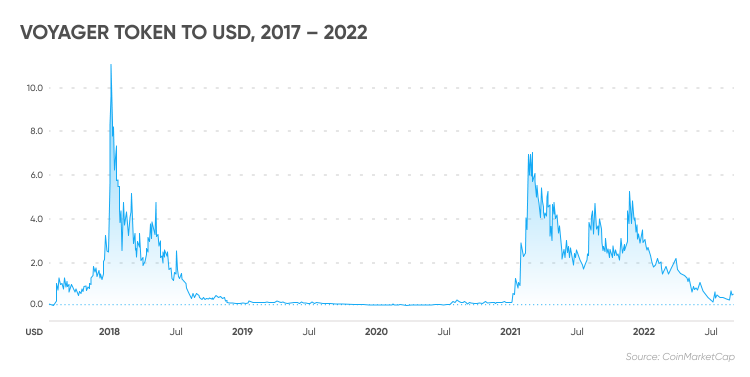
The VGX token was met with enthusiasm. The price rose to an all-time high of $11.02 just six months after the token launched in 2017. The bullish run was short-lived, and the price fell by 96.7% to $0.3678 by August 2018.

Voyager token to USD, 2017 – 2022

The next big jump took place between January and February 2021, when VGX surged 3,267% to $6.9023, from levels as low as $0.2. Around this time, the Uniswap (UNI) token became available on the Voyager platform.

On 22 November 2021, VGX surged to $5 amid a positive general crypto market sentiment, however, this was the token’s last peak as it embarked on a bearish run. But since its November high, the VGX has lost more than 75% of its value, sliding down to $0.9188.

Latest voyager crypto news

In July 2021 Voyager filed for Chapter 11 bankruptcy protection, as it was heavily affected by the global crypto crash. Since then, the company has been in and out of court proceedings.

As Voyager moves through the Chapter 11 bankruptcy process, latest filings revealed on 8 September that the company will auction off the remainder of its assets on 13 September. The results of the auction will become final during a court hearing approving them on 29 September.

In the latest voyager token news, potential buyers remained unnamed. However, bids previously made by the crypto trading platform FTX were made public. FTX said in a press release on 22 July that it would buy Voyager’s assets and loans at cash value and open accounts for Voyager customers on FTX. This proposal, however, was branded a “low-ball” bid by Voyager’s lawyers.

In a second-day hearing presentation on 4 August, the company stated that it had received “higher and better” buyout offers. As of 12 September, Voyager said that it was contacted by 88 potentially interested buyers and was in “active discussions” with 20.

Who owns the most Voyager crypto?

So, who owns the most Voyager crypto and how is the token distributed?

When Voyager decided to integrate its tokens (VGX and LGO (the native token of a company Voyager acquired) into one, VGX was exchanged for VGX 2.0 (now known as VGX) at a 1:1 rate. LGO’s exchange rate to VGX 2.0 was 6.5356340619:1.

The circulating supply of VGX tokens stood at 222 million. The circulating supply of LGO was over 33 million. Following the token swap, Voyager chose to mint a growth pool of tones on an annual basis to power Voyager Loyalty Program rewards, as well as fund promotional campaigns for new and existing customers.

Hence, 40 million new tokens were minted in the first year since the integration, 20 million will be minted in the second year and 10 million between the third and eight years.

According to data provided by CoinMarketCap, the total and circulating supply of VGX, as of 12 September, surpassed 278 million tokens. The maximum supply stood at 297 million.

Voyager also introduced a new initiative called the Voyager Loyalty Program, which Voyager customers can qualify for by maintaining a number of VGX tokens in their accounts. The programme has three tiers:

  • Adventurer – customers holding over 500 VGX
  • Explorer – customers holding over 5,000 VGX
  • Navigator – customers holding over 20,000 VGX

The more VGX customers stake, the higher they move up these tier categories and the more rewards they earn with each tier.

So, who owns the most Voyager crypto?

Over the last few months, VGX whales have gradually reduced their holdings. However, data revealed by etherscan.io showed that the top 100 VGX token holders, as of 12 September, collectively owned 97.62% of the total supply in circulation.

The website noted that the top account holding the most voyager tokens owned 93.9% of the circulating supply, which amounted to 208 million VGX tokens worth $191m, as of 12 September. According to the website, the account’s address is 0x933bb73de8fcfb74415fbc99561623c593bf3b61.

The second biggest VGX whale owned 1.9% of the total circulating supply, amounting to four million VGX tokens.

The third biggest VGX holder was an account under the address ‘Binance 8’ that held around 0.18% of the total circulating supply, amounting to around 395,757 tokens.

The fourth and fifth biggest voyager coin whales owned around 0.14% of the total circulating supply.

Final thoughts

While knowing who owns voyager crypto may be useful for the coin’s enthusiasts, it shouldn’t be used as a sole reason to trade. Nearly all of the maximum VGX supply is in circulation, as of the time of writing (12 September), which could lead to the possibility of greater volatility. Investors are warned to exercise caution.

According to Invezz’s analyst Crisous Nyaga, “uncertainty about the Voyager collapse and low volume trading could lead to market manipulation.

“The coin’s future is uncertain and it will depend on the outcome of the bankruptcy proceedings. If the firm moves completely out of business, there is a possibility that the VGX token will not survive. On the other hand, if it is acquired, there is a possibility that the coin will continue doing well.”

Anndy Lian, chief digital advisor at the Mongolian Productivity Organisation and the author of NFT: From Zero to Hero, told Capital.com that retail investors are buying VGX based on rumours that the company will be acquired by either Binance or FTX.

“I noted that the current investors are still working very hard promoting in different channels with the hope of making the VGX a more viable choice for new investors and perhaps drawing more attention so that the buyout can complete faster. These are positive signs from the community members who want the token to do well and resume their staking and cashback rewards,” he stressed.

Note that analysts’ predictions and opinions can be wrong. Always conduct your own due diligence before trading. And never invest or trade money you cannot afford to lose.


Source: https://capital.com/voyager-who-owns-most-vgx-crypto-tokens

Anndy Lian is an early blockchain adopter and experienced serial entrepreneur who is known for his work in the government sector. He is a best selling book author- “NFT: From Zero to Hero” and “Blockchain Revolution 2030”.

Currently, he is appointed as the Chief Digital Advisor at Mongolia Productivity Organization, championing national digitization. Prior to his current appointments, he was the Chairman of BigONE Exchange, a global top 30 ranked crypto spot exchange and was also the Advisory Board Member for Hyundai DAC, the blockchain arm of South Korea’s largest car manufacturer Hyundai Motor Group. Lian played a pivotal role as the Blockchain Advisor for Asian Productivity Organisation (APO), an intergovernmental organization committed to improving productivity in the Asia-Pacific region.

An avid supporter of incubating start-ups, Anndy has also been a private investor for the past eight years. With a growth investment mindset, Anndy strategically demonstrates this in the companies he chooses to be involved with. He believes that what he is doing through blockchain technology currently will revolutionise and redefine traditional businesses. He also believes that the blockchain industry has to be “redecentralised”.

j j j