Green Satoshi Token price prediction: Will M2E crypto rebound?

Green Satoshi Token price prediction: Will M2E crypto rebound?

The green satoshi token (GST), the utility token of the STEPN project, started 2022 with a high, but soon burnt out amid a wider negative shift in investor sentiment. Being the pioneer of move-to-earn (M2E) projects, STEPN, a Web3 app powered by the GST token, inspired crypto enthusiasts to exercise while earning money.

However, as the wider crypto market collapsed, following the fall of the TerraUSD stablecoin and its sister cryptocurrency LUNA, so did GST. Its price action relies on the performance of the Solana (SOL) blockchain, where  it was built.

What do experts have to say, and what other factors will shape the green satoshi token price prediction?

What is the green satoshi token?

The green satoshi token (GST) is the native cryptocurrency of the Web3 lifestyles app STEPN, according to the project’s whitepaper.

STEPN combines SocialFi and GameFi elements and is built “around an essential daily activity for most people – moving around”.

When STEPN launched in December 2021, it was the first M2E mobile non-fungible token (NFT) game powered by the Solana network. The game was created by a fintech studio based in Australia named Find Satoshi lab.

In the game, users equip themselves with NFT Sneakers and can either jog, walk or run outdoors to earn GST tokens. Players can also choose whether they want to lease or sell their NFT Sneakers on the in-app Marketplace.

“With Game-Fi, STEPN aims to nudge millions toward a healthier lifestyle, combat climate change and connect the public to Web 3.0, all while simultaneously hinging on it’s Social-Fi aspect to build a long-lasting platform fostering user generated Web 3.0 content,” the platform’s whitepaper said in a statement.

STEPN is currently under a Public Beta Phase. The application makes profit from small taxes on in-app activities, like NFT trading, Shoe-minting and Shoe-rental.In addition, part of STEPN’s profit goes to buy Carbon Removal Credit on the blockchain to combat climate change.

STEPN has a dual token system:

  • GMT is the platform’s governance token
  • GST is the platform’s utility token.

The two tokens are utilised for different purposes within the platform. GST tokens can be used to level up or mint new NFT Sneakers or even cash out for profit, meanwhile GMT tokens can be used for customisation fees.

STEPN has a burn mechanism which means tokens are available in a limited supply. Both GMT and GST tokens are burned through a number of in-app activities.

In order to become part of the STEPN community, a person must first download the STEPN mobile app, register an account and open a wallet. Users deposit SOL tokens to the built-in STEPN wallet with which they can buy NFT Sneakers.

Activity rewards motivate users to use the app everyday for sports, thus pushing them to continue to exercise.

The total supply of GST tokens amounts to a little over 286m – over 276m tokens are currently in circulation, according to data provided by CoinMarketCapas of 20 July. GST has a market capitalisation surpassing $18m and is ranked as the 621st largest cryptocurrency.

In 2021, STEPN finished fourth out of over 500 projects at the Solana Ignition Hackathon.

GST price analysis

The GST token was arguably one of the most successful tokens of 2022 as it embarked on a bullish trend shortly after launch. Debuting at $1.8451 on 22 December 2021, the token gained nearly 70% in two weeks as it reached $3.1216 on 6 January 2022.

Even though it managed to lose some momentum between 16 and 20 January, GST started a steady climb to $2.9423 by 20 February, up from $1.6839 lows a month earlier.
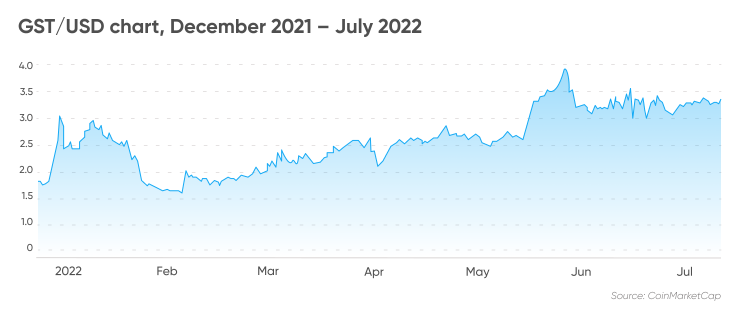
GST/USD chart, December 2021 – July 2022 

Between 1 and 6 March, the GST token jumped by nearly 50%, reaching its then all-time high of $3.9838. A second jump followed in April, when the token first reached $4.7337 on 1 April, surging to $5.4805 six days later.

After some downward action and fluctuation between $4 and $5, the token skyrocketed to $7.8233 – a 42.7% surge since its 7 April value and a 324% jump since its launch in December 2021.

Following the massive surge, the token dipped on the following day and lost over 45% of its value as it fell back to the $4 levels. The token is trading at its record lows, as of 20 July.

As of 20 July, the coin was valued at $0.06673, a 96.4% decline since its launch in December and a 99.1% fall since its all-time high in April.

This comes amid a wider shift in market sentiment to risk-off due to the tightening cycle of monetary policy, soaring inflation, the war in Ukraine, and fears of recession, with cryptocurrency veterans bitcoin (BTC) and ether (ETH) down 48% and 56% respectively year-to-date.

Key GST news that are driving the token

The GST token seemed to have been performing fairly well at the start of May. However, the positive rally was short-lived as the token soon embarked on a bearish trend following the collapse of the TerraUSD (UST) stablecoin and its sister token LUNA that brought down a sea of other cryptocurrencies.

In addition, the token was affected by a Solana outage on 30 April. The outage happened in Solana’s Mainnet Beta cluster which ceased producing blocks as result of stalled consensus. Even though the system was quickly restored and the GST token ended up dipping by 48.7% in a day.

The biggest STEPN news, however, came on 22 April, Earth Day 2022, several days before the GST token reached its all-time high, as the coin announced its goal of carbon neutrality. As the company noted:

“STEPN, a Web3 lifestyle app, is kickstarting their mission toward combating climate change and achieving carbon neutrality with a purchase of $100,000 worth of Carbon Removal Tonnes, or 5,797.1 tonnes. STEPN will continue to power the movement to reverse climate change with a monthly commitment to pay for carbon removal.”

On 27 April Coinbase announced that it would be adding support for GMT and GST tokens. A day later, OpenSea said that STEPN NFTs were “now available” on the platform.

Following the news, the GST token surged by around 65% in April to its all-time high of $7.8233.

In addition, at the start of April, STEPN released its first quarterly GMT results, which saw a profit of 198,635.62 SOL ($26,815,807.35 at the time) from the platform’s NFT marketplace trading and royalty fees.

One week later, the platform announced that over the previous few months, the app was used by 200,000 daily active users. In the aftermath of positive news, the GST cryptocurrency grew by around 15%, from $4.7337 on 1 April to $5.4422 on 8 April.

On 28 February the company announced that it was looking into launching two updates: a merge spending account with Wallet and an NFT marketplace upgrade. On 1 March the platform announced a giveaway and the token was made available to buy on the Binance Launchpad.

GST price prediction: What should traders look out for?

In the third quarter of 2022, STEPN is planning to launch the spin-off of their NFT marketplace. In the fourth quarter it plans to implement a system where players can rent each other’s sneakers for running.

According to Mark Fidelman, the founder of SmartBlocks and host of the Cryptonized podcast, the GST token “is a speculation”.

“That’s what’s driving its price action. It’s a pretty cool concept, but I don’t think the token price is going to go anywhere in the future,” he told Capital.com.

Fidelman added that whilst STEPN’s main goal is to pay people to be healthy and move around, the token has no other value that could be driving it forward.

“I mean, yes, [people] have to buy NFT’s before they can start moving around on the app and there’s some money there, but the amount of money [people] are spending, or the token is spending, on people moving can’t be paid back because there’s no underlying value there.”

Anndy Lian, the chief digital advisor at Mongolian Productivity Organisation and the author of Blockchain Revolution 2030, added that in order for GST to pick up its pace again, STEPN must try to “find a place within the GameFi space”.

“GST has to scale up or find more users sustainably. Earning $1 daily by walking seems to be more sustainable compared to $30. The company should rethink its marketing strategy for it to scale up,” Lian added.
“When that is addressed, they can find real investors who are interested in their product and not just trying to make money off it. This will also help them to position themselves to attract more prominent institutions or sports brands to buy into their company too.”

Both Lian and Fidelman agreed that STEPN proposes a unique concept, however, the company must work on their marketing strategy and value in order to return to past highs.

“STEPN is the pioneer in the move-to-earn space. This will continue to give them a good head start. I wrote a lot about them in my new book titled NFT: From Zero to Hero. My friendly piece of advice for the team is to get them to sprint and not walk,” Lian concluded.
Fidelman added: “Maybe if they figure out an exercise model that works, maybe that would work. But this has been tried with startups and failed miserably.”

Green satoshi token price prediction

In line with recent action, algorithm-based forecasting service Wallet Investor gave a bearish green satoshi token price prediction.

As of 20 July, the site called GST is “a bad investment”. According to the website’s future GST coin price prediction, the token could fall to $0.0223 in 2023.

DigitalCoinPrice on the other hand, had a more bullish view on the GST crypto price prediction.

According to its green satoshi token price prediction for 2022, the cryptocurrency could average at $0.0998 by the end of the year.

The site’s  green satoshi token price prediction for 2025 suggested that the coin could average $0.13 and $0.22 by 2028. Meanwhile, DigitalCoinPrice’s long-term green satoshi token price prediction for 2030 indicated that the cryptocurrency could average at $0.31 during the year.

Note that price predictions can be wrong. Forecasts shouldn’t be used as a substitute for your own research. Always conduct your own due diligence, and never invest or trade money you cannot afford to lose.


Original Source: https://capital.com/green-satoshi-gst-price-prediction
Anndy Lian is an early blockchain adopter and experienced serial entrepreneur who is known for his work in the government sector. He is a best selling book author- “NFT: From Zero to Hero” and “Blockchain Revolution 2030”.

Currently, he is appointed as the Chief Digital Advisor at Mongolia Productivity Organization, championing national digitization. Prior to his current appointments, he was the Chairman of BigONE Exchange, a global top 30 ranked crypto spot exchange and was also the Advisory Board Member for Hyundai DAC, the blockchain arm of South Korea’s largest car manufacturer Hyundai Motor Group. Lian played a pivotal role as the Blockchain Advisor for Asian Productivity Organisation (APO), an intergovernmental organization committed to improving productivity in the Asia-Pacific region.

An avid supporter of incubating start-ups, Anndy has also been a private investor for the past eight years. With a growth investment mindset, Anndy strategically demonstrates this in the companies he chooses to be involved with. He believes that what he is doing through blockchain technology currently will revolutionise and redefine traditional businesses. He also believes that the blockchain industry has to be “redecentralised”.

j j j

How To Prepare for the Next Crypto Bull Run

How To Prepare for the Next Crypto Bull Run

There is a lot to learn about what appears to be the first bear market since 2018 in light of recent developments in the cryptocurrency space. For both experienced and novice investors, bear markets have historically been a very trying time, with little to no gains being realized. Many investors suffer significant financial losses during bear markets as they attempt to trade despite the unpredictability of recovering from failures. For a newcomer to succeed in cryptocurrency, learning how to protect your investments and have liquidity for the next bull run is crucial. The aim of this article is to offer informed advice on how to avoid common errors in a bear market and essential steps to take in preparation for the continuation of a bull run in this article.

The upside of the newly created crypto bear market, hard by the crash of Terra and more recently the bankruptcy of 3AC, is the opportunity to improve your portfolio in crypto and NFTs. While there’s plenty of YouTubers advising you to “buy the dip” what does this actually mean in practice? A key to that is a strategy revolving around risk mitigation, bearing in mind that while in the long run crypto and NFTs will likely continue to grow in value, while also accepting a lot of NFT projects are not going to survive. A first step to preparing your bear market strategy is to figure out your risk tolerance.

Types of crypto risk strategy from @krissyos

While there’s lots of discussion and peer to peer pressure about buying the dip whether its Bitcoin or Ether the best approach to help mitigate risk is to adopt a more rational attitude. A key tactic to use dollar-cost-averaging. “If you put a certain amount of money in Bitcoin every single week since 2010, you’d be one happy person right now. If you did it over the last year, today you may not be happy, but maybe in a few months you would be incredibly happy,” recommended Ron Levy, CEO of The Crypto Company. In fact, with most exchanges, you can set up dollar cost averaging, with the benefit that you can set and leave it, However, the fact remains it’s only a worthwhile strategy if the investments in crypto increases over time. “For Bitcoin, I like the dollar-cost averaging strategy because I like Bitcoin long term. It is one of the more stable [crypto] investments that a person can make. When we’re talking about dollar-cost averaging with altcoins, I think that that carries a lot more risk to it,” said Wendy O, crypto investor and popular TikToker.

An essential component of the cryptocurrency industry is research and data. Although profitable investors have previously used the bear market to pinpoint blue-chip projects that would soar in the following bull market, because of how innovative and dynamic the cryptocurrency market is, most of the projects on the market stand a good chance of failing to take off before the next bull run. A good run in the bull market, as in the past, would be yours if you took the time to research the “next big thing” in cryptocurrency. Most research involves reading a lot and collecting a lot of data. Researching projects in a bear market can benefit from a variety of resources, some of which are listed below:

DappRadar -When it comes to discovering, tracking, and trading everything from DeFi, to NFTs and gaming with accurate data and analysis then DappRadar, which was born out of the last crypto winter of 2018, is a beneficial tool. It aims to provide its users with access to “top collections, trending dapps, trader volume and maybe, just maybe, uncover the next blockchain unicorn.” Driving more than 1.5 million users into DApps every month, DappRadar tracks of over 9,000 DApps across 30 blockchains. It’s also recently introduced its own token to enable access to useful investor content, as well as participate in its DAO governance, as it looks to develop its “community-driven Web3 ecosystem,” according to their white paper.

Bankless – Bankless is a well-known podcast in the cryptocurrency industry where thought-leaders and the founders of cutting-edge startups are invited to speak and share their opinions on current events in the industry. In addition, Bankless is a resource for information that supports investment choices by providing direct feedback from seasoned investors on telltale signs of a promising project. Weekly newsletters from Bankless also cover DeFi and cryptocurrency.

On taking a positive attitude to the opportunities in the bear market co-host Ryan Sean Adams said on a recent discussion: “First of all you have to get convicted; if you’re not convicted like just don’t listen to what David and I say go develop your own conviction okay, just like stop the podcast and figure out what this asset class is for yourself.”

CoinMarketCap – It’s the most popular cryptocurrency tracking website in the world, according to CoinMarketCap, with data on thousands of cryptocurrencies. To help you better make investment decisions during a bear market, CoinMarketCap provides helpful information on digital assets to retail investors. The problem is that a lot of people who use it don’t really take full advantage of its resource. For example, right at the top of the homepage there is a snapshot of useful global metrics which helps give a real time view of where the market is at. Another useful but under-used feature is the display it provides of all the places to buy a coin, simply by clicking on the market tab.


Source: How to Use CoinMarketCap: 17 Must-Know Tips [2022 Tutorial]

Nansen: Nansen is another helpful blockchain analytics platform that uses on-chain data to tag the wallets of seasoned investors, or whales in cryptocurrency jargon so that retail investors can replicate their holdings and invest in the same projects. To quote data journalist Martin Lee: “Blockchain analytics helps to surface new opportunities, do due diligence and using platforms such as Nansen, you’re able to set up alerts to get real time notifications on certain events. You’re able to make more informed investment decisions by knowing who and what transactions are happening on a blockchain as they happen.” Nansen helps to surface the signal and allow you to focus your time on the crypto projects that matter, as early as possible, Lee added.

Cryptocurrency influencers: There is a plethora of cryptocurrency influencers on YouTube, Twitter, and other social media sites which are well-known for their opinions on cryptocurrency projects, for using their platforms to promote different projects from the bull market. Although it’s obviously not a good idea to take every influencer’s advice, they can also help with investment choices if you choose wisely. Examples worth mentioning include Bitboy CryptoZachXBT, and Laura Shin.

The best action in a bear market is to step back, evaluate the market, and pinpoint potential blue-chip projects that spearhead the next bull run. Your success as a retail investor in the next bull market will significantly depend on how effectively you use the available resources and cryptocurrency data available. I advise investors to start learning about various cryptocurrency projects to position themselves for the next bull run as the bear market appears to be here to stay for now. In order to survive the current bear market the smart thing to do was use the best tools available to guide your decision making. “Now’s the time to double down on use of data and crypto sentiment tools like LunarCrush to up your investor game. It’s a time to improve your understanding both technically and socially. Go re-connect with your friends and family now that things have calmed down, and maybe catch up with what’s happening in the larger blockchain eco-system outside of NFTs and crypto tokens.”


Original Source: https://www.securities.io/how-to-prepare-for-the-next-crypto-bull-run-thought-leaders/

Anndy Lian is an early blockchain adopter and experienced serial entrepreneur who is known for his work in the government sector. He is a best selling book author- “NFT: From Zero to Hero” and “Blockchain Revolution 2030”.

Currently, he is appointed as the Chief Digital Advisor at Mongolia Productivity Organization, championing national digitization. Prior to his current appointments, he was the Chairman of BigONE Exchange, a global top 30 ranked crypto spot exchange and was also the Advisory Board Member for Hyundai DAC, the blockchain arm of South Korea’s largest car manufacturer Hyundai Motor Group. Lian played a pivotal role as the Blockchain Advisor for Asian Productivity Organisation (APO), an intergovernmental organization committed to improving productivity in the Asia-Pacific region.

An avid supporter of incubating start-ups, Anndy has also been a private investor for the past eight years. With a growth investment mindset, Anndy strategically demonstrates this in the companies he chooses to be involved with. He believes that what he is doing through blockchain technology currently will revolutionise and redefine traditional businesses. He also believes that the blockchain industry has to be “redecentralised”.

j j j

What Are the Stages of a Crypto Bear Market?

What Are the Stages of a Crypto Bear Market?

Bear market is a term used in the crypto space to describe a general market crash, typically when the market has lost more than 20% of its value. That said, most signs of an impending bearish market are not always so clear at the onset.

Although volatility is nothing new in the industry, the cryptocurrency market is currently experiencing severe difficulties. Bitcoin is down more than 60% from its all-time high, and Ether is down more than 65% from its peak price. The rapid fall of $LUNA also contributed to the crypto market slump, as nearly $50 billion was wiped off the market cap in less than two days. Fear and uncertainty in the sector are currently at an all-time high, with the Fear and Greed Index displaying extreme fear and with most altcoins down at least 40% from their all-time highs.

Right now, nobody knows for sure when the market will completely recover. However, it’s also worth noting that there are stages of a crypto bear market, and the best bet right now is to study them to see where the market is currently, and to better job of discernment when it starts to recover. Blockworks’ Jason Yanowitz recently

what he sees as the three stages of a crypto bear market, with the market currently in the second stage of a downturn.

The Stages of a Crypto Bear Market

First stage: the unwind

confirmed Connor Sephton for CoinMarketCap.

about the crypto bear market

Another market crisis that typifies stage two of the current bear market is the Celsius situation- after withdrawals were halted due to the platform’s current liquidity issues. “Celsius Network hasn’t offered an update to its community since June 20, when it warned affected users that it will take time to stabilize its operations,” it was confirmed.

To avoid liquidation, Celsius has been putting up more collateral as the price of Bitcoin falls. It’s reported that when Luna fell, Celsius pulled more than $535 million in crypto assets from Anchor, according to public blockchain data.

“Unlike banks, Celsius promises retail customers huge returns, sometimes as much as 18.6% annually. The lure of big profits has led individual investors to pour assets into Celsius and platforms like it,” according to a report in Reuters.

In October Celsius had $25 billion in assets, although that had fallen to around $11.8 billion last month. And now there’s news that FTX, which was looking at making a deal with Celsius, has walked away due to the state of its finances. “Celsius had a $2 billion hole in its balance sheet,” according to a source quoted by The Block.

regarding Celsius on June 30 from @BlockchainAndy

With Bitcoin nearing its worst monthly losses since 2011 and BTC price at $19K, it’s not surprising that the market sentiment is still saturated by fear and anger; in other words, the market is still far from stage three of the crypto market, typified by “bottomless exhaustion” where “max exhaustion” replaces “max pain” to quote Yanowitz.

Indeed, in a report on June 29, Deutsche Bank argued that the crypto market prices are unlikely to stabilize as there are no “common valuation models like those within the public equity system”. The market is also highly fragmented, it added. While the bank said that Bitcoin could touch $28,000 by the end of the year, it also warned that “speculative trades are likely to involve the simultaneous use of several coins, which increases spillover effects, the bank said.

Whatever liquidity might exist in these markets could quickly evaporate, which would erode confidence in prices and increase the likelihood of contagion.” Any macro shock could test the recent lows in cryptocurrencies prices and “reignite contagion risks in the DeFi ecosystem, the report added. It appears then we are stuck in stage two of crypto winter for many months to come, dependent on wider stability in the crypto and wider markets.


Original Source: https://hackernoon.com/what-are-the-stages-of-a-crypto-bear-market

Anndy Lian is an early blockchain adopter and experienced serial entrepreneur who is known for his work in the government sector. He is a best selling book author- “NFT: From Zero to Hero” and “Blockchain Revolution 2030”.

Currently, he is appointed as the Chief Digital Advisor at Mongolia Productivity Organization, championing national digitization. Prior to his current appointments, he was the Chairman of BigONE Exchange, a global top 30 ranked crypto spot exchange and was also the Advisory Board Member for Hyundai DAC, the blockchain arm of South Korea’s largest car manufacturer Hyundai Motor Group. Lian played a pivotal role as the Blockchain Advisor for Asian Productivity Organisation (APO), an intergovernmental organization committed to improving productivity in the Asia-Pacific region.

An avid supporter of incubating start-ups, Anndy has also been a private investor for the past eight years. With a growth investment mindset, Anndy strategically demonstrates this in the companies he chooses to be involved with. He believes that what he is doing through blockchain technology currently will revolutionise and redefine traditional businesses. He also believes that the blockchain industry has to be “redecentralised”.

j j j