Bankless Times- People Hesitant To Buy Crypto Due to Lack of Knowledge: Study

Bankless Times- People Hesitant To Buy Crypto Due to Lack of Knowledge: Study

With over 100 million people globally using cryptocurrencies in 2021, the digital dollar has become a widely accepted way of saving and spending.

A new study, however, points out that the majority of those who have not invested in cryptos are either due to a lack of knowledge, massive fluctuations, or a perception that the digital currencies are a scam.

A study conducted by Coupon Follow also found out that Gen Z says further government regulations and crypto law enforcement is most likely to convince them to buy crypto and one in five people who have never bought crypto have downloaded a crypto exchange app at some point.

Coupon Follow surveyed 1,172 respondents over the age of 18 via SurveyMonkey and respondents were limited to those in the United States who had not yet bought or invested in cryptocurrency.

Gen Z, millennials, Gen X, and baby boomers were all included in the survey, with sample sizes ranging from 172 to 333 for each generation.

Hesitation due to lack of understanding

When respondents were asked about their aversion toward purchasing cryptocurrency, 42% said it was because they didn’t understand its value. Meanwhile, 39% were put off by the massive fluctuations in value that have plagued certain cryptocurrencies.

The third most common reason for hesitation was a concern that cryptos as a whole seemed like a scam. This sentiment was most common among baby boomers, 44% of whom selected it as their primary cause for pause.

Surprisingly, 18% of crypto skeptics have downloaded crypto exchange apps onto their phones but never ended up investing in any coins. The biggest reason for this sort of course reversal was a lack of knowledge about how to use the app or the currencies.

Interest Piqued?

Crypto investment interest seems to have taken a hit in 2022, with 61% of respondents saying they’re not at all likely to buy in this year. Only 6% of respondents who didn’t currently own crypto said they would be very or extremely likely to do so in the near future.

Looking forward to learning

The study results point out that interest in learning more about cryptocurrency is not dead. 6 out of 10 people were at least somewhat willing to learn more about cryptocurrency, even if they weren’t ready to spend money on it.

Experts say educating the masses is the need of the hour and relying on hear-say or sole dependence on the media is not good enough.

Anndy Lian, Thought Leader and Chief Digital Advisor to Mongolian Productivity Organization says people should look at reading online expert opinion articles and blogs where real users share their experiences.”

“This would help them think wider and allow them to make sound decisions on what to do next. Be the changemaker, don’t be the problem. Crypto changes minds and empowers you to think beyond what you have learned in the textbook,” Lian says.

Raj Kapoor, chief Advisor at Acryptoverse, a crypto blockchain and advisory firm, says for years crypto has seemed like the fleeting tech trend most people could safely ignore, however, its power – both economic and cultural – has become too big to overlook.

“The elephant is in the room. Can we kick it out? I don’t think so, so let us learn to dance with the elephant now,” he adds.


Original Source: https://www.banklesstimes.com/news/2022/05/18/people-hesitant-to-buy-crypto-due-to-lack-of-knowledge-study/

Anndy Lian is an early blockchain adopter and experienced serial entrepreneur who is known for his work in the government sector. He is a best selling book author- “NFT: From Zero to Hero” and “Blockchain Revolution 2030”.

Currently, he is appointed as the Chief Digital Advisor at Mongolia Productivity Organization, championing national digitization. Prior to his current appointments, he was the Chairman of BigONE Exchange, a global top 30 ranked crypto spot exchange and was also the Advisory Board Member for Hyundai DAC, the blockchain arm of South Korea’s largest car manufacturer Hyundai Motor Group. Lian played a pivotal role as the Blockchain Advisor for Asian Productivity Organisation (APO), an intergovernmental organization committed to improving productivity in the Asia-Pacific region.

An avid supporter of incubating start-ups, Anndy has also been a private investor for the past eight years. With a growth investment mindset, Anndy strategically demonstrates this in the companies he chooses to be involved with. He believes that what he is doing through blockchain technology currently will revolutionise and redefine traditional businesses. He also believes that the blockchain industry has to be “redecentralised”.

j j j

Polkadot crypto price prediction: Connecting all blockchains

Polkadot crypto price prediction: Connecting all blockchains

After a strong April 2022, the price of DOT, the native cryptocurrency of the Polkadot blockchain, declined by over 50% to $11.22 on 16 May 2022.

Triggered by overall negative market sentiment that saw bitcoin (BTC), the number one cryptocurrency by market capitalisation, fall to $26,000 levels for the first time since 2020, the polkadot token has been also acting bearish.

Currently in the final stage of its development, polkadot aims to connect all the blockchains through one platform. Will it be able to succeed, and what is in store for the polkadot crypto forecast? Read on for our analysis.

What is polkadot coin?

Founded in 2016 by Ethereum co-founder Gavin Wood, the Polkadot network is one among many software competitors aiming to incentivise a global network of computers to operate a blockchain, on top of which users will be able to launch and operate their own blockchains.

The project is being developed by Web3 Foundation’s Parity Technologies, which focuses on the development of innovations that break down centralised online services and enable institutional innovation.

Unlike similar projects such as Ethereum, Cosmos and EEOSIO, Polkadot’s protocol connects a whole network of purpose-built blockchains, allowing them to seamlessly operate with one another, through its so-called parachains.

Polkadot allows for a number of transactions to be conducted at once and is easy and open for more innovations and collaborations due to its collaboration with other blockchain protocols.

Additionally, the network enables blockchains to upgrade without having to fork the chain, which used to take months and at times split the community.

The Polkadot network is powered by DOT, which has three leading purposes:

  • Governance: DOT holders have complete control over the Polkadot protocol like deciding which events take place within the protocol (upgrades and fixes) through voting.
  • Staking: through storing funds in a digital wallet, users can earn DOT tokens by running operations on the blockchain. There are four ways in which DOT holders can interact with the staking system.
  • Bonding: DOT holders can block a certain number of tokens for a certain period of time.

DOT holders can become:
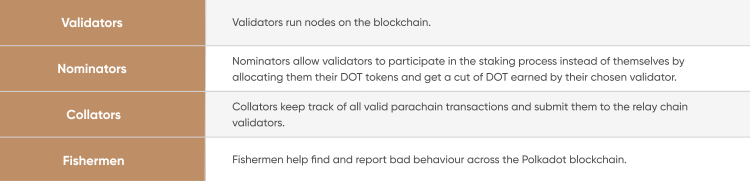
table

As of 16 May, the total supply of DOT coins stands at over 1.1 billion, with over 987 million tokens in circulation, according to data provided by CoinMarketCap. The cryptocurrency has a market cap surpassing $10bn, ranking it as the 11th biggest cryptocurrency.

Polkadot chart analysis: Does Polkadot have a future?
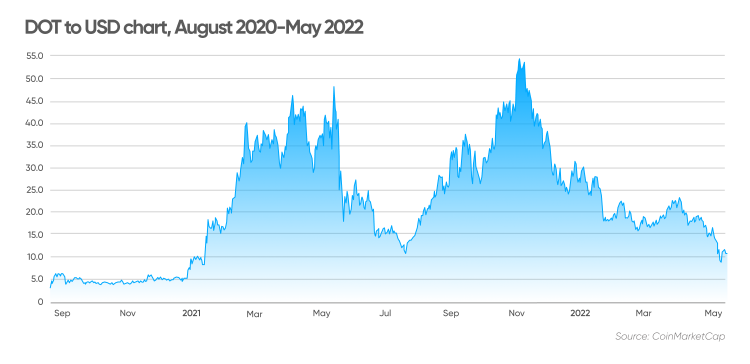
DOT to USD chart, August 2020-May 2022

Polkadot launched in late August 2020 at $2.875. For the next six months, the DOT token price moved sideways before gaining some momentum in mid-January 2021. It jumped 187.4% since its launch to hit $8.2641 by 12 January 2021.

The token continued on a bullish trend, skyrocketing to $39.7 by 21 February 2021 – a 380% surge in a little over a month. However, positive sentiment did not last long as DOT dropped below the $32 mark in the next four days and continued to fluctuate between $33 and $38 for the entirety of March 2021.

By 14 May 2021, the DOT cryptocurrency surged to $47.95, a then all-time high, ahead of Polkadot’s launch of parachains – the network’s final launch in a series of multi-phase processes. On 23 May 2021, however, the token dipped by over 60% to $18.03 as Polkadot nodes failed with an out of memory error while trying to build a block. While the nodes themselves did not crash, their runtime did. It kept a bearish trend throughout the summer months, falling as low as $10.98 in mid-July.

The polkadot coin price started to resurface once again at the start of September 2021 following news that the crypto was planning the launch of its cross-consensus messaging format.

On 4 November 2021, DOT reached its all-time high, surging by over 390% since its July lows to $53.88, as the network announced the passing of referendum 42 in a community vote that would enable parachain registration and ‘crowdloans’.

The following day, Polkadot announced the passing of referendum 41 in a separate community vote, which saw the registration of its first parachain, keeping the polkadot token valued above $50 for the next few days.

A Polkadot technical analysis provided by CoinCodex showed the short-term sentiment for the token was largely bearish at the time of writing (16 May).

What is your sentiment on DOT/USD?

A Relative Strength Index (RSI) reading of 38.73 indicated neutral territory. A reading of 30 or below would indicate the asset has become undervalued and a trend reversal is likely. Meanwhile, the token was trading above its three and five-day moving averages (MAs) but below its 10-day MA.

Following its November 2021 success, the token embarked on a bearish trend losing over 79% of its value since its all-time high and reaching $11.22 by 16 May 2022.

Is polkadot a good investment?

Recent DOT crypto news has seen the platform developing its parachain rollout stage, the final part of the Polkadot v1 launch process. As of 16 May 2021, the Polkadot community is on the final stage of voting to enable parachain functionality via a runtime upgrade. Once the vote is complete, parachains will be live on Polkadot and the network’s launch will be complete.

SmartBlocks and Fanatics Media fonder Mark Fidelman told Capital.com:

“Overall, the DOT is down but it’s not as down as other tokens. So, this is a good sign. What’s driving it, of course, are all the parachains… I believe the infrastructure that Polkadot is creating is driving the [token’s] value because there’s true value here.”

On 3 May 2022, cross-chain functionality went live on Polkadot which, according to BigOne Exchange chair in Asia Anndy Lian, “sets an example for interoperability and sets the tone for their network expansion of substrate-native assets and tokens”.

“DOT can now be used on several DeFi apps and on their parachains involving yield farming, borrowing, lending and liquidity sharing. As their cross-chain use cases increase within their ecosystem, I hope to see positive trends in their pricing too,” Lian noted.

Future Polkadot upgrades include the development of the Cross-Chain Message Passing, which will allow parachains to exchange messages with other parachains. As well as the launch of parathreads, that temporarily participate in Polkadot security without needing to lease a dedicated parachain slot.

Following the recent crypto crash surrounding stablecoins, many investors are looking to turn towards more trustworthy cryptocurrencies. Media Coin LLC founder Jeff Freiberger told Capital.com:

“There have been some recent press mentions that [DOT] is a good one to invest in and it shows how hard the market is looking for some hope to bounce back with many people ready to buy in. I think people are finding value in its uniqueness to connect to several different blockchains.”

Freiberger added that the DOT/USD future price had a lot of potential to resurface due to recent positive coverage around the cryptocurrency.

“The fact that news is circling it in a manner that gives the consumer hope is a good thing. I also see a lot of cryptos eventually growing again after the final current sell off is reached.”

SmartBlocks’ Fidelman added that the token has potential to be better adopted by the wider market, however, it also runs several risks, like a failed mission to unite all blockchains in one.

Polkadot prediction 2022-2025, 2030

Despite the latest downward price action, algorithm-based forecasting service Wallet Investor gave a bullish DOT crypto price prediction at the time of writing (16 May). The site noted that DOT was “an awesome long-term investment”, adding that it has a long-term earning potential amounting to 348.53%.

Based on its analysis of past price performance, Wallet Investor expected that DOT could be valued at $20.549 in 2023. The polkadot long-term price prediction was expected to reach $50.379 by 2027.

DigitalCoinPrice supported the positive DOT coin price prediction but saw a much slower pace of growth in the following years, projecting that the polkadot 2022 value could grow to $14.62, reach $20.26 by the end of 2024 and jump to $25.48 in 2025.

By the end of 2028, the site predicted the DOT coin could reach $39.37. The price of polkadot in 2030 was projected to grow to $54.12.

Note that predictions about the future of DOT can be wrong. Forecasts and analyst expectations shouldn’t be used as a substitute for your own research. Always conduct your own due diligence and rely on your own projections. And never invest or trade money you cannot afford to lose.


Original Source: https://capital.com/polkadot-forecast-will-dot-price-rise

Anndy Lian is an early blockchain adopter and experienced serial entrepreneur who is known for his work in the government sector. He is a best selling book author- “NFT: From Zero to Hero” and “Blockchain Revolution 2030”.

Currently, he is appointed as the Chief Digital Advisor at Mongolia Productivity Organization, championing national digitization. Prior to his current appointments, he was the Chairman of BigONE Exchange, a global top 30 ranked crypto spot exchange and was also the Advisory Board Member for Hyundai DAC, the blockchain arm of South Korea’s largest car manufacturer Hyundai Motor Group. Lian played a pivotal role as the Blockchain Advisor for Asian Productivity Organisation (APO), an intergovernmental organization committed to improving productivity in the Asia-Pacific region.

An avid supporter of incubating start-ups, Anndy has also been a private investor for the past eight years. With a growth investment mindset, Anndy strategically demonstrates this in the companies he chooses to be involved with. He believes that what he is doing through blockchain technology currently will revolutionise and redefine traditional businesses. He also believes that the blockchain industry has to be “redecentralised”.

j j j

Industry experts weigh in on SEC hiring more crypto cops + Additional Comments

Industry experts weigh in on SEC hiring more crypto cops + Additional Comments

Additional comments from Anndy Lian to the reporter at CoinTelegraph: 

What are your thoughts on crypto firms working with regulators?

Crypto firms should be working alongside with the regulators to make sure that they comply with the laws and regulations. By working along side, it does not mean seeking approval on every steps they take. On a need to know basis, regulators should be kept informed. Many times the contact points at the regulators side are not people from the industry, you may be taking too much time trying to explain the technology side of things to them which is not necessary.

How can the two sides work together to create a mutually beneficial relationship?

I deal with governments and regulators from different countries. In order for the relationship to be mutually beneficial, the regulators must “listen” and give feedback promptly. This does back to my point that the regulators must hire people who are subject matter experts and “not paperwork boys”.

Would you say that the relationship between cryptos and regulators is healthy at the moment?

It really depends on which country you are talking about. I think in general, it is not healthy. Many times, it is a one way communication and it is extremely biased if you do not know the people inside.

Do you think there is a danger of over-regulation when it comes to cryptocurrencies?

Yes and no. We are at a phase where regulations started to kick in, it is not overly regulated yet. For those who think that there are too many restrictions right now, wait for 2025 where more countries are ready with their crypto regimes. You will know that what we see now is nothing.

Are you confident in the ability of regulatory bodies to properly regulate the cryptocurrency industry?

No. 100% no. I have interacted with many of them to come out with this answer. Most of the regulatory bodies are trying to use old laws and rules to regulate the cryptocurrency industry. This resulted in a catching up game where they have to be constantly changing. To make things worst, regulators are not hiring subject matter experts, most of them are just merely “paperwork boys”.

What do you think about the community’s perception of the relationship between regulators and crypto exchanges?

The community at large would rather be indifferent. The community consists of mainly retail investors, they just want to make the money. As long as they are making the money, they do not really care about the regulators. But when they lose their money, they will find ways to contact the regulators to get a refund. This is the truth and this means the industry is still at a very young stage.

————————————————-


Industry experts weigh in on SEC hiring more crypto cops

The SEC’s decision to expand its digital assets section was well received by industry experts and came as no surprise, given the growing interest in cryptocurrencies.

The United States Securities and Exchange Commission (SEC) is seeking to hire more people to focus on digital assets, raising the number of personnel charged with safeguarding investors in cryptocurrency markets by almost twofold.

The SEC’s Cyber Unit, which comprises the Crypto Assets and Cyber team, is expected to hire 20 new people for 50 dedicated roles as reported by Cointelegraph on May 3. This development comes as the regulatory body attempts to keep up with the rise in the popularity of virtual assets.

The SEC’s decision to expand its cryptocurrency assets unit has been praised by industry experts, with Dr. Anna Becker, CEO and co-founder of EndoTech, calling it “a welcome development.” She believes that enhanced security, regulation and complex financial investment solutions will enable digital currencies to become more accepted.

On the crypto firms collaborating with regulators, she told Cointelegraph that “When we collaborate to set and uphold the rules, we will create a market that serves the public and gives them the opportunity to make money with proper protection.” She added:

“This market is still in its infancy. When it comes to crypto trading, we need the same types of safeguards that have developed in equity and other mainstream markets over the years. These will enable crypto to develop into a more robust asset class with more advanced financial tools.”

Jay Fraser, head of the strategy at BSTX, believes that crypto companies should interact with regulators. He noted that the severity of recent price declines might be partly attributed to a lack of depth and the number of active participants in cryptocurrency markets. According to Fraser, a consistent and predictable regulatory environment would potentially encourage more institutional traders to participate in dampening the price swings.

Andrea Gordon, a compliance expert and counsel at Eversheds Sutherland, stressed the importance of crypto businesses working with regulators. She told Cointelegraph that in an ideal world, firms would be able to have an open dialogue with authorities about particular offerings because the regulatory climate for cryptocurrency is always changing.

According to Gordon, some firms may not want to deal with authorities because the procedure might be costly and time-consuming (resulting in a product launch’s delay) or perhaps result in an enforcement action. She cited Coinbase’s experience with the SEC over its Lend service as a cautionary tale. She said

“In September 2021, Coinbase’s chief legal officer announced in a blog post that, after Coinbase had engaged with the SEC about the product for nearly six months, the SEC threatened to sue if Coinbase launched Lend.”

On how the two sides collaborate to build a mutually beneficial relationship, she said that education is crucial in the cryptocurrency world. The sector should seek methods to educate regulators while also encouraging a regulatory approach that makes sense.

“Regulators often issue proposed rules for public comment. These are great opportunities for the industry to weigh in on and explain the potential effects or (perhaps unanticipated) consequences of regulation.”

Anndy Lian, a thought leader and chief digital advisor to the Mongolian Productivity Organisation, stated that regulatory bodies could regulate the cryptocurrency sector adequately. Lian claims that most regulatory bodies are attempting to apply old rules and laws to the cryptocurrency industry in order to catch up, and it has “resulted in a catching up game where they have to be constantly changing.”

Pratik Gauri, founder and CEO of 5ire, addressed the present situation between crypto businesses and regulators. According to him, “there is still great mistrust on both sides.” He told Cointelegraph that “crypto people have demonized regulators ” as working for the banking lobby or other organized interests, and regulators have characterized all crypto operations as illegal activities. However, he added that recent innovation and the volatility in the crypto space have caused the two parties to reconsider their stance.


Original Source: https://cointelegraph.com/news/industry-experts-weigh-in-on-sec-hiring-more-crypto-cops

Anndy Lian is an early blockchain adopter and experienced serial entrepreneur who is known for his work in the government sector. He is a best selling book author- “NFT: From Zero to Hero” and “Blockchain Revolution 2030”.

Currently, he is appointed as the Chief Digital Advisor at Mongolia Productivity Organization, championing national digitization. Prior to his current appointments, he was the Chairman of BigONE Exchange, a global top 30 ranked crypto spot exchange and was also the Advisory Board Member for Hyundai DAC, the blockchain arm of South Korea’s largest car manufacturer Hyundai Motor Group. Lian played a pivotal role as the Blockchain Advisor for Asian Productivity Organisation (APO), an intergovernmental organization committed to improving productivity in the Asia-Pacific region.

An avid supporter of incubating start-ups, Anndy has also been a private investor for the past eight years. With a growth investment mindset, Anndy strategically demonstrates this in the companies he chooses to be involved with. He believes that what he is doing through blockchain technology currently will revolutionise and redefine traditional businesses. He also believes that the blockchain industry has to be “redecentralised”.

j j j