Bitcoin cracks $100,000 as Asia’s crypto bulls rejoice

Bitcoin cracks $100,000 as Asia’s crypto bulls rejoice

Bitcoin, the world’s largest cryptocurrency, cracked the $100,000 mark for the first time on Thursday, marking a dramatic reversal in fortunes following a digital assets crash a few years ago and in anticipation of pro-crypto policies from U.S. President-elect Donald Trump.

The threshold was breached a day after Trump said he would nominate Paul Atkins, seen as a crypto advocate, to run the U.S. Securities and Exchange Commission.

Scrutiny of the digital tokens industry increased under current SEC Chair Gary Gensler, who has indicated he would step down when Trump enters the White House.

“What we’re seeing isn’t just a rally,” said Nathan McCauley, chief executive officer of crypto platform Anchorage Digital, “it’s a fundamental transformation of Bitcoin’s place in the financial system.”

In Asia, those bullish on crypto’s resurgence see further potential for blockchain — the distributed ledger technology underpinning virtual tokens, to be integrated into financial systems.

“In emerging markets such as India and Southeast Asia, where traditional banking infrastructure may be less accessible, Bitcoin’s rise could further democratize financial services,” Anndy Lian, a Singapore-based fund manager, told Nikkei Asia.

Others are cashing in already.

Hong Kong-listed Chinese tech company Meitu, which acquired 940 units of Bitcoin in April 2021 at $49.5 million, has been on a selling spree of its digital asset holdings.

The platform said it will use proceeds from the move to dish out special dividends for shareholders as well as invest them into its business. Shares of Meitu rose over 3% on Thursday.

The digital asset rally comes years after tokens were plunged into a “crypto winter” in 2022 when Terra Classic USD, a so-called “stablecoin” pegged to the U.S. dollar, lost parity with the greenback and influenced the crash of other virtual currencies.

Trump’s electoral victory last month and his perceived pro-crypto stance has further pushed the market away from its downturn of the past few years as investors flock back to tokens in anticipation of brighter prospects.

While the U.S. appears ready to pivot toward being more crypto-friendly, other countries remain guarded. In Singapore, authorities have asked investors to be cautious in speculating on digital currencies.

While rival financial hub Hong Kong earlier this year debuted the listing of exchange-traded funds tracking crypto, Singapore has taken a more conservative approach.

Desmond Yong, legal and compliance director at Singapore-based blockchain tech outfit Chainup, noted that risks will also proliferate as crypto solidifies its presence.

He highlighted how cyber thefts, scams and hacking activities are set to be more prevalent as investors pile into digital assets. For developing markets, a rush into crypto might also pose a threat if many investors use debt to buy virtual currencies.

“Regulators alike would have to jump on a frenzy to come up with new rules to limit borrowing [for crypto purchases] so that the economy does not get into a high household debt burden,” Yong told Nikkei. “These countries will also have a tougher time dealing with the risks and making sure everything grows in a responsible way.”

Source: https://asia.nikkei.com/Spotlight/Cryptocurrencies/Bitcoin-cracks-100-000-as-Asia-s-crypto-bulls-rejoice


Anndy Lian is an early blockchain adopter and experienced serial entrepreneur who is known for his work in the government sector. He is a best selling book author- “NFT: From Zero to Hero” and “Blockchain Revolution 2030”.

Currently, he is appointed as the Chief Digital Advisor at Mongolia Productivity Organization, championing national digitization. Prior to his current appointments, he was the Chairman of BigONE Exchange, a global top 30 ranked crypto spot exchange and was also the Advisory Board Member for Hyundai DAC, the blockchain arm of South Korea’s largest car manufacturer Hyundai Motor Group. Lian played a pivotal role as the Blockchain Advisor for Asian Productivity Organisation (APO), an intergovernmental organization committed to improving productivity in the Asia-Pacific region.

An avid supporter of incubating start-ups, Anndy has also been a private investor for the past eight years. With a growth investment mindset, Anndy strategically demonstrates this in the companies he chooses to be involved with. He believes that what he is doing through blockchain technology currently will revolutionise and redefine traditional businesses. He also believes that the blockchain industry has to be “redecentralised”.

j j j

South Korea grapples with how to stymie crypto-fueled drug trade

South Korea grapples with how to stymie crypto-fueled drug trade

South Korea is well-known for its strict stance on drug use, often branding itself as a “clean” society with zero tolerance for illegal substances.

However, the use of cryptocurrencies to facilitate online drug purchases presents a rising challenge, as the decentralized and pseudonymous nature of digital assets is complicating efforts to maintain control over the illegal drug trade.

In August, the Seoul Southern District Prosecutors’ Office uncovered a network of university students buying drugs with cryptocurrencies. This case is far from isolated; similar incidents in 2022 involved drug purchases via messaging platforms like Telegram, paid for using cryptocurrencies.

With the rise of non-face-to-face drug transactions and digital currency use, South Korean authorities face mounting pressure to tighten their regulatory framework — without stifling a burgeoning financial sector.

HOW CRYPTOCURRENCIES FACILITATE DRUG PURCHASES

One of the critical factors making cryptocurrencies attractive to drug dealers is their ease of use and relative anonymity.

As seen in the case of the university students, users can make payments through crypto exchanges and transfer funds to drug dealers using messaging apps like Telegram. The drugs are then hidden in drop locations, eliminating the need for direct contact between buyers and sellers.

In 2023, South Korea saw a significant 50% increase in drug-related arrests, with over 27,000 individuals apprehended, according to a white paper on Drug Crime published by the Supreme Prosecutor’s Office’s Narcotics and Organized Crime Department.

Authorities have cited the rise of cryptocurrency transactions and secure messaging apps as major contributing factors. Despite the perception that cryptocurrencies offer complete anonymity, this is not entirely accurate. While blockchain transactions are pseudonymous, they are also publicly recorded and traceable with the right tools and expertise.

This traceability allowed South Korean police to track cryptocurrency transactions in the aforementioned case in August, uncovering the identities of buyers like “User A” who spent over $8,800 (12 million won) on illicit drugs in 2023.

Anndy Lian, an intergovernmental blockchain advisor, told Korea Pro that the inherent transparency of blockchain can deter criminals but that many falsely assume that crypto transactions are entirely anonymous.

TIGHTENING REGULATIONS

South Korea has made significant strides in regulating its cryptocurrency sector, aiming to balance innovation with law enforcement.

In 2024, the Virtual Asset User Protection Act (VAUPA) came into effect, marking a critical step toward enhancing transparency and protecting users from illicit activities. VAUPA primarily targets Virtual Asset Service Providers, imposing strict requirements like real-name verification for account holders, anti-money laundering procedures (AML) and cybersecurity measures.

These efforts are aligned with global recommendations from the Financial Action Task Force (FATF), which emphasizes the importance of AML and Know Your Customer (KYC) rules in regulating digital assets.

South Korea’s measures also include requirements for exchanges to register with the Financial Services Commission (FSC) and partner with domestic banks, further ensuring that cryptocurrency transactions are traceable.

Despite these frameworks, experts like Ohoon Kwon, a managing partner at Cha & Kwon law offices, argue that fully crypto-based transactions remain difficult to track, especially when criminals use advanced money-laundering techniques.

Kwon stresses the importance of increasing South Korea’s capacity to detect and prevent crypto-facilitated crimes, urging the government to invest in more sophisticated tracking technologies.

Moreover, there is an increasing recognition that regulation needs to account for the global nature of cryptocurrencies. South Korea has sought to align its regulatory framework with international norms due to the cross-border nature of digital assets.

This means not only improving local law enforcement’s capabilities but also collaborating with international bodies to ensure that cryptocurrencies are not exploited for illicit purposes.

IMPACT OF STRICTER REGULATIONS

While South Korea is tightening the noose on illicit crypto transactions, concerns are growing that overly stringent regulations could stifle innovation in the burgeoning crypto sector.

South Korea has emerged as a hub for blockchain development, with events like the annual Korea Blockchain Week attracting international attention. Moreover, the South Korean won surpassed the U.S. dollar in cumulative crypto trading volume during the first quarter of 2024.

The enactment of VAUPA has already placed significant pressure on cryptocurrency exchanges, many of which struggle to comply with the rigorous regulatory standards.

By requiring exchanges to partner with banks for real-name verification, smaller players have been driven out of business due to the reluctance of major banks to bear the financial crime risks associated with crypto.

Justin Kim of Ava Labs told Korea Pro that while bad actors have always exploited new technologies, overregulation could hinder growth in what is one of Asia’s leading crypto markets. Similarly, Rich O, a country manager at OneKey, criticized the South Korean government’s disconnect from Web3 companies, warning that overly harsh measures may stifle the industry’s development.

There appears to be a growing consensus among crypto experts that while regulation is necessary to prevent the misuse of digital assets, the government must strike a balance to avoid driving innovation out of the country. South Korea, which ranks among the top crypto trading nations globally, risks losing its competitive edge if regulations become too burdensome.

STRIKING A BALANCE

The South Korean government faces a delicate balancing act. While increased regulation is necessary to curb the illegal use of cryptocurrencies in drug transactions, overly restrictive policies could risk driving crypto innovation out of the country. As blockchain technology advances, it is vital that regulators recognize both the opportunities and risks it presents.

The traceability of cryptocurrencies, while often misunderstood, could become a powerful tool in law enforcement’s arsenal.

As demonstrated by the arrest of the university students, authorities can track illicit activities with sufficient expertise and resources. However, experts like Anndy Lian caution that public awareness of this traceability could naturally deter criminals from using digital currencies for illegal activities.

Ultimately, South Korea’s regulatory response will need to evolve in tandem with technological developments in the crypto space, and more stringent regulations alone may not solve the issue.

Instead, a nuanced approach that fosters innovation while enhancing law enforcement’s ability to track and prevent crime will be key to maintaining South Korea’s leadership in the cryptocurrency sector while addressing the challenges of the digital age.


Source: https://koreapro.org/2024/11/south-korea-grapples-with-how-to-stymie-crypto-fueled-drug-trade/

Anndy Lian is an early blockchain adopter and experienced serial entrepreneur who is known for his work in the government sector. He is a best selling book author- “NFT: From Zero to Hero” and “Blockchain Revolution 2030”.

Currently, he is appointed as the Chief Digital Advisor at Mongolia Productivity Organization, championing national digitization. Prior to his current appointments, he was the Chairman of BigONE Exchange, a global top 30 ranked crypto spot exchange and was also the Advisory Board Member for Hyundai DAC, the blockchain arm of South Korea’s largest car manufacturer Hyundai Motor Group. Lian played a pivotal role as the Blockchain Advisor for Asian Productivity Organisation (APO), an intergovernmental organization committed to improving productivity in the Asia-Pacific region.

An avid supporter of incubating start-ups, Anndy has also been a private investor for the past eight years. With a growth investment mindset, Anndy strategically demonstrates this in the companies he chooses to be involved with. He believes that what he is doing through blockchain technology currently will revolutionise and redefine traditional businesses. He also believes that the blockchain industry has to be “redecentralised”.

j j j

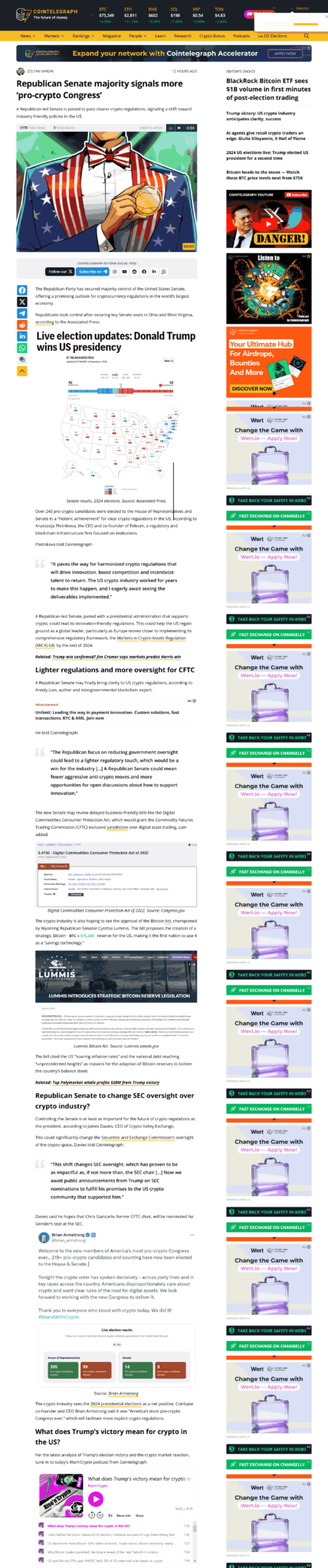
Republican Senate majority signals more ‘pro-crypto Congress’

Republican Senate majority signals more ‘pro-crypto Congress’

The Republican Party has secured majority control of the United States Senate, offering a promising outlook for cryptocurrency regulations in the world’s largest economy.

Republicans took control after securing key Senate seats in Ohio and West Virginia, according to the Associated Press.

Over 240 pro-crypto candidates were elected to the House of Representatives and Senate in a “historic achievement” for clear crypto regulations in the US, according to Anastasija Plotnikova, the CEO and co-founder of Fideum, a regulatory and blockchain infrastructure firm focused on institutions.

Plotnikova told Cointelegraph:

“It paves the way for harmonized crypto regulations that will drive innovation, boost competition and incentivize talent to return. The US crypto industry worked for years to make this happen, and I eagerly await seeing the deliverables implemented.”

A Republican-led Senate, paired with a presidential administration that supports crypto, could lead to innovation-friendly regulations. This could help the US regain ground as a global leader, particularly as Europe moves closer to implementing its comprehensive regulatory framework, the Markets in Crypto-Assets Regulation (MiCA) bill, by the end of 2024.

Lighter regulations and more oversight for CFTC

A Republican Senate may finally bring clarity to US crypto regulations, according to Anndy Lian, author and intergovernmental blockchain expert.

He told Cointelegraph:

“The Republican focus on reducing government oversight could lead to a lighter regulatory touch, which would be a win for the industry […] A Republican Senate could mean fewer aggressive anti-crypto moves and more opportunities for open discussions about how to support innovation.”

The new Senate may review delayed business-friendly bills like the Digital Commodities Consumer Protection Act, which would grant the Commodity Futures Trading Commission (CFTC) exclusive jurisdiction over digital asset trading, Lian added.

Digital Commodities Consumer Protection Act of 2022. Source: Congress.gov

The crypto industry is also hoping to see the approval of the Bitcoin Act, championed by Wyoming Republican Senator Cynthia Lummis. The bill proposes the creation of a strategic Bitcoin BTCtickers down$75,398 reserve for the US, making it the first nation to use it as a “savings technology.”

The bill cited the US’ “soaring inflation rates” and the national debt reaching “unprecedented heights” as reasons for the adoption of Bitcoin reserves to bolster the country’s balance sheet.

Republican Senate to change SEC oversight over crypto industry?

Controlling the Senate is at least as important for the future of crypto regulations as the president, according to James Davies, CEO of Crypto Valley Exchange.

This could significantly change the Securities and Exchange Commission’s oversight of the crypto space, Davies told Cointelegraph:

“This shift changes SEC oversight, which has proven to be as impactful as, if not more than, the SEC chair […] Now we await public announcements from Trump on SEC nominations to fulfill his promises to the US crypto community that supported him.”

Davies said he hopes that Chris Giancarlo, former CFTC chair, will be nominated for Gensler’s seat at the SEC.

The crypto industry sees the 2024 presidential elections as a net positive. Coinbase co-founder and CEO Brian Armstrong said it was “America’s most pro-crypto Congress ever,” which will facilitate more explicit crypto regulations.


Source: https://cointelegraph.com/news/republicans-majority-control-us-senate-pro-crypto-congress

Anndy Lian is an early blockchain adopter and experienced serial entrepreneur who is known for his work in the government sector. He is a best selling book author- “NFT: From Zero to Hero” and “Blockchain Revolution 2030”.

Currently, he is appointed as the Chief Digital Advisor at Mongolia Productivity Organization, championing national digitization. Prior to his current appointments, he was the Chairman of BigONE Exchange, a global top 30 ranked crypto spot exchange and was also the Advisory Board Member for Hyundai DAC, the blockchain arm of South Korea’s largest car manufacturer Hyundai Motor Group. Lian played a pivotal role as the Blockchain Advisor for Asian Productivity Organisation (APO), an intergovernmental organization committed to improving productivity in the Asia-Pacific region.

An avid supporter of incubating start-ups, Anndy has also been a private investor for the past eight years. With a growth investment mindset, Anndy strategically demonstrates this in the companies he chooses to be involved with. He believes that what he is doing through blockchain technology currently will revolutionise and redefine traditional businesses. He also believes that the blockchain industry has to be “redecentralised”.

j j j