
New Crypto Trend: Trading Tokens Before Release

New Crypto Trend: Trading Tokens Before Release

A new trend is taking off in the cryptocurrency community — as investors start to purchase tokens before waiting for them to hit the markets.

In a fast-paced industry, being an early investor is a crucial step as it allows individuals to potentially capitalize on significant price appreciation as innovative projects gain traction and adoption.

And now, investors are finding ways to start buying before the firing pistol has signaled the start of the race.

Here’s everything you need to know.

Key Takeaways

  • Investing in tokens before their release allows investors to potentially benefit from significant price increases as projects gain traction.
  • Platforms like AEVO and Hyperliquid have introduced new opportunities to speculate or hedge against future token prices, marking a shift from traditional ICOs to more dynamic pre-token trading environments.
  • Pre-token and point market sales have seen $50 million in trades despite low liquidity.
  • The pre-token and point markets are heavily dominated by buyers, a sign of potential investor confidence.
  • Despite the enthusiasm and high trading volumes, these markets face challenges such as lower liquidity and higher volatility compared to post-TGE markets.

Pre-Token & Point Markets Take Off

Until recently, investors could purchase cryptocurrencies prior to their official launch through their initial coin offering (ICO), a fundraising mechanism used by new decentralized finance (DeFi) projects to raise capital by selling tokens to investors prior to a project’s full development.

This allows anyone to speculate on or hedge against the price of a token before its launch, creating a new era of crypto investing.

In short, pre-token and point markets are platforms that allow people to buy or sell the promise of receiving tokens or points at a future date, often before the official release of the token.

Such markets are divided into two main types: one where trades are settled with cash and another where the actual tokens or points are exchanged. Such a setup lets investors speculate on the future value of tokens or points, potentially profiting from changes in their price before they become available.

According to Anndy Lian, an inter-governmental blockchain adviser, by participating in pre-sales, investors get the opportunity to directly support the development and growth of new projects, as well as create a sense of community and alignment with the project’s goals.

He said:

“This community effect can drive demand as more people become involved and invested in the token’s success. Effective marketing campaigns can generate significant hype around a token before its release, leading to increased demand as investors don’t want to miss out on what is being promoted as a promising opportunity.”

A Keyrock report released on April 30 uncovered that the crypto community has seen a notable surge in interest and participation in these pre-tokens and point markets with $50 million already being traded.

This high level of activity reflects a growing enthusiasm among investors to engage with new crypto projects at an early stage.

The markets predominantly cater to buyers, with the majority of orders coming from users eager to purchase tokens or points ahead of their public release. This eagerness is driven by the potential for high returns on investments as token values can increase significantly upon official launch.

Pre-token & Point Markets See Higher Buyer Dominance

According to the Keyrock report, the markets showed a pronounced buyer dominance, with most tokens analysed displaying a higher buying than selling volume.

This trend suggested that investors were more interested in acquiring tokens rather than selling them, believing in the potential for token value appreciation after their Token Generation Event (TGE).

The report highlighted:

“Most tokens exhibit a buying volume significantly higher than the sell volume. Only 5 out of 57 tokens that have been traded on Whales Market show a selling volume that exceeds the buy volume. Participants in Whale Markets demonstrate a strong preference for buying tokens, points, and runes.”
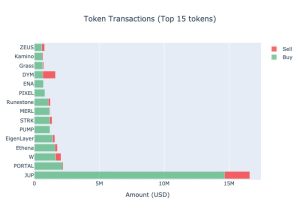
Data on buying vs selling tokens from Whales Market. Source: Keyrock Data Intelligence

Data on buying vs selling tokens from Whales Market. Source: Keyrock Data Intelligence

Liquidity Remains Low

Despite optimistic trading volumes, pre-token and point markets still face challenges related to liquidity.

The Keyrock report highlighted that compared to traditional post-TGE markets, pre-token and point markets are relatively less liquid, meaning they have relatively fewer buyers and sellers, which could lead to price volatility and make it harder to execute larger orders without affecting the market price.

Additionally, sometimes the demand for a pre-release token is driven more by hype and marketing than by the project’s fundamentals, which could lead to an inflated valuation that does not reflect the token’s true worth, Lian explained.

“Projects that prioritize transparency, communication, and community trust are more likely to succeed in pre-release trading. Investors will gravitate toward projects they believe in.”

Technical issues could also serve as a major potential risk in purchasing cryptocurrencies before they fully launch since the technology behind the asset is only just being developed.

The Bottom Line

As the landscape of pre-token and point markets continues to evolve, strategic considerations and forward-thinking approaches are essential for both investors and project developers.

The surge in trading volumes and the enthusiasm observed in these markets suggest a robust interest in early-stage investment opportunities.

According to Lian, this has been an ongoing trend since the beginning of the crypto ICO period, and the act of trading tokens before their official release is likely to continue into the future as well. However, investors should exercise caution when investing in new projects and never invest money they cannot afford to lose.


Source: https://www.techopedia.com/news/exploring-crypto-pre-token-and-point-markets

Anndy Lian is an early blockchain adopter and experienced serial entrepreneur who is known for his work in the government sector. He is a best selling book author- “NFT: From Zero to Hero” and “Blockchain Revolution 2030”.

Currently, he is appointed as the Chief Digital Advisor at Mongolia Productivity Organization, championing national digitization. Prior to his current appointments, he was the Chairman of BigONE Exchange, a global top 30 ranked crypto spot exchange and was also the Advisory Board Member for Hyundai DAC, the blockchain arm of South Korea’s largest car manufacturer Hyundai Motor Group. Lian played a pivotal role as the Blockchain Advisor for Asian Productivity Organisation (APO), an intergovernmental organization committed to improving productivity in the Asia-Pacific region.

An avid supporter of incubating start-ups, Anndy has also been a private investor for the past eight years. With a growth investment mindset, Anndy strategically demonstrates this in the companies he chooses to be involved with. He believes that what he is doing through blockchain technology currently will revolutionise and redefine traditional businesses. He also believes that the blockchain industry has to be “redecentralised”.

j j j

Top 5 Billionaires Who Lost the Most Money in Crypto

Top 5 Billionaires Who Lost the Most Money in Crypto

From the collapse of Sam Bankman-Fried (SBF) and Gary Wang’s FTX to the fall of Binance’s Changpeng Zhao (CZ), the cryptocurrency industry has witnessed some of the biggest pitfalls in the last couple of years, with a number of notable individuals losing millions if not billions of dollars-worth in crypto.

Who lost the most money in crypto in past years, and why are even seasoned investors and billionaires prone to lose money in the industry?

We talked to experts about the major reasons for such dire losses and identified the key best practices crypto investors could use to protect their money.

Key Takeaways

  • Crypto investments are prone to fall victim to high volatility and risks, as evidenced by massive losses experienced by key figures in the industry.
  • Understanding the underlying technology and market dynamics is crucial for navigating the complexities of the crypto space.
  • Seasoned investors can also face significant losses, highlighting the unpredictability of crypto markets.
  • Implementing strong security practices and risk management strategies is essential for protecting investments.

Who Lost the Most Money in Crypto?

The cryptocurrency market continues to be highly volatile, which is why investors must be able to grasp the fundamentals before judging the risks or getting caught up in the hype and fear of missing out (FOMO) of many decentralized finance (DeFi) projects, Dr. Fardad Zand, the co-founder and CEO of Wisdomise, told Techopedia.

“Poor security practices can also lead to losses from scams and hacks. In addition, overleveraging amplifies potential gains and losses for traders — many get liquidated when the volatile market turns against them.”

The lack of a solid risk management strategy that would dictate to investors when the right time to exit a trade is regardless of its outcome is also another reason why individuals could be prone to lose large sums of money while trading cryptocurrencies, Jonathan Solomon, the co-founder and co-CEO of ARIA, added.

So, who were the people who lost the most money in crypto in recent years?

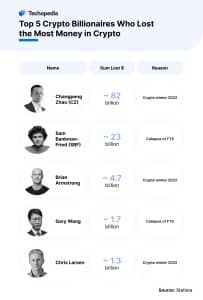
Top 5 Crypto Billionaires Who Lost the Most Money in Crypto
Source: Statista

Changpeng Zhao (CZ): $82 Billion

One of the most prominent names in the cryptocurrency industry, the former CEO of Binance Changpeng Zhao, allegedly lost around $82 billion during the crypto winter of 2022, data on Statista showed.

However, since then, the crypto billionaire’s net worth continued to decline, as he pleaded guilty to violating anti-money laundering requirements enforced by the U.S. Department of Justice in late November 2023 and paid a $4 billion settlement.

Despite the losses, it is estimated that CZ has a net worth of $33 billion as of April 2024.

Sam Bankman-Fried (SBF): $23 Billion

Another prominent name in the cryptocurrency industry, Sam Bankman-Fried, was the former co-founder of the doomed crypto exchange FTX, who lost about $23 billion, according to Statista, as the value of FTX and related assets collapsed.

ARIA’s Solomon noted that in SBF’s case, his losses could have been attributed to high-risk strategies that led to significant financial losses.

However, SBF had also faced allegations of fraud for his role in the collapse of FTX, including defrauding the exchange’s customers. His actions led to a significant loss of customer funds and investments, resulting in his arrest and a trial where he was found guilty.

On April 1, 2024, SBF revealed that he was planning to appeal his 25-year sentence in an exclusive interview with ABC News.

Brian Armstrong: $4.7 Billion

Brian Armstrong, the co-founder and CEO of Coinbase, is another big name in the cryptocurrency space who lost a significant amount of money when the market plummeted in 2022.

Armstrong’s wealth was closely tied to Coinbase’s performance and the overall health of the crypto market. Therefore, when the crypto winter occurred in 2022, and the industry faced substantial losses, so did Armstrong’s net worth.

Still, even with the loss of $4.7 billion, estimated by Statista, Brian Armstrong’s net worth is $10.9 billion as of April 2024.

Anndy Lian, an inter-governmental blockchain adviser, further explained how the 2022 crypto winter could have affected investors:

“Many investors are drawn to the allure of quick profits without fully understanding the assets they’re investing in. This, coupled with the market’s notorious volatility, can lead to substantial financial losses.


Prices in the crypto market can swing dramatically, and without a solid grasp of market trends and the factors driving them, investors can find themselves buying high and selling low.”

Gary Wang: $1.7 Billion

Gary Wang, the former co-founder and CTO of FTX, also faced a substantial loss of about $1.7 billion following the collapse of the FTX cryptocurrency exchange, according to Statista.

Most of his fortune was tied up in a 16% stake in FTX and a share of its FTT tokens. As of April 2024, Garry Wang dropped off all the Forbes ratings.

Chris Larsen: $1.3 Billion

Chris Larsen is known as a pioneering force in cryptocurrency, having co-founded Ripple, a digital payment protocol and currency exchange.

In 2022, he also faced a significant loss of $1.3 billion due to the downturn in the cryptocurrency market, according to Statista.

As of April 2024, Larsen’s net worth is $3.2 billion.

Other Prominent Losses: TerraUSD/LUNA Crash

Meanwhile, the collapse of the TerraUSD (UST) stablecoin and its sister cryptocurrency, LUNA, is not directly linked to one person losing all their assets. Industry experts allege this collapse was one of the most “catastrophic” losses in the crypto market.

The pitfall of TerraUSD and Luna in May 2022 wiped out almost $45 billion in crypto market capitalization in just one week.

Do Kwon, the co-founder of Terraform Labs, is often blamed for this collapse; however, his losses are not mentioned in public sources.

Why Even Seasoned Investors Lose Money on Crypto?

Many might think that seasoned investors are rarely ever prone to face substantial losses in the crypto space, but that is rarely true.

Wisdomise’s Dr. Zand explained:

“Sometimes, overconfidence leads them to misjudge the actual risks involved. The technological complexities of blockchain and smart contracts are easy to overlook or misunderstand.

The crypto market is susceptible to manipulation by wealthy “whale” players, which can catch experienced investors off guard with volatile price swings. Some black swan events like major exchange hacks or new regulations can also unpredictably impact the entire market.”

Lian added that the complexity of the market, which is often characterized by its rapid evolution and the development of new technologies, could also pose significant challenges that even seasoned investors cannot evade.

Additionally, the crypto space is prone to high-profile scams and security breaches, which can also lead to financial losses.

Lian added:

“Market manipulation is another hazard that can lead to losses. Influential players can distort market prices, affecting the entire market and catching even the most vigilant investors off guard.”

Best Practices to Protect Your Money: Risk Management & Research

Lian highlighted that some of the critical takeaways from situations like these are the importance of risk management and research. He said:

  • Understanding the assets, the technology behind them, and the market dynamics is crucial for making informed decisions.
  • Emotional discipline is also essential; investors must learn to control their emotions and avoid making impulsive decisions based on fear or greed.
  • Moreover, the significance of security practices cannot be overstated.
  • Investors should prioritize the security of their investments by using reputable platforms, enabling two-factor authentication, and being wary of too-good-to-be-true schemes that could be fraudulent.

Additionally, developing a long-term investment strategy could also act as a safety net for many investors.

ARIA’s Solomon said:

“The historical performance of Bitcoin illustrates that holding investments over the long term has been profitable for those who have stayed the course, unlike many traders who have faced challenges in recent years. This emphasizes the importance of patience and the potential benefits of a long-term investment horizon in the crypto market.”

The Bottom Line

The dramatic losses in the crypto world underline the high volatility and risk inherent in cryptocurrency investments, as well as the market’s complexity and rapid evolution.

From the collapse of FTX, affecting Sam Bankman-Fried and Gary Wang, to the regulatory challenges faced by Changpeng Zhao and the market downturns impacting Brian Armstrong and Chris Larsen, these events highlight the precarious nature of wealth in the crypto industry.

They serve as a reminder of the importance of having robust risk management, a deep understanding of blockchain technology, and the importance of navigating the market with caution.


Source: https://www.techopedia.com/crypto-biggest-losers-who-lost-the-most-money-in-crypto

Anndy Lian is an early blockchain adopter and experienced serial entrepreneur who is known for his work in the government sector. He is a best selling book author- “NFT: From Zero to Hero” and “Blockchain Revolution 2030”.

Currently, he is appointed as the Chief Digital Advisor at Mongolia Productivity Organization, championing national digitization. Prior to his current appointments, he was the Chairman of BigONE Exchange, a global top 30 ranked crypto spot exchange and was also the Advisory Board Member for Hyundai DAC, the blockchain arm of South Korea’s largest car manufacturer Hyundai Motor Group. Lian played a pivotal role as the Blockchain Advisor for Asian Productivity Organisation (APO), an intergovernmental organization committed to improving productivity in the Asia-Pacific region.

An avid supporter of incubating start-ups, Anndy has also been a private investor for the past eight years. With a growth investment mindset, Anndy strategically demonstrates this in the companies he chooses to be involved with. He believes that what he is doing through blockchain technology currently will revolutionise and redefine traditional businesses. He also believes that the blockchain industry has to be “redecentralised”.

j j j

How the EU is regulating crypto-assets with MiCAR and why you should care

How the EU is regulating crypto-assets with MiCAR and why you should care

The EU has recently adopted the Markets in Crypto-Assets Regulation (MiCAR). This groundbreaking legislation aims to provide a clear and consistent framework for regulating crypto-assets and related services in the EU. MiCAR will apply from the end of 2024, with some provisions applying from mid-2024.

MiCAR defines crypto-assets as “a digital representation of value or rights which may be transferred and stored electronically, using distributed ledger technology or similar technology.” This definition covers various types of crypto-assets, such as cryptocurrencies, tokens, stablecoins, and non-fungible tokens (NFTs). It excludes crypto-assets already regulated under existing EU financial services legislation, such as financial instruments, deposits, electronic money, or insurance products. I agree with this definition, as it is broad and neutral enough to capture the diversity and innovation of crypto-assets while also respecting the existing regulatory frameworks for other types of assets.

Furthermore, it classifies crypto-assets into three main categories: e-money tokens (EMTs), asset-referenced tokens (ARTs), and other tokens. EMTs are crypto-assets pegged to one official currency, such as Tether or USD Coin. ARTs are crypto-assets backed by a pool of assets, such as fiat currencies, commodities, or other crypto-assets. Other tokens are crypto-assets that have various purposes and characteristics, such as utility tokens, payment tokens, or governance tokens.

As mentioned above, MiCAR also introduces the concept of significant tokens for EMTs and ARTs, which are subject to additional requirements due to their potential impact on financial stability or monetary policy. The European Banking Authority (EBA) will identify and monitor significant tokens based on criteria such as the number of users, transaction values, interconnectedness with the financial system, or innovation or complexity of the token. I think this classification is reasonable and valuable, as it reflects the different functions and risks of crypto-assets while also allowing for some flexibility and adaptation. Personally, when I spoke to EU-based bankers who are considering ESG-related crypto funds, they mentioned that MiCAR should also consider the environmental and social impact of crypto-assets, especially those that consume a lot of energy or resources or those that may affect human rights or privacy. I did not comment on that, but I am well aware of their “crypto agenda”. Additionally, I also think that they should actively involve other stakeholders, such as consumers, investors, or developers, in identifying and monitoring significant tokens, as they may have valuable insights and feedback.

MiCAR imposes different authorization and supervision requirements for crypto-asset issuers and crypto-asset service providers (CASPs), depending on the type and significance of the crypto-asset. Crypto-asset issuers offer crypto-assets to the public or seek their admission to trading on a trading platform for crypto-assets. CASPs provide or perform services or activities related to crypto-assets, such as custody, exchange, execution, advice, or portfolio management. Crypto-asset issuers of EMTs and ARTs must obtain authorization from the competent authority of their home member state before offering or admitting such tokens to trading. They must also prepare and publish a white paper that discloses essential information about the crypto-asset project, such as the features, rights, and obligations of the crypto-asset, the risks and costs involved, the governance and technical arrangements, and the identity and contact details of the issuer. Do note that they do not need authorization but must comply with the white paper requirement and other general obligations.

CASPs must obtain authorization from the competent authority of their home member state before providing or performing any crypto-asset services or activities. They must also comply with prudential requirements, the conduct of business rules, safeguarding requirements, and anti-money laundering and counter-terrorism financing (AML/CTF) obligations. I support these requirements, as they aim to ensure the transparency, accountability, and responsibility of crypto-asset issuers and CASPs and protect the interests and rights of consumers, investors, and the public. On top of this, I think that MiCAR should also provide some incentives and benefits for crypto-asset issuers and CASPs that comply with these requirements, such as lower fees, faster processing, or broader access. I also think that MiCAR should promote cooperation and coordination among the competent authorities of different member states and other international regulators and organizations to avoid duplication, inconsistency, or conflict.

MiCAR also provides some transitionary provisions and exemptions for crypto-asset issuers and CASPs already operating in the EU before the application date of MiCAR. For example, those authorized or registered under national regimes in one or more member states may continue to operate in those member states until mid-2025 without obtaining authorization under MiCAR. However, they must comply with the relevant national rules and regulations and apply them by mid-2024 if they wish to operate in the EU after mid-2025.

They also established a pilot regime for distributed ledger technology (DLT) market infrastructures, which are a new type of market participants that use DLT to provide trading and settlement services for crypto-assets that qualify as financial instruments. The pilot regime aims to test the use of DLT in trading and post-trading crypto-assets while ensuring high investor protection and market integrity. The pilot regime will apply for five years from the application date of MiCAR, with a possibility of extension. These provisions are good in my opinion, as they recognize the diversity and maturity of the existing crypto-asset market in the EU and can provide a smooth and gradual transition to the new regulatory framework. They should also ensure a fair and equal treatment of all crypto-asset issuers and CASPs, regardless of origin, size, or status, and avoid creating undue advantages or disadvantages for some over others. If they can encourage and support the participation and experimentation of different actors and stakeholders in the pilot regime, such as incumbents, newcomers, or innovators, and foster a collaborative and inclusive environment for the development and adoption of DLT. This will be a big plus for them.

MiCAR does not apply to crypto-assets issued or guaranteed by central banks, member states, third countries, or public international organizations. It also does not apply to crypto-asset services or activities provided or performed by central banks or other public authorities in performing their public tasks or functions. These exemptions aim to preserve the monetary sovereignty and policy of the EU and its member states and facilitate the development of central bank digital currencies (CBDCs) and other public initiatives in the crypto-asset space. While I understand these exemptions, as they reflect the special and privileged status of central banks and public authorities and their role and responsibility in the monetary and financial system. However, I think MiCAR should also ensure a close and constructive dialogue and cooperation between the public and the private sectors and foster a balanced and complementary relationship between the traditional and innovative forms of money and finance. I also think that MiCAR should monitor and assess the impact and implications of CBDCs and other public initiatives on the crypto-asset market and address any potential issues or challenges that may arise.)

I also want to highlight that there are also some implications for investment firms and the travel rule, which are relevant to the crypto-asset market. Investment firms are those who provide or perform investment services or activities on a professional basis, such as execution of orders, portfolio management, or investment advice. The travel rule is a requirement that obliges financial institutions to exchange certain information about the originator and the beneficiary of a funds transfer, such as their names, addresses, account numbers, and transaction amounts.

They allow investment firms that are authorized under the Markets in Financial Instruments Directive 2014/65/EU (MiFID II) to provide or perform crypto-asset services or activities in relation to crypto-assets that qualify as financial instruments without obtaining additional authorization under MiCAR. However, they must comply with the relevant MiFID II rules and regulations, as well as some specific requirements under MiCAR, such as the safeguarding and AML/CTF obligations. Investment firms that wish to provide or perform crypto-asset services or activities concerning crypto-assets that do not qualify as financial instruments must obtain authorization and comply with its rules and regulations.

The travel rule applies to crypto-asset transfers, which are any transactions resulting in the change of ownership of one or more crypto-assets from one person to another. MiCAR requires CASPs that are involved in crypto-asset transfers to exchange certain information with other CASPs, such as the name and account number of the originator and the beneficiary, the amount and type of crypto-asset transferred, and the date and time of the crypto-asset transfer. The CASPs must ensure that the information is accurate, complete, secure, and confidentially transmitted. They must also keep records of the information for at least five years. They must implement the travel rule by mid-2024, the same date as applying the Financial Action Task Force (FATF) standards on virtual assets and virtual asset service providers.

They aim to establish a level playing field and a single market for crypto-assets and related services within the EU. This is achieved by harmonizing and simplifying the current national regulatory frameworks, thereby eliminating regulatory fragmentation and uncertainty. They also acknowledge the need for a degree of regulatory flexibility and discretion at the national level, which opens the door to regulatory arbitrage and competition among EU member states in specific areas. Some of the leading EU jurisdictions for MiCAR compliance and regulatory arbitrage are France, Germany, and Malta. These jurisdictions have already adopted national regimes for crypto-assets and related services, which are solid, flexible, favorable, attractive, and clear and consistent. They also have supportive and innovative regulators, such as the AMF, BaFin, and MFSA, which have issued several guidance and recommendations on crypto-assets and related services. They also have robust and diversified crypto-asset ecosystems, with several established and emerging players. These jurisdictions are likely to maintain and enhance their leading positions in the crypto-asset market under MiCAR, as they have a competitive edge and a first-mover advantage over other member states.

To sum up, MiCAR is a landmark legislation shaping the future of crypto-assets in the EU. It will introduce legal certainty, consumer protection, market integrity, and financial stability and foster innovation and competition by enabling cross-border activities and passporting rights for crypto-asset issuers and CASPs within the EU.

They are visionary and ambitious legislation that reflects the importance and potential of crypto-assets and related services and that responds to the needs and expectations of the crypto-asset community and society at large. It is also a complex and dynamic legislation that requires constant monitoring and evaluation and may face some difficulties and uncertainties in its application and enforcement. I hope that MiCAR will be able to adapt and evolve with the changing and growing nature of crypto-assets and related services and that it will be able to achieve its objectives and benefits.

I look forward to seeing the development and implementation of this framework, and I hope it will contribute to the growth and maturity of the crypto-asset industry in the EU and beyond.


Source: https://www.financialexpress.com/business/digital-transformation-how-the-eu-is-regulating-crypto-assets-with-micar-and-why-you-should-care-3434243/


Anndy Lian is an early blockchain adopter and experienced serial entrepreneur who is known for his work in the government sector. He is a best selling book author- “NFT: From Zero to Hero” and “Blockchain Revolution 2030”.

Currently, he is appointed as the Chief Digital Advisor at Mongolia Productivity Organization, championing national digitization. Prior to his current appointments, he was the Chairman of BigONE Exchange, a global top 30 ranked crypto spot exchange and was also the Advisory Board Member for Hyundai DAC, the blockchain arm of South Korea’s largest car manufacturer Hyundai Motor Group. Lian played a pivotal role as the Blockchain Advisor for Asian Productivity Organisation (APO), an intergovernmental organization committed to improving productivity in the Asia-Pacific region.

An avid supporter of incubating start-ups, Anndy has also been a private investor for the past eight years. With a growth investment mindset, Anndy strategically demonstrates this in the companies he chooses to be involved with. He believes that what he is doing through blockchain technology currently will revolutionise and redefine traditional businesses. He also believes that the blockchain industry has to be “redecentralised”.

j j j