India will introduce a legislation to regulate cryptocurrencies during the winter session of parliament that begins Nov. 29, sparking panic in the crypto market as traders speculated that the government will ban some—if not all—digital currencies.
Prices of major cryptocurrencies fell on Indian exchanges on the news. Bitcoin dropped by 17%, Ethereum by 15% and Tether by almost 18%.
The planned legislation comes after Reserve Bank of India (RIB) Governor Shaktikanta Das said earlier this month that he had “serious concerns” about cryptocurrencies impact on financial stability, alluding to hordes of small investors who were attracted by speculation in the asset.
The notification for the proposed bill, posted Tuesday on the lower house of parliament Lok Sabha’s website, seeks to prohibit all “private cryptocurrencies” in India, with exceptions to “promote the underlying technology and its uses.” It also seeks to “create a facilitative framework for creation of the official digital currency to be issued by the Reserve Bank of India.”
But the government has not clarified the definition of “private cryptocurrencies” or the exceptions, and it is not known whether that term refers to crypto assets whose transactions cannot be tracked on crypto exchanges—or to cryptocurrencies in general.
Previous crypto bills
This is not the India’s first attempt to regulate the freewheeling crypto market.
Three years ago, the Reserve Bank of India (RBI), ordered financial institutions to break all ties with individuals and businesses dealing in cryptocurrency. But in March 2020, the Supreme Court derailed the plan, overturning the order because it violated the freedom of trade guaranteed by India’s Constitution.
Since then, however, retail banks have been reluctant to facilitate crypto transactions, despite the RBI revocation of its 2018 directive.
Earlier this year, Indian lawmakers were expected to revisit crypto regulation, with a bill that would have issued a complete ban on cryptocurrency and punish any violation with 10 years’ jail time or a fine—or both.
The proposed legislation was not taken up due to a lack of space on the legislative calendar, which gave crypto exchanges and digital currency professionals time to lobby for regulation of the sector instead of an outright ban.
The lobbying reportedly persuaded government officials to regulate rather than prohibit private digital currencies. But doubts have now resurfaced about the shape of the proposed legislation. Policymakers are reportedly again thinking of more stringent regulation of private cryptocurrencies.
Sowing doubt is the fact that the draft contents of the Cryptocurrency and Regulation of Official Digital Currency Bill 2021, as the legislation is known, have not yet been made public.
A panic reaction
With India having the second-largest number of crypto users worldwide, “this move looks like it will not only hurt individuals, but also larger businesses,” says Anndy Lian, Chairman at BigONE Exchange for cryptocurrency.
India is estimated to have around 15 million crypto investors with a cumulative investment value of $6 billion.
Clarity on whether the new regulation proposes to ban most cryptocurrency will only be known when the bill is presented to parliament. And after the bill is introduced in parliament at the end of this month, it will likely be extensively debated and modified.
When parliament produces final regulations, however, legal analysts expect them to fall short of a full ban.
“Banning cryptos is a non-workable proposition from the word go because crypto is a global phenomenon. It cannot be banned,” said Pavan Duggal, a senior Supreme Court lawyer and a specialist in cyber laws and cryptocurrencies. “The better option would be to regulate in a legal framework and enabling manner.”
The proposed legislation on cryptocurrency is the first time that the Indian government “is seriously looking at the crypto ecosystem,” he added.
Much of today’s fear of a ban has been driven by the lack of clarity of what constitutes a “private cryptocurrency”, but according to Kumar Gaurav, founder and CEO of Cashaa, a company that finances the crypto industry, its prohibition won’t affect most people.
The term refers to digital assets that are used for financing drug trafficking and terrorism, not digital assets in general, says Gaurav.
“I am sure that what we’ve seen is a panic reaction to India’s bill. It will probably blow over in a couple of days,” he added.
Anndy Lian is an early blockchain adopter and experienced serial entrepreneur who is known for his work in the government sector. He is a best selling book author. The latest book is Web4: The Age of Autonomous Intelligence.
Passion Venture Capital spoke at CPA Australia- ISCA monthly talk series on 6 July 2021 about investing in cryptocurrencies.
Cryptocurrencies have been making headlines and are a widely debated topic. What are they, how do you use them and what are the risks that come with investing in cryptocurrencies? These are some of the questions addressed.
Passion Venture Capital, based in Singapore and is granted Capital Markets Services (CMS) Licence. The team cumulatively has 200 years of financial sector career experience and expertise in fund management, banking, corporate advisory and global markets equity research.
CPA Australia (“Certified Practising Accountant”) is a professional accounting body in Australia founded in 1886. They are one of the world’s largest accounting bodies with a global membership of over 168,000 members (as of February 2021) in more than 100 countries supported by 19 offices globally.
The speakers from Passion Venture Capital include:
And moderated by Melvin Yong, Country Head Singapore, CPA Australia.
The video captured is showing the Q & A session where Anndy Lian took the lead.
“Cryptocurrencies are changing the financial markets and how businesses operate. I really hope to share more insights on cryptocurrencies investing and NFT, DeFI funds to what kind of blockchain tech companies should you look out for.” Anndy Lian commented.
Anndy Lian is an intergovernmental blockchain expert. He is currently serving as the Chief Digital Advisor to Mongolian Productivity Organisation and Chairman to BigONE Asia.
Anndy Lian is an early blockchain adopter and experienced serial entrepreneur who is known for his work in the government sector. He is a best selling book author. The latest book is Web4: The Age of Autonomous Intelligence.
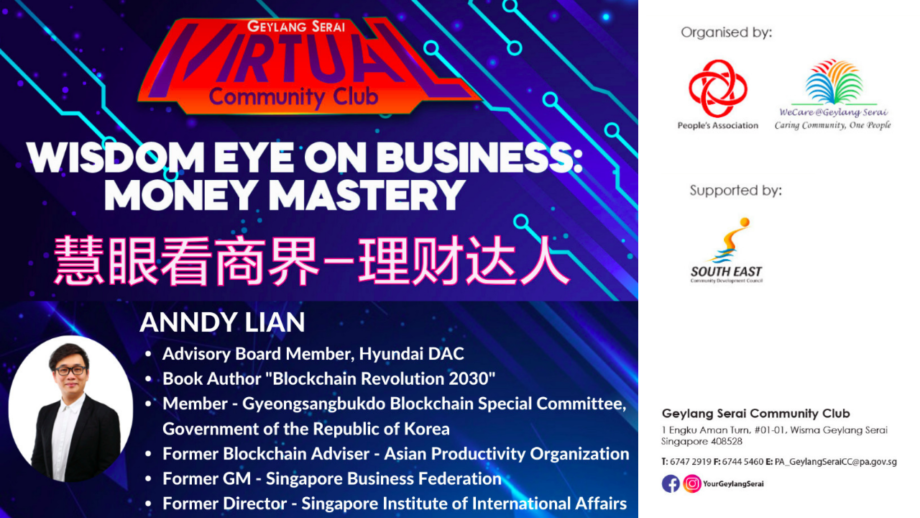
Anndy Lian spoke about at the event titled “The Cryptocurrencies Paradox: Hype, Reality, Opportunities” on 4 May 2021. This event is organised by the People’s Association and supported by South East Community Development Council at the Geylang Serai Virtual Community Club.
Blockchain technology is a system of recording information in a way that makes it difficult or impossible to change, hack, or cheat the system. This technology is often linked to “cryptocurrency”. A cryptocurrency, broadly defined, is virtual or digital money that takes the form of tokens or “coins” has been the buzz word. The two terms come into the limelight again in the mainstream media thanks to bitcoin, ethereum and dogecoin lately.
“Blockchain technology is definitely is not hype. Governments and corporates are adopting the technology. Cryptocurrencies on another hand have a speculative angle. There is hype, just like many other exciting assets. Most importantly, when we look at crypto, we should not be looking at the price only, hype is temporary, the real substance behind the coin is when you see the utility of the coin in the real life.” Anndy Lian told the live audiences.
Anndy has also mentioned that the trend right now in the market is NFT and DeFi. Ethereum who is the second biggest cryptocurrency, behind bitcoin should also be carefully watched. The coin is at $3,400 at the time of the live telecast is gaining traction after the announcement of ‘EP 1559’ fee market structure.
“Ethereum is like oil in the crypto space. It has big followings, liquidity and a proven ecosystem. The fees are high now, but it should be lower when changed to POS. The burning mechanism will be a game-changer for the chain. To add on, layer 2 are also working hard to make the chain faster, cheaper and more scalable as we speak. We should not be worried about the fees now. If you are very worried you can switch to Binance Smart Chain, they are a good choice too.”
At the event, Anndy has also addressed the following:
– The current bitcoin and doge trends.
– How do you evaluate and decide to invest in a project/ coin?
– Is crypto a good long term investment?
– What should I do if I got into a scam crypto investment?
– Should I invest in crypto? How do I buy it?
At the end of the event, Anndy cautioned all that investing in crypto is subjected to high risk, including the possible loss of the money you invest. Check www.anndy.com/updates for the full footages for the event.
About Anndy Lian:
Anndy Lian is an all-rounded business strategist with more than 15 years of experience in Asia. He has provided advisory across a variety of industries for local, international and public listed companies. He is an early blockchain adopter and experienced serial blockchain entrepreneur who is known for his work in the government sector.
Currently, he is appointed as the Advisory Board Member for Hyundai DAC, the blockchain arm of South Korea’s largest car manufacturer Hyundai Motor Group where he looks after the governance and compliance aspects of the business.
Anndy is also part of the Gyeongsangbuk-do Blockchain Special Committee, Government of Republic Korea, helping the province to grow using blockchain technologies.
He also played a pivotal role as the Blockchain Advisor for Asian Productivity Organisation (APO), an intergovernmental organization committed to improving productivity in the Asia-Pacific region.
Lian wrote a book titled “Blockchain Revolution 2030” and is published by Kyobo, the largest bookstore chain in South Korea where he shares insights on how blockchain technology plays an important foundation for the Fourth Industrial Revolution.
Anndy Lian is an early blockchain adopter and experienced serial entrepreneur who is known for his work in the government sector. He is a best selling book author. The latest book is Web4: The Age of Autonomous Intelligence.