Beyond the announcement: The ripple effects of liberation day on global assets

Beyond the announcement: The ripple effects of liberation day on global assets

I’m diving deep into the current market wrap, with a particular focus on the looming “Liberation Day” tariffs announced by US President Donald Trump, set to take effect today, April 2, 2025. This pivotal moment has cast a long shadow over global risk sentiment, and it’s no surprise that investors, analysts, and everyday folks alike are on edge, waiting to see how this bold policy shift will ripple through economies and asset classes worldwide.

My perspective on this topic is one of cautious scepticism—while the intent behind these tariffs may be rooted in a desire to bolster American manufacturing and rebalance trade, the potential for unintended consequences, from inflation spikes to global trade wars, looms large. Let’s unpack this complex scenario with a thorough examination of the data, market reactions, and broader implications.

The White House has framed “Liberation Day” as a cornerstone of Trump’s economic vision—a decisive move to bring manufacturing jobs back to US soil and address long-standing trade imbalances with key partners like China, Canada, Mexico, and the European Union. The tariffs, which are being unveiled today, promise to be sweeping in scope, though the exact scale and country-specific details remain under wraps until the official announcement.

This uncertainty has fuelled a subdued global risk sentiment in the lead-up to the event, as markets grapple with the possibility of a seismic shift in trade dynamics. Economists and market watchers are particularly concerned about the potential for these tariffs to exacerbate inflationary pressures, disrupt supply chains, and dampen economic growth—not just in the US, but globally. My take? While the goal of revitalising American industry is laudable, the execution of such a broad and aggressive tariff regime could easily backfire, especially in an already fragile economic environment.

On the US economic front, recent data paints a troubling picture that only heightens these concerns. The March reading of the US ISM Manufacturing Index slipped into contractionary territory at 49.0, down from expectations of modest growth. This decline was driven by notable weakness in new orders and employment, two critical forward-looking indicators that suggest manufacturers are bracing for tougher times ahead. Even more alarming is the Prices Paid Index, which surged to its highest level since June 2022.

This spike signals that input costs are rising sharply—likely a direct result of tariff-related uncertainty and supply chain jitters. For me, this data underscores a key risk: the US economy may be heading toward stagflation, a toxic mix of stagnant growth and rising prices that could prove difficult for the Federal Reserve to navigate. The Fed, which began cutting rates in September 2024, might find its hands tied if inflation accelerates further, forcing a pivot back to tighter policy at a time when growth is already faltering.

The equity markets reflected this unease in yesterday’s volatile session. The S&P 500, a bellwether for US stocks, initially slid one per cent as investors digested the weak manufacturing data and fretted over the tariff fallout. However, a late-day rally in the technology sector—perhaps driven by bargain hunting or optimism about tech’s resilience—pushed the index into positive territory, closing up 0.4 per cent.

This recovery is a testament to the market’s ability to find silver linings, but I’m not convinced it signals a lasting reprieve. Historical trends cited by The Kobeissi Letter offer a sobering perspective: when the Fed cuts rates during a recession, the S&P 500 has typically declined six per cent within six months and 10 per cent within a year.

Given that the index is already down two per cent since rate cuts began last fall, we could be in for a rough ride if “Liberation Day” triggers a deeper economic slowdown. My view is that investors should remain cautious—yesterday’s tech-driven bounce feels more like a temporary breather than a sign of sustained confidence.

Bond markets, meanwhile, are telling their own story. Benchmark 10-year US Treasury yields dipped about 4 basis points to 4.17 per cent, hitting their lowest level since March 11. This decline suggests a flight to safety as investors seek refuge from equity volatility and economic uncertainty. The US Dollar Index, however, held steady at 104.26, showing little movement overnight. This stability might reflect a wait-and-see approach among currency traders, who are likely holding their breath until the tariff details emerge.

Gold, often a barometer of fear, edged down slightly to US$3,118.90 per ounce after hitting an all-time high of US$3,149 earlier this week. The fact that gold remains near record levels speaks volumes about the underlying anxiety in the market, even if it pulled back marginally yesterday. Brent crude, down 0.3 per cent to US$74.5 per barrel, also suggests a lack of fresh catalysts to drive oil prices higher, though tariff-induced disruptions to global trade could change that picture quickly.

Across the Atlantic, Europe offers a contrasting narrative that highlights the uneven impact of global economic pressures. The final March reading for the Eurozone Manufacturing PMI came in at 48.6, still below the 50 threshold that separates expansion from contraction. Yet, a bright spot emerged: output rose to 50.5, marking the first expansion in two years. This uptick suggests that European manufacturers might be finding their footing, perhaps buoyed by domestic demand or a weaker euro boosting exports.

Inflation, meanwhile, cooled to 2.2 per cent in March, its lowest since January 2022, bolstering expectations that the European Central Bank (ECB) will cut interest rates later this month. European equity indices broadly ended in the green yesterday, reflecting a degree of optimism that stands in stark contrast to the US’s tariff-driven angst.

From my perspective, this divergence underscores a critical point: while Trump’s tariffs aim to protect US interests, they could inadvertently hand a competitive edge to Europe, at least in the short term, by driving up costs for American firms and consumers.

In Asia, the mood is more mixed as markets brace for the tariff hammer to fall. The Reserve Bank of Australia (RBA) held interest rates steady at 4.1 per cent, as expected, and struck a neutral tone in its commentary. This decision reflects a balancing act—acknowledging global uncertainties like tariffs while keeping an eye on domestic inflation and growth. Asian equity indices showed a split performance in early trading today, with some markets holding up while others faltered.

The impending tariffs, now just hours away, are clearly weighing on sentiment, particularly for export-heavy economies like China, Japan, and South Korea. I suspect that Asia’s reaction will hinge heavily on the specifics of Trump’s announcement—targeted tariffs on China, for instance, could spark a sharper sell-off, while a broader, less discriminatory approach might spread the pain more evenly across the region.

Turning to the cryptocurrency space, Bitcoin and Ethereum offer a fascinating subplot amid this tariff-fueled uncertainty. Bitcoin has clawed its way back above US$84,000, posting a nearly two per cent gain in the past 24 hours after weeks of weakness that saw it struggle to breach US$89,000. This resilience is noteworthy, especially given the headwinds from global trade tensions and a risk-off mood among retail investors.

Institutional interest, however, remains robust—firms like Tether and Strategy are making nine- and ten-figure Bitcoin buys, and GoMining’s new US$100 million Bitcoin mining fund targets institutional players with a “fully managed, compounding hashrate strategy.” Yet, the price isn’t budging much, which suggests a disconnect between institutional accumulation and broader market sentiment.

My take? Bitcoin’s recovery is a sign of its growing status as a “digital gold” hedge, but it’s not immune to the macroeconomic storm brewing around “Liberation Day.” Technical analysis points to key resistance ahead at US$89,000—if it can’t break through, we might see another leg down.

Ethereum, meanwhile, has staged its own recovery, climbing above US$1,850 and consolidating around US$1,860. It’s trading above the 100-hourly simple moving average, with a bullish trend line forming at US$1,860 on the hourly chart. However, resistance looms near US$1,900 and US$1,920, and a failure to clear these levels could cap its upside.

Like Bitcoin, Ethereum’s fate is tied to broader market dynamics, and the tariff announcement could either bolster its safe-haven appeal or drag it down with risk assets. I see cryptocurrencies as a wild card in this scenario—capable of defying gravity if traditional markets falter, but vulnerable to a broader sell-off if recession fears take hold.

So, where does this leave us as “Liberation Day” dawns? Trump’s tariff gambit is a high-stakes roll of the dice. The intent—to reassert US economic dominance and revive manufacturing—has merit, but the execution risks sparking a global trade war, driving up inflation, and tipping an already wobbly US economy into recession. The data backs this up: manufacturing is contracting, input costs are soaring, and consumer confidence is cratering.

Markets are jittery, with equities volatile, yields falling, and gold near all-time highs. Europe might catch a break if it can capitalise on US missteps, but Asia faces a tougher road, especially if China bears the brunt of the tariffs. Cryptocurrencies, meanwhile, are a mixed bag—showing resilience but not invincibility.

For now, the markets are holding their breath too, and the next few days could set the tone for months to come. One thing’s for sure: we’re in for a wild ride.


Source: https://e27.co/beyond-the-announcement-the-ripple-effects-of-liberation-day-on-global-assets-20250402/


Anndy Lian is an early blockchain adopter and experienced serial entrepreneur who is known for his work in the government sector. He is a best selling book author- “NFT: From Zero to Hero” and “Blockchain Revolution 2030”.

Currently, he is appointed as the Chief Digital Advisor at Mongolia Productivity Organization, championing national digitization. Prior to his current appointments, he was the Chairman of BigONE Exchange, a global top 30 ranked crypto spot exchange and was also the Advisory Board Member for Hyundai DAC, the blockchain arm of South Korea’s largest car manufacturer Hyundai Motor Group. Lian played a pivotal role as the Blockchain Advisor for Asian Productivity Organisation (APO), an intergovernmental organization committed to improving productivity in the Asia-Pacific region.

An avid supporter of incubating start-ups, Anndy has also been a private investor for the past eight years. With a growth investment mindset, Anndy strategically demonstrates this in the companies he chooses to be involved with. He believes that what he is doing through blockchain technology currently will revolutionise and redefine traditional businesses. He also believes that the blockchain industry has to be “redecentralised”.

j j j

Exploring the Future of Privacy-Preserving DeFi: Insights from the DeCC Day X Shielding Summit

Exploring the Future of Privacy-Preserving DeFi: Insights from the DeCC Day X Shielding Summit

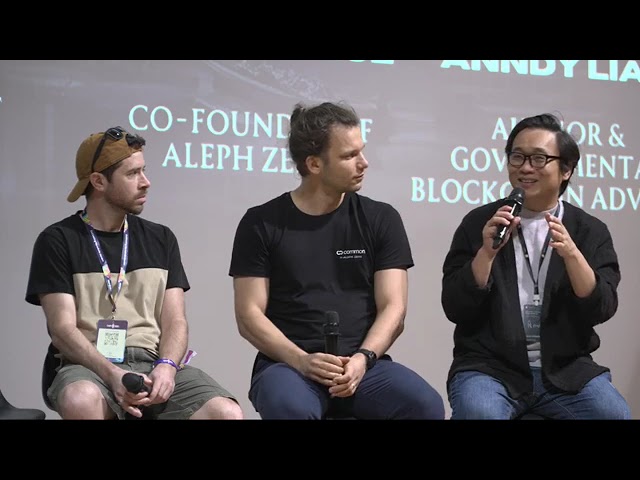
Privacy remains a critical yet challenging frontier. The DeCC Day X Shielding Summit brought together thought leaders and innovators to discuss the current state and future of privacy-preserving DeFi. Moderated by Carter Woetzel of Shade Protocol, the panel featured Supdoggie of SilentSwap, Adam Gagol of Aleph Zero, and intergovernmental expert Anndy Lian. The panel dives into their insights on the importance of privacy in DeFi, the hurdles faced by developers, and the potential pathways to broader adoption.

The Importance of Privacy in DeFi

Privacy in DeFi is not just a feature; it’s a necessity. As Carter Woetzel pointed out, “Privacy and the concept of shielding assets in DeFi have been around for a long time, yet adoption has lagged.” The panelists agreed that privacy is crucial for protecting user data and preventing malicious activities like front-running, where traders exploit transaction information for profit.

Anndy Lian, a governmental blockchain advisor, emphasized the significance of privacy from an investment perspective. “I realized that privacy is really important,” he said, drawing from his experience in the medical field where data breaches are a major concern. Lian’s journey into privacy began with creating a blockchain-based medical record system, highlighting the cross-industry relevance of privacy solutions.

Challenges in Privacy-Preserving DeFi

Despite its importance, privacy in DeFi faces significant challenges. Adam Gagol of Aleph Zero noted, “Right now, it has terrible user experience because the proof generation times are over 10 seconds for most products.” This technical hurdle, coupled with the complexity of privacy protocols, deters users who are accustomed to more straightforward financial interactions.

Regulatory barriers also play a significant role in stifling adoption. Supdoggie pointed out that “the biggest problem is regulation,” citing the example of Tornado Cash, a privacy tool classified as a mixer and banned in many jurisdictions. This regulatory uncertainty creates a hostile environment for privacy-focused projects, limiting their growth and accessibility.

Overcoming the Hurdles

To overcome these challenges, the panelists discussed several strategies. Improving user experience is paramount. As Adam Gagol mentioned, “We’re trying to build a wallet that looks like a regular wallet so that you don’t immediately even notice that this is a private wallet.” By simplifying the user interface and reducing the complexity of privacy features, developers can make privacy-preserving DeFi more accessible to the average user.

Another approach is to address liquidity issues. Supdoggie explained that SilentSwap is tackling this by “borrowing liquidity from public blockchains but transacting or swapping privately.” This innovative method allows users to benefit from the liquidity of public networks while maintaining privacy.

The Path to Adoption

The path to widespread adoption of privacy-preserving DeFi involves not only technical improvements but also strategic marketing and community building. Anndy Lian highlighted the importance of creating demand: “If you don’t have users, you don’t have liquidity. If you don’t have liquidity, you have nothing.” Building a strong community and generating excitement around privacy features are crucial steps toward achieving critical mass.

Carter Woetzel added that the race between privacy-first projects and traditional DeFi platforms integrating privacy features will be pivotal. “The Uniswaps of the world are going to start adding in privacy features,” he noted, suggesting that the first to successfully combine privacy with liquidity and user-friendliness will gain a significant advantage.

The Future of Privacy-Preserving DeFi

Looking ahead, the panelists were optimistic about the future of privacy-preserving DeFi. Adam Gagol predicted that “the proof generation time for the majority of use cases will stop being the topic of conversation because it’s going to be low enough to be actually useful.” As technical barriers diminish, the focus will shift to broader adoption and integration with existing financial systems.

Anndy Lian emphasized the need for collaboration and integration with larger platforms. “Instead of them creating that demand, the real true blue privacy guys should go there and say, ‘Hey, can we integrate? Can we do something together?'” By partnering with established players, privacy-focused projects can leverage existing networks to reach a wider audience.

Conclusion

The DeCC Day X Shielding Summit highlighted both the challenges and opportunities in the realm of privacy-preserving DeFi. As the panelists discussed, the road to adoption is fraught with technical, regulatory, and market challenges. However, with innovative solutions, strategic partnerships, and a focus on user experience, the future of privacy in DeFi looks promising. As Carter Woetzel aptly summarized, “Private DeFi is good. Can we find the demand and do it before someone else integrates privacy with large-scale distribution?” The race is on, and the stakes are high.

Anndy Lian is an early blockchain adopter and experienced serial entrepreneur who is known for his work in the government sector. He is a best selling book author- “NFT: From Zero to Hero” and “Blockchain Revolution 2030”.

Currently, he is appointed as the Chief Digital Advisor at Mongolia Productivity Organization, championing national digitization. Prior to his current appointments, he was the Chairman of BigONE Exchange, a global top 30 ranked crypto spot exchange and was also the Advisory Board Member for Hyundai DAC, the blockchain arm of South Korea’s largest car manufacturer Hyundai Motor Group. Lian played a pivotal role as the Blockchain Advisor for Asian Productivity Organisation (APO), an intergovernmental organization committed to improving productivity in the Asia-Pacific region.

An avid supporter of incubating start-ups, Anndy has also been a private investor for the past eight years. With a growth investment mindset, Anndy strategically demonstrates this in the companies he chooses to be involved with. He believes that what he is doing through blockchain technology currently will revolutionise and redefine traditional businesses. He also believes that the blockchain industry has to be “redecentralised”.

j j j

Highlights of DeCC Day at Token2049 Singapore

Highlights of DeCC Day at Token2049 Singapore

Lisa Loud, executive director of Secret Network Foundation, opened the day and spoke of two key conversations that were directly relevant to DeCC Day.

The first was a gathering at EthDenver in February where the DeCC Alliance first met, and first put together an overview and informal alliance of companies dedicated to promoting and delivering confidential computing. It is really important to note that the almost 30 companies under this umbrella use different technologies, and some are even directly competitive, but all have as a common goal confidential computing.

The second conversation germane to the DeCC Day was Lisa’s meetings with SEC Commissioner Hester Pierce. Lisa remarked to Hester that she really deserved the term CryptoMom for her hard work on behalf of crypto.

However, Hester replied she wasn’t a champion of crypto, she was a champion of people making their own decisions.

And to paraphrase the last line from Robert Frost’s poem ‘The Road not Taken’ that has made all the difference.

The DeCC Day carried on in style. The Silent Swap team were there in force and made a big announcement that their Beta was open. Supdoggie from the team gave a highly technical look at how SilentSwap is using TEE and FHE in its architecture.

Sodalabs, represented by Avishay Yanai, gave a talk on the tech behind Garbled Circuits, yet another technology added to the Alliance which already includes TEE, MPC, ZK and FHE.

The first panel, on the Importance of DePIN, was moderated by Crypto Megan. Her guests were Amar Bedi of Tashi, Alex Zaidelson of SCRT Labs and Anil Murty of Akash. The triple A guests were united in their comment that OpenAI is very closed – and that is why we need DePIN to democratize access to GPUs.

The Building Web3 Responsibly panel was moderated by Varuni Trivedi, editor of The Coin Republic and included LC of IBL Law, Joshua Maddox of COTI, Bruce Ahn of Partisia, and Zheng Leong Chua of Automata Network. Echoing shades of Games of Thrones, LC said ‘regulation is coming.’ Bruce said ‘Devs understand the rules.’ Zheng said ‘we love compliance,’ and Joshua said ‘we need to get dirty.’

Zoe McFox of Phala Network moderated the Power of DeCC panel. During this conversation, it was pointed out that in the military, there are armed guards securing databases with guns, and that we needed to find equally secure tech solutions. She was joined by Supdoggie, Yannick Schrade of Arcium and Kabal.

Finally, Anndy Lian, Governmental Blockchain Advisor, led the panel looking at commercial use cases. He was joined by Josh Wyant of Novapolis, Gavin Thomas of TEN, Cal of SquidGrow and Juan Mari of Blok Assets. During this panel it was observed that Vitalik’s lack of privacy is well documented with people tracking him through his publicly acknowledged wallets. But it’s the same for ordinary people who need protection also.

Throughout the presentations and discussions, the audience was engaged and every opportunity for questions to be asked was filled with participation and insightful answers.

The event ended with a powerful round of networking where relationships were built that will live on and keep the value of the event going for years to come.


Source: https://www.blockleaders.io/events/highlights-of-decc-day-at-token2049-singapore-

Anndy Lian is an early blockchain adopter and experienced serial entrepreneur who is known for his work in the government sector. He is a best selling book author- “NFT: From Zero to Hero” and “Blockchain Revolution 2030”.

Currently, he is appointed as the Chief Digital Advisor at Mongolia Productivity Organization, championing national digitization. Prior to his current appointments, he was the Chairman of BigONE Exchange, a global top 30 ranked crypto spot exchange and was also the Advisory Board Member for Hyundai DAC, the blockchain arm of South Korea’s largest car manufacturer Hyundai Motor Group. Lian played a pivotal role as the Blockchain Advisor for Asian Productivity Organisation (APO), an intergovernmental organization committed to improving productivity in the Asia-Pacific region.

An avid supporter of incubating start-ups, Anndy has also been a private investor for the past eight years. With a growth investment mindset, Anndy strategically demonstrates this in the companies he chooses to be involved with. He believes that what he is doing through blockchain technology currently will revolutionise and redefine traditional businesses. He also believes that the blockchain industry has to be “redecentralised”.

j j j