RWA isn’t decentralised: It’s TradFi wearing a blockchain costume

RWA isn’t decentralised: It’s TradFi wearing a blockchain costume

Real World Asset (RWA) tokenisation has emerged as one of the most talked-about frontiers in the blockchain and web3 space, promising to unlock trillions of dollars of otherwise illiquid value by bringing tangible assets like real estate, bonds, commodities, and even art onto the blockchain. Proponents often tout RWA as the missing link that will finally bring institutional capital into decentralised ecosystems while democratising access to high-value investment opportunities.

A growing chorus of sceptics warns that RWA may not represent a true web3 innovation at all, but rather a repackaging of traditional finance wrapped in digital form, still tethered to centralised institutions, legacy legal frameworks, and regulatory dependencies that contradict the core tenets of decentralisation, trustlessness, and permissionless access.

At the heart of this critique lies a fundamental truth: the token itself is not the asset. Instead, it functions as a digital proxy, a claim or receipt, whose validity depends entirely on off-chain realities that the blockchain cannot enforce. When you tokenise a commercial building in Manhattan or a US Treasury bond, the blockchain records a cryptographic representation of ownership, but the legal title, physical custody, and enforceability of that claim remain firmly outside the ledger.

That disconnection forces RWA systems to rely on third parties, lawyers, custodians, courts, and regulators to verify, manage, and defend the value the token purports to represent. In doing so, RWA reintroduces the very intermediaries that web3 was designed to disintermediate.

One of the most pressing structural flaws is regulatory uncertainty. Unlike purely digital assets such as Bitcoin or Ethereum, which operate in a grey zone but are increasingly recognised as commodities, tokenised RWAs often fall squarely within the definition of securities under existing financial laws. This triggers a cascade of compliance obligations, registration, prospectus disclosures, and investor accreditation checks that vary wildly across jurisdictions.

A token representing a German mortgage-backed security may be treated as a regulated investment product in the EU, an unregistered security in the US, and something entirely different in Singapore or the UAE. The absence of global regulatory harmonisation means that RWA projects must either limit their operations to a narrow geography or bear the immense cost of multi-jurisdictional legal compliance. This not only stifles innovation but also limits participation to well-capitalised institutions, effectively pricing out the average retail investor that web3 claims to empower.

Even if regulatory hurdles were overcome, RWA tokenisation remains vulnerable to counterparty and custodial risk. Most RWA protocols do not hold physical assets directly on-chain. They cannot, because a blockchain cannot store a deed or a warehouse full of gold. Instead, the underlying asset is held by a legal entity, often a Special Purpose Vehicle (SPV), which issues tokens backed by that asset. This arrangement creates a single point of failure. If the SPV is mismanaged, becomes insolvent, or engages in fraudulent activity, token holders may find their digital claims backed by nothing more than empty promises.

Unlike in a truly decentralised system, where code and consensus govern outcomes, RWA token holders must place faith in the honesty and solvency of a centralised custodian. This dependency fundamentally undermines the trustless ethos of web3. When a smart contract cannot guarantee the redemption of a token for its underlying value without invoking human intermediaries, the promise of self-sovereign ownership rings hollow.

Moreover, many RWA implementations contradict the foundational principles of permissionless and open access. Because of regulatory pressures and risk management concerns, most RWA platforms require users to undergo Know Your Customer (KYC) and Anti-Money Laundering (AML) verification before they can buy, sell, or hold tokens. Some even deploy their tokens on permissioned blockchains, where validators are pre-approved institutions rather than open participants.

These design choices may make sense from a compliance standpoint, but they erode the open, borderless, and censorship-resistant nature of public blockchains. Instead of creating a new financial paradigm, such systems replicate the gated, hierarchical structures of traditional finance, merely digitising the gatekeeping rather than dismantling it.

Liquidity, often cited as the chief benefit of tokenisation, also proves more illusory than real in practice. While fractional ownership theoretically enables smaller investors to participate in high-value assets, the secondary markets for RWA tokens remain thin and fragmented. Without deep pools of buyers and sellers, accurate price discovery becomes difficult. This leads to wide bid-ask spreads, susceptibility to manipulation, and the need for professional market makers, who again reintroduce centralised actors into the ecosystem.

More critically, the liquidity of the token is not the same as the liquidity of the underlying asset. A token representing shares in a private commercial building may trade freely on a decentralised exchange, but if the building itself cannot be sold quickly or at fair market value, the token’s price may decouple from reality, creating systemic fragility.

Perhaps the most philosophically damning argument is that enforcement of RWA ownership ultimately depends on traditional legal systems. Smart contracts can automate payments or transfers of tokens, but they cannot compel a physical handover of property or enforce rights against a defaulting counterparty in the real world.

If a dispute arises, say, the custodian refuses to honour redemptions or a third party challenges the legal title, the resolution must occur in a court of law, not on a blockchain. This means that the finality promised by decentralised ledgers is conditional, contingent on off-chain institutions that operate outside the protocol’s control. In such a model, the blockchain becomes little more than a glorified database, recording claims that derive their enforceability from the very centralised systems web3 seeks to replace.

Critics, therefore, argue that RWA tokenisation is not a revolution but a bridge, one that may facilitate the onboarding of institutional capital into crypto ecosystems, but at the cost of ideological purity. Rather than reimagining property rights, ownership, and value transfer from first principles, RWA grafts blockchain technology onto the existing scaffolding of TradFi.

It digitises paperwork but does not eliminate the need for paperwork. It tokenises trust but does not render trust obsolete. In doing so, it risks creating a hybrid system that inherits the inefficiencies of both worlds, the rigidity of legacy finance and the volatility of crypto, without delivering the autonomy or resilience that true decentralisation promises.

This is not to say that RWA has no utility. For certain use cases, such as streamlining syndication in private credit or enabling faster settlement in bond markets, it may offer genuine efficiency gains. But those gains come within the confines of a system that remains fundamentally centralised in its legal and economic underpinnings. As such, RWA should be understood not as the future of web3, but as an on-ramp from the old world to the new, an interim solution that may accelerate adoption but does not embody the transformative potential that defines the web3 vision.

Until the legal, custodial, and enforcement layers can be fully encoded and executed on-chain, a feat that may require not just technological innovation but societal and legal paradigm shifts, RWA will remain a digital shadow of the physical world, not a self-contained sovereign alternative.


Source: https://e27.co/rwa-isnt-decentralised-its-tradfi-wearing-a-blockchain-costume-20260105/

Anndy Lian is an early blockchain adopter and experienced serial entrepreneur who is known for his work in the government sector. He is a best selling book author- “NFT: From Zero to Hero” and “Blockchain Revolution 2030”.

Currently, he is appointed as the Chief Digital Advisor at Mongolia Productivity Organization, championing national digitization. Prior to his current appointments, he was the Chairman of BigONE Exchange, a global top 30 ranked crypto spot exchange and was also the Advisory Board Member for Hyundai DAC, the blockchain arm of South Korea’s largest car manufacturer Hyundai Motor Group. Lian played a pivotal role as the Blockchain Advisor for Asian Productivity Organisation (APO), an intergovernmental organization committed to improving productivity in the Asia-Pacific region.

An avid supporter of incubating start-ups, Anndy has also been a private investor for the past eight years. With a growth investment mindset, Anndy strategically demonstrates this in the companies he chooses to be involved with. He believes that what he is doing through blockchain technology currently will revolutionise and redefine traditional businesses. He also believes that the blockchain industry has to be “redecentralised”.

j j j

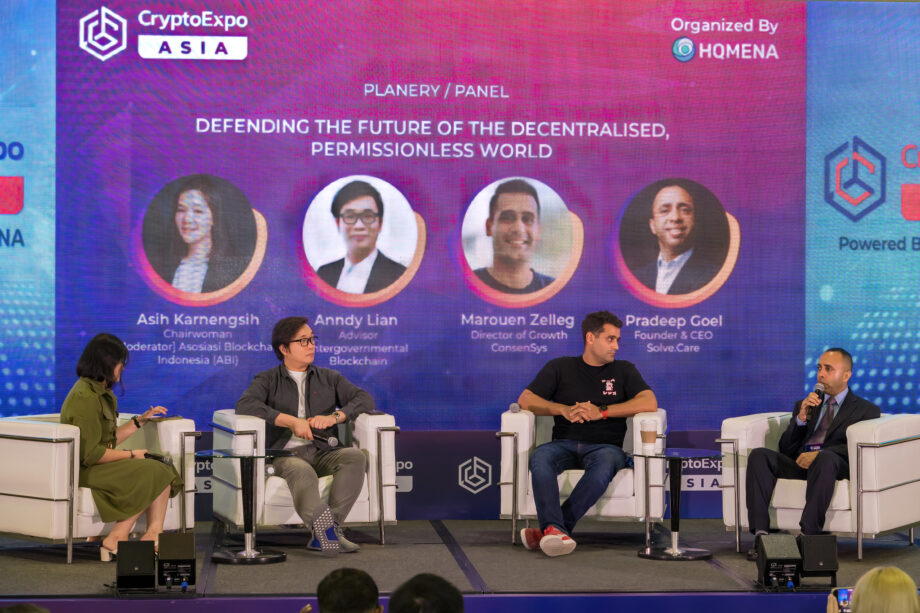
Crypto Expo Asia Panel Discussion: Defending the Future of the Decentralised, Permissionless World

Crypto Expo Asia Panel Discussion: Defending the Future of the Decentralised, Permissionless World

Topic- Defending the Future of the Decentralised, Permissionless World

Crypto Expo Asia, 7-8th June 2023, Singapore

Moderator- Asih Karnengsih, Chairwoman (Asosiasi Blockchain Indonesia)

Panelists:
– Anndy Lian (Intergovernmental Blockchain Advisor)
– Marouen Zelleg, Director of Growth (ConsenSys)
– Pradeep Goel, Founder & CEO (Solve.Care)

Crypto Expo Asia 2023 is a premier virtual asset and Blockchain Conference, organized by HQMena announced in Singapore 2023 with its large audience attending globally. Over 100+ Crypto companies are expected to participate in this event, with an estimated 3000+ attendees, Featured conference with 60+ Speakers, and many attendees from 30+ Countries.

One of the key discussions we have lined up is focused on “Defending the Future of the Decentralized Permissionless World.” This panel discussion brings together experts from different backgrounds to share their perspectives. The panelists include Asih Karnengsih, the moderator, Chairwoman of the Asosiasi Blockchain Indonesia; Anndy Lian, NFT from Zero to Hero book author; Marouen Zelleg, Director of Growth at ConsenSys, and Pradeep Goel, Founder and CEO of Solve Care.

Pradeep Goel emphasized the importance of user-centric security in the blockchain industry. He highlighted the challenges faced by users, especially in regulated industries such as healthcare. According to him, user-friendly solutions that protect identities, assets, and roles are crucial for driving adoption. Pradeep stressed the need for a holistic approach to security that combines nuanced identity management, asset protection, and role-based access.

Marouen Zelleg spoke about his commitment to decentralization. He shared his personal experiences from Tunisia, a country known for its centralized bureaucracy, and the limitations it imposes on individuals and businesses. Marwan expressed his passion for blockchain technology’s potential to transform economies and people’s lives. Consensus, through its software solutions, contributes to this mission by enabling developers to build on the blockchain.

Anndy Lian highlighted his role in advising companies and governments on blockchain adoption. He emphasized the importance of educating governments about the potential of blockchain technology and its benefits. Andy also mentioned his book, “NFT from Zero to Hero,” where he aims to educate people about decentralization and its implications.

The panelists further discussed the role of security in the decentralized world. Pradeep emphasized the significance of tying identity, assets, and roles together to provide a secure user experience. Marouen highlighted the need for a balance between security and decentralization. He drew parallels with the traditional taxi system, showcasing how decentralization can provide security and safety without relying on centralized entities. Anndy emphasized the role of artificial intelligence and blockchain analytics in enhancing security measures.

The conversation also touched upon the involvement of governments in the blockchain space. Anndy shared insights into the diverse perspectives of governments, ranging from concerns about regulation and taxation to promoting innovation and harnessing blockchain’s potential. He mentioned the increasing interest of governments in regulating aspects like wallets and monitoring crypto activities.

The panelists concluded that the implementation of blockchain technology in traditional institutions varies based on use cases and regulatory environments. While some institutions explore blockchain to revamp their infrastructure and benefit from quicker settlement times, others aim to cater to customer demands, such as providing crypto-related services within existing banking systems.

Socials:

Facebook: http://www.facebook.com/anndylian
Twitter: http://www.twitter.com/anndylian
Instagram: http://www.instagram.com/liananndy
LinkedIn: https://www.linkedin.com/in/anndylian/
Homepage: http://www.anndy.com
YouTube: https://www.youtube.com/@AnndyLian


Anndy Lian is an early blockchain adopter and experienced serial entrepreneur who is known for his work in the government sector. He is a best selling book author- “NFT: From Zero to Hero” and “Blockchain Revolution 2030”.

Currently, he is appointed as the Chief Digital Advisor at Mongolia Productivity Organization, championing national digitization. Prior to his current appointments, he was the Chairman of BigONE Exchange, a global top 30 ranked crypto spot exchange and was also the Advisory Board Member for Hyundai DAC, the blockchain arm of South Korea’s largest car manufacturer Hyundai Motor Group. Lian played a pivotal role as the Blockchain Advisor for Asian Productivity Organisation (APO), an intergovernmental organization committed to improving productivity in the Asia-Pacific region.

An avid supporter of incubating start-ups, Anndy has also been a private investor for the past eight years. With a growth investment mindset, Anndy strategically demonstrates this in the companies he chooses to be involved with. He believes that what he is doing through blockchain technology currently will revolutionise and redefine traditional businesses. He also believes that the blockchain industry has to be “redecentralised”.

j j j

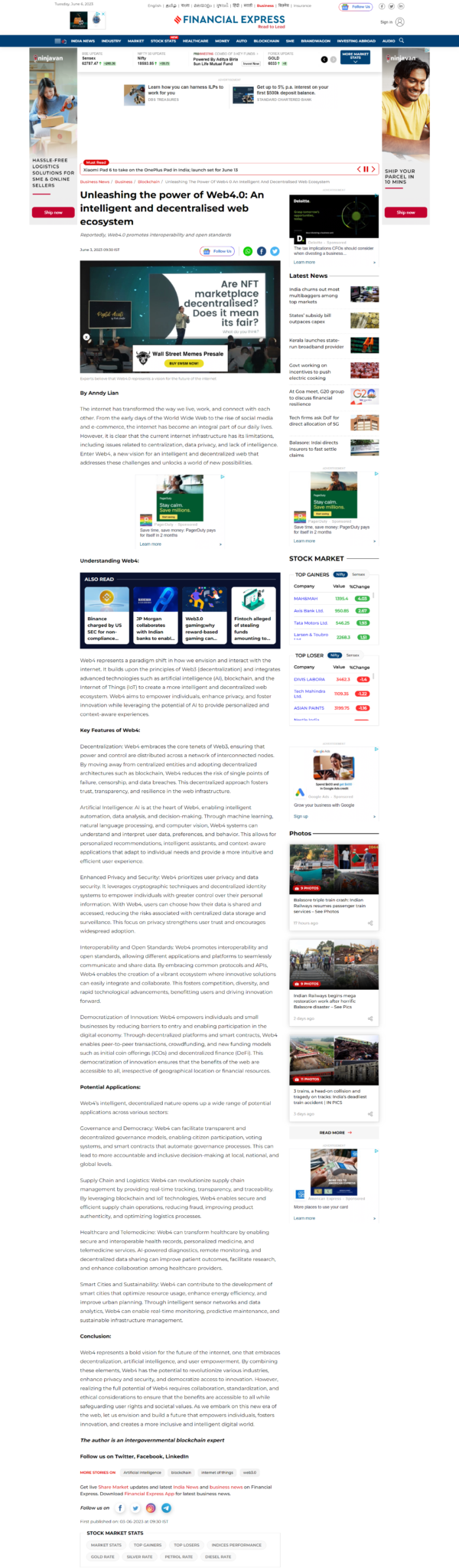
Unleashing the power of Web4.0: An intelligent and decentralised web ecosystem

Unleashing the power of Web4.0: An intelligent and decentralised web ecosystem

The internet has transformed the way we live, work, and connect with each other. From the early days of the World Wide Web to the rise of social media and e-commerce, the internet has become an integral part of our daily lives. However, it is clear that the current internet infrastructure has its limitations, including issues related to centralization, data privacy, and lack of intelligence. Enter Web4, a new vision for an intelligent and decentralized web that addresses these challenges and unlocks a world of new possibilities.

Understanding Web4:

Web4 represents a paradigm shift in how we envision and interact with the internet. It builds upon the principles of Web3 (decentralization) and integrates advanced technologies such as artificial intelligence (AI), blockchain, and the Internet of Things (IoT) to create a more intelligent and decentralized web ecosystem. Web4 aims to empower individuals, enhance privacy, and foster innovation while leveraging the potential of AI to provide personalized and context-aware experiences.

Key Features of Web4:

Decentralization: Web4 embraces the core tenets of Web3, ensuring that power and control are distributed across a network of interconnected nodes. By moving away from centralized entities and adopting decentralized architectures such as blockchain, Web4 reduces the risk of single points of failure, censorship, and data breaches. This decentralized approach fosters trust, transparency, and resilience in the web infrastructure.

Artificial Intelligence: AI is at the heart of Web4, enabling intelligent automation, data analysis, and decision-making. Through machine learning, natural language processing, and computer vision, Web4 systems can understand and interpret user data, preferences, and behavior. This allows for personalized recommendations, intelligent assistants, and context-aware applications that adapt to individual needs and provide a more intuitive and efficient user experience.

Enhanced Privacy and Security: Web4 prioritizes user privacy and data security. It leverages cryptographic techniques and decentralized identity systems to empower individuals with greater control over their personal information. With Web4, users can choose how their data is shared and accessed, reducing the risks associated with centralized data storage and surveillance. This focus on privacy strengthens user trust and encourages widespread adoption.

Interoperability and Open Standards: Web4 promotes interoperability and open standards, allowing different applications and platforms to seamlessly communicate and share data. By embracing common protocols and APIs, Web4 enables the creation of a vibrant ecosystem where innovative solutions can easily integrate and collaborate. This fosters competition, diversity, and rapid technological advancements, benefitting users and driving innovation forward.

Democratization of Innovation: Web4 empowers individuals and small businesses by reducing barriers to entry and enabling participation in the digital economy. Through decentralized platforms and smart contracts, Web4 enables peer-to-peer transactions, crowdfunding, and new funding models such as initial coin offerings (ICOs) and decentralized finance (DeFi). This democratization of innovation ensures that the benefits of the web are accessible to all, irrespective of geographical location or financial resources.

Potential Applications:

Web4’s intelligent, decentralized nature opens up a wide range of potential applications across various sectors:

Governance and Democracy: Web4 can facilitate transparent and decentralized governance models, enabling citizen participation, voting systems, and smart contracts that automate governance processes. This can lead to more accountable and inclusive decision-making at local, national, and global levels.

Supply Chain and Logistics: Web4 can revolutionize supply chain management by providing real-time tracking, transparency, and traceability. By leveraging blockchain and IoT technologies, Web4 enables secure and efficient supply chain operations, reducing fraud, improving product authenticity, and optimizing logistics processes.

Healthcare and Telemedicine: Web4 can transform healthcare by enabling secure and interoperable health records, personalized medicine, and telemedicine services. AI-powered diagnostics, remote monitoring, and decentralized data sharing can improve patient outcomes, facilitate research, and enhance collaboration among healthcare providers.

Smart Cities and Sustainability: Web4 can contribute to the development of smart cities that optimize resource usage, enhance energy efficiency, and improve urban planning. Through intelligent sensor networks and data analytics, Web4 can enable real-time monitoring, predictive maintenance, and sustainable infrastructure management.

Conclusion:

Web4 represents a bold vision for the future of the internet, one that embraces decentralization, artificial intelligence, and user empowerment. By combining these elements, Web4 has the potential to revolutionize various industries, enhance privacy and security, and democratize access to innovation. However, realizing the full potential of Web4 requires collaboration, standardization, and ethical considerations to ensure that the benefits are accessible to all while safeguarding user rights and societal values. As we embark on this new era of the web, let us envision and build a future that empowers individuals, fosters innovation, and creates a more inclusive and intelligent digital world.


Source: https://www.financialexpress.com/business/blockchain-unleashing-the-power-of-web4-0-an-intelligent-and-decentralised-web-ecosystem-3111477/


Anndy Lian is an early blockchain adopter and experienced serial entrepreneur who is known for his work in the government sector. He is a best selling book author- “NFT: From Zero to Hero” and “Blockchain Revolution 2030”.

Currently, he is appointed as the Chief Digital Advisor at Mongolia Productivity Organization, championing national digitization. Prior to his current appointments, he was the Chairman of BigONE Exchange, a global top 30 ranked crypto spot exchange and was also the Advisory Board Member for Hyundai DAC, the blockchain arm of South Korea’s largest car manufacturer Hyundai Motor Group. Lian played a pivotal role as the Blockchain Advisor for Asian Productivity Organisation (APO), an intergovernmental organization committed to improving productivity in the Asia-Pacific region.

An avid supporter of incubating start-ups, Anndy has also been a private investor for the past eight years. With a growth investment mindset, Anndy strategically demonstrates this in the companies he chooses to be involved with. He believes that what he is doing through blockchain technology currently will revolutionise and redefine traditional businesses. He also believes that the blockchain industry has to be “redecentralised”.

j j j