The X-to-Earn model: Eat, sleep, do almost anything and get paid in crypto

The X-to-Earn model: Eat, sleep, do almost anything and get paid in crypto

Are you a good runner? Or eater? Or sleeper? Chances are whatever you’re good at, there’s a Web3 project out there to reward you in crypto. But do the tokenomics stack up?

Axie Infinity — a non-fungible token-based online video game that’s generated over US$4 billion in secondary NFT sales — is credited with kicking off the so-called “play-to-earn” (P2E) craze, allowing gamers to earn money while playing. While the Axie hype has somewhat died down, it also spawned a series of copycat projects that pay users to perform everyday activities.

These projects have developed into an industry of their own; a sort of “X-activity-to-earn” (X2E) model, now including tie-ins with brands from Asics to European soccer clubs, paying users in cryptocurrency for running, eating or even sleeping.

Perhaps not surprisingly, questions are being raised about the economic principles many of these projects are founded on.

“The problem with some of these X2E models is that it seems like a really good innovation, but then it is just purely a Ponzi [scheme],” said Anndy Lian, author of the new book “NFT: From Zero to Hero,” in an interview with Forkast, though he did not mention any by name. “And it’s actually very disturbing, to be really honest.”

Without ongoing revenue to support what is being paid out, Lian said, the X2E model risks becoming an unsustainable compensation structure, relying on the hope that more people will come in to “pay” for the tokens that were previously dropped.

There were similar accusations leveled at Axie Infinity after a period of explosive growth failed to generate earlier returns for its users, as its native token SLP is now trading at US$0.004 at press time after reaching as high as US$0.41 in May 2021.

Running tokenomics

One of the more popular variations of this new industry model is the “Move-to-Earn” (M2E) project StepN, which pays users in cryptocurrency for walking, jogging or cycling by tracking their movements via GPS on their phone.

To participate in the project, users buy NFT sneakers and hold them in their wallets on their phones when they go for a walk and are then compensated for the exercise in the project’s native currency, Green Satoshi Tokens (GST).

Users then cash out GST for profit or invest it back into the project to mint additional NFTs for other users to buy.

Brian Lu, founding partner of investment fund Infinity Ventures Crypto, is more optimistic about the outlook for these projects than Lian, however, telling Forkast in an interview there are ways such projects can be successful.

“There’s always going to [need to] be people to support the token or the token has to have some type of utility [for the project to work],” he said.

StepN does this by allowing users to cash out their GST for profit or by investing it back into the ecosystem to mint more sneaker NFTs. This was the tokenomics model initially adopted by Axie Infinity, which allowed users to cash out their SLP or to re-invest it back to create more “Axies” — Pokémon-like creatures that players bred and battled to earn more SLP.

After launching in December, GST reached a high of US$9.03 in late April before the crash along with the rest of the crypto market in May. Despite tie-ins with sports-brand Asics and Spanish soccer club Atlético de Madrid, GST had fallen to under US$1 by early June, and has been trading under US$0.10 since early July.

Sleeping on the job

Positioning itself in direct response to the Move-to-Earn projects, Gang Azit Social Club (GASC) has taken a different approach, and wants to remind users that it’s important for one’s mental health to take a break and relax from time to time, and incentivizes this practice by paying them to do just that.

Calling itself a “Relax-to-Earn” project, GASC detects when users are within a predetermined zone using GPS and pays them in the project’s HIPS token if they press a “relax” button on their phone while in the space.

If anyone needs an incentive to eat, Esca — an online marketplace for food consumers and vendors — promises to pay customers, restaurants and at-home chefs in both Bitcoin and USDC. According to its website, Esca thinks the commissions charged by most food delivery platforms are too high and is using cryptocurrency to balance the equation.

So many projects have popped up promising to pay users to sleep that there is even its own category of finance for the industry — SleepFi.

The Sleepee app pays users based on their sleep quality score in its native currency, which can be converted to buy products or services in their store. Even the Move-to-Earn app MetaGym offers a SleepFi feature that pays users in its native token that can be spent in-app or cashed out for USDC.

The future of Web3 and gaming

Measuring the success of these projects over the past few months has been difficult amid the broader crypto downturn, which has seen even well-established crypto funds and businesses file for bankruptcy or needing a bailout.

If the situation doesn’t improve soon, Lu says there are other options available to such projects.

“These X2E projects that are coming up [are] going to start learning to advertise their users and their user’s behavior [and] user data to marketing companies that are willing to pay for it,” said Lu, explaining this process will become more commonplace as brand tie-in continues to gain traction.

Selling user data may seem against the ethos of Web3, which is often touted to offer a new incentive model to break away from the data mining method of business which has led to massive wealth concentration from a few giant tech companies.

Back to the genre that started it all, Lu says the industry has learned its lesson from the short-lived success of Axie Infinity and is shifting from Play-to-Earn to Play-and-Earn, or Web 2.5.

These projects are putting gameplay back at the center of the game, with the option to earn money — sometimes even in fiat — a bonus element rather than making a game whose main draw card is earning.

Lian is hopeful these types of games can still survive in the meantime, but says it will be a long time before the mainstream gaming industry adopts Web3 in any meaningful way.

“I don’t think the super app is coming anytime soon,” said Lian, who explained the technology is there but the US$300 billion a year gaming industry has little incentive to change. “[Game studios] might not be agreeable to how it is actually going to help them since they are really making millions of dollars in revenue every year.”


Source: https://forkast.news/x-to-earn-model-eat-sleep-anything-paid-crypto/

Anndy Lian is an early blockchain adopter and experienced serial entrepreneur who is known for his work in the government sector. He is a best selling book author- “NFT: From Zero to Hero” and “Blockchain Revolution 2030”.

Currently, he is appointed as the Chief Digital Advisor at Mongolia Productivity Organization, championing national digitization. Prior to his current appointments, he was the Chairman of BigONE Exchange, a global top 30 ranked crypto spot exchange and was also the Advisory Board Member for Hyundai DAC, the blockchain arm of South Korea’s largest car manufacturer Hyundai Motor Group. Lian played a pivotal role as the Blockchain Advisor for Asian Productivity Organisation (APO), an intergovernmental organization committed to improving productivity in the Asia-Pacific region.

An avid supporter of incubating start-ups, Anndy has also been a private investor for the past eight years. With a growth investment mindset, Anndy strategically demonstrates this in the companies he chooses to be involved with. He believes that what he is doing through blockchain technology currently will revolutionise and redefine traditional businesses. He also believes that the blockchain industry has to be “redecentralised”.

j j j

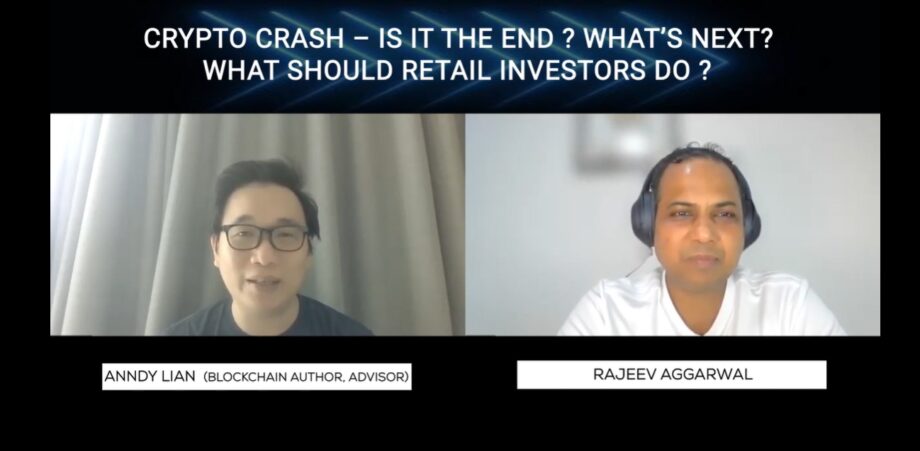
Crypto Crash: Is it the end and what should retail investors do?

Crypto Crash: Is it the end and what should retail investors do?

The Crypto market is in tatters.  The global cryptocurrency market cap moved up to the $961 billion mark, rising about 3 per cent in the last 24 hours. Several big players in the cryptocurrency markets have had difficulties, and further declines could force other crypto investors to sell out.

Rajeev who is kind enough to host me and brought up the following topics.
a) How long this bear market or correction go?
b) How to save your crypto capital now
c) Who / which exchanges could be next to fall?
d) Should you buy the crypto dip?
e) Staking, stablecoins

00:00:00 Introduction
00:00:59 What lead to the bear market in Crypto.
00:02:16 The worst is not yet over for Crypto markets
00:04:38 What exchanges can fall next?
00:08:10 How should retail investors save their capital? Buy a cold wallet and withdraw from the exchange?
00:09:14 Could Binance be under threat?
00:10:26 Does the current bear market affect the long-term bullish thesis of Crypto?
00:12:55 How to use spare cash when crypto prices are low? What are possibly good coins?
00:20:35 View on Luna? Why did Luna fail and why Anndy was one of Luna’s skeptics?
00:23:33 Are stablecoins here to stay?
00:27:09 What should retail investors do in this scenario?
00:29:19 Should investors stake their coins now?
00:32:15 Investors should be careful of crypto influencers!
00:34:50 Thank you

Anndy Lian is an early blockchain adopter and experienced serial entrepreneur who is known for his work in the government sector. He is a best selling book author- “NFT: From Zero to Hero” and “Blockchain Revolution 2030”.

Currently, he is appointed as the Chief Digital Advisor at Mongolia Productivity Organization, championing national digitization. Prior to his current appointments, he was the Chairman of BigONE Exchange, a global top 30 ranked crypto spot exchange and was also the Advisory Board Member for Hyundai DAC, the blockchain arm of South Korea’s largest car manufacturer Hyundai Motor Group. Lian played a pivotal role as the Blockchain Advisor for Asian Productivity Organisation (APO), an intergovernmental organization committed to improving productivity in the Asia-Pacific region.

An avid supporter of incubating start-ups, Anndy has also been a private investor for the past eight years. With a growth investment mindset, Anndy strategically demonstrates this in the companies he chooses to be involved with. He believes that what he is doing through blockchain technology currently will revolutionise and redefine traditional businesses. He also believes that the blockchain industry has to be “redecentralised”.

j j j

Do Crypto Airdrops Benefit the Community in the Long Term?

Do Crypto Airdrops Benefit the Community in the Long Term?

Airdrops became mainstream in the ICO boom years starting around 2016 as a means to incentivize users to promote a new token on social media for example. More recently, in 2020, decentralized exchange Uniswap changed the outlook on incentives and rewards when the ecosystem gave away tokens for free to anyone who had utilized the Uniswap platform before a specific date. The 400 UNI tokens distributed provided many investors with their first big break. Putting aside the popularity of airdrops, it’s a good time to consider how effective they are for users and for startups, and to look at both the upsides and downsides for this sometimes controversial mechanism for driving crypto growth, especially in a bear market.

A good way to start this analysis on the ‘state of airdrops’ is to begin with a little academic rigor! Late last year a quartet of academics took a close look at the rise of DEXs, including the role of airdrops and governance tokens, using data from CoinGecko. They found that DEXs typically use airdrops to reward their early supporters, serve as marketing tools to reach potential users on other DEXs. But they also found that, “airdrops can backfire, because they put governance tokens in the hand of individuals who do not believe in the long-term viability of the exchange and want to maximize their short-run returns. Moreover, airdrops may unintentionally signal that the tokens are lower quality, influencing expectations about the exchange’s longevity.”

Despite those risks, overwhelmingly from the same of 51 exchanges they analyzed, they did find a positive relationship between airdrops and growth in DEXs market cap and volume, but with the important caveat that such benefits were concentrated on exchanges offering a governance token. Specifically, that DEXs which airdrop manifest an average 16.1% rise in their growth rate. “We also find some evidence, although the estimates are not statistically significant at conventional levels, that DEXs who airdrop governance tokens experience higher volume growth than those who do not,” the paper’s authors added.

The successful Optimism airdrop at the start of June was a rare example of good news in the crypto sphere following the collapse of Terra. Back in April Optimism, the layer-2 scaling solution for Ethereum, said it planned to launch a decentralized autonomous organization (DAO) along with the OP token which enables users to vote with. In turn the DAO will use money raised from Optimism fees to fund grants for the community. While this tends to point to the value of airdrops to build crypto communities, how safe is this assumption? Indeed, there was criticism from within the Optimism community that users who sold their tokens straight after receiving them should be ineligible for further airdrops.

Following the Optimism airdrop, and a sharp drop of 40% in price, “a member of the governance community named OxJohn submitted a proposal to the Optimism Governance forum to exclude addresses that dumped 100% of their tokens. The post, titled ‘Users who sold the initial OP airdrop should become ineligible for all future airdrops’ attracted considerable attention from the community with 11,200 views, 305 replies and 595 likes,” it was reported. His contention was that wallet accounts that simply collected the OP airdrop and swapped straight to Uniswap were “not playing a constructive role in Optimism governance. Instead of contributing to governance, they are maximising for profit..Hence, this proposal is to discuss excluding such accounts in all the future distribution of Optimism’s airdrop. Also, we can make a public list of accounts that engage in this behaviour, so that other projects and DAOs can also choose to borrow from our work – I believe many projects will be interested in rewarding those who actually contribute to governance, rather than those who just see ownership given into a protocol as a short term liquidity bonus.” While it provoked quite a negative reaction Bankless host, Ryan Sean Adams said it came down to deciding who you were trying to incentivize, whether for the settlers of the community, those that will stick around, rather than the people who are just dumping. “But I’m probably more in favor of let’s try to incent the network towards governors and towards settlers and away from the traders and that sort of thing. So, I can definitely understand this governance post,” Adams added.

Airdrops and community-building

Without a doubt, many established crypto communities owe their longevity to the proper distribution of airdrops. It appears to be one of the finest strategies to attract new users to a new crypto project. What makes it even more unique is that these airdropped tokens also function as governance tokens for some of these projects, thereby increasing their value and utility. Clearly, the issue for projects that distribute airdrops has always been: how do you avoid giving your airdrop to people who would simply dump and devalue your tokens without contributing anything? There is a fine line between an airdrop negatively impacting ecosystem growth and being a useful tool for developing a sustainable community. As Michael J. Casey, chairman of CoinDesk’s advisory board wrote on the subject, “I think the debate could be better served by, first, viewing airdrops as a marketing expense in the service of promoting community adoption and, second, recognizing that, one way or another, adoption requires some level of marketing. A currency is nothing if it is not widely used. And that can’t be achieved unless people make some cost-incurring effort to encourage widespread usage.”

Airdrops should be utilized carefully as a reward for dedicated and loyal members of a crypto community and should work for the benefit of the community. Unfortunately, one of the issues that always affects the value and usability of an airdrop is that the mechanics occasionally favor users who are not long-term believers in a certain project and regard it as easy money.

The Terra (CRYPTO: LUNA) ecosystem also faced the downside of airdrops when Luna V2 tokens were distributed to investors to compensate them for their losses. However, the airdrop did not go as planned, as some investors complained on social media about the uneven distribution of new Luna tokens. Many investors received a relative handful of Luna tokens compared to what the Terra ecosystem promised. The Terra ecosystem admitted that token distribution was uneven and vowed to rectify the issue. The uneven distribution of airdrop was undoubtedly one of the factors that caused Luna to drop from an all-time high of $19.2 to an all-time low of $4.08.

Chairman of BigONE Exchange Anndy Lian said: “Airdrop mechanisms should be improved and strategically implemented to ensure that committed community members who understand the long-term goals of a crypto project benefit more than short-term holders who are only interested in profits. Accepting tokens from a project without a plan and a clear value proposition is, at most, a short-term play, not a long-term wealth development approach. I do believe that airdrops can help build the necessary momentum and buzz for a crypto project but that if they are poorly executed, they may negatively impact the community’s growth. Therefore, it is critical airdrops get the balance right for the long-term, and target long-term holders who are true community builders rather than simply short-term holders.”


Original source: https://uk.investing.com/news/cryptocurrency-news/do-crypto-airdrops-benefit-the-community-in-the-long-term-2674845

Anndy Lian is an early blockchain adopter and experienced serial entrepreneur who is known for his work in the government sector. He is a best selling book author- “NFT: From Zero to Hero” and “Blockchain Revolution 2030”.

Currently, he is appointed as the Chief Digital Advisor at Mongolia Productivity Organization, championing national digitization. Prior to his current appointments, he was the Chairman of BigONE Exchange, a global top 30 ranked crypto spot exchange and was also the Advisory Board Member for Hyundai DAC, the blockchain arm of South Korea’s largest car manufacturer Hyundai Motor Group. Lian played a pivotal role as the Blockchain Advisor for Asian Productivity Organisation (APO), an intergovernmental organization committed to improving productivity in the Asia-Pacific region.

An avid supporter of incubating start-ups, Anndy has also been a private investor for the past eight years. With a growth investment mindset, Anndy strategically demonstrates this in the companies he chooses to be involved with. He believes that what he is doing through blockchain technology currently will revolutionise and redefine traditional businesses. He also believes that the blockchain industry has to be “redecentralised”.

j j j