Session 2: Singapore’s Model for Startup Ecosystem- Anndy Lian

Session 2: Singapore’s Model for Startup Ecosystem- Anndy Lian

On May 13, 2025, Anndy Lian, a best-selling book author, licensed fund manager, and seasoned venture capitalist, delivered an insightful speech at the “Policy Ecosystem Development for Startups” event in Mongolia. Organized by the Mongolian Ministry of Economy and Development, the Asian Productivity Organization, and the Mongolian Productivity Organization, the event brought together representatives from over ten countries to discuss strategies for fostering startup ecosystems.

In his session titled “Singapore’s Model for Startup Ecosystem,” Lian explored how Singapore has transformed from a colonial trading post into a global innovation hub, emphasizing its strategic policies, robust infrastructure, and international collaborations. This article distills the key points and highlights from Lian’s speech, offering a comprehensive look at Singapore’s startup success story.

Singapore’s Journey to a Global Innovation Hub

Lian began by tracing Singapore’s evolution from a 19th-century colonial trading port to one of the world’s leading startup hubs in the 21st century. This transformation, he noted, was not accidental but the result of deliberate government policies, a strategic location, and a forward-thinking approach to innovation. With a startup ecosystem valued at approximately SGD 1.44 billion, Singapore has leveraged its position in Asia, multilingual workforce, and robust financial sector to attract entrepreneurs and investors alike.

“Singapore’s strength lies in its location in Asia, a multilingual workforce, and a very robust financial sector,” Lian emphasized. The city-state hosts nearly all major global venture capital (VC) funds, either through Asian offices or dedicated subdivisions, making it a magnet for startups in sectors like fintech, healthcare, and deep tech. With over 4,500 tech startups, more than 400 VC firms, and 240 incubators and accelerators, Singapore has created a comprehensive ecosystem that supports startups at every stage of their journey.

Government Initiatives: The Backbone of Success

A cornerstone of Singapore’s startup ecosystem is its proactive government support, exemplified by initiatives like Startup SG and the Smart Nation vision. Lian highlighted how these programs have been instrumental in driving entrepreneurial growth and technological advancement. Startup SG, launched in 2017, provides mentorship, grants, and networking opportunities, fostering an environment where startups can thrive. “The networking opportunity is, in my opinion, the most important part,” Lian said, underscoring how connections facilitated by Startup SG have led to success stories in the VC space.

Since 2015, the Singapore government has invested over SGD 1 billion in startup programs, supporting more than 2,000 startups annually across sectors like fintech, healthcare, and sustainability. Programs like the Startup SG Founder Grant offer up to SGD 50,000 and mentorship to first-time entrepreneurs, while Startup SG Equity co-invests up to SGD 8 million with private VCs in high-growth startups. Lian cited Ninja Van, a logistics provider that scaled rapidly with support from SG Equity funding, as a prime example of how these initiatives translate into real-world success.

The Smart Nation initiative, another key pillar, integrates technology into areas like the Internet of Things (IoT) and artificial intelligence (AI). Lian noted that Singapore’s small size makes it an ideal testbed for innovative solutions, enabling rapid implementation and iteration. “Because we are small, it’s easy for us to implement a lot of different initiatives,” he said, pointing to Singapore’s ambition to lead in smart urban living.

Historical Milestones and Growth Phases

Lian provided a historical perspective to illustrate Singapore’s long-term commitment to innovation. In 1981, the National Computer Board (NCB) laid the groundwork for tech development, followed by companies like Creative Technology, which pioneered MP3 players and speakers. By 2000, the Economic Development Board (EDB) launched a bioscience initiative, attracting SGD 2 billion in startup investments. The National Research Foundation, established in 2006, further bolstered research and development (R&D) efforts, supporting companies like Hyflux, a water refinery innovator.

The period from 2010 to 2015 marked a significant growth phase, with startup funding rising from USD 80 million to USD 1 billion. Lian highlighted Lazada, founded in 2012, which leveraged Singapore’s logistical advantages to become a dominant e-commerce player in Southeast Asia. By 2017, the ecosystem had grown to USD 11 billion, driven by government support and global attention. Companies like Grab, initially a Malaysia-based startup, solidified their unicorn status in Singapore, expanding into markets like Cambodia, Malaysia, and Thailand while diversifying into financial tools and cryptocurrency payments.

Attracting Global Talent and Partnerships

Singapore’s ability to attract global talent and foster international partnerships was another key focus of Lian’s speech. With over 150,000 foreign professionals working in Singapore—29% of whom are in the tech sector—the city-state has become a hub for diverse expertise. Initiatives like the Tech.Pass, launched in 2021, and the EntrePass offer visas to top talent and entrepreneurs, with approval rates for tech roles reaching 90%. “The government views talent as one of the key pillars of economic growth,” Lian noted, highlighting the selective yet supportive nature of these programs.

International collaborations further enhance Singapore’s global competitiveness. Partnerships with institutions like MIT, Tsinghua University, and the Israel Innovation Authority have driven advancements in AI, cybersecurity, and deep tech. The Singapore-Israel Innovation Summit in 2022, for instance, facilitated cross-border exchanges, enabling Singaporean and Israeli companies to learn from each other. Collaborations with the World Bank, DBS, and the United Nations on fintech projects, as well as partnerships with France on autonomous systems, underscore Singapore’s commitment to global integration.

A Supportive Regulatory Environment

Singapore’s pro-business regulatory framework is a critical enabler of its startup ecosystem. Lian emphasized the ease of doing business, with company registration possible within one to two days. The city-state ranks highly for its strong legal framework and business-friendly policies, making it a preferred destination for crypto and fintech companies.

The Monetary Authority of Singapore (MAS) has established a fintech sandbox, which Lian described as “one of the best” he has seen, allowing startups to test innovative solutions with regulatory guidance. Compliance workshops and a trusted reputation further enhance Singapore’s appeal, ensuring accountability while fostering innovation.

Success Stories and Future Outlook

Lian shared inspiring success stories to illustrate Singapore’s impact. Carousell, a marketplace platform, grew from a valuation of a few million to unicorn status with support from Singaporean funds and government initiatives. Similarly, ShopBack’s cashback model and Grab’s expansion into financial services highlight the scalability of Singapore-based startups. Over 40% of Singapore’s unicorn founders have international backgrounds, reflecting the city-state’s ability to attract and nurture global talent.

Looking ahead, Lian identified fintech, healthcare, deep tech, AI, cryptocurrency, and green tech as key growth sectors. Singapore’s consistent VC funding—over USD 12 billion in recent years—and its ranking as the fifth-best startup ecosystem globally position it for continued leadership. “Those who dare to dream big are the architects of a better world,” Lian concluded, inviting entrepreneurs to explore Singapore’s supportive ecosystem. He extended a personal offer to connect with startups, emphasizing Singapore’s willingness to go the extra mile compared to other governments.

Bottom Line

Anndy Lian’s speech at the Mongolia event painted a vivid picture of Singapore’s startup ecosystem, driven by strategic government initiatives, a robust financial sector, and a commitment to global collaboration. From its historical roots to its current status as a top-five global startup hub, Singapore offers a model for fostering innovation through talent attraction, regulatory support, and international partnerships.

With success stories like Carousell, Grab, and Ninja Van, and a forward-looking focus on emerging technologies, Singapore continues to solidify its position as a launchpad for startups aiming to make a global impact. For entrepreneurs worldwide, Lian’s message was clear: Singapore is ready to help you turn bold dreams into reality.


Anndy Lian is an early blockchain adopter and experienced serial entrepreneur who is known for his work in the government sector. He is a best selling book author- “NFT: From Zero to Hero” and “Blockchain Revolution 2030”.

Currently, he is appointed as the Chief Digital Advisor at Mongolia Productivity Organization, championing national digitization. Prior to his current appointments, he was the Chairman of BigONE Exchange, a global top 30 ranked crypto spot exchange and was also the Advisory Board Member for Hyundai DAC, the blockchain arm of South Korea’s largest car manufacturer Hyundai Motor Group. Lian played a pivotal role as the Blockchain Advisor for Asian Productivity Organisation (APO), an intergovernmental organization committed to improving productivity in the Asia-Pacific region.

An avid supporter of incubating start-ups, Anndy has also been a private investor for the past eight years. With a growth investment mindset, Anndy strategically demonstrates this in the companies he chooses to be involved with. He believes that what he is doing through blockchain technology currently will revolutionise and redefine traditional businesses. He also believes that the blockchain industry has to be “redecentralised”.
j j j

Allegations of North Korean Involvement Rock Cosmos Ecosystem

Allegations of North Korean Involvement Rock Cosmos Ecosystem

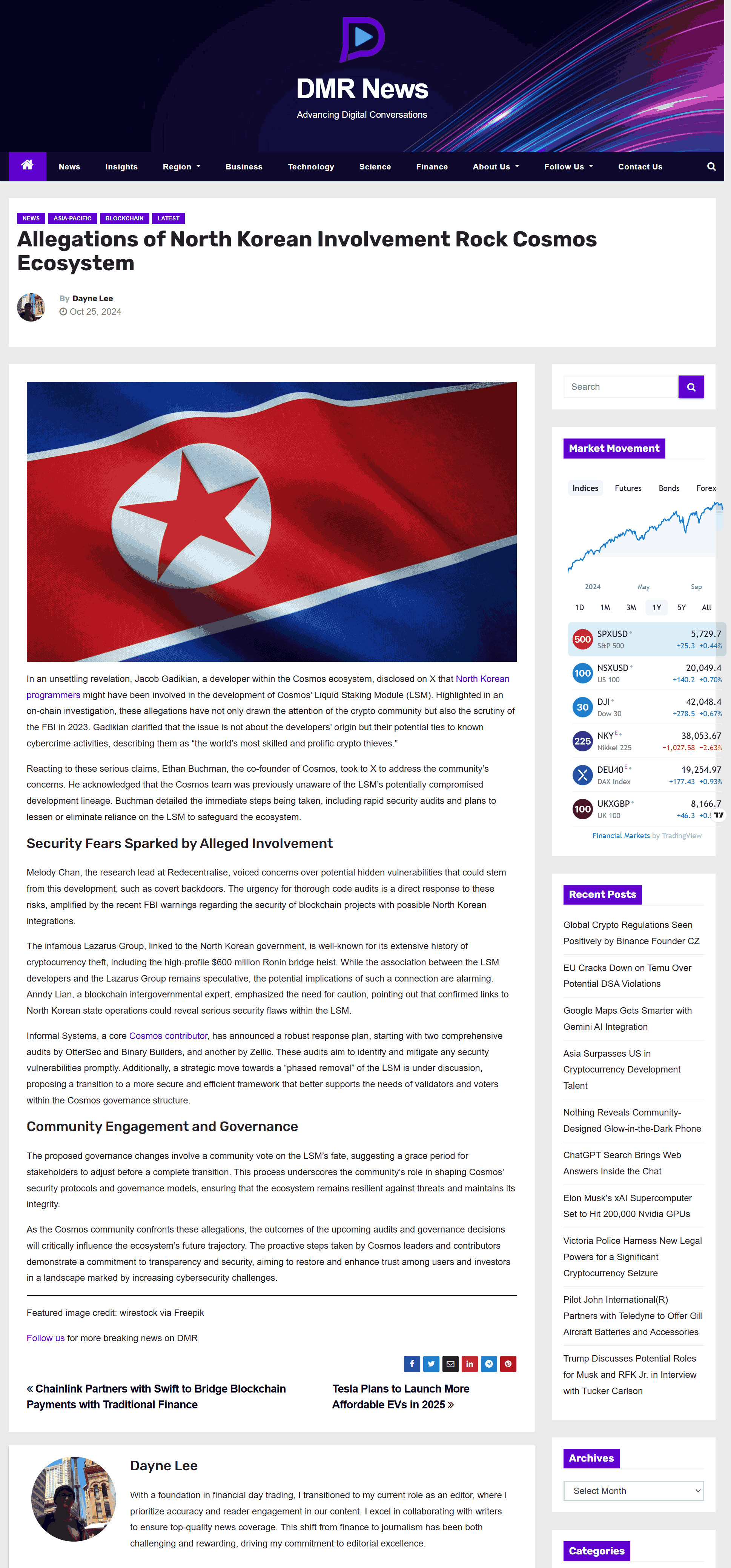
In an unsettling revelation, Jacob Gadikian, a developer within the Cosmos ecosystem, disclosed on X that North Korean programmers might have been involved in the development of Cosmos’ Liquid Staking Module (LSM). Highlighted in an on-chain investigation, these allegations have not only drawn the attention of the crypto community but also the scrutiny of the FBI in 2023. Gadikian clarified that the issue is not about the developers’ origin but their potential ties to known cybercrime activities, describing them as “the world’s most skilled and prolific crypto thieves.”

Reacting to these serious claims, Ethan Buchman, the co-founder of Cosmos, took to X to address the community’s concerns. He acknowledged that the Cosmos team was previously unaware of the LSM’s potentially compromised development lineage. Buchman detailed the immediate steps being taken, including rapid security audits and plans to lessen or eliminate reliance on the LSM to safeguard the ecosystem.

Security Fears Sparked by Alleged Involvement

Melody Chan, the research lead at Redecentralise, voiced concerns over potential hidden vulnerabilities that could stem from this development, such as covert backdoors. The urgency for thorough code audits is a direct response to these risks, amplified by the recent FBI warnings regarding the security of blockchain projects with possible North Korean integrations.

The infamous Lazarus Group, linked to the North Korean government, is well-known for its extensive history of cryptocurrency theft, including the high-profile $600 million Ronin bridge heist. While the association between the LSM developers and the Lazarus Group remains speculative, the potential implications of such a connection are alarming. Anndy Lian, a blockchain intergovernmental expert, emphasized the need for caution, pointing out that confirmed links to North Korean state operations could reveal serious security flaws within the LSM.

Informal Systems, a core Cosmos contributor, has announced a robust response plan, starting with two comprehensive audits by OtterSec and Binary Builders, and another by Zellic. These audits aim to identify and mitigate any security vulnerabilities promptly. Additionally, a strategic move towards a “phased removal” of the LSM is under discussion, proposing a transition to a more secure and efficient framework that better supports the needs of validators and voters within the Cosmos governance structure.

Community Engagement and Governance

The proposed governance changes involve a community vote on the LSM’s fate, suggesting a grace period for stakeholders to adjust before a complete transition. This process underscores the community’s role in shaping Cosmos’ security protocols and governance models, ensuring that the ecosystem remains resilient against threats and maintains its integrity.

As the Cosmos community confronts these allegations, the outcomes of the upcoming audits and governance decisions will critically influence the ecosystem’s future trajectory. The proactive steps taken by Cosmos leaders and contributors demonstrate a commitment to transparency and security, aiming to restore and enhance trust among users and investors in a landscape marked by increasing cybersecurity challenges.


Source: https://digitalmarketreports.com/news/28267/allegations-of-north-korean-involvement-rock-cosmos-ecosystem/

Anndy Lian is an early blockchain adopter and experienced serial entrepreneur who is known for his work in the government sector. He is a best selling book author- “NFT: From Zero to Hero” and “Blockchain Revolution 2030”.

Currently, he is appointed as the Chief Digital Advisor at Mongolia Productivity Organization, championing national digitization. Prior to his current appointments, he was the Chairman of BigONE Exchange, a global top 30 ranked crypto spot exchange and was also the Advisory Board Member for Hyundai DAC, the blockchain arm of South Korea’s largest car manufacturer Hyundai Motor Group. Lian played a pivotal role as the Blockchain Advisor for Asian Productivity Organisation (APO), an intergovernmental organization committed to improving productivity in the Asia-Pacific region.

An avid supporter of incubating start-ups, Anndy has also been a private investor for the past eight years. With a growth investment mindset, Anndy strategically demonstrates this in the companies he chooses to be involved with. He believes that what he is doing through blockchain technology currently will revolutionise and redefine traditional businesses. He also believes that the blockchain industry has to be “redecentralised”.

j j j

Cosmos ecosystem rocked by North Korean developer allegations

Cosmos ecosystem rocked by North Korean developer allegations

A newly released onchain investigation alleges that part of the Cosmos ecosystem may have been developed by North Korean agents and attracted the FBI’s attention in 2023.

Part of Cosmos’ Liquid Staking Module (LSM) may have been built by North Korean developers, according to Cosmos ecosystem developer Jacob Gadikian, who shared the investigation in an Oct. 16 X post:

“It isn’t about their geography or ethnicity.  The people who built the LSM are the world’s most skilled and prolific crypto thieves.”

Investor concerns arose after the revelation, fearing that some of the developers might have come from the infamous Lazarus Group, a cybercrime group with North Korean government affiliation credited for some of the biggest crypto hacks, including the $600 million Ronin bridge exploit.

Cosmos was previously unaware of the North Korean contribution to the LSM, according to Ethan Buchman, the co-founder of Cosmos, who wrote in an Oct. 18 X post:

“Props to the teams coming together to line up these audits quickly. We’re also looking at ways to remove dependence on LSM completely. None of us were aware of the North Korean work on LSM, but working together to deal with it.”

Decentralization, North Korea, Developers, Cosmos, Staking
Cosmos co-founder response to North Korean connection. Source: Ethan Buchman

The fact that malicious North Korean actors may be involved with Cosmos LSM code could present hidden vulnerabilities, like a secret back door in the ecosystem, according to Melody Chan, research lead at Redecentralise, a nonprofit advocating the sustainable development of decentralized finance (DeFi).

The research lead told Cointelegraph:

“The big fear is that these developers might add vulnerabilities, like backdoors or ways to hack the system. With the current issues in the LSM and the FBI’s warnings, it’s clear that thorough code audits are urgently needed.”

Lazarus is among the most notorious groups of crypto hackers, first emerging in 2009 and stealing over $3 billion in crypto assets in the six years leading up to 2023.

Cosmos LSM’s fate could be decided by incoming security audits

While the possible North Korean connection is concerning, it doesn’t necessarily imply that the developers were affiliated with the Lazarus Group, according to Anndy Lian, author and intergovernmental blockchain expert.

Based on the current information, ties to the Lazarus Group are still just allegations, Lian told Cointelegraph. Still, he added:

“Should developers with connections to North Korea—especially those linked to military or state operations known for cyberattacks and cryptocurrency theft—be implicated, there is a potential risk of hidden vulnerabilities or backdoors in the code.”

Decentralization, North Korea, Developers, Cosmos, Staking
Incoming Cosmos LSM audits. Source: Informal Systems

Two parallel audits will be conducted to tackle any potential vulnerabilities. The first one by OtterSec and Binary Builders, scheduled to begin next week, and the second one by Zellic, set to start in mid-November, announced core Cosmos contributor Informal Systems

Core Cosmos contributors suggest phased removal of Cosmos LSM

Following the reports, Informal Systems suggested a “phased removal” of the Cosmos LSM, which would be replaced by a new framework.

The new framework would benefit validators, voters and overall Cosmos governance, the Cosmos contributor firm wrote in an Oct. 22 X post:

“After a community vote to remove the LSM, there would be a 1-2 month grace period for LSM shareholders to un-tokenize and convert their shares to native delegations. The Cosmos Hub will then need to upgrade to remove the LSM, invalidating remaining tokenized shares and automatically converting them back to native delegations.”

Decentralization, North Korea, Developers, Cosmos, Staking
Cosmos Hub, LSM removal plan. Source: Informal Systems 

The new framework would separate governance from block production, enabling users to delegate block production to one validator while assigning governance votes to different entities.

Cointelegraph has asked Cosmos for comment, but received no immediate reply.


Source: https://cointelegraph.com/news/cosmos-lsm-built-north-korean-developers-security-concerns


Anndy Lian is an early blockchain adopter and experienced serial entrepreneur who is known for his work in the government sector. He is a best selling book author- “NFT: From Zero to Hero” and “Blockchain Revolution 2030”.

Currently, he is appointed as the Chief Digital Advisor at Mongolia Productivity Organization, championing national digitization. Prior to his current appointments, he was the Chairman of BigONE Exchange, a global top 30 ranked crypto spot exchange and was also the Advisory Board Member for Hyundai DAC, the blockchain arm of South Korea’s largest car manufacturer Hyundai Motor Group. Lian played a pivotal role as the Blockchain Advisor for Asian Productivity Organisation (APO), an intergovernmental organization committed to improving productivity in the Asia-Pacific region.

An avid supporter of incubating start-ups, Anndy has also been a private investor for the past eight years. With a growth investment mindset, Anndy strategically demonstrates this in the companies he chooses to be involved with. He believes that what he is doing through blockchain technology currently will revolutionise and redefine traditional businesses. He also believes that the blockchain industry has to be “redecentralised”.

j j j